Closing the Wireless Visibility Gap: Juniper Mist & HP Aruba

Distributed enterprise networks present a persistent challenge for configuration management: wireless infrastructure often operates as an unmapped blind spot. As hybrid work and edge expansion increase reliance on modern Wi-Fi architectures, that blind spot doesn’t stay static — it grows every time an access point moves, a controller gets reconfigured, or a new site comes online without a corresponding CMDB update.
When wireless CIs are missing or misclassified, the cost shows up at the worst possible moment. Incident response slows down while responders manually trace a connection your CMDB should already show. Change impact analysis misses edge dependencies that only surface after the change is live. And security teams lose track of network entry points they can’t audit if they can’t see them.
Virima’s 6.1.4 release closes that gap with new discovery support for Juniper Mist wireless environments and enhanced HP Aruba Access Point (AP) Cluster discovery — so the map your team troubleshoots from during an incident is the same one that’s actually true.
Why does wireless network discovery matter for CMDB accuracy?
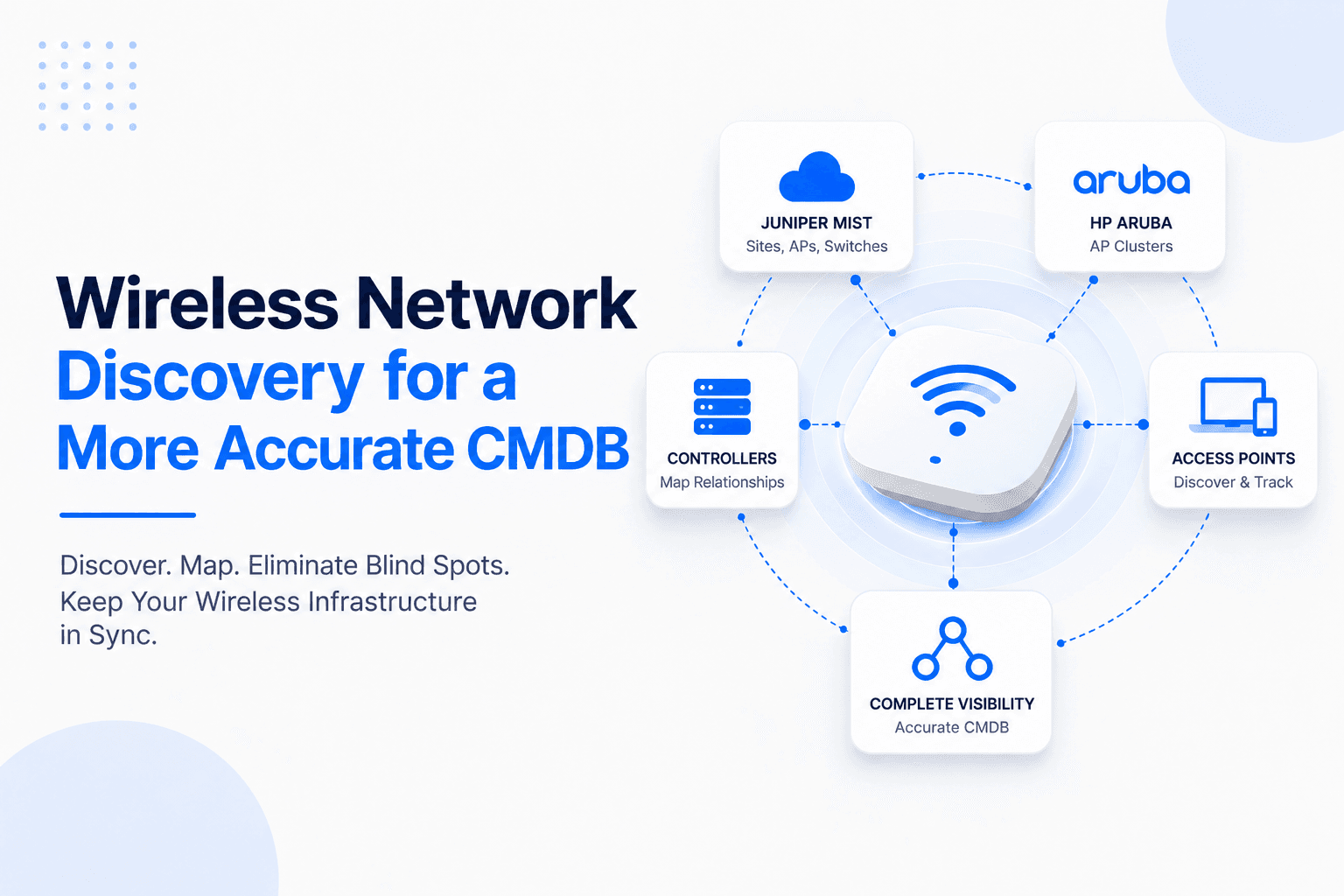
Wireless discovery closes a common CMDB gap by importing access points, controllers, and clusters as CIs, organized under the controller or site that manages them. That gives IT teams accurate wireless inventory and dependency visibility that didn’t exist before. It’s the foundation for incident resolution and change planning across the wireless estate.
The Hidden Cost of Unmapped Wireless Infrastructure
Modern enterprise networks no longer rely solely on static wired connections. Business-critical applications, mobile point-of-sale systems, healthcare devices, and IoT hardware all connect through enterprise wireless networks managed by platforms like Juniper Mist and HP Aruba — which means a wireless blind spot isn’t a networking inconvenience anymore, it’s a hole in the infrastructure the rest of the business depends on.
Traditional CMDB discovery processes fail to capture wireless topologies accurately for three reasons — and each one leaves a specific, avoidable hole in your CMDB:
- Dynamic Access Point (AP) Clustering: High-density access points dynamically distribute client loads across clusters, making static single-device inventory records obsolete almost as soon as they’re captured. The CMDB record you’re troubleshooting from may already be describing a topology that no longer exists.
- Controller-to-AP Relationship Gaps: Discovering a wireless controller without mapping its individual managed CIs creates an incomplete dependency tree — so when that controller degrades or fails, your team doesn’t know how many access points or connected devices are actually affected until someone checks manually.
- Multi-Vendor Blind Spots: Disparate network management consoles isolate asset data, requiring manual exports that quickly become outdated — meaning the map you pull up during a P1 is often already stale before the ticket is opened.
Without discovery that continuously bridges these vendor platforms into your central CMDB, every hardware update or relocation creates a new unmapped change — and each one widens the mismatch between what your CMDB says and what’s actually running.
Juniper Mist Import (Beta)
Juniper Mist uses AI-driven wireless management to optimize Wi-Fi performance. Historically, keeping Mist-managed assets synchronized with your central CMDB required custom scripts or manual data entry.
Virima now provides native support for Juniper Mist import, enabling IT teams to:
- Sync Inventory from Mist: Import Juniper sites, access points, switches, and security appliances directly into Virima.
- Maintain CI Accuracy: Keep imported network assets part of the same accurate, central CMDB as the rest of your IT estate.
- Stay in Sync: Once configured, changes in your Mist environment update your asset inventory automatically — so you’re not stuck making decisions off a stale export.
By bringing Juniper Mist asset data into Virima, IT operations get accurate, centralized visibility into their wireless infrastructure, without the manual work of stitching together separate exports.
HP Aruba AP Cluster Discovery and Relationship Modeling
HP Aruba wireless controllers manage large volumes of access points across campus and branch locations. In complex deployments, identifying individual APs and their controlling hardware is vital for rapid troubleshooting.
Virima’s enhanced HP Aruba discovery models wireless controller environments with granular relationship precision:
- AP Cluster Modeling: The central HP Aruba controller is modeled as an Access Point (AP) Cluster CI.
- Member CI Linking: Each managed access point is created as an individual member CI within the CMDB.
- Contains Relationships: Virima establishes a formal Contains relationship between the AP Cluster controller and each member AP CI.
For example, an HP Aruba controller managing three access points across two buildings would appear in the CMDB as:
HP Aruba Controller (AP Cluster)
├─ Access Point — Building A, Floor 2
├─ Access Point — Building A, Floor 3
└─ Access Point — Building B, Floor 1
This structured modeling ensures that if an AP controller experiences performance degradation, IT teams can immediately trace every dependent access point under that controller.
Closing the Network Dependency Gap
Wireless infrastructure visibility is no longer optional for modern ServiceOps — it’s the difference between a CMDB your team can act on during an incident and one they have to double-check first. By bringing Juniper Mist and HP Aruba access point topologies into the same CMDB as your servers and switches, organized under their controllers and sites, Virima delivers authoritative visibility across your wireless environment.
To learn how authoritative data transforms IT operations, read our breakdown of Trusted Runtime Truth for Agentic IT.
See wireless discovery in action — Request a demo with a Virima solution engineer today.