IT Discovery in Hospitality: Track Every Property Device

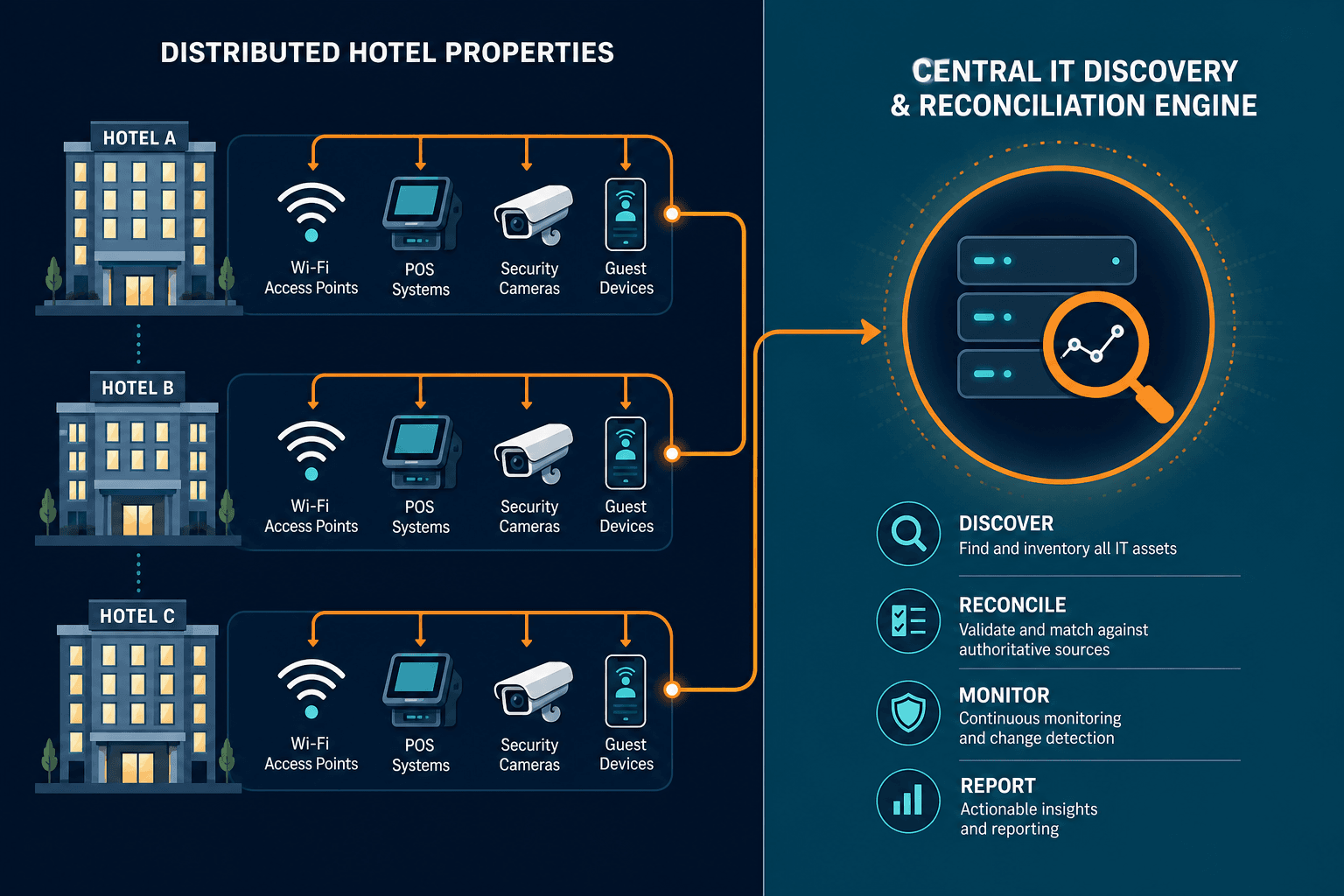
A ransomware incident hits one hotel in a 40-property portfolio, and central IT cannot say with confidence which POS terminals, cameras, or access points at that resort were even online that week, let alone patched. The spreadsheet lists 200 devices. The network tells a different story. This gap is what IT discovery in hospitality — the technology asset discovery process that finds what’s actually running at each property — has to close. Hotel brands set technology standards from headquarters. The infrastructure that has to meet those standards sits scattered across separately managed properties, each running its own switches, POS lanes, cameras, and staff endpoints that change without central IT ever finding out.
What is IT discovery in hospitality?
IT discovery in hospitality is the automated process of identifying, scanning, and cataloging all physical, virtual, network, and endpoint devices operating across distributed hotel and resort properties. It converts fragmented property-level technology into a centrally observable, reconciled operational asset inventory.
Every hotel property behaves like a distributed IT site
Hospitality does not behave like one campus or one data center. Each property holds a local network stack, wireless coverage, staff endpoints, POS lanes, security gear, guest-facing systems, and sometimes local servers or edge hosts. Brand standards may be shared. Physical estates are not. Geographic distribution therefore matters more than raw device counts alone.
The case studies referenced below are vendor-published materials without a listed publication year. Device counts illustrate how quickly assets accumulate across distributed sites — they are not claimed as current-year figures.
Distributed hospitality environments can reach substantial scale. In a published case study, Cisco reports that Mitchells & Butlers manages 13,000 Windows devices, 8,000 tablets, 8,000 access points, and a large router and switching estate across its venues. While Mitchells & Butlers operates primarily in pubs and restaurants, its footprint illustrates how quickly endpoint and network assets accumulate across distributed sites.
Distance also changes failure modes. A dead access point at one resort does not appear in another property’s rack. A seasonal wing may power equipment only for peak months. Discovery has to treat each site as its own small estate that still reports into one operating picture.
Connected hospitality now extends beyond laptops and servers
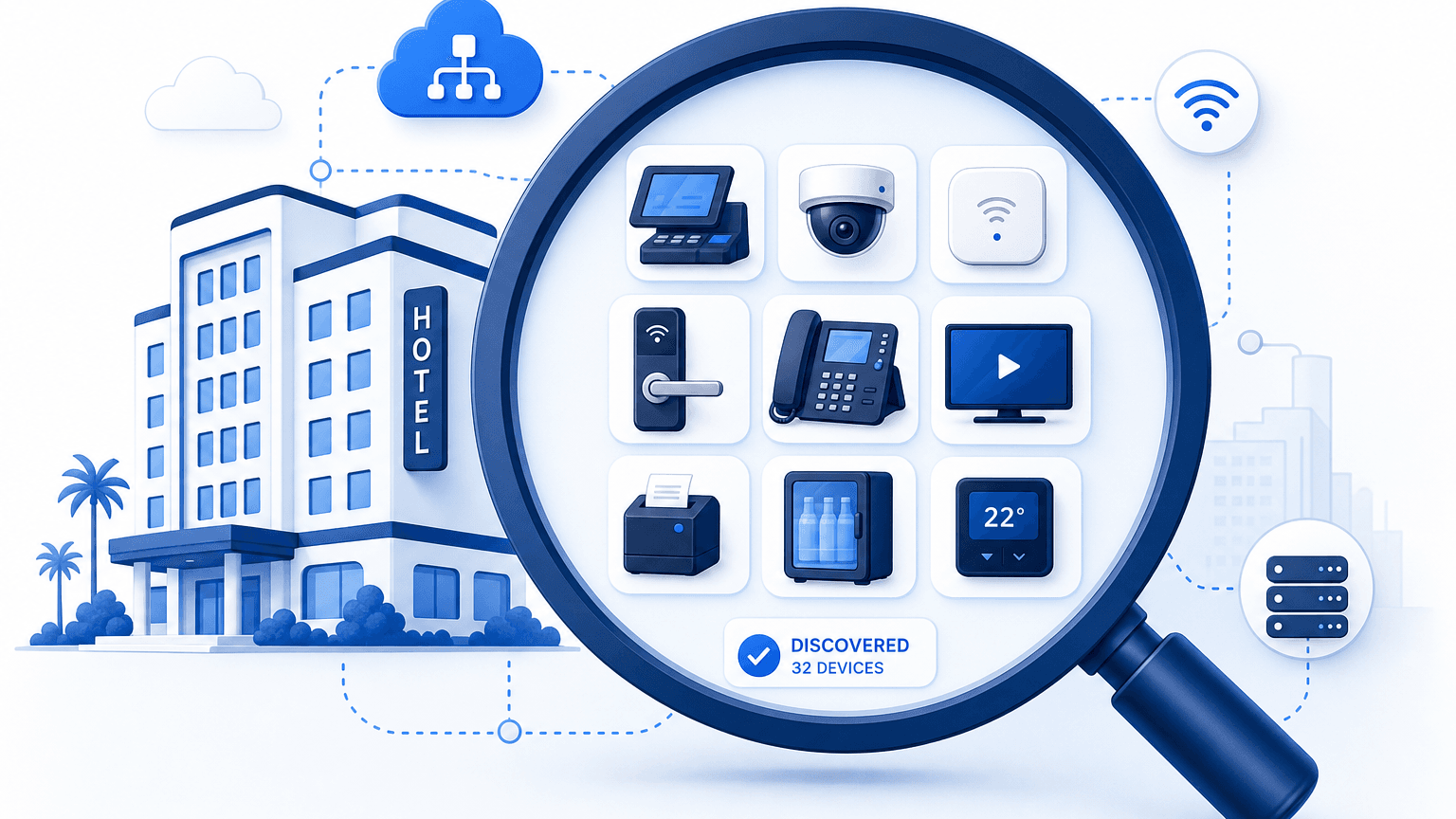
Hotel technology no longer stops at back-office PCs and a few servers. Guest experience and operations now pull in smart locks, sensors, streaming endpoints, POS lanes, room-control gear, and other network-attached systems.
Property Management Systems (PMS) sit at the center of that stack, handling reservations, guest folios, and room status, and they typically integrate with POS, door locks, and other on-site systems. That makes a hotel’s PMS and its integrations a discovery and reconciliation target in their own right — not a system central IT can assume is already accounted for elsewhere.
Vendor case studies highlight this multi-device reality. Rotana Hotels & Resorts deployed Aruba networking to maintain Wi-Fi coverage for POS terminals, guest services, and smart TVs across its properties. Distinctive Resorts deployed Meraki smart cameras for physical security and property operations.
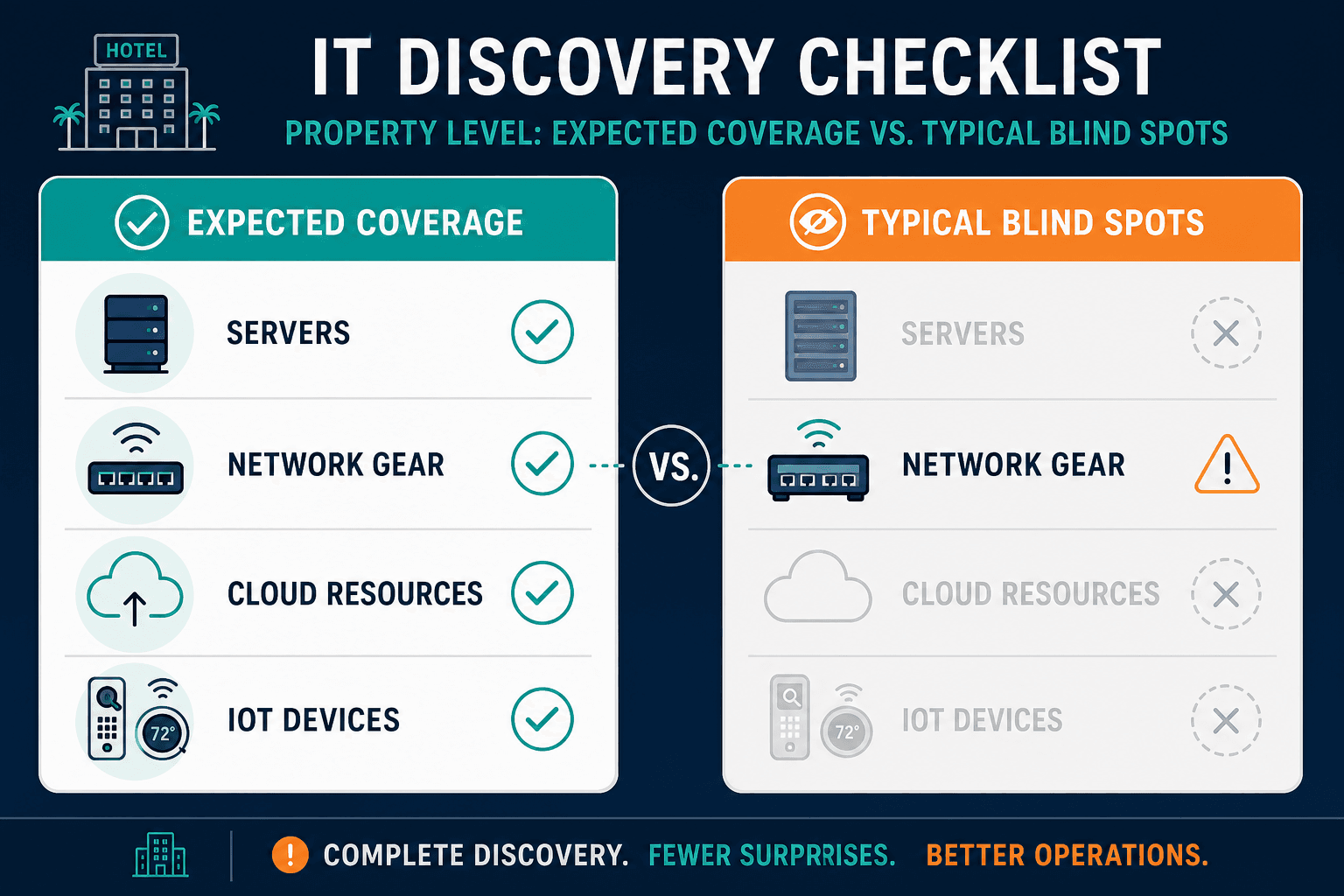
Discovery programs therefore have to account for conventional IT, network infrastructure, selected IoT, edge devices, virtual resources, and cloud resources. Coverage is not uniform across every device class. Many IoT and OT endpoints can be found only when they are network-reachable and speak supported protocols. Teams should not claim every lock or sensor inventories like a workstation.
Rosen Hotels & Resorts shows how fragmented management tools can limit network visibility across hospitality operations. Cisco reports that the organization lacked traffic visibility, segmentation, and integration between its existing tools. That fragmentation strengthens the case for a broader infrastructure view, but discovery and network-access visibility remain distinct capabilities.
Property-level inventories become stale quickly
Property-maintained inventories can become stale whenever equipment changes between reporting cycles. Access points may get replaced, cameras added, POS devices moved, or temporary equipment introduced during renovations and seasonal operations. Short-lived gear often bypasses central recordkeeping entirely. This is the core hotel device inventory problem: what’s recorded and what’s actually running drift apart continuously.
Manual inventories record what someone said existed. Discovery tests that record against the live environment. The difference shows up in patch queues, license counts, firewall rules, and incident response. A spreadsheet may list last year’s access-point model, but a scan may find a different model, firmware level, or an extra switch in a new wing. Central teams that plan from spreadsheets plan from unverified claims. Teams that plan from recurring discovery plan from observed state.
Staleness also multiplies across brands and regions. One property may update a sheet monthly. Another may update only at budget time. Without a common discovery method, the central view becomes a collage of uneven self-reports. Hospitality IT discovery replaces that collage with property-level observations reconciled on a schedule.
Why do manual hotel asset inventories fail?
Manual hotel inventories fail because resort and hotel technology changes continuously between reporting cycles. Hardware replacements, seasonal equipment additions, and local network changes create static inventory drift, leaving central IT teams with unverified records that fail during audits, security updates, and outages.
Centralized operations depend on distributed discovery
Central network, security, and service teams still own brand-level standards. They cannot enforce those standards on devices they cannot see. Distributed IT discovery is the mechanism that feeds central operations.
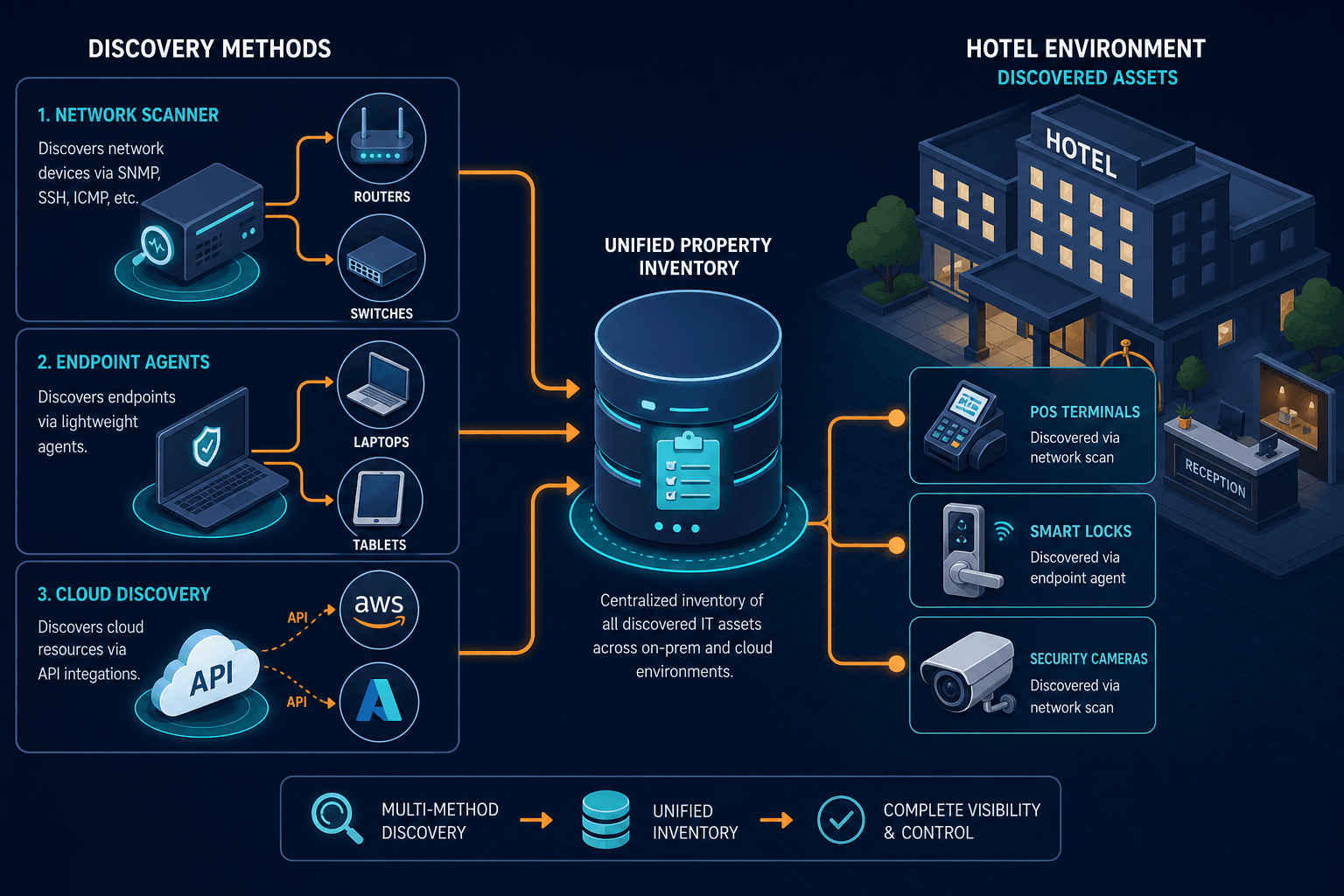
Each managed property needs an appropriate discovery path, whether through centralized scanning, a local discovery application, endpoint agents, APIs, or another supported collection method. A practical approach usually combines several methods. Agentless network scans can inventory routers, switches, firewalls, and other SNMP-reachable gear where credentials and paths allow. Endpoint agents can deepen hardware and software detail on staff workstations and servers that roam or sit behind tighter segments. API-based cloud discovery can pull accounts, instances, and related resources that never appear on a local VLAN. Scheduled scans keep those methods on a clock instead of an ad hoc request.
Virima’s IT Discovery supports discovery across remote sites using multiple collection methods, including agentless scans, agents, and APIs. Central control still needs local collection points, credential scope, and scan windows that respect property networks. Without that design, central dashboards only reflect estates reachable from headquarters.
Discovery supports security and payment-scope decisions
Hospitality places payment systems across many properties. POS terminals, payment applications, and related hosts sit close to guest-facing operations. Scope decisions under PCI DSS depend on knowing which systems store, process, or transmit cardholder data, and which systems can connect to or influence that environment. PCI SSC’s scoping and segmentation guidance for modern network architectures emphasizes asset inventory maintenance in complex environments.
IT discovery does not certify PCI DSS compliance on its own, but it supplies the asset data compliance scoping depends on. PCI SSC’s guidance identifies current asset inventory as a prerequisite for accurate cardholder-data-environment scoping.
Discovery does not establish PCI compliance by itself. Assessors, controls, and compensating evidence still sit outside the discovery tool. Discovery can provide current asset data that supports scoping work. Network, segmentation, and dependency data from complementary tools can then help teams validate how those assets relate to the cardholder-data environment.
Incomplete property inventories leave connected systems undocumented. Payment-scope work benefits from the same distributed discovery pattern used for general operations. Property-level scans and agents surface POS-adjacent devices and supporting infrastructure, giving security teams the baseline observations required to verify segmentation. Virima blog post on IT asset visibility for PCI DSS scoping and segmentation
The real goal is not discovering once, but keeping coverage current
A distributed hotel estate is not fully observable at one moment in time. Discovery therefore needs cadence, not merely coverage.
Devices power on during different shifts. Remote endpoints leave and rejoin property networks. Seasonal properties may sit dark for months, then run fully loaded for peak season. One fixed scan window will miss systems that were offline or offsite at that moment.
Recurring discovery with varied timing addresses that pattern. Schedules should cover different hours and days so intermittent devices have a chance to appear. Recurring, time-varied scanning is the recommended approach for catching devices that only appear during particular windows — a seasonal wing that only powers on for three months, a night-shift POS terminal, a laptop that roams between properties.
Current coverage also changes how central teams work. Patch campaigns target devices last seen recently. Security reviews start from verified hosts rather than hoped-for lists. Hospitality IT discovery earns its keep when it stays on a cadence that matches how properties actually run.
How frequently should hotel IT discovery scans run?
Hotel IT discovery should run on a recurring, time-varied schedule rather than a single fixed scan window. Time-varied scanning captures intermittent endpoints, seasonal property gear, and shift-based POS devices that are offline during standard business hours.
What hospitality teams should expect from IT discovery
Hospitality teams evaluating discovery should judge capabilities against distributed reality. This is what hospitality IT asset discovery should cover, at minimum:
- Servers and workstations
- Routers, switches, firewalls, and access points, where methods and credentials support them
- Virtual machines and cloud resources, through appropriate APIs or hypervisor integrations
- Installed software, OS detail, and patch-related attributes, on endpoints where agents or deep scans run
- Relevant IoT devices, when accessible and protocol-supported, without a promise of universal IoT coverage
Central teams also need change markers between discovery cycles to spot drift without manual audits. Source metadata and last-verified timestamps show where a fact came from and when it was confirmed.
Expectations should also include operational design. Multi-site collector placement, credential management, scan windows, and reconciliation rules belong beside feature checklists. A tool that only works from one central network will leave remote properties dark. Hospitality IT discovery succeeds when method, placement, and cadence match the estate.
Bringing IT discovery in hospitality together with Virima
Before central IT can govern a distributed hospitality estate, it first needs recurring observation of what actually exists at each managed property. This is the operational core of Trusted Runtime Truth — discovery-sourced data that reflects what’s actually running, not what a spreadsheet last recorded.
Virima supports agent-based, agentless, and API-based discovery across physical, virtual, cloud, network, and selected IoT or OT environments where access and protocols allow. Multiple discovery sources map to authority-based reconciliation, so conflicting attributes can be resolved into a traceable CI record inside Virima’s CMDB. Hardware and software attributes, source information, and last-verified timestamps get captured during each cycle. Existing ITSM environments can receive that data through downstream integrations, with direct connectivity to external platforms via Virima all integrations.
| Property element | Discovery method |
|---|---|
| Distributed properties | Scheduled coverage and remote discovery options |
| Network equipment | SNMP and agentless methods, where supported |
| Staff and roaming endpoints | Agent-based discovery |
| Cloud resources | API discovery |
| Intermittent devices | Recurring, time-varied scans |
Virima Discovery gives hospitality IT teams agent-based, agentless, and API-driven ways to observe infrastructure across distributed properties. Recurring scans, source attribution, last-verified timestamps, and reconciliation help turn those observations into a central record teams can use across IT operations.
For hotel groups managing technology across many properties, IT discovery in hospitality comes down to one principle: central management depends on distributed observation.
Frequently Asked Questions
Why do hotel groups need IT discovery at each property?
Each hotel or resort runs its own local network, endpoints, POS gear, and guest systems. Central standards cannot apply to devices known only from property lists. Site-level discovery feeds a reconciled central view of what is actually online.
Can spreadsheets replace hotel device inventory processes?
Spreadsheets record what staff last reported. Properties replace access points, move POS lanes, and add seasonal equipment between updates. Discovery compares those claims to the live environment on a schedule.
How often should hospitality IT discovery run?
Coverage should recur on a defined cadence with varied timing. Hotel devices may be offline, seasonal, or roaming during a single annual window. Multiple scan windows improve intermittent coverage.
How does Virima fit distributed hotel and resort discovery?
Virima provides agent-based, agentless, and API discovery with reconciliation, source attribution, and last-verified detail. Remote collection methods support property-level observation for central ITSM workflows.