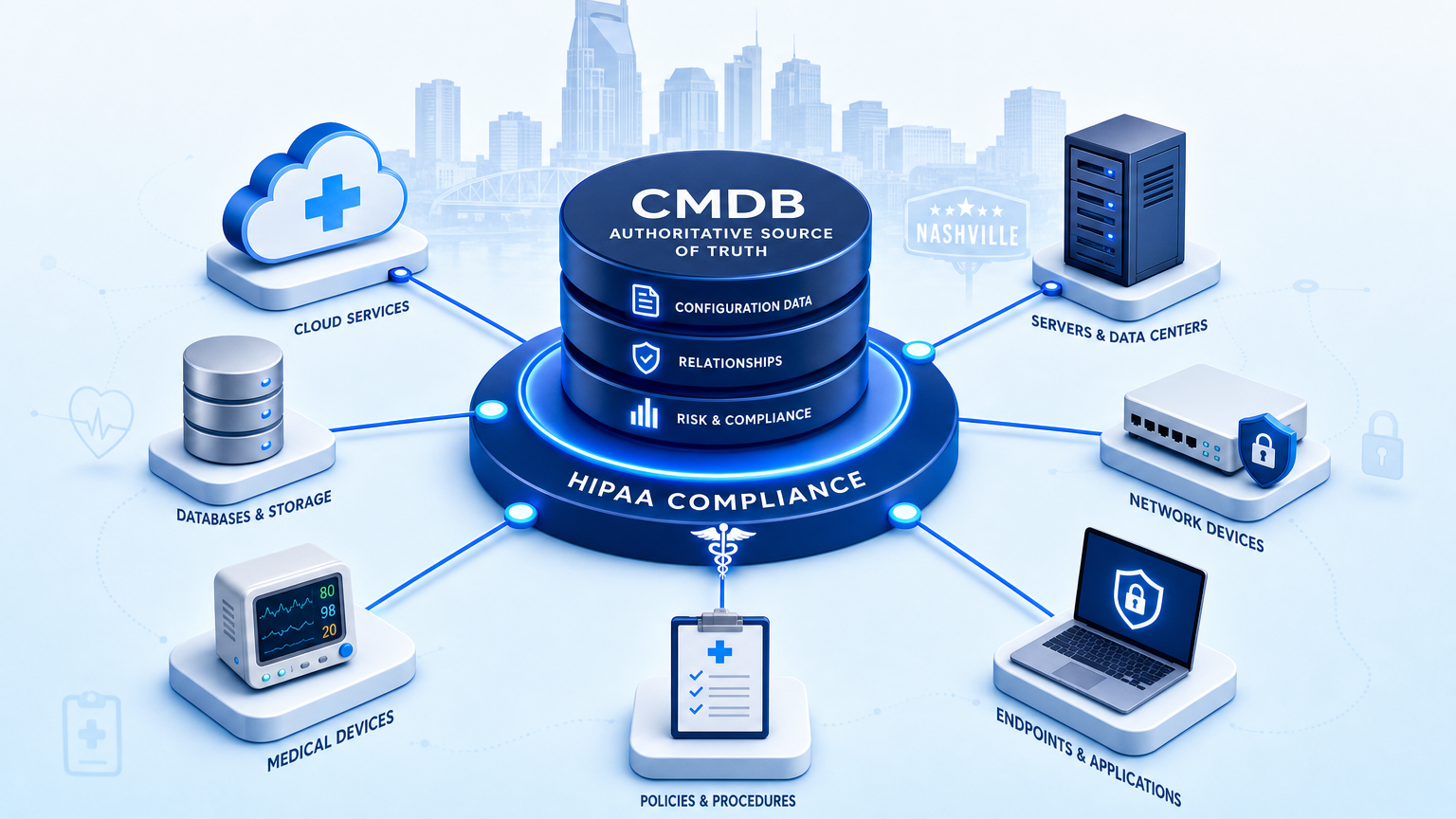
Does HIPAA Compliance via CMDB for Healthcare Companies in Nashville Start With Assets?

Every annual healthcare risk analysis starts with a scoping question that corporate compliance and IT teams struggle to resolve together. When privacy and security officers ask for the definitive list of infrastructure in scope for HIPAA evaluation, corporate IT teams often discover three competing records across the parent organization: the central configuration management database, the active vulnerability scanner register, and the enterprise finance depreciation ledger. In a multi-facility healthcare operating company, these repositories frequently disagree on active server counts, cloud subscriptions, and remote clinical facility boundaries.
Nobody can state with verified certainty which system inventory represents operational truth across the enterprise. The operational dilemma facing healthcare IT leaders is straightforward: can an existing configuration management database serve as the authoritative starting record for risk analysis, and which designated individuals verify its scope?
Achieving reliable HIPAA compliance via CMDB for healthcare companies in Nashville requires understanding the unique structural scale of this regional corporate ecosystem. According to the Nashville Health Care Council 2025 Economic Impact Report, prepared through an Ernst and Young analysis of Lightcast data, Nashville serves as headquarters for seventeen publicly traded healthcare enterprises and more than nine hundred healthcare service provider companies, generating over seventy-two billion dollars in regional economic output.
Corporate headquarters oversee hundreds of affiliated surgical centers, regional hospital campuses, outpatient clinics, and specialized imaging networks distributed across several states. An enterprise corporate IT team cannot maintain physical oversight of remote server closets, regional subnets, and local clinical endpoints through manual inspection. Establishing dependable baseline visibility into enterprise infrastructure requires systematic discovery and unified technical accounting rather than fragmented local spreadsheets.
What OCR Findings Reveal About Infrastructure Risk
A configuration management database records technical infrastructure components, attributes, and dependency relationships. It does not inspect data payloads, determine which application databases contain electronic protected health information, or confer regulatory compliance by itself. Federal regulators evaluating security posture examine whether an enterprise maintains an accurate, thorough analysis of operational risk across all technical environments.
On March 5, 2026, the Department of Health and Human Services Office for Civil Rights announced a formal settlement with dental practice software vendor MMG Fusion, operating as a designated business associate. Federal investigators identified failures to conduct an accurate and thorough risk analysis, alongside failures to notify covered entities and impermissible data disclosure following a major security breach affecting approximately fifteen million individuals.
The enforcement resolution required a ten-thousand-dollar monetary payment alongside a rigorous three-year corrective action monitoring agreement. This enforcement proceeding marked the twelfth formal action completed under the specialized Risk Analysis Initiative established by federal enforcement leadership.
Federal enforcement releases focus on administrative execution rather than configuration management standards. The official resolution announcement does not mention configuration databases or IT asset management platforms. The operational connection remains rooted in baseline governance logic. A defensible security risk analysis cannot evaluate systemic operational risk across technical environments without an accurate inventory of systems, platforms, and network connections.
Healthcare organizations seeking foundational guidance often review the national HIPAA compliance via CMDB guide to evaluate how automated technical records establish audit baseline clarity across enterprise infrastructures.
What a Headquarters Cluster Adds to the Record Problem
Managing technical infrastructure across an extensive healthcare corporate cluster introduces systemic configuration discrepancies that single-facility operators rarely encounter. These administrative challenges emerge across three distinct operational patterns:
- Acquisitions and Local Facility Affiliation: When regional clinic networks or specialized hospital groups join an established parent healthcare system, each entity introduces legacy endpoint agents, localized domain controllers, and disparate network management tooling. Corporate configuration teams inherit multiple unaligned technical registers that contradict the central platform. Result: Corporate engineering leadership holds divergent, conflicting technical records for the same operating facilities.
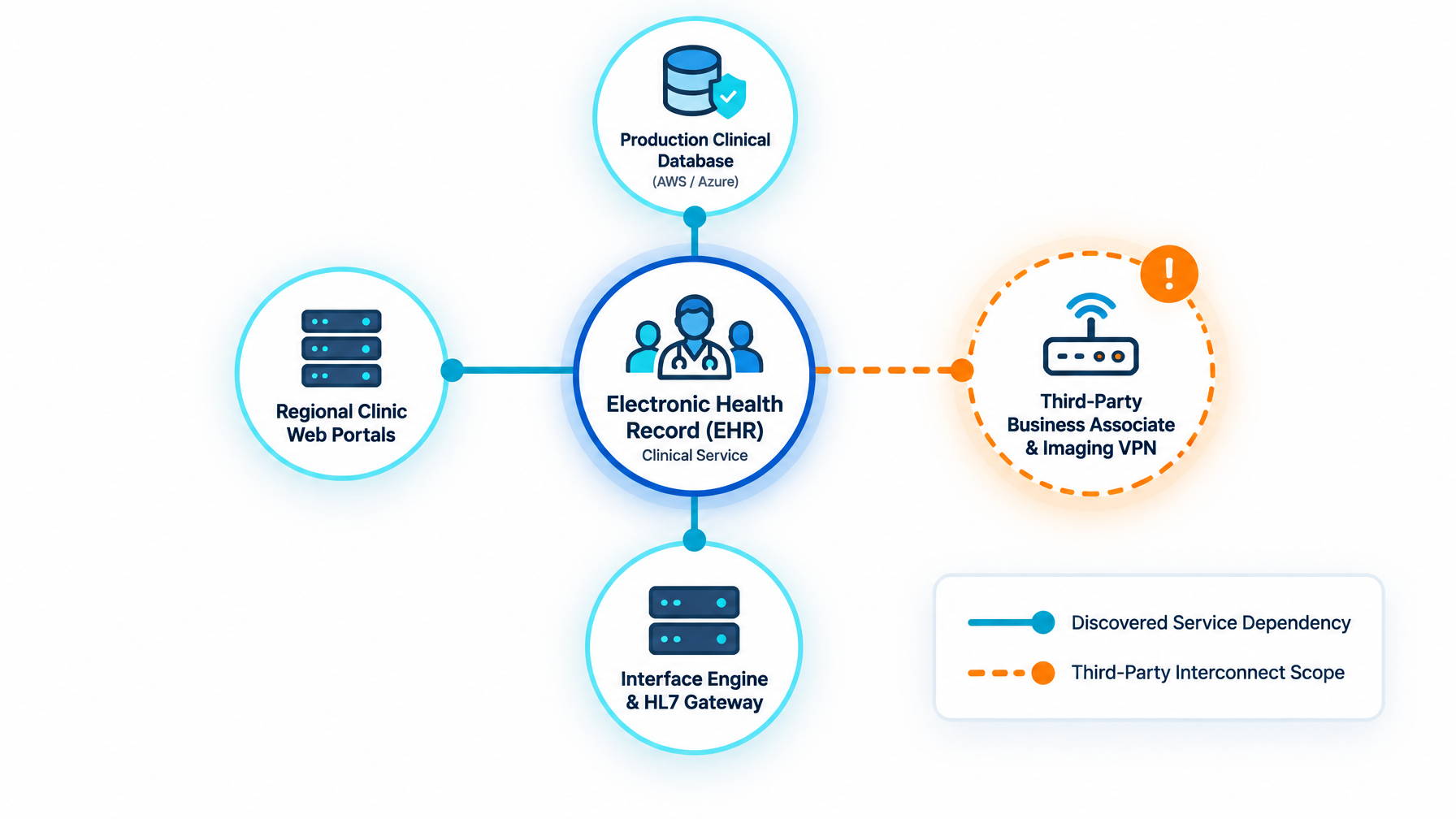
- Business Associate and Third-Party Connectivity: External revenue cycle processors, specialized radiology services, and clinical software vendors connect persistent administrative accounts and dedicated site-to-site VPN tunnels into corporate networks. Engineering teams lose track of which network pathways carry active production traffic or connect directly to critical clinical platforms. Result: Compliance teams cannot verify which third-party interconnects belong within the scope of the annual enterprise risk analysis.
- Incomplete Facility System Decommissioning: When a regional care center replaces a legacy picture archiving platform or closes a physical clinic, local staff retire devices without updating central asset tracking databases. In a defensible configuration lifecycle, designated technical owners verify every system decommissioning event. Result: Stale hardware and phantom cloud instances remain listed within active compliance audit boundaries, absorbing unnecessary assessment resources.
These configuration hurdles explain why corporate healthcare leaders struggle to maintain estate parity across multi-entity portfolios. Without centralized discovery standards, technical debt expands across every acquired operating entity. Healthcare systems seeking enterprise visibility can examine how modern healthcare IT asset management practices establish clear operational baselines across geographically distributed facilities.
What Is Current and What Remains Proposed Under the Security Rule
Healthcare technology leadership must carefully distinguish between enforceable regulatory mandates and proposed future administrative standards. Current administrative regulations under the HIPAA Security Rule require covered entities and business associates to execute comprehensive, scheduled risk analysis protocols across all operational infrastructure. Federal enforcement teams regularly penalize healthcare organizations when administrative investigations expose incomplete enterprise inventories during mandatory post-breach audits.
In contrast, proposed regulatory updates published in the Federal Register during January 2025 outline more rigorous technical mandates. Under the proposed Security Rule modifications summarized in recent industry analyses of the 2026 HIPAA Security Rule update, federal regulators propose requiring covered entities to maintain verified technology asset inventories and current network topology maps updated at least every twelve months. This proposed requirement has not achieved final statutory enactment, remaining subject to ongoing administrative rulemaking and anticipated federal review schedules through 2027.
Corporate teams must avoid treating proposed inventory requirements as finalized statutory law. Operational leaders should evaluate their current compliance posture against active risk analysis obligations rather than premature mandate assumptions.
Healthcare compliance executives can review national enforcement frameworks and administrative penalty structures in detail through Virima’s primary HIPAA compliance via CMDB technical analysis.
HIPAA Compliance via CMDB for Healthcare Companies in Nashville: Making the CMDB Dependable
Enterprise healthcare providers operating in Nashville rarely need to purchase new configuration databases from scratch. Most established healthcare management organizations already operate enterprise configuration platforms like ServiceNow, Jira Service Management, or Ivanti. The central governance challenge centers on making the existing corporate CMDB dependable enough to serve as the baseline record for compliance reviews. Turning an existing database into an authoritative technical baseline requires four disciplined operational mechanisms:
- Reconciling Ingestion Feeds Across Operating Entities: Healthcare IT teams must routinely contrast configuration records against active vulnerability scanner results and finance depreciation ledgers. Discovery engines then deploy non-intrusive agentless discovery across remote subnets while maintaining lightweight endpoint agents for distributed staff laptops. Direct API connectors pull virtual infrastructure from Amazon Web Services and Microsoft Azure enterprise subscriptions. Medical devices running specialized clinical operating systems that resist network probing require deliberate, manual registration protocols managed in coordination with biomedical engineering teams.
- Mapping Environmental Relationships and Communication Flows: Establishing technical context requires illuminating inter-device communication pathways. Through ViVID™ Service Mapping, network communication flows establish which supporting servers, operating systems, and network switches route operational traffic toward designated clinical applications. Designated service owners establish application definitions, while automated protocol mapping details underlying infrastructure dependencies.
- Assigning Explicit Technical Ownership to Every Configuration Item: An unowned server or orphan database represents an immediate compliance liability. Every configuration record within the CMDB must maintain an explicit, verified technical owner alongside an authoritative verification timestamp. Integrating corporate directory structures and credentialed administrative data ensures specific engineering managers remain accountable for confirming asset viability.
- Capturing Operational Change via Enterprise ITSM Integrations: Technical modifications, routine patch deployments, and hardware retirements must synchronize directly with the central configuration repository. Bi-directional connections to enterprise service desks ensure infrastructure records update automatically whenever technicians execute approved change tickets or process decommission requests.
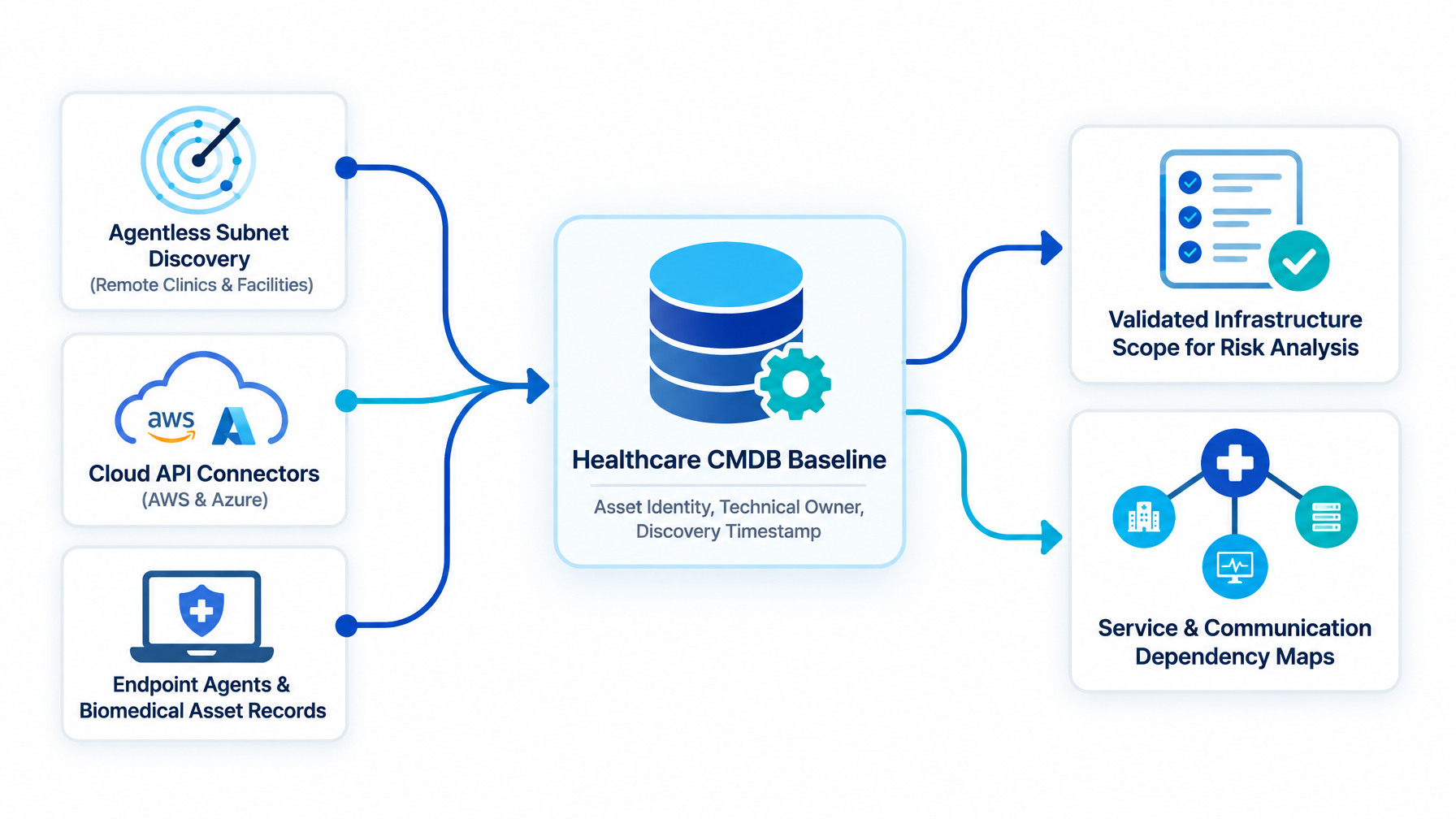
The following comparison details the operational differences between standard, manually maintained configuration databases and discovery-fed configuration records:
| Configuration Management Capability | Standard Manually Updated CMDB | Discovery-Fed Healthcare CMDB Baseline |
|---|---|---|
| New Entity System Ingestion | Relies on periodic spreadsheet imports and manual ticket submission | Scheduled agentless discovery sweeps subnets and ingests cloud accounts |
| Asset Record Ownership | Frequently unassigned, outdated, or pointing to departed personnel | Named engineering lead assigned with verifiable recertification timestamp |
| Dependency and Port Mapping | Static documentation boxes created during initial system launch | Dynamic communication mapping by port, protocol, and network pathway |
| Currency and Verification Evidence | Assumed current until an audit exposes missing infrastructure | Verifiable discovery timestamp proving asset existence within schedule |
| Risk Analysis Preparation Effort | Weeks spent manually cross-checking scanner lists against finance files | Instant export of verified infrastructure scoped by designated service |
| Required Human Oversight | Manual data entry, administrative chasing, and repetitive spreadsheet reconciliation | Service definition, clinical scope designation, and exception approval |
Healthcare providers operating complex multi-region organizations can also examine regional compliance nuances, such as state-level healthcare enforcement analyses for Chicago health systems and Los Angeles healthcare teams. Aligning discovery cadence with automated IT discovery software enables healthcare IT organizations to maintain dependable configuration parity across diverse facility portfolios.
What the CMDB Settles, and What Stays Elsewhere
Maintaining clear operational boundaries prevents executive teams from misunderstanding the true role of technical discovery. A configuration repository delivers essential visibility into physical, virtual, and cloud infrastructure, but it does not satisfy the total breadth of federal privacy and security mandates. The following division outlines technical configuration ownership versus broader organizational responsibilities:
| Operational and Compliance Questions | Answered by the Central CMDB | Governed by Privacy, Security, and Clinical Leadership |
|---|---|---|
| Infrastructure Existence and Location | Confirms active hosts, virtual machines, cloud instances, and subnets across all facilities | Verifies physical building security and on-site hardware access restrictions |
| System Dependencies and Network Paths | Details network communication pathways, active ports, and inter-server connections | Defines organizational service boundaries and business application criticality |
| Hardware and Software Technical Ownership | Tracks designated system administrators, custodians, and verification timestamps | Assigns organizational data classification and legal data ownership roles |
| ePHI Scope and Data Classification | Not addressed (CMDB tracks infrastructure, not data payloads) | Privacy and Security Officers formally designate systems containing ePHI |
| Risk Mitigation and Administrative Policy | Delivers baseline asset inventories for vulnerability and change correlation | Develops enterprise risk management plans, policies, and remediation budgets |
| Third-Party Business Associate Scoping | Identifies technical integration endpoints, VPN tunnels, and external connections | Negotiates, executes, and audits formal Business Associate Agreements (BAAs) |
| Clinical Device and Biomedical Oversight | Tracks network-connected IP interfaces discovered via standard protocols | Biomedical engineering manages specialized medical device maintenance and safety |
For corporate healthcare executives, understanding this separation is vital. The configuration management database serves as dependable upstream infrastructure. It establishes the factual technical foundation that privacy and security officers rely on to conduct thorough, legally defensible risk analyses.
Where Operational Efficiency and Administrative Savings Emerge
Eliminating manual configuration tracking yields tangible administrative dividends across multi-entity healthcare systems. Establishing an automated technical record reduces the labor-intensive friction that routinely slows engineering teams before scheduled compliance audits. Measurable operational improvements appear across four core operational areas:
- Risk Analysis Preparation Efficiency: Preparing for annual compliance reviews typically requires engineers to spend dozens of hours comparing scanner logs against static spreadsheets. Automated discovery aggregates verified infrastructure into a unified repository, cutting the preparation timeline from weeks of administrative hunting to a structured validation review.
- Accelerated Entity Technical Integration: When healthcare management companies acquire regional surgical practices or outpatient clinics, engineers often spend months discovering untracked hardware. Deploying automated network discovery quickly identifies active subnets, legacy servers, and orphan storage, accelerating standard security onboarding.
- Reduced Software Licensing Waste: Multi-facility healthcare systems frequently overpay for duplicate software licenses and untracked cloud instances. According to the cross-industry Flexera 2026 State of ITAM Report, forty-eight percent of organizations faced vendor software audits in the past year, while forty-four percent expended over one million dollars managing audit penalties and true-up settlements over three years. Automated configuration tracking isolates unused entitlements, enabling significant cost recovery through license reuse.
- Minimized Attack Surface Visibility Gaps: Unmanaged endpoints and forgotten development servers represent severe enterprise security vulnerabilities. The Flexera report highlights that only thirty-six percent of surveyed IT leaders report complete estate visibility across hybrid environments. Establishing consistent scheduled discovery cycles closes visibility blind spots before unauthorized access triggers costly breach disclosure protocols.
Making the CMDB Dependable: The First Ninety Days
Transforming an existing healthcare configuration management database into an audit-ready compliance foundation requires a phased, realistic execution roadmap. Healthcare IT leaders can establish dependable visibility across complex facility networks by executing a disciplined ninety-day milestone framework:
- Days 1 to 30 (Establish Governance and Single-Facility Reconciliation): Appoint designated technical owners for central CMDB governance and select one representative operating facility. Convene joint working sessions with corporate privacy and security officers to codify formal criteria for designating systems containing sensitive clinical records. Run a baseline comparison between the central CMDB, active vulnerability scanner registers, and local finance fixed-asset records for that pilot facility, documenting all discrepancies with assigned remediation owners.
- Days 31 to 60 (Deploy Scheduled Discovery and Map Critical Dependencies): Deploy agentless discovery collectors across the pilot facility network and connect corporate AWS and Microsoft Azure cloud subscriptions using secure API credentials. Coordinate with biomedical engineering teams to establish network exclusion zones protecting sensitive clinical equipment from automated probing. Use ViVID™ Service Mapping to model application dependencies and communication pathways supporting primary patient care platforms.
- Days 61 to 90 (Automate Change Synchronization and Scale Facility Onboarding): Establish bi-directional synchronization between the central configuration platform and the enterprise service desk, ensuring IT changes update records automatically through standard ITSM integrations. Formalize mandatory acquisition gating protocols requiring every new operating facility to complete discovery reconciliation before inclusion in corporate risk assessments. Validate the retirement workflow by decommissioning stale pilot systems, verifying record updates, and initiating the rollout across subsequent regional entities.
Where to Begin
Nashville healthcare organizations preparing for annual risk assessments should validate technical configuration baselines across their operating entities before compliance deadlines arrive. Conducting an initial discovery assessment on a single operating facility or cloud subscription reveals hidden visibility gaps without disrupting clinical workflows.
To learn how automated discovery and dependency mapping establish verifiable technical records across multi-facility healthcare environments, explore Virima’s IT Discovery capabilities or request a personalized demonstration with an enterprise solution architect today.
Frequently Asked Questions
Does a CMDB make a healthcare company HIPAA compliant?
A configuration management database does not confer HIPAA compliance by itself. It provides an automated, verifiable technical record of enterprise infrastructure, system dependencies, and administrative owners that corporate compliance teams require to conduct comprehensive security risk assessments.
Can an automated CMDB detect which systems store or transmit ePHI?
Configuration management databases do not inspect data contents or classify protected health information automatically. Corporate privacy and security officers designate which business applications manage electronic protected health records, while the CMDB maps the underlying infrastructure supporting those designated systems.
Does the HIPAA Security Rule currently mandate an automated IT asset inventory?
The active HIPAA Security Rule requires comprehensive risk analyses across all operational systems rather than a specific asset tool. Proposed federal regulatory modifications include explicit annual asset inventory requirements, but these proposals remain subject to ongoing federal administrative rulemaking through 2027.
Can automated network discovery scan specialized clinical and medical devices?
Automated discovery identifies network-connected clinical devices communicating through standard computing protocols. Specialized medical equipment that does not support standard network queries requires manual asset registration coordinated between biomedical engineering teams and clinical department administrators.
Does Virima integrate with existing enterprise service management platforms?
Virima integrates seamlessly with major enterprise service management systems including ServiceNow, Jira Service Management, Ivanti, and Cherwell. Automated synchronization ensures infrastructure configuration changes, patch updates, and system retirements reflect accurately across operational service desks.