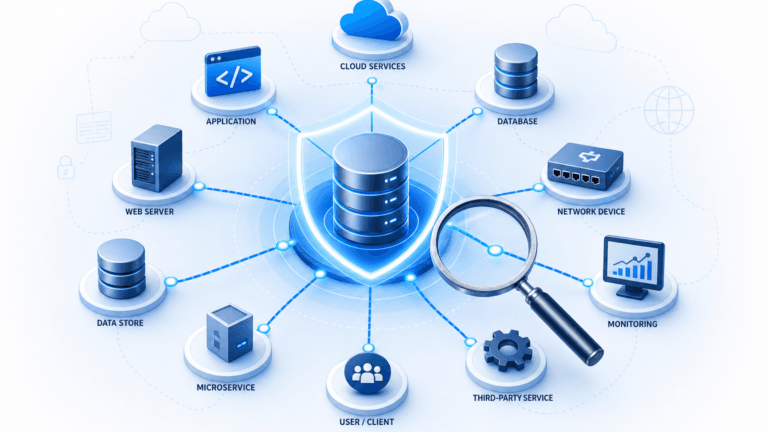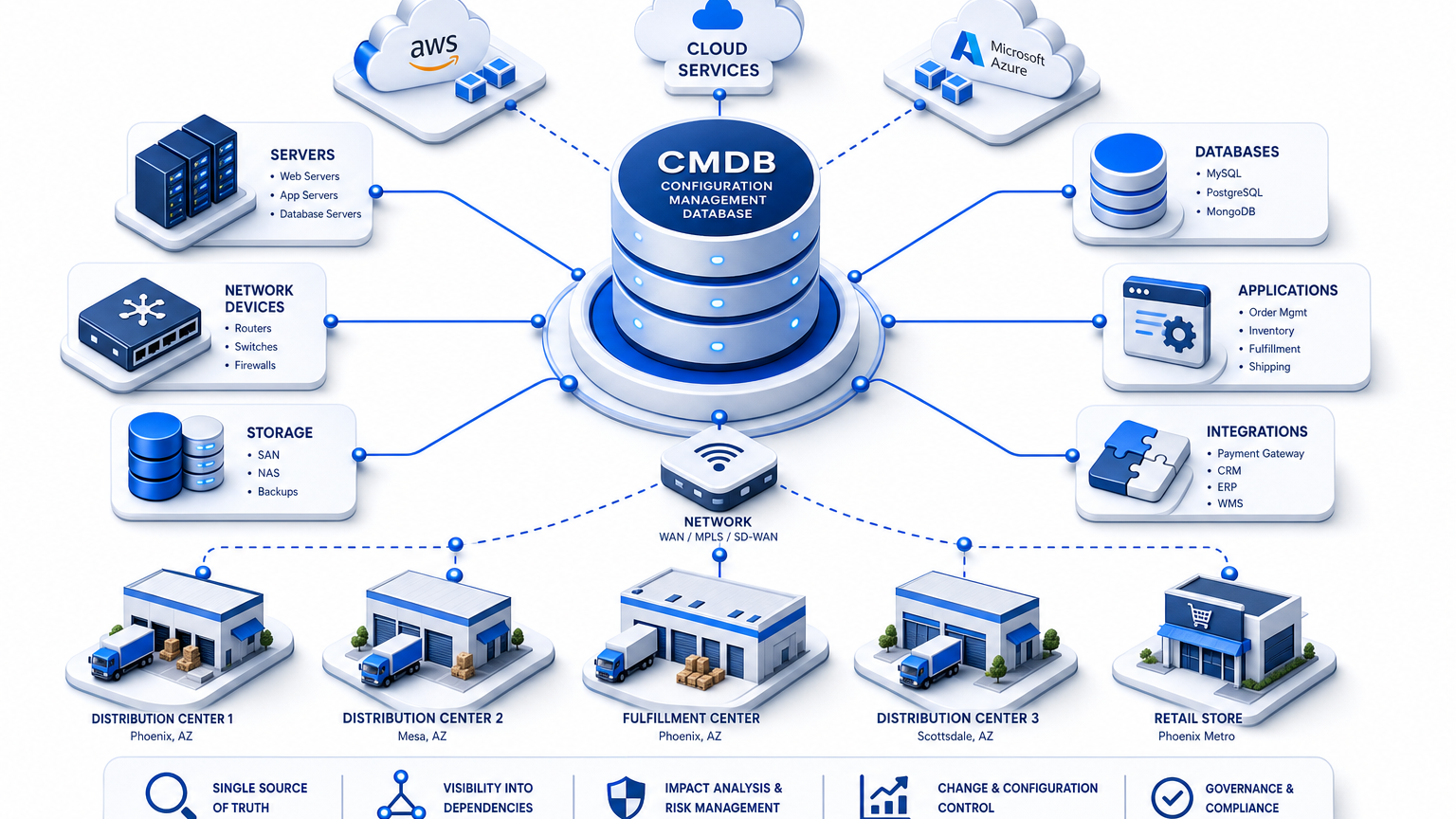
CMDB for Phoenix’s E-Commerce Distribution and Fulfillment Corridor: One Record Across Every Building

Industrial leases across the Valley of the Sun are closing faster than fragmented operations records can absorb new sites. Commercial market reporting from Kidder Mathews shows 7.6 million square feet leased across the Phoenix industrial market in the third quarter of 2026, alongside 2.9 million square feet of net absorption led by Glendale and the Southwest submarkets. With another 3.4 million square feet delivered and overall vacancy at 11.5%, logistics operators and regional retail brands are opening buildings under tight turnarounds. Every new facility poses the same governance challenge: how quickly the new building joins the central configuration record, and who confirms ownership of each connected device before peak seasonal order volume hits the floor.
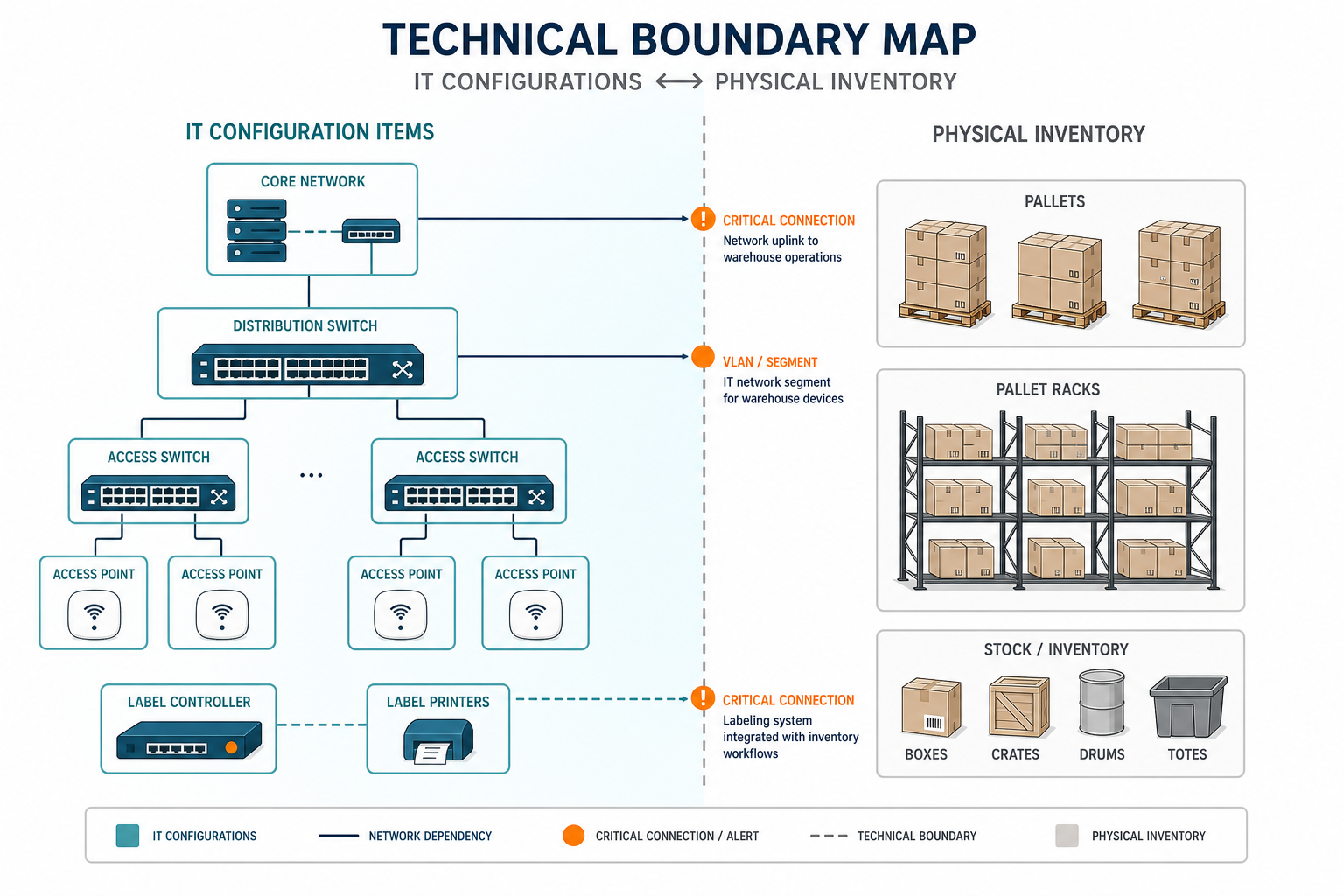
That operational threshold defines the practical role of a CMDB for e-commerce distribution and fulfillment in Phoenix. A configuration management database records technical infrastructure and relationship dependencies across fulfillment centers, carrier links, and cloud systems. It does not track parcels, stock-keeping units, pallet positions, or customer orders. When outbound packing stalls on a Saturday because an access gateway dropped offline, the outage stems from an unmapped dependency in the IT record rather than a failure in the warehouse management system.
Where a fulfillment network’s IT record breaks
In supply chain environments, the word asset routinely refers to physical merchandise, yard equipment, or transport trailers. A configuration management database instead records servers, managed network hardware, workstations, fixed endpoints, cloud accounts, and the dependencies linking those components. Fulfillment executives seeking stock visibility or carton counts require specialized supply chain platforms rather than an IT register.
Across distributed fulfillment networks spanning company-operated warehouses, third-party logistics facilities, and contract pack centers, three breakdown patterns recur during growth cycles.
- New fulfillment sites onboard through disconnected communication threads. Network switches, wireless access points, barcode scanners, and thermal label printers are manually cataloged across fit-out emails and spreadsheet trackers during facility setup. Result: The new building enters production with an incomplete hardware inventory, leaving operations teams unaware of unrecorded devices until an unmonitored switch or gateway fails under peak load.
- Shared boundary infrastructure operates without clear operational ownership. The consumer brand, the third-party logistics operator, and regional parcel carriers each run independent systems that exchange data over custom interfaces. Result: When an order handoff stalls or a shipping label pipeline halts, neither team can produce verified documentation proving who owns the intermediate network link or the gateway credentials.
- Peak seasonal capacity and temporary accounts linger past the holidays. Cloud instances, supplemental packing terminals, and staging networks deployed for fourth-quarter volume routinely remain active months into the following year. Result: Forgotten technical debt accumulates unnoticed, inflating infrastructure bills and leaving unmonitored attack paths exposed across the corporate perimeter.
These friction points represent common structural gaps across modern fulfillment networks rather than traits unique to Arizona operators. Similar drift across multi-site logistics estates emerges whenever facility expansion moves faster than configuration governance. Preventing these failures requires scheduled discovery cadences and verified configuration ownership across every operational building.
What the numbers say
Cross-industry configuration and asset audits consistently show why unverified inventory records introduce systemic operating risk. Flexera’s 2026 State of ITAM survey of 512 technology leaders revealed that only 36% of organizations report complete technology visibility across their estate, marking a notable drop from 43% in the prior cycle. At the same time, 78% of technology respondents ranked an accurate asset inventory as their primary governance priority. The same report documented that 48% of surveyed enterprises underwent an external vendor audit within the preceding twelve months, with 44% spending more than $1 million resolving audit demands across three years.
Hybrid complexity compounds these visibility challenges across modern e-commerce architectures. Flexera’s 2026 State of the Cloud Report found that 73% of enterprises maintain hybrid operations, with 54% citing application and infrastructure dependencies as their single largest operational hurdle. When fulfillment engines run order allocation in public cloud environments while execution hardware lives inside physical distribution centers, blind spots multiply rapidly.
Vendor-sponsored research confirms how deeply these technical disconnects affect supply chain leadership. A study of 328 retail and e-commerce fulfillment leaders conducted by TrendCandy and supply chain provider Kase reported that 79% of executives expect reactive operational decision-making once peak shipping volume spikes. Participants highlighted automated system integration and end-to-end operational visibility as essential provider selection criteria.
Security incidents multiply these financial liabilities when inventory records fail. IBM’s Cost of a Data Breach Report 2026 placed the global average enterprise breach expense at $4.99 million, representing a 12% annual increase. Incomplete site registers directly expand incident blast radii because security response personnel spend initial triage hours identifying which unrecorded site systems were compromised.
Commercial real estate reports confirm strong absorption across Phoenix logistics parks, yet leasing velocity does not equate to technical readiness. Operating resilience depends on configuration accuracy maintained through automated discovery.
What configuration automation means here, and where it stops
Within enterprise distribution IT, configuration automation refers to high-frequency scheduled discovery passes that update component records and dependencies across physical facilities and cloud subscriptions. It relies on configured discovery schedules rather than continuous event streaming. Short-lived cloud containers or ephemeral compute instances that spin up and terminate between scheduled collection cycles are captured on the subsequent scheduled sweep.
A defensible CMDB establishes explicit operational boundaries from the outset:
- Network-accessible infrastructure remains in scope. Discovery scans inventory devices that reside on accessible enterprise subnets and respond across standard administrative protocols.
- Physical automation machinery stays separate. Automated sortation machinery, robotic conveyor controls, automated storage units, and proprietary programmable logic controllers remain managed within operational technology platforms unless they expose standard network management interfaces.
- Handheld warehouse terminals require compatible endpoints. Mobile barcode scanners, ruggedized tablets, and radio-frequency picking guns appear in discovery records only when connected to managed subnets and running compatible device agents.
- Partner third-party networks require intentional access. Systems located inside dedicated third-party logistics facilities appear in discovery records only when the logistics provider grants secure network visibility into those shared boundary segments.
- Business data and customer records remain excluded. Discovery tools interrogate infrastructure configurations, installed operating software, firmware revisions, and connection ports without inspecting transaction payloads or application customer records.
- Public cloud discovery targets core enterprise platforms. Cloud discovery mechanisms interrogate configured Amazon Web Services and Microsoft Azure tenancies when administrative credentials are supplied through the console interface.
What the CMDB authoritative record contains includes rack servers, hypervisors, core and distribution switches, wireless access controllers, office endpoints, database hosts, cloud virtual instances, and the network relationships connecting them. When competing discovery feeds report conflicting hardware attributes, configured multi-source reconciliation rules decide which administrative source governs each field, preserving a single authoritative configuration item for each physical or virtual asset.
Similar architectural discipline applies across other major distribution centers. Unifying multi-site technical dependencies follows the same structural boundaries established for multi-site logistics distribution in Minneapolis, keeping industrial control hardware in operational engineering tools while consolidating core IT dependencies inside the central register.
CMDB for e-commerce distribution and fulfillment in Phoenix: scheduled discovery across every site
For retail brands, third-party logistics firms, and multi-tenant fulfillment operators managing facilities across the Phoenix metropolitan area, establishing a CMDB for e-commerce distribution and fulfillment in Phoenix relies on four foundational operational mechanisms.
- Discover each operational site on a predictable schedule. Scheduled discovery probes and lightweight agent scanners run across local facility subnets, cataloging distribution switches, wireless access points, print servers, and local order controllers. Cloud discovery collectors connect into Amazon Web Services and Microsoft Azure accounts hosting web storefronts, order allocation engines, and electronic data interchange brokers. Remote distribution buildings connect their discovery feeds back to the central console through secure network paths, giving IT leaders visibility into local facility assets alongside corporate cloud estates.
- Map dependencies across application and warehouse layers. ViVID™ service maps visualize actual network communication paths across open ports and active protocols after engineering teams supply the foundational definitions of which applications, interfaces, and servers constitute a business service. Once personnel define services like Order Routing or Shipping Label Generation, automated relationship mapping traces dependencies from cloud database clusters down to facility edge switches and local label printers.
- Assign a verified human owner to every configuration item. Automated systems catalog infrastructure attributes, yet human system owners must confirm operational ownership and business criticality. Every configuration record stores a named owner, organizational role, authoritative discovery source, and last-verified timestamp. When a carrier communications gateway or facility edge router degrades, incident responders immediately identify the designated technical owner without consulting external spreadsheets.
- Synchronize configuration state with change management workflows. Enterprise service desk platforms, including ServiceNow, Jira Service Management, Ivanti, Hornbill, HaloITSM, Xurrent, and TeamDynamix, ingest verified configuration context through pre-built connectors available on the Virima integrations hub. When engineers submit a change ticket to adjust an edge routing rule or replace a core switch before peak shipping week, the integrated change ticket shows the full downstream blast radius before approval.
Organizations evaluating Trusted Runtime Truth rely on discovery-backed records and verified service dependencies to ensure change evaluators and operational personnel act on documented operational facts rather than outdated site documentation.
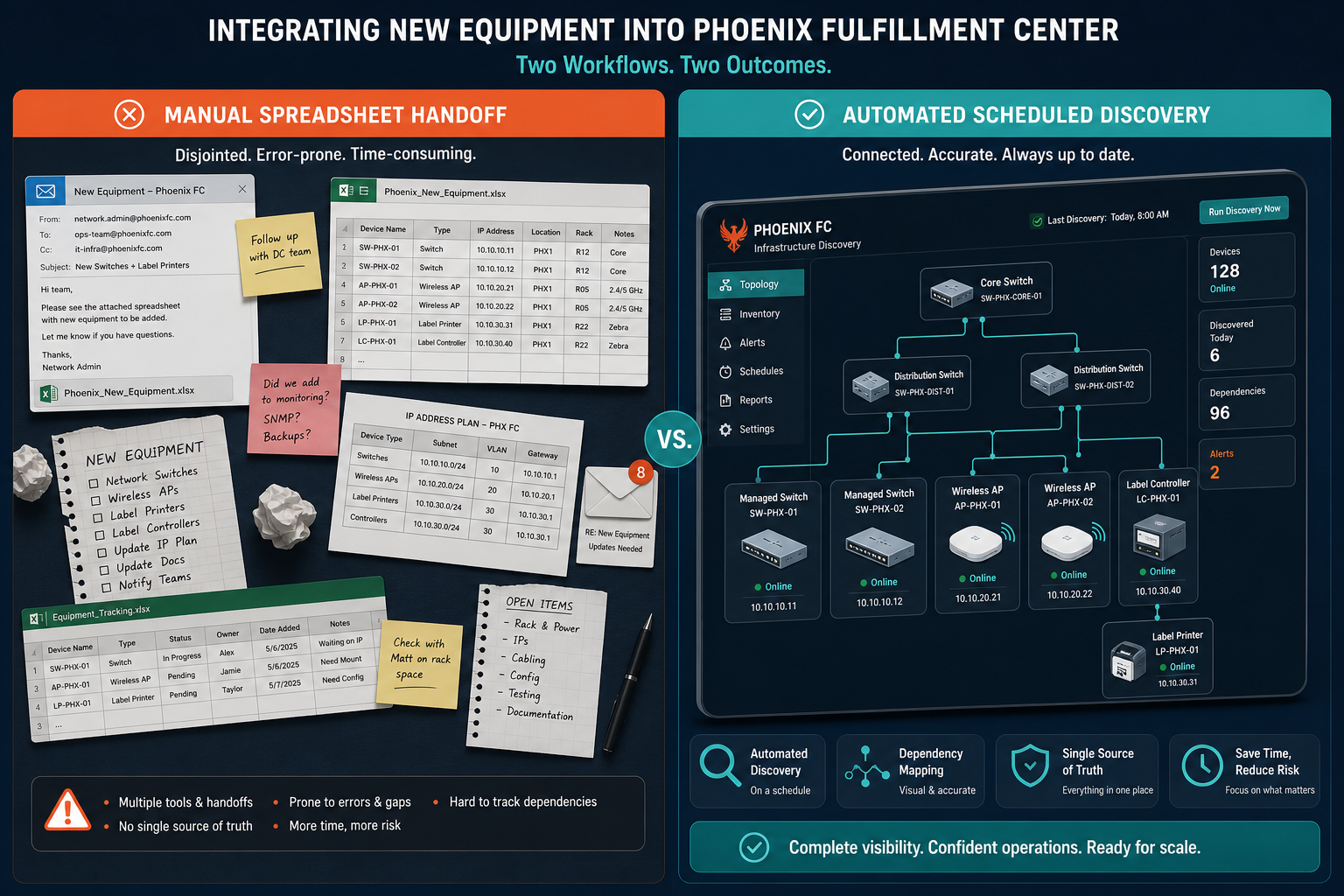
| Operating Dimension | Spreadsheet and Email Onboarding | Discovery-Fed Enterprise CMDB |
|---|---|---|
| Site Equipment Ingestion | Manual typing from vendor packing lists and email chains | Scheduled agentless network probes, local agent scans, and AWS/Azure cloud imports |
| Component Ownership | Frequently left blank, unassigned, or tracked informally | Named technical and operational owners with verification timestamps |
| Dependency Context | Undocumented or trapped inside senior engineers’ heads | Port and protocol communication flows mapped automatically once services are defined |
| Currency Verification | Trapped on static project delivery sign-off dates | Validated on each scheduled discovery cycle and reconciliation pass |
| Pre-Peak Audit Effort | Weeks spent chasing facility managers and spreadsheet revisions | Hours spent reviewing automated discovery delta reports and exception logs |
| Required Human Input | Repetitive manual inventory entry and ongoing chasing | Service boundary definitions, ownership confirmation, and retirement approvals |
Discovery cadences remain high-frequency and scheduled, configured by internal IT teams to align with corporate change windows and available network bandwidth. This structure provides repeatable configuration governance across distributed fulfillment footprints.
Deep architectural details for this operational model are documented across the Virima CMDB and Virima IT Discovery platforms. These resources enable operational teams to perform change impact analysis before deploying infrastructure adjustments.
What the CMDB settles, and what stays elsewhere
A discovery-fed CMDB answers a fixed set of infrastructure questions across every fulfillment building and cloud account. Warehouse management, carrier routing, handheld device control, and operational technology stay in the systems built for those jobs. The table below draws that line so technology and supply chain leaders know which decisions the configuration record can settle before peak volume arrives.
| Operational Question | Answered by the Central CMDB | Governed by Other Systems |
|---|---|---|
| Which physical and virtual IT assets operate in each warehouse? | Yes, for all discovered and registered network infrastructure | Warehouse management systems track physical freight, pallets, and cartons |
| How do local facility devices connect to cloud commerce engines? | Relationship maps and port dependencies after service definition | Carrier routing guides and commercial transport agreements |
| Who is accountable for maintaining a specific network component? | Stored ownership and operational team metadata confirmed by staff | Human resources directories and corporate supplier contracts |
| When was a specific warehouse switch or server last verified? | Authoritative discovery timestamps and audit log histories | Warehouse floor labor productivity metrics in labor management tools |
| How are handheld warehouse barcode terminals configured? | Discovered as network configuration items when IP-reachable | Mobile device management consoles for over-the-air firmware pushes |
| Are automated conveyor belts and sorters running within mechanical tolerance? | Captured only if connected to managed IT network subnets | Operational technology maintenance systems and PLC supervisory tools |
| Does local warehouse network cabling meet engineering design specs? | Inventories active devices, but does not validate architectural design | Enterprise network engineering blueprints and cable certifications |
| Who coordinates incident response during an infrastructure outage? | Supplies technical dependency context and CI ownership for triage | Security operations runbooks and incident commander assignments |
For corporate technology executives and operations directors, this separation provides operational clarity. The configuration management database delivers an authoritative record of what technical assets exist, how they connect, who owns them, and when discovery last confirmed their state. Decisions concerning transportation logistics, warehouse staffing, and inventory allocation remain entirely with supply chain leadership.
Where operational efficiency and cost recovery emerge
Financial and operational savings from configuration management stem from verifiable process improvements rather than speculative vendor metrics.
- Shortening new facility technical turnarounds — Operations teams measure the calendar days elapsed from initial building handover to the date every network switch, server, and endpoint carries a verified owner in the corporate register. Automated discovery replaces manual equipment audits, identifying configuration gaps weeks before operations commence.
- Preventing launch-week shipping interruptions — Organizations track production incidents occurring during the first thirty operating days of a new warehouse. Eliminating unrecorded gateway routers, undocumented print controllers, and unmonitored wireless access points directly prevents operational work stoppages across packing lines.
- Accelerating change evaluation before maintenance windows — Engineering teams measure the hours required to assess an infrastructure change ticket. Maintaining active communication relationships across order intake services and warehouse edge devices removes the need for manual network tracing before applying firewall patches or firmware updates.
- Decommissioning seasonal surge capacity promptly — Following peak holiday fulfillment cycles, technology teams review active cloud compute instances, temporary warehouse subnets, and leased equipment. Automated reconciliation highlights assets that have ceased processing production transactions, allowing administrators to terminate surplus subscriptions and return leased equipment on schedule.
- Eliminating audit penalties through verified software positions — Software inventory scanning identifies active software deployments across all facility servers and administrative workstations. Technology managers match discovered deployments against purchased entitlements within Virima IT Asset Management, preventing surprise non-compliance findings during external software vendor audits.
- Streamlining incident triage during peak shipping windows — Incident management teams measure the elapsed duration from an outage alert to identifying the affected configuration items and assembling the appropriate technical owners. Authoritative relationship mapping eliminates cross-departmental confusion during critical shipping periods.
Operational teams can evaluate how organizations simplify IT asset management audits through automated discovery routines, measuring reclaimed engineering hours against verified internal baselines.
Preparing the fulfillment network: the 90-day implementation path
- Phase 1: Ownership baseline and pilot facility selection (Days 1 to 15). Designate a central CMDB program lead alongside local IT site owners for each operating warehouse. Establish formal criteria requiring ownership sign-off before new facility infrastructure enters production. Select one mature operational fulfillment center and one planned facility expansion to serve as the initial deployment pair.
- Phase 2: Discovery deployment and multi-source reconciliation (Days 16 to 45). Deploy scheduled agentless discovery probes across the pilot facilities and connect cloud discovery connectors into Amazon Web Services and Microsoft Azure tenancies. Compare discovered hardware inventories against historical vendor fit-out spreadsheets and procurement purchase orders. Log every discrepancy inside the central register, assigning an operational owner to confirm whether missing items require manual registration, immediate remediation, or formal retirement.
- Phase 3: Service mapping and ITSM integration (Days 46 to 75). Define core business services, such as Order Routing, Pack-Bench Verification, and Carrier Shipping Label Generation, within the management console. Allow ViVID™ service maps to catalog active port and protocol communication paths between warehouse components and cloud application tiers. Connect the central CMDB into existing service desk workflows across ServiceNow, Jira Service Management, Ivanti, or supported ITSM tools via the integrations hub. This ensures change tickets automatically surface upstream and downstream service dependencies.
- Phase 4: Pre-peak audit freeze and go-live readiness (Days 76 to 90). Conduct a formal pre-peak readiness review across all recorded fulfillment locations. Enforce a change freeze policy requiring any supplemental holiday hardware, temporary packing terminal, or surge cloud instance to carry a designated technical owner and verified discovery timestamp before activation. Schedule post-peak retirement reviews to ensure temporary seasonal assets are cleanly decommissioned once shipping volumes return to baseline.
Validating multi-site fulfillment IT before peak volume
Building a resilient configuration database for distributed fulfillment networks requires testing discovery coverage against real warehouse conditions before seasonal shipping peaks arrive. Technology teams can begin by deploying scheduled discovery across a single fulfillment location and contrasting the automated inventory against existing equipment spreadsheets to expose undocumented infrastructure.
To evaluate how automated discovery, multi-source reconciliation, and service dependency mapping unify multi-site warehouse operations, schedule a demo with the Virima solution engineering team.
Frequently Asked Questions
What does a CMDB do for an e-commerce fulfillment network?
A CMDB maintains an authoritative, scheduled record of IT hardware, cloud instances, and service communication dependencies across fulfillment facilities, ensuring technical owners understand system relationships when managing changes or troubleshooting outages.
Does an IT CMDB track physical warehouse inventory or consumer orders?
No. A CMDB manages configuration items like servers, network switches, access points, and cloud subscriptions. Physical inventory, carton movements, and consumer orders remain governed by dedicated warehouse management and enterprise resource planning systems.
Can scheduled discovery identify assets operated by third-party logistics partners?
Discovery probes catalog partner-hosted systems only when those devices are reachable across authorized enterprise subnets using compatible administrative protocols. Isolated partner systems remain documented through manual configuration entries or direct partner-provided integration feeds.
Which public cloud environments does Virima discover for fulfillment workloads?
Virima discovers cloud virtual machines, database instances, and storage resources hosted across Amazon Web Services and Microsoft Azure when administrators configure API read credentials inside the central administration console.
How does Virima synchronize warehouse configuration data with existing ITSM platforms?
Virima synchronizes discovered configuration items, attribute changes, and mapped service relationships with enterprise service desks, including ServiceNow, Jira Service Management, Ivanti, and HaloITSM, through supported connectors on the integrations hub.