Cybersecurity Frameworks & Asset Inventory | Virima

Ask any CISO which control matters most in their framework of choice, and you will get a thoughtful answer about risk tiers or access governance. Ask which control they would fail an honest audit on today, and the answer is almost always the same: the one nobody talks about, knowing what the organization actually owns.
That gap is not a documentation problem. It is an asset inventory problem. For IT security leads, CISOs, GRC and compliance leaders, and infrastructure architects who supply the data frameworks depend on, cybersecurity frameworks only hold if the inventory underneath them is current, complete, and defensible.
What a cybersecurity framework actually is (and isn’t)
Security teams often treat “framework” as one bucket. In practice, the term covers several different instruments, and mixing them creates false confidence.
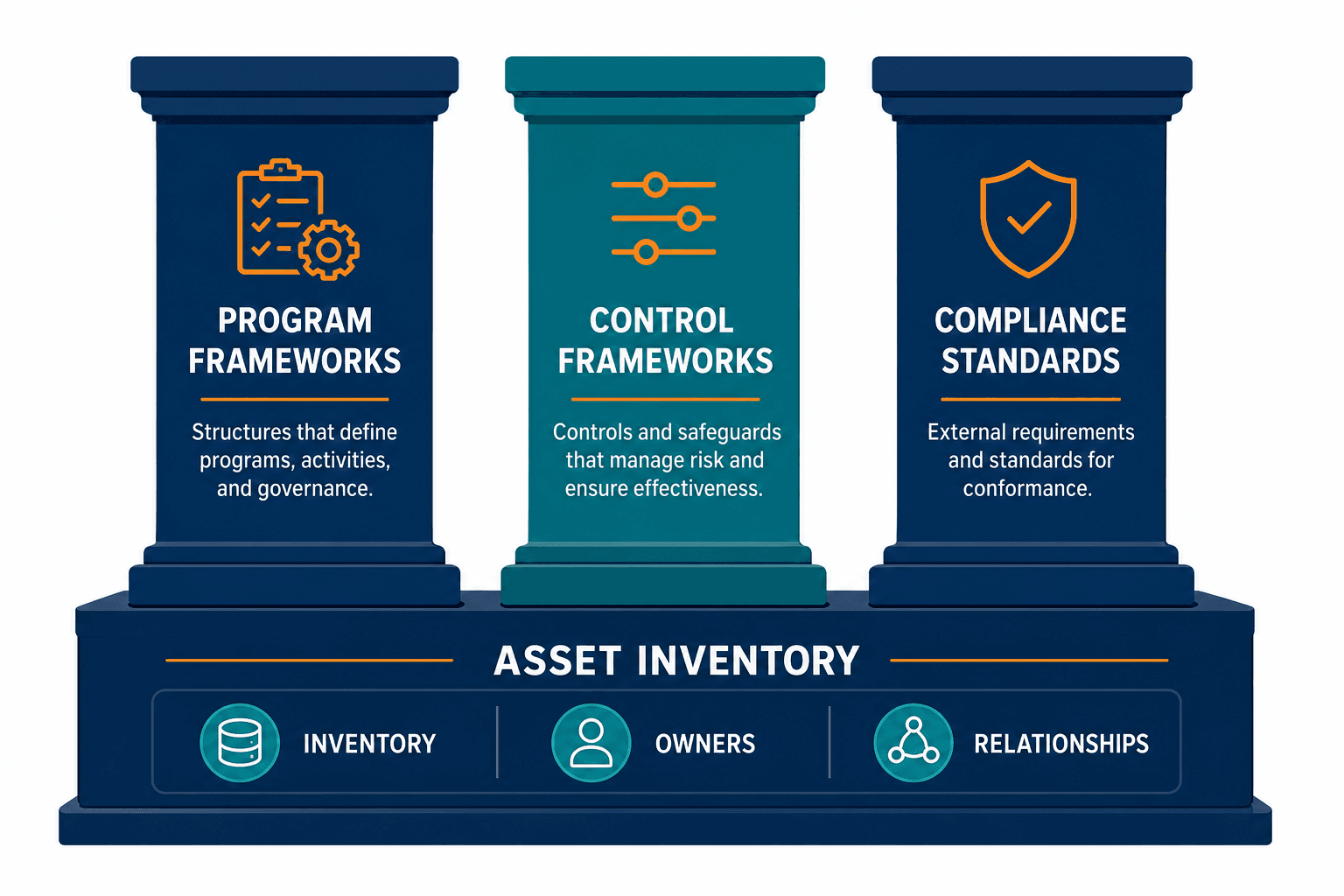
Program frameworks such as the NIST Cybersecurity Framework (CSF) and ISO/IEC 27001 describe how an organization should govern cybersecurity risk end to end. They organize outcomes (identify risk, protect systems, detect events, respond, recover) more than they prescribe every technical control.
Control frameworks such as the CIS Critical Security Controls and NIST SP 800-53 prescribe concrete safeguards. They are denser, more checklist-like, and closer to what auditors sample.
Compliance standards such as PCI DSS and HIPAA define mandatory requirements for a regulated context. Failing them has contractual or legal consequences that a voluntary program framework does not automatically create.
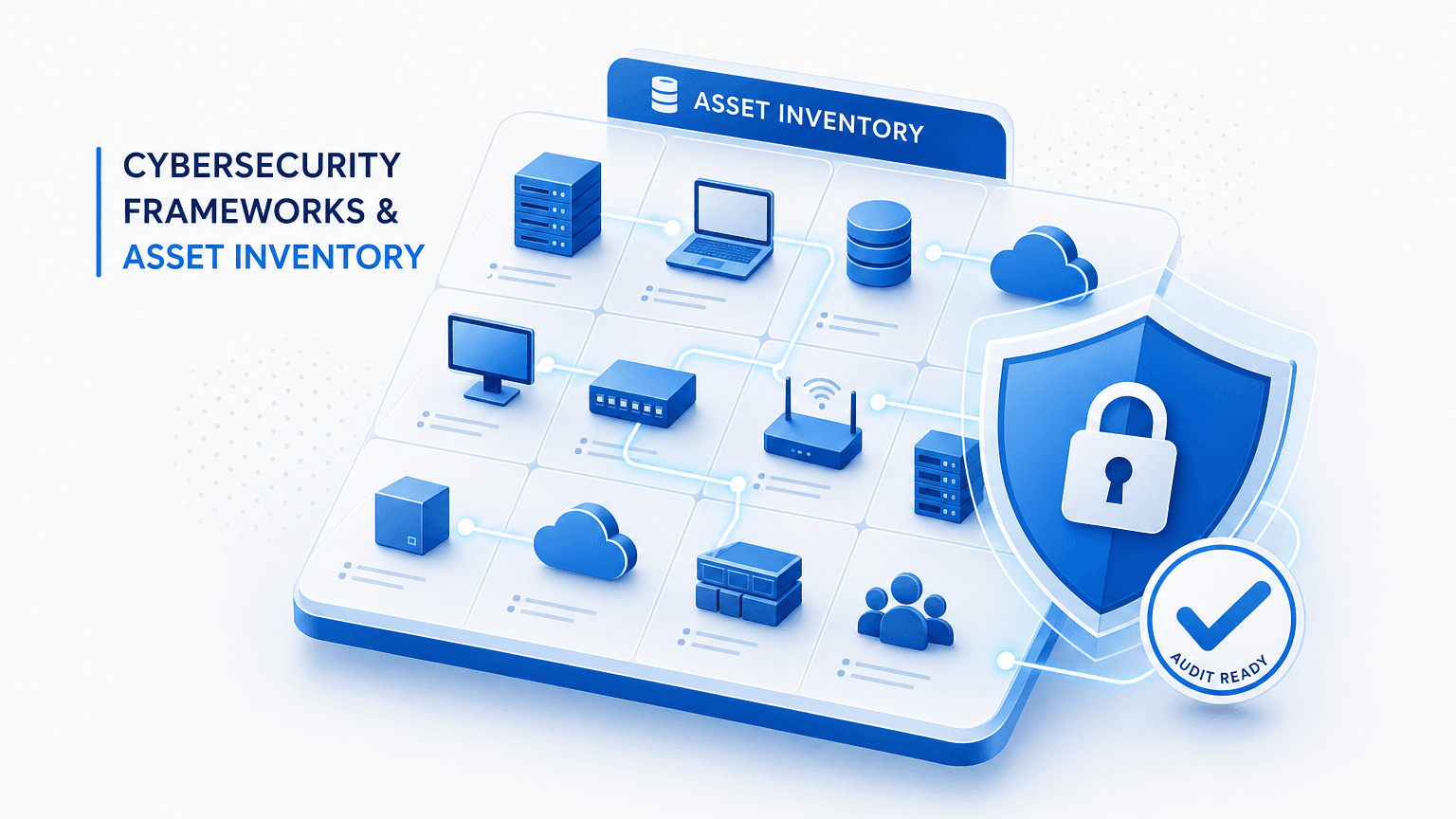
A framework is not a certificate by itself. It is also not a GRC tool, a scanner, or a CMDB. It is a structured way to decide what must be true about the estate, then prove it. The proof always starts with a trustworthy list of assets, owners, and relationships. Without that list, control mapping overstates coverage: policies describe systems that may no longer exist, and evidence packs cover only the assets someone remembered to register. In practical terms, a cybersecurity frameworks asset inventory is the current, owned, dependency-mapped list of enterprise assets that NIST CSF, CIS Controls, and ISO 27001 all assume before other controls can be scored.
The one control every framework shares, and why it is the first to break
Look past the branding and a single pattern appears.
CIS Control 1, Inventory and Control of Enterprise Assets, is explicitly first in CIS Controls v8. It requires organizations to actively inventory, track, and correct every enterprise asset connected to the infrastructure, including running an active discovery tool daily or more frequently to catch unauthorized devices. CIS states the reason plainly: enterprises cannot defend what they do not know they have.
NIST CSF’s Identify function asks the organization to understand systems, people, assets, data, and capabilities before it can prioritize risk. Its Asset Management category requires hardware asset inventory (ID.AM-01) and data asset inventory (ID.AM-07) — this is the NIST CSF asset inventory work CSF 2.0 keeps central even as Govern becomes its own function. You cannot score residual risk on an asset that never entered the inventory.
ISO/IEC 27001 expects an inventory of information and associated assets (Annex A control 5.9 in the 2022 edition) so ownership, classification, and protection can be assigned. An ISMS that cannot produce that inventory cannot show auditors how scope was defined or how residual risk was calculated.
The shared control is not “write a policy about assets.” It is “maintain a living, accurate inventory.” That is why it breaks first. Spreadsheets lag, and shadow SaaS never lands in the CMDB. Cloud instances appear and vanish between quarterly true-ups, and OT and IoT sit outside IT’s credentialed scan paths. Manual CMDBs hold last quarter’s truth with high confidence and low accuracy.
When Control 1 fails silently, every downstream control inherits the blind spot:
- Vulnerability prioritization misses hosts
- Access reviews miss service accounts
- Change risk scores miss dependencies
- Incident response cannot name the business service behind a failing CI
Why does asset inventory matter for cybersecurity frameworks?
CIS Control 1, NIST CSF Identify, and ISO 27001 Annex A all require a current list of assets, owners, and relationships before other security controls can be scoped or tested.
Why asset inventories fail before frameworks do
Framework programs usually stall for operational reasons, not because the control library is incomplete.
Spreadsheet sprawl. Different teams maintain different lists (finance fixed assets, network diagrams, cloud consoles, OT historians). None of them reconciles cleanly, so audit prep becomes a merge exercise under deadline pressure.
Shadow IT and unmanaged SaaS. Business units adopt tools outside IT procurement. Those assets never enter the inventory that GRC uses for scope, so control coverage claims overstate reality.
Cloud ephemerality. Auto-scaling groups, short-lived containers, and multi-account estates change faster than point-in-time CMDB loads. A monthly import is already wrong on day two.
OT and IoT blind spots. Plants, medical devices, and building systems often cannot accept the same agents or scan intensity as enterprise servers. In August 2025, CISA and partners published Foundations for OT Cybersecurity: Asset Inventory Guidance because incomplete OT inventories leave critical infrastructure unprotected by design, not by accident.
Stale or untrusted CMDBs. Many organizations already “have a CMDB.” The problem is trust. If operators refuse to use it for change windows, auditors will not treat it as authoritative evidence either. Multi-source conflict without clear authority rules produces duplicate CIs, missing relationships, and silent drift after every import project.
None of this is unique to one industry. It is the default failure mode when framework adoption is treated as a documentation project instead of a data-quality project.
What good asset visibility looks like for framework readiness
For framework readiness, “good” inventory is not a perfect spreadsheet. It is a defensible operating model.
Discovery breadth and frequency
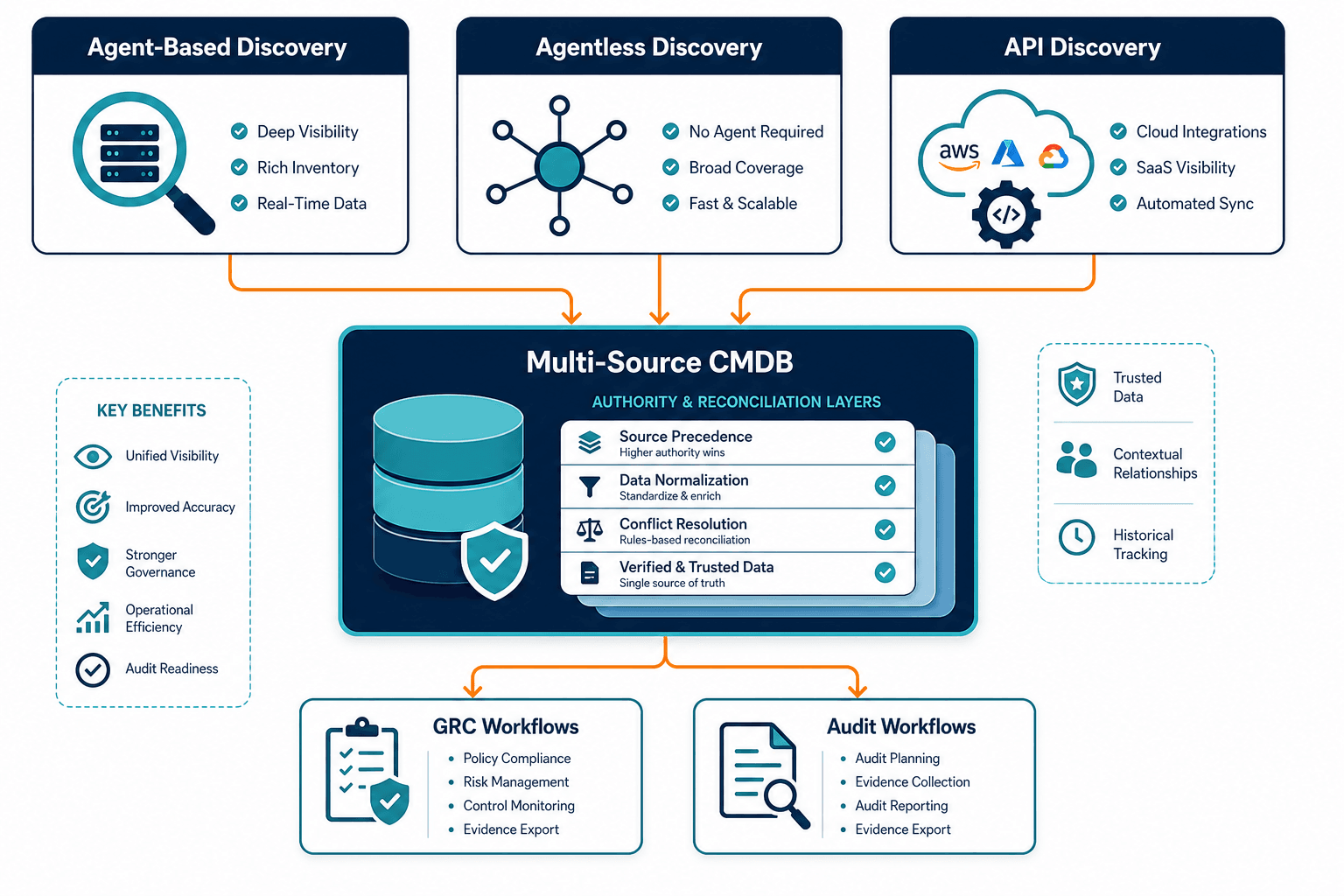
Discovery breadth. Combine agent-based discovery for deep endpoint and software detail. Add agentless discovery for network and credentialed infrastructure views. Layer in API-based discovery for cloud and platform estates, for example AWS and Azure. One method alone leaves systematic gaps that Control 1 reviewers notice.
High-frequency discovery cycles. Point-in-time annual inventories cannot keep pace with hybrid change. CIS recommends running active discovery daily or more frequently under Safeguard 1.1; Virima’s scheduled, high-frequency cycles are built to close that gap without claiming passive, continuous real-time discovery, so evidence packs reflect the estate auditors will actually sample.
Reconciliation, ownership, and evidence
Multi-source reconciliation with authority rules. “Most recent scan wins” is a weak audit story when sources disagree. Framework-ready CMDBs need defined authority: which source wins for serial number, owner, lifecycle state, or relationship type, and how conflicts are logged.
Ownership and service context. Inventory without owner and business-service linkage fails change, incident, and risk workflows even when the hardware row exists. Virima’s ViVID™ service maps, built from agreed service definitions plus discovered dependencies, give GRC and SecOps a blast-radius view frameworks assume but rarely receive from raw asset lists.
Exportable evidence. Auditors ask for populations, samples, and change history. Discovery-sourced CMDB data with history logging supports those requests better than screenshots of a console from last quarter.
This is where IT discovery and a maintained CMDB earn their place: not as a GRC product replacement, but as the asset-data layer GRC tools, vulnerability programs, and ITSM workflows consume. Virima is built for that discovery-to-CMDB path, including multi-source reconciliation and dependency mapping once service definitions are provided. It integrates with major ITSM platforms — including ServiceNow, Jira Service Management, and Ivanti — through a single integrations hub at all integrations.
For the deeper cybersecurity and Zero Trust angle on the same inventory problem, see IT Asset Visibility for Cybersecurity: The Complete CMDB.
What is CIS Control 1?
CIS Control 1 is Inventory and Control of Enterprise Assets. It requires organizations to inventory, track, and correct enterprise assets connected to their infrastructure, including running active discovery daily or more frequently, so unauthorized and unmanaged assets can be found and remediated. It is the first control in CIS Controls v8 because defense depends on knowing what exists.
Framework compliance is a byproduct of accurate asset data, not a separate project
Teams often staff a “framework workstream” and a “CMDB workstream” as if they were optional peers. The dependency runs one way. Control mapping, policy writing, and tool configuration can only describe the estate the inventory can see.
That does not mean a discovery platform replaces ISO certification bodies, PCI QSAs, or enterprise GRC suites. Those systems still own workflow, attestations, and regulatory interpretation. The discovery-driven CMDB supplies the populations and relationship context those systems need: what exists, how it is connected, what changed, and who owns it.
Treating inventory as infrastructure under ITOM and configuration management, rather than a pre-audit scramble, changes the cost curve. Evidence collection becomes a query against maintained data instead of a war-room spreadsheet merge. Residual risk discussions start from a shared CI list instead of competing departmental lists. For how CMDB data supports security and risk programs more broadly, read the role of CMDB compliance in IT security and risk management.
Trusted runtime truth — live enough through high-frequency cycles, explainable through source and history, usable in change and incident context — is what keeps framework language honest. Without it, Identify stays theoretical, Control 1 stays a green checkbox on paper, and audit findings cluster on “incomplete asset inventory” year after year.
Do you need a CMDB to comply with NIST CSF?
NIST CSF does not mandate a specific CMDB product. It does require organizations to understand and manage assets under the Identify function, including the ID.AM-01 hardware asset inventory sub-control. A discovery-maintained CMDB is one practical way to produce the current inventory, ownership, and dependency context that Identify activities and later controls assume.
Put inventory under the framework before you expand the control map
If your organization is selecting or operationalizing cybersecurity frameworks, start with an honest inventory test. Can you produce, within a short window, a current list of in-scope enterprise assets across on-prem, cloud, and (where relevant) OT? Does that list include owners and enough dependency context to explain blast radius? If not, expanding control mappings will not repair the foundation.
Before adding another documentation layer, prioritize discovery coverage and CMDB trust:
- Align GRC, SecOps, and infrastructure on authority rules for conflicting sources
- Use high-frequency discovery cycles so evidence stays close to the estate auditors sample
- Keep framework tools focused on workflow and attestation
- Keep the CMDB focused on runtime asset truth
For adjacent risk-framework reading, see the essential guide to IT operational risk management frameworks.
Frequently Asked Questions
What are the main cybersecurity frameworks organizations use?
Common program frameworks include NIST CSF and ISO/IEC 27001. Common control frameworks include CIS Controls and NIST SP 800-53. Regulated environments also apply standards such as PCI DSS and HIPAA. Most mature programs combine a program framework for governance with a control set for technical safeguards.
What is the difference between a cybersecurity framework and a compliance standard?
A framework is a structured model for managing cybersecurity risk and controls. A compliance standard sets mandatory requirements for a specific regulatory or contractual context. Organizations often use frameworks to organize work that also supports compliance evidence, but adopting a framework alone does not equal certification or regulatory clearance.
Why do audits still find inventory gaps after a framework project launches?
Framework projects often prioritize policy and control mapping while inventory stays manual, fragmented, or refreshed too rarely. Cloud and shadow IT change faster than those processes. Auditors sample live populations, so stale CMDBs and partial spreadsheets surface as incomplete asset inventory findings even when other controls look documented.
How does Virima support framework readiness without replacing GRC tools?
Virima provides discovery-sourced CMDB data, multi-source reconciliation, and dependency mapping once service definitions are provided. That asset and relationship layer feeds ITSM and security workflows GRC programs rely on. Virima is not a compliance platform and does not guarantee audit outcomes; it strengthens the inventory foundation frameworks assume.
Does Virima replace ServiceNow, or work alongside it?
Virima does not replace ServiceNow. It integrates directly with ServiceNow, Jira, Ivanti, and other ITSM platforms to enrich existing CMDB and asset records with discovery-sourced ground truth, so established ITSM workflows run on more current, complete asset data instead of being replaced.
This article references NIST, CIS, ISO, and CISA materials for general awareness only. Framework selection, scoping, and certification decisions should go through your legal, compliance, and audit advisors, and any Virima capability described here should be validated against current product documentation.