FedRAMP cloud asset discovery for DC federal and defense IT

A program office near the National Mall rarely fails an ATO packet on the named boundary diagram alone. It fails when the live cloud estate no longer matches the inventory the package still cites.
New subscriptions appear under a contractor path. A test account in AWS GovCloud outlives its pilot. An Azure Government resource group still hosts a service nobody owns in the configuration management database (CMDB).
For Washington DC federal and defense IT teams, FedRAMP-authorized cloud raises the bar on where workloads run — it doesn’t keep records current alone.
This guide covers FedRAMP cloud asset discovery for federal IT: what defense and agency operators need to prove about assets running inside authorized cloud estates, and why that proof is continuous operational work rather than a one-time authorization milestone. Product scope stays limited to discovery and CMDB truth, covering the AWS and Azure government paths teams already run.
Why authorized cloud still leaves inventory gaps in DC
FedRAMP standardizes security assessment, authorization, and continuous monitoring for cloud products used by federal agencies under one program model. That program model draws a boundary: which cloud offerings, and which components inside them, a Package covers on the day it’s approved. The boundary is a snapshot. What runs inside it keeps changing every time a new resource, account, or contractor path appears — and reconciling that drift is inventory work, not authorization work.
DC teams often run several layers at once. That is the norm across the public sector now. 80 percent of government cloud decision-makers report running a hybrid cloud model. 71 percent run multiple public clouds at the same time, according to Nutanix’s 2025 public sector cloud research.
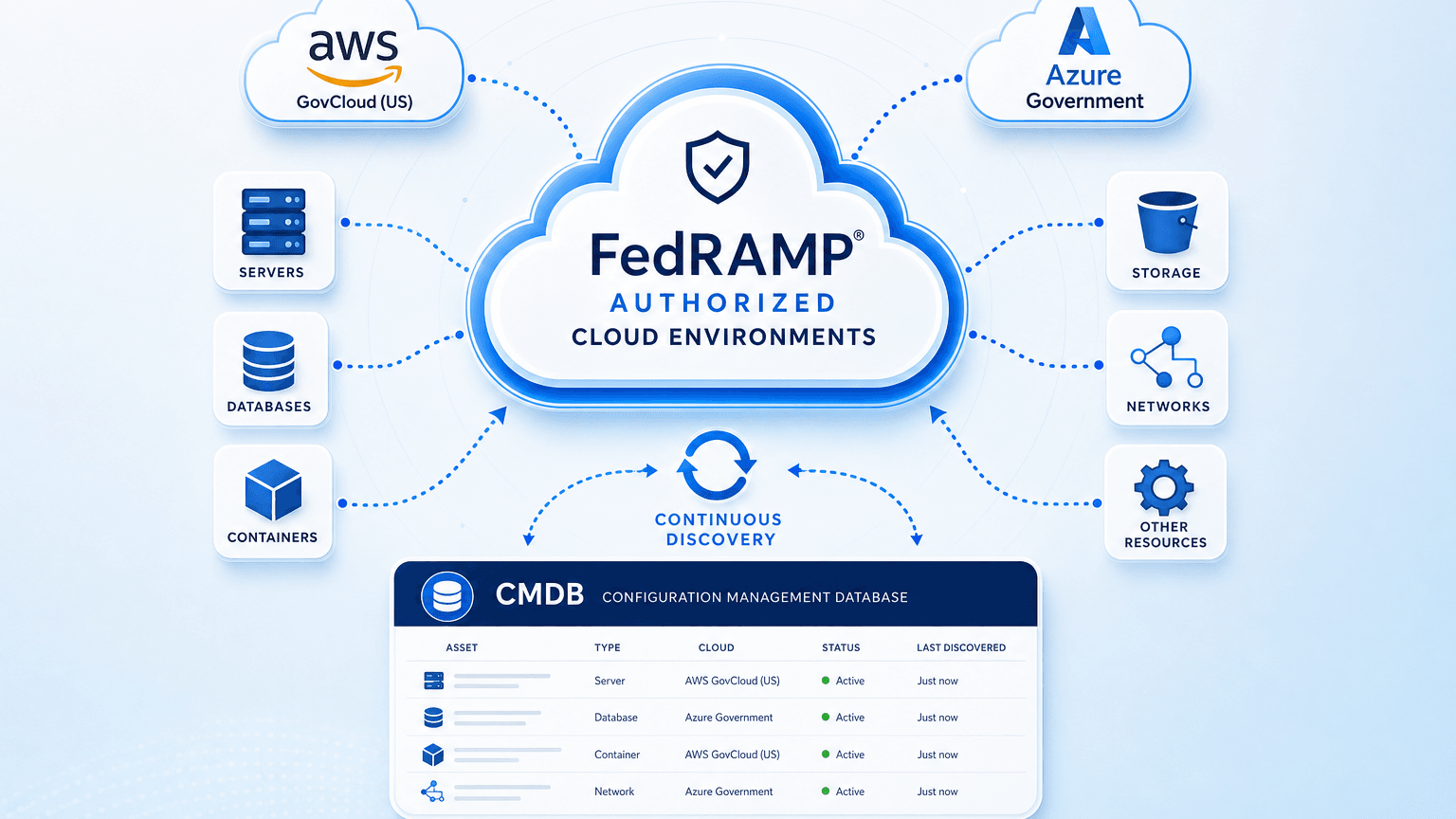
Commercial AWS and Azure sit beside AWS GovCloud and Azure Government. Shared services may serve multiple bureaus. Mission apps may land in contractor-managed accounts that still affect agency risk. Authorization paperwork freezes a picture of approved paths. Discovery must keep refreshing what actually runs on those paths after every sprint and every contract option year.
When discovery only samples a subset of accounts on a slow schedule, three failure modes appear. First, orphaned resources keep billing and expand the attack surface with no named owner. Second, change boards approve work against CMDB rows that no longer match live cloud state. Third, continuous monitoring evidence leans on spreadsheets that lag the environment the assessor will sample next.
That risk already shows up in federal oversight findings. A GAO review of the 24 largest CFO Act agencies found nine were still running cloud services that had never received FedRAMP authorization. That gap appeared even as agency use of the program grew 60 percent from 2019 to 2023 (GAO-24-106591).
High-frequency discovery cycles across agreed AWS and Azure scopes reduce that lag before the next package update or incident bridge. They do not need to mean passive continuous packet capture. They do mean scheduled passes short enough that a month-old blind spot is treated as a defect.
When cloud inventories still lag the authorized estate, start with Trusted Runtime Truth. Pressure-test whether discovery scope matches the accounts you already run.
Is a FedRAMP authorization boundary the same as an asset inventory?
No. A FedRAMP authorization boundary defines which cloud components a Package covers on the day it’s approved — a static document artifact. Asset inventory is the ongoing, discovery-sourced record of what is actually running inside that boundary right now. The two drift apart the moment a new resource, account, or contractor path appears.
Ownership friction across agency, defense, and contractor clouds
National Capital Region IT rarely has a single cloud landlord. CIO shops own enterprise identity and shared platforms. Program offices own the mission systems that sit on those platforms.
Defense components add classification and boundary rules that further split who may scan what. Integrators open temporary accounts for migrations and leave residual resources after cutover. Security teams want complete inventory while cloud engineering wants automation velocity. Contracting officers want clear ownership for spend and residual risk.
Those constraints produce permanent dark corners. A resource group created for a thirty-day pilot remains six months later. A storage account used for a tabletop exercise never receives a CI owner. A virtual network peering path still links a retired sandbox to a production subscription. None of those gaps wait for the next FedRAMP reauthorization cycle to become operational problems.
Operators who close the corners treat discovery scope as a negotiated map. They list every AWS and Azure account or subscription that can host federal data or support federal services, then document:
- Which paths accept API-based cloud discovery
- Which on-prem jump hosts still need agent or agentless methods
- Which segments stay out of scope for policy reasons
- Who reconciles duplicates when the same resource ID appears in a cloud export and an ITSM import
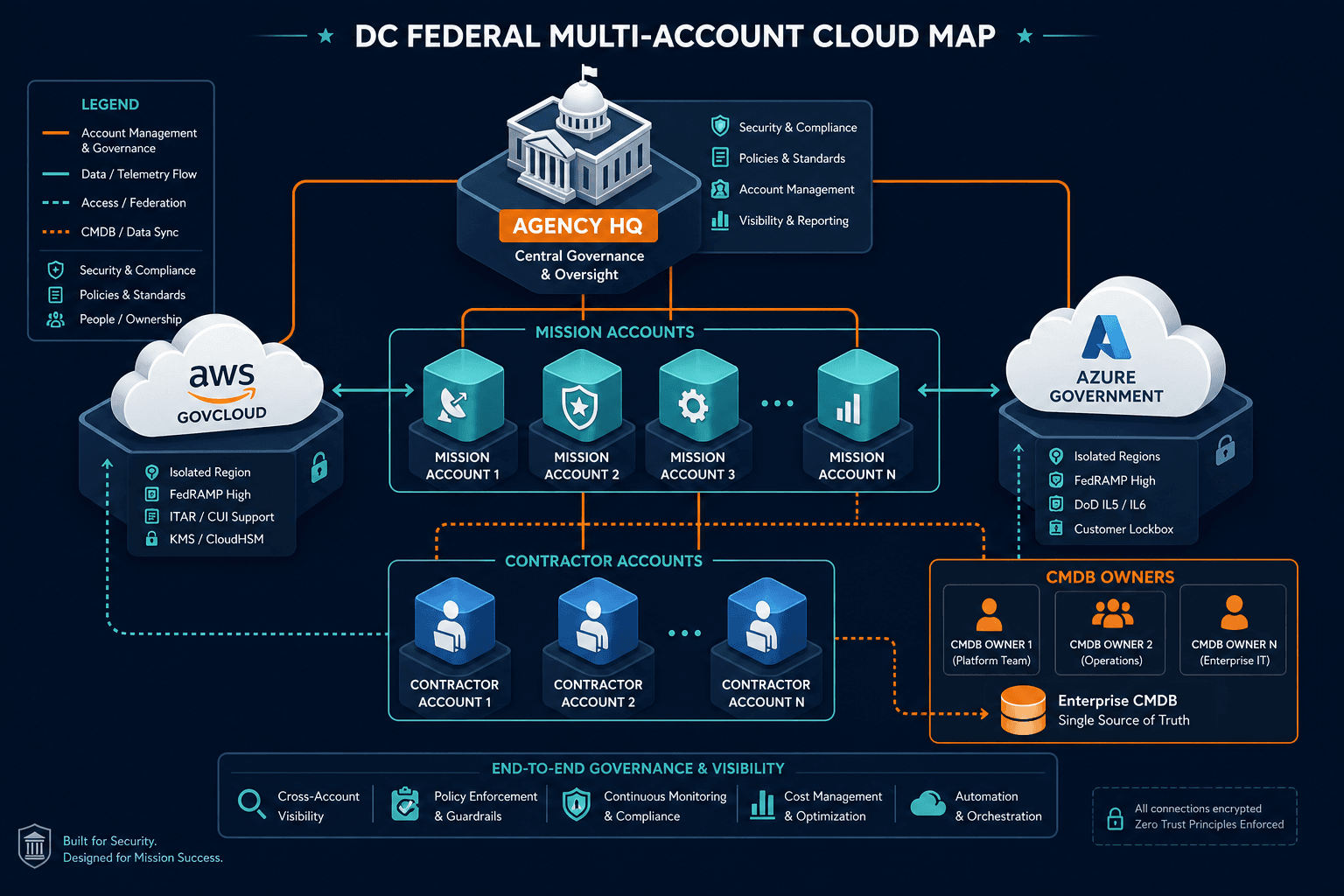
Teams already building cloud CMDB practice can connect this federal framing to broader patterns. See the AWS and Azure CMDB discovery guide so government paths use the same reconciliation discipline as commercial estates. For DC teams weighing how discovery scope maps to segmentation policy, Zero Trust Architecture and CMDB for Washington DC’s federal IT covers how the same account inventory feeds trust-boundary enforcement, not only audit prep.
What FedRAMP cloud asset discovery for federal IT must cover
Coverage design beats tool branding for these estates. DC federal and defense teams need a written scope that names:
- Commercial and government AWS accounts
- Azure and Azure Government subscriptions
- Resource groups tied to mission services
- Identity paths that create resources
- Network constructs that define trust boundaries
Each scope entry needs a method. API-based cloud asset discovery reaches the same account and resource data that AWS Config and Azure Resource Graph already track, where credentials and policy allow. Agent or agentless methods cover the hybrid jump points API access can’t reach. Assign a named cadence owner for every entry.
AWS GovCloud discovery results should feed directly into the same CMDB used for commercial-account discovery — GovCloud asset discovery and CMDB population are one reconciliation process, not two separate ones.
Cadence matters as much as method. FedRAMP continuous monitoring deliverables require agencies and the cloud service providers they rely on to maintain a complete, current asset inventory updated at least monthly, or immediately after any change to the authorized boundary (OMB Memorandum M-24-15). A quarterly-only discovery cadence cannot meet that bar regardless of tooling. High-frequency discovery cycles keep last-seen data close enough to trust during change control and incident response. Stale cloud rows should raise the same concern as stale data center rows.
Relationship data is the third coverage requirement. A flat list of instance IDs will not tell a change owner enough. It will not show whether a government-region database still supports a citizen-facing service.
Once program or enterprise architects provide service definitions, dependency maps can show installed-on and runs-on links. Those links matter for impact analysis. Virima ViVID™ builds those maps from defined services rather than inventing service composition automatically. That boundary keeps maps honest when contractor and agency systems share infrastructure in ways org charts never drew.
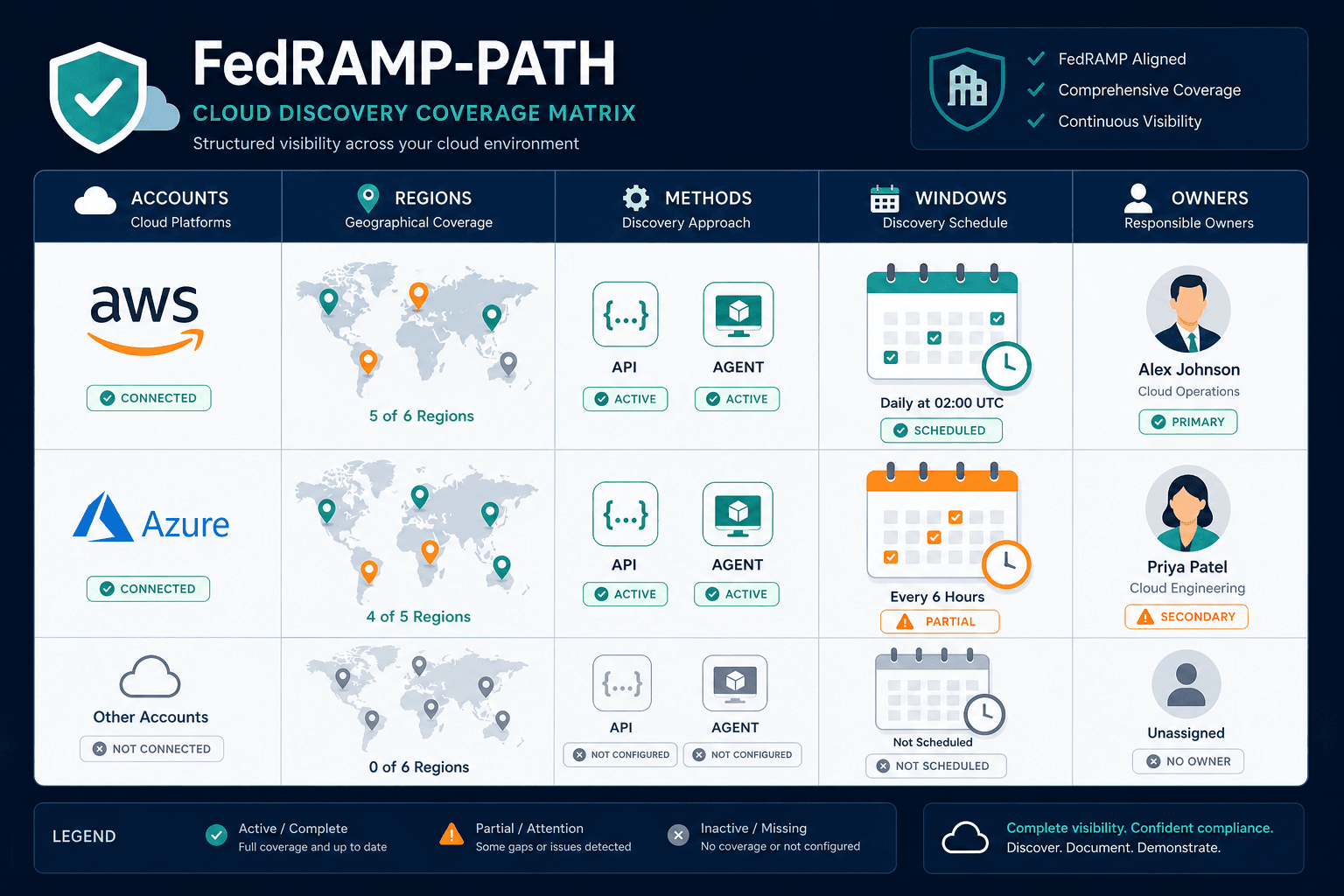
Internal teams evaluating platform fit should review how Virima IT discovery collects cloud assets across AWS and Azure. Authorized estates can feed the same CMDB model used for on-prem infrastructure. Pair cloud discovery with agency continuous monitoring and GRC tools for control evidence. Do not treat discovery alone as a FedRAMP authorization substitute.
What should FedRAMP cloud asset discovery for federal IT cover first?
Start with every AWS and Azure account that can host federal data or support mission services. Include GovCloud and Azure Government paths, contractor-managed accounts still in the trust boundary, and hybrid jump hosts. Then attach owners, last-seen dates, and service relationships before the next change or monitoring sample.
Building discovery-sourced truth federal leaders can defend
When discovery runs on shared scope and cadence, the next failure mode is political. Agency IT, mission owners, defense stakeholders, and integrators must agree which system is authoritative for a CI class. They must agree how conflicts resolve when a cloud API and an ITSM import disagree on tags or owners. Multi-source reconciliation should prefer discovery evidence with recent last-seen data over static exports nobody revalidates. Manual overrides stay allowed for business metadata without freezing hardware and cloud facts scanners still observe.
Virima approaches this as Trusted Runtime Truth for the operational estate. Leaders need what exists, how it is connected, what changed, and who owns it. That picture should be sourced from discovery rather than from the last spreadsheet edit. Automated discovery refreshes CIs while the CMDB holds relationships and health signals. Once services are defined, dependency maps give leaders a shared blast-radius view before weekend changes. Integrations can push that truth into ServiceNow, Jira Service Management, Ivanti, HaloITSM, Xurrent, and Hornbill workflows. Tickets stop inventing separate cloud and on-prem asset lists. Partner connections sit on the Virima integrations hub.
For DC federal and defense IT teams, the practical win is fewer package and bridge surprises. Cloud resources that joined last month appear beside the services they can affect. Owners and last-seen dates land before the next continuous monitoring sample. That is inventory as mission safety across authorized cloud paths.
This guide does not assert FedRAMP authorization or any federal ATO outcome for Virima; it describes discovery and CMDB practices for teams operating inside FedRAMP-path and government cloud estates. Validate fit against your agency policy and the live estate you already operate.
Score your agency’s account coverage, ownership, and cadence gaps before your next ATO evidence pull.
What good looks like before the next ATO evidence pull
Leaders can score readiness with the same short operational checklist behind the scorecard above. First, every AWS and Azure scope that can host federal data has a named discovery method. The last successful cycle must be newer than the change freeze policy requires. Second, unknown cloud resources open an ownership workflow instead of remaining unlabeled forever. Third, CMDB health tracks completeness and staleness so executives see inventory debt as a metric, not an anecdote. Fourth, service maps for mission and shared services exist from defined compositions. Those maps stay tied to infrastructure CIs that discovery still confirms.
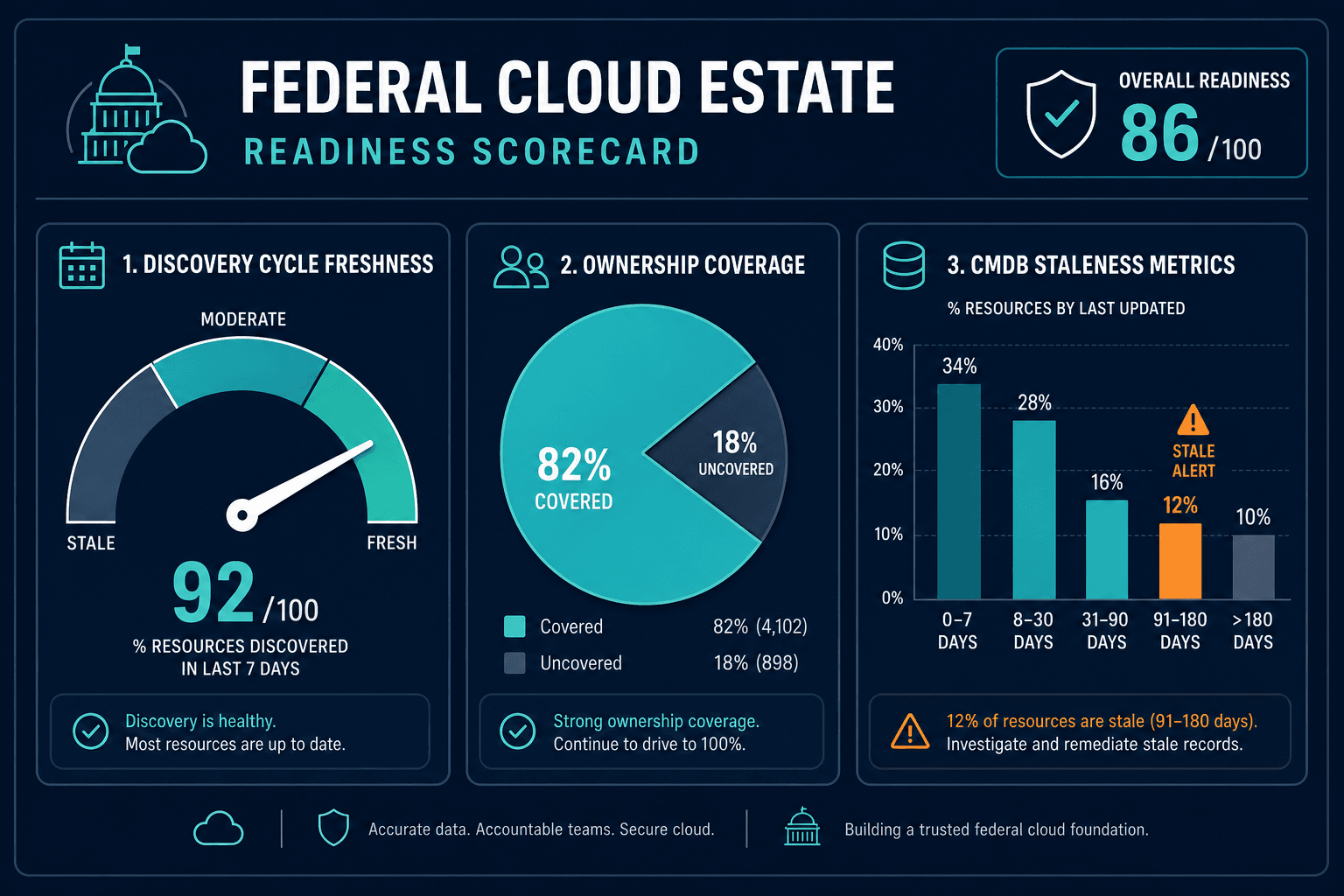
For teams that need to trace this checklist back to specific controls rather than a general practice, NIST 800-53 control mapping in Washington DC walks through how discovery-sourced CMDB records support control evidence line by line, anchored to NIST SP 800-53 Rev. 5 control families.
How do DC federal teams know FedRAMP-path cloud discovery is working?
Authorized-path accounts show recent last-seen cycles. Unknown cloud resources open ownership workflows for named operators. CMDB health tracks staleness as a metric. Mission service maps stay tied to cloud and hybrid CIs. Discovery still confirms those CIs before change windows and monitoring samples.
When those conditions hold, FedRAMP cloud asset discovery for federal IT becomes a managed control. It spans agency, defense, and contractor accounts. Discovery-sourced CMDB records and dependency context give a shared runtime picture. That picture lands before the next patch window, migration cutover, or evidence request.
If your teams still reconcile government-cloud inventories by hand before every major package update, Discovery and Service Mapping for Xurrent to score your coverage, ownership, and cadence gaps before the next evidence pull.
Frequently Asked Questions
Is FedRAMP the same as complete cloud asset inventory for an agency?
FedRAMP is not the same as complete agency inventory. FedRAMP authorizes cloud products and services under a shared security framework. Each agency or defense program still needs discovery of its own accounts, resources, and owners. CMDB and monitoring evidence must match live state inside those environments.
Why do contractor cloud accounts stay missing from federal CMDBs?
Integrator and pilot accounts often join outside central subscription governance and enterprise discovery scope. Without a shared account map and cadence across agency and contractor paths, residual resources stay invisible. Spend, incident, or audit then forces a manual hunt.
How often should DC federal teams run cloud discovery on authorized estates?
Cadence should beat how fast new resources, functions, and storage objects appear in active programs. Many teams treat month-old blind spots as defects. High-frequency discovery cycles on agreed AWS and Azure scopes beat annual or quarterly-only sweeps. That cadence supports change and monitoring readiness.
Does Virima claim FedRAMP authorization in this guidance?
This article does not claim FedRAMP authorization for Virima. It discusses discovery and CMDB practices for teams operating inside FedRAMP-path and government cloud estates. It does not claim any federal ATO outcome for Virima. Validate product fit against your agency policy and live scope.
How does Virima help federal IT teams with cloud asset discovery?
Virima runs cloud and hybrid discovery on agreed AWS and Azure scopes. It populates a CMDB with multi-source reconciliation. It builds ViVID™ dependency maps after services are defined. Teams use that discovery-sourced truth inside ITSM workflows instead of maintaining separate cloud and on-prem spreadsheets.