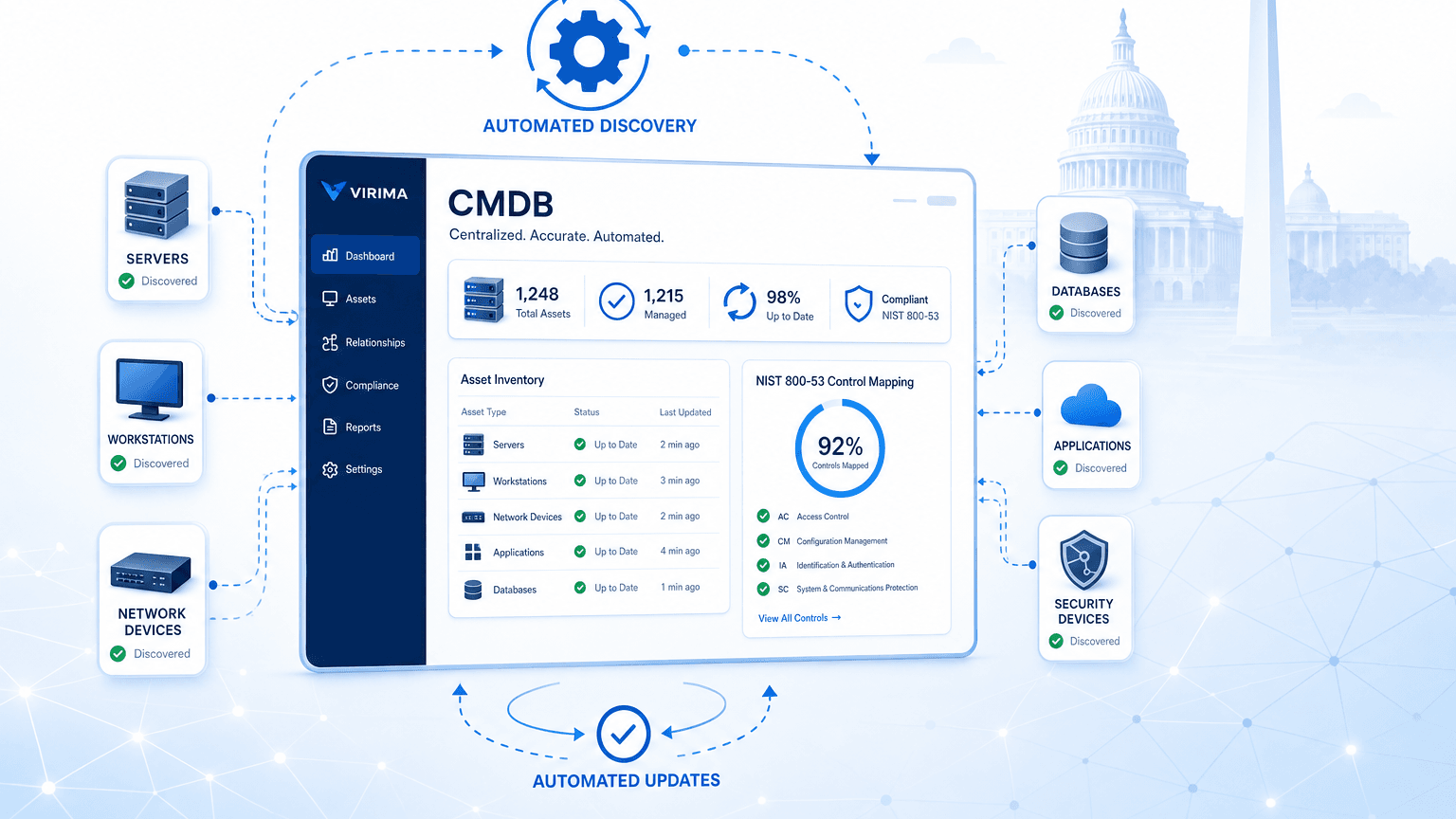
NIST 800-53 Control Mapping in Washington, DC Needs a CMDB

In April 2025, the Environmental Protection Agency Office of Inspector General published an audit that exposed a foundational vulnerability across federal information security programs. According to FedScoop coverage of the EPA OIG report, the Inspector General reported that the agency could not validate the completeness or accuracy of its primary IT systems inventory. Auditors found that agency program offices tracked information systems independently. The resulting records conflicted with each other and contradicted central reporting. In a separate finding, the watchdog reported that enterprise managers could not tie software license records to active software installations across production environments. These gaps breached both Office of Management and Budget Circular A-130 mandates and the foundational controls that any credible NIST 800-53 control mapping in Washington, DC, or anywhere in the federal government depends on.
Federal civilian executive branch agencies operating across the capital face identical scrutiny from congressional committees and oversight bodies. The failure at the Environmental Protection Agency stemmed from inventory freshness failures rather than legal misunderstanding alone. Operational asset records decayed faster than manual compliance teams could reconcile them. When technical teams attempt NIST 800-53 control mapping in Washington, DC, using outdated spreadsheets, the resulting compliance documentation presents an illusion of security. Real compliance defensibility requires discovery-sourced inventory data that reflects technical runtime reality on a high-frequency scheduled cadence.
What is NIST 800-53 control mapping?
NIST SP 800-53 Revision 5 is the catalog of security and privacy controls for federal information systems. The publication outlines twenty control families containing more than one thousand individual security controls. Control mapping is the operational practice of associating specific technical configurations, organizational policies, and automated safeguards with corresponding controls in the federal catalog. This crosswalk provides authorizing officials with the evidence required to grant an Authority to Operate under the Federal Information Security Modernization Act.
Within the catalog, the framework establishes two distinct asset inventory requirements that govern all subsequent security controls. Control CM-8 focuses on the CM-8 system component inventory, requiring teams to track individual hardware devices, operating systems, firmware versions, and network interfaces. Control PM-5 governs program-level system inventory, mandating that the agency maintain a strategic register of all accredited information systems boundaries.
When agency engineers map controls, they frequently confuse governance workflows with technical discovery. A governance dashboard can structure control statements, but it cannot verify whether an unmanaged server is processing traffic inside a sensitive boundary.
What is NIST 800-53 control mapping?
NIST 800-53 control mapping aligns an agency’s technical safeguards, infrastructure configurations, and operational workflows with specific controls in the NIST catalog. This process validates that hardware, software, and data repositories meet baseline security standards required to maintain an active federal Authority to Operate.
The table below outlines the operational divergence between documented expectations and actual network conditions within federal program offices:
| Operational Condition | What Happened |
|---|---|
| Agency leadership assumes system inventories remain current after accreditation. | Routine discovery scans and vulnerability assessments identify production assets with no corresponding configuration management record. |
| Configuration teams populate CM-8 inventory components during initial system authorization. | Unmanaged container environments and contractor hardware outpace manual update schedules between triennial assessments. |
| Software procurement records reside in financial systems separated from operational tooling. | Purchased license volumes fail to reconcile with live network deployments, creating audit findings and financial penalties. |
Why is NIST 800-53 control mapping important for government IT teams?
Federal agencies operate in one of the most hostile threat landscapes in the world while managing massive technical debt. According to the GAO-25-107743 High-Risk Series report, the federal government spends more than $100 billion annually on information technology. The vast majority of that spending goes toward operations and maintenance of existing systems. Related GAO reporting on IT acquisition and management risk reinforces that agencies still depend heavily on aging legacy systems. Many of these systems lack native telemetry. The Government Accountability Office has kept improving IT acquisitions and operations on its High-Risk List for years, citing hundreds of open recommendations on cybersecurity oversight and asset visibility.
When control mapping relies on disconnected records, federal IT operations enter predictable breakdown sequences. These operational failures produce direct consequences for authorization boundaries:
- Stale program-level system inventories — when agency components maintain siloed registries under PM-5, enterprise security officers cannot define the organizational attack surface, so CyberScope submissions and congressional compliance disclosures convey operational metrics that agency leaders cannot defend during audits.
- Configuration management drift — as reported in FedScoop coverage of the VA FISMA audit, oversight teams identified deficiencies in configuration management alongside vulnerability management and access controls, and the outcome is repeated material weaknesses from Inspectors General that compromise multi-year modernization budgets.
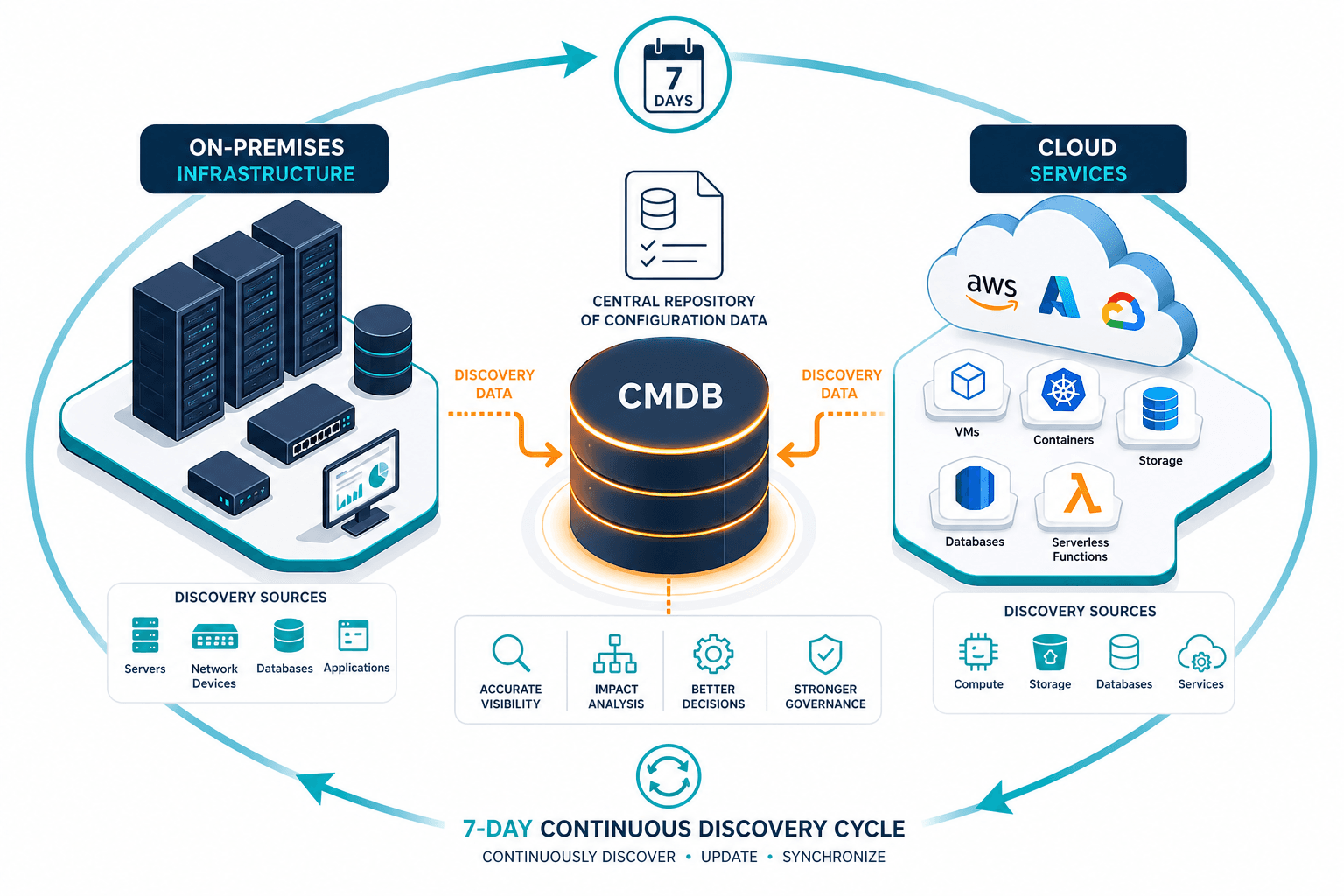
- Asset-to-vulnerability mismatch under strict schedules — CISA BOD 23-01 requires Federal Civilian Executive Branch agencies to run automated asset discovery at least every seven days across their entire IPv4 address space (not a sample or a subset of “known” subnets) and vulnerability enumeration every fourteen days. Security teams end up investigating alerts on decommissioned assets while uninventoried production systems remain unpatched.
- Disconnection between procurement and deployment — when asset inventory mechanisms fail to capture installed software, financial teams cannot validate enterprise agreements, so programs pay for redundant entitlements while simultaneously failing software licensing audits.
The operational friction intensifies under that binding discovery cadence. Manual inventories cannot satisfy BOD 23-01 asset discovery tempo. If an agency configuration management database requires thirty days of manual reviews to reflect infrastructure changes, the program operates outside the directive window between scheduled discovery cycles.
The real cost of getting control mapping wrong
The legal and operational ramifications of inaccurate control mapping extend across every tier of agency leadership. Under federal statutes, agency heads bear direct personal responsibility for ensuring information security safeguards match the risk of operational disruption. When Inspectors General identify systematic inventory failures, agency executives face public congressional testimony, potential budget reductions, and delayed modernization initiatives.
For configuration managers and system administrators, control failures create relentless administrative burnout. The EZO 2026 State of IT Maturity Report found that 16% of organizations still depend on spreadsheets to track assets and configurations as a primary system of record.
Reconciling discrepancies across spreadsheets, ticket histories, and scanner logs consumes hundreds of engineering hours every quarter. Technicians spend their workdays answering auditor questionnaires rather than securing production infrastructure. For a closer look at why spreadsheet tracking breaks down once an agency environment grows past a handful of systems, see ServiceNow CMDB Accuracy: Why Native Discovery Falls Short at Scale.
The stakes escalate when evaluating systems categorized under Federal Information Processing Standards Publication 199. Systems categorized as moderate or high impact require hundreds of supplemental controls governing boundary protection, continuous monitoring, and incident response. If an agency cannot verify the inventory boundary under CM-8, every downstream control linked to that boundary fails audit review. Because the District of Columbia houses the highest density of federal agency headquarters and defense contractors, regional program offices face elevated oversight pressure from oversight bodies and the executive branch.
Federal civilian leaders require infrastructure confidence before approving modernization investments. Establishing trusted runtime truth across complex agency networks provides the operational context needed to satisfy oversight expectations and defend agency missions.
Before you rebuild a control-mapping process around another audit cycle, see where your current inventory practice actually stands: download the How to Build an AI-Ready CMDB Checklist for 2026 and compare your current discovery cadence against BOD 23-01’s seven-day window.
How automated CMDB fixes NIST 800-53 control mapping in Washington, DC
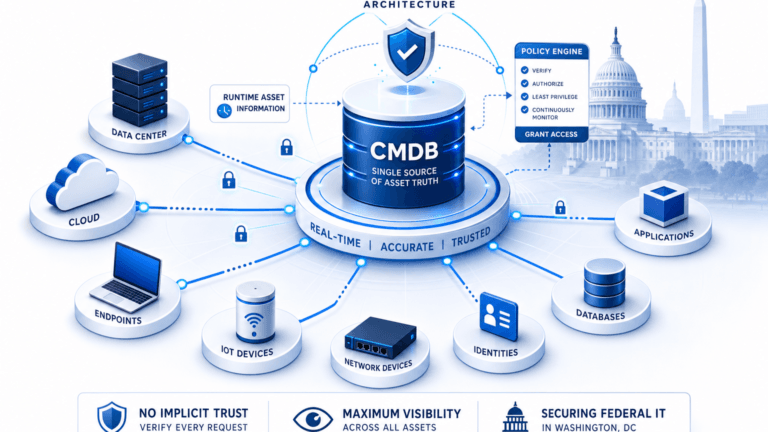
Remediating systemic compliance gaps requires transitioning from point-in-time documentation to discovery-driven infrastructure management. An automated CMDB for government IT establishes a dynamic record of technical truth that refreshes through high-frequency scheduled discovery cycles. Rather than treating compliance as an administrative retrospective, modern IT organizations use discovery automation to align operational infrastructure with NIST control families.
How does an automated CMDB support NIST 800-53 control mapping in Washington, DC?
An automated CMDB runs high-frequency discovery cycles across agency networks to identify hardware, software, and network relationships. By replacing manual spreadsheets with scheduled discovery data, the platform provides current component inventories that support CM-8 and PM-5 audit evidence across federal environments.
Three core capabilities enable automated platforms to resolve chronic federal compliance challenges:
- High-frequency scheduled discovery: Automated platforms run scheduled discovery sweeps across on-premises data centers, software-defined networks, and authorized cloud environments. By executing agent-based and agentless scans on a high-frequency schedule, discovery engines identify newly provisioned virtual machines, unauthorized network devices, and modified software packages. This data populates CM-8 and PM-5 records automatically, ensuring inventories match physical network reality.
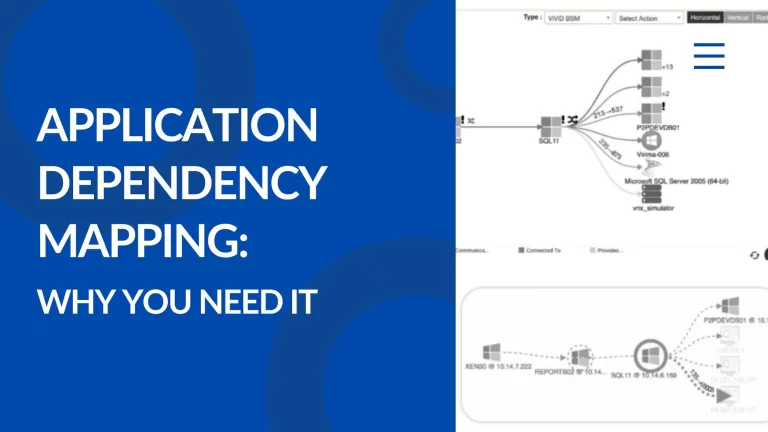
- Dependency and relationship context: Understanding that a server exists does not satisfy modern security requirements. Technical teams must know which business applications, data repositories, and mission workflows depend on that component. Dynamic relationship mapping links infrastructure assets to their parent system boundaries, delivering the architectural visibility required for CA-7 continuous monitoring and RA-5 vulnerability prioritization.
- Auditable configuration records: Compliance assessments require chronological proof of configuration changes over time. Automated platforms log every discovered attribute modification, hardware replacement, and software update with clear timestamps. When external auditors review access or configuration controls, agency administrators present definitive system records rather than reconstructed ticket trails.
The following comparison illustrates the functional operational shift between legacy manual practices and automated discovery platforms:
| Compliance Dimension | Manual Reconciliation Method | Discovery-Driven CMDB Platform |
|---|---|---|
| Inventory currency | Remains accurate only on the date when data was exported manually. | Refreshed through high-frequency scheduled discovery cycles. |
| Auditor verification | Relies on static spreadsheets and subjective questionnaire responses. | Supplies timestamped configuration histories and verifiable scan logs. |
| Vulnerability association | Requires manual matching of CVE reports to static hardware lists. | Maps discovered Windows Server assets against the National Vulnerability Database. |
| BOD 23-01 alignment | Demands unsustainable administrative effort to meet seven-day cadences. | Executes automated discovery schedules designed to satisfy federal directives. |
NIST 800-53 control mapping examples in practice
Examining real-world operational scenarios clarifies how dynamic configuration management transforms federal security administration.
Annual FISMA Inspector General assessment preparation
Prior to an annual audit, an agency security manager must produce evidence validating that all systems operating within the human resources boundary maintain approved security configurations. In a manual environment, configuration staff spend six weeks exporting records from hypervisors, cross-referencing network switch tables, and emailing application owners to confirm server identities. In contrast, an automated environment allows the security manager to generate a complete CM-8 inventory artifact directly from the CMDB. The report contains verified hardware models, serial numbers, operating system build levels, and network addresses verified during the prior week’s discovery cycle.
Streamlining the system authorization boundary
When an agency development team prepares a cloud-native analytics platform for production authorization, security engineers must document the system boundary. Rather than asking engineers to complete manual hardware questionnaires, the team initiates an automated discovery scan across the cloud tenancy. The discovery engine maps every virtual computing instance, managed database service, storage bucket, and external connection point. This structural baseline integrates directly into the System Security Plan, reducing authorization review timelines from six months to several weeks.
Rapid remediation under CISA emergency directives
When the Cybersecurity and Infrastructure Security Agency issues an emergency directive regarding an actively exploited zero-day vulnerability, agency analysts must locate all vulnerable assets within twenty-four hours. Programs relying on static documentation search through spreadsheets that fail to reflect recent configuration adjustments. With automated discovery integrated into vulnerability management, security analysts query the CMDB for the specific software library version. The platform immediately returns affected hosts along with application ownership records, allowing teams to isolate vulnerable infrastructure before adversaries establish persistence.
Understanding these operational scenarios allows technical teams to evaluate their current compliance architecture and identify visibility gaps across mission boundaries. For the broader security case on how CMDB-backed asset visibility supports federal cyber operations, see cybersecurity and IT asset visibility via CMDB.
How Virima powers NIST 800-53 control mapping in Washington, DC
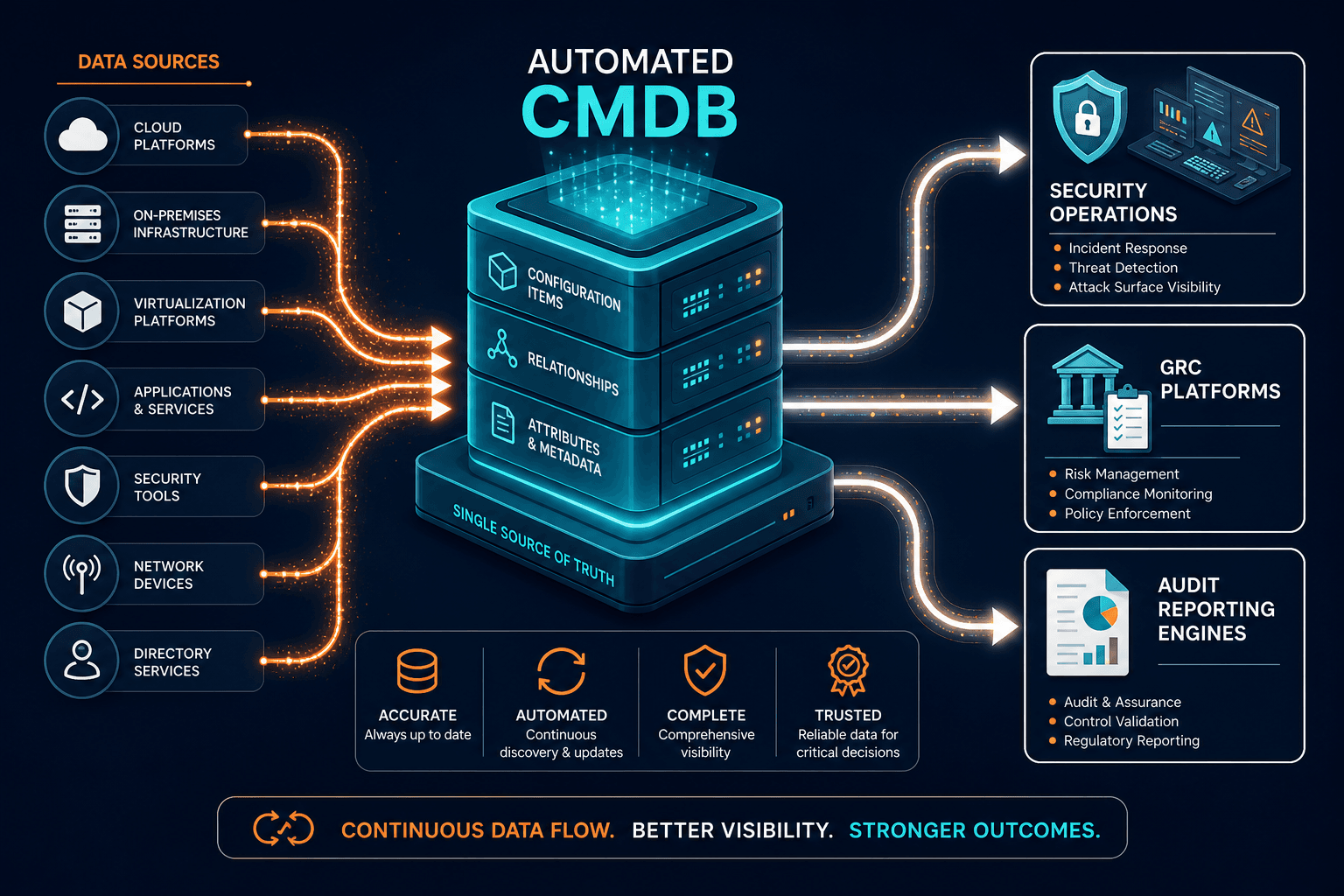
Virima provides the foundational visibility layer that enables government IT teams to maintain defensible compliance baselines. The platform combines deep infrastructure discovery with advanced relationship mapping to ensure federal inventories reflect technical reality across distributed architectures.
Immediate operational impact
Deploying Virima eliminates the manual labor required to collect infrastructure data for compliance filings. The platform’s discovery engine operates across on-premises infrastructure, legacy enterprise hardware, and government cloud regions. Virima identifies active IP assets, interrogates device specifications, catalogs installed software titles, and records network interface configurations without disrupting mission operations. This automation satisfies the data collection requirements of NIST controls CM-8 and PM-5 from the initial discovery pass.
Long-term configuration integrity
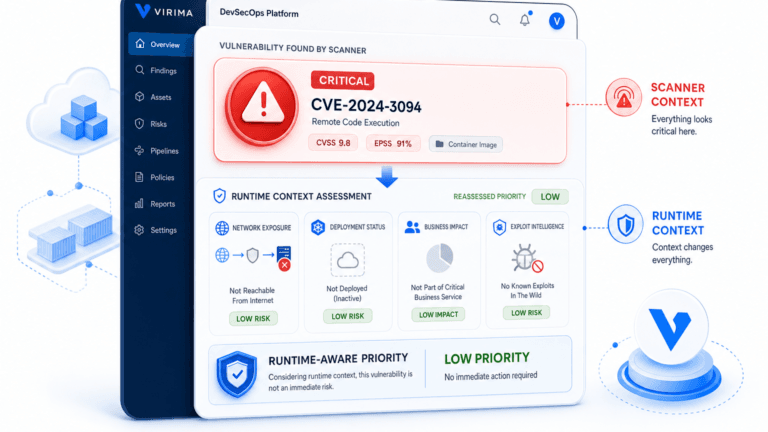
Configuration management databases frequently deteriorate into untrusted data repositories when discovery mechanisms cannot sustain pace with operational changes. Decommissioned assets are a common source of that drift: a virtual appliance taken offline without a corresponding CMDB update leaves behind a ghost record that inflates the inventory and confuses vulnerability scoping. Virima’s discovery cycles reconcile these disappearances the same way they catch new assets, flagging anything that no longer responds to a scan instead of leaving it to age silently in the database. Built-in vulnerability correlation links discovered Windows Server assets with relevant records from the NIST National Vulnerability Database, giving security teams contextual awareness of active configuration weaknesses.
Service context through ViVID™
Raw infrastructure inventories lack the operational context necessary to evaluate mission impact during security incidents. Virima’s ViVID™ service maps translate discrete technical components into visual service dependency maps. ViVID™ illustrates how servers, storage arrays, database clusters, and network switches support specific agency business services and mission programs. This contextual understanding enables teams to determine the operational blast radius of discovered vulnerabilities, supporting the continuous monitoring expectations defined under NIST control CA-7.
Operational integration with existing workflows
Virima functions as an authoritative discovery and context layer that integrates with existing government workflow investments. Through bi-directional integrations with enterprise platforms including ServiceNow and Jira Service Management, Virima enriches existing incident, change, and configuration workflows with verified runtime data. See the full list of supported platforms on the integrations hub.
Virima provides the authoritative inventory data, configuration histories, and dependency mapping that substantiate compliance controls. The platform does not serve as a GRC policy crosswalk system, does not generate System Security Plans, and does not replace the formal authorization authority of the designated Authorizing Official. Virima ensures that the technical evidence presented to authorizing officials and auditors holds up under independent audit scrutiny.
Moving from manual reconciliation to discovery-driven control mapping
Transitioning an agency infrastructure program from static records to dynamic discovery requires a phased implementation methodology. Federal IT leaders can establish defensible control mapping by following a structured five-step progression:
- Scope an initial system boundary: Select a single FISMA-reportable system boundary currently scheduled for authorization renewal or upcoming audit review. Isolating one operational environment allows teams to establish baseline metrics without disrupting enterprise operations.
- Execute multi-method discovery scans: Run agent-based and agentless discovery passes across the selected boundary. Ensure scans encompass on-premises hardware, virtual clusters, network routing elements, and connected cloud subscriptions.
- Reconcile against NIST baseline fields: Compare discovered technical attributes against required CM-8 and PM-5 reporting specifications. Identify unauthorized assets, untracked network interfaces, and unapproved software packages operating within the environment.
- Construct mission dependency maps: Use service mapping automation to link discovered infrastructure components to parent mission applications. Document component relationships to establish structural baselines for continuous monitoring and vulnerability triage.
- Establish scheduled discovery cycles: Formalize discovery scan schedules to ensure configuration baselines refresh within regulatory windows. Feeding automated updates directly into agency configuration management workflows eliminates manual data maintenance.
For a deeper walkthrough of how relationship mapping shortens mission-impact analysis during an active incident, see Improve your incident response process with service mapping.
Government agencies that replace manual compliance tracking with dynamic discovery establish resilient infrastructure programs capable of withstanding rigorous oversight scrutiny.
What is the difference between manual and automated control mapping?
Manual control mapping relies on periodic audits, static spreadsheets, and questionnaire responses that deteriorate quickly. Automated control mapping uses high-frequency network discovery to track infrastructure components on a scheduled cadence, ensuring compliance evidence reflects live network configurations.
Build defensible NIST 800-53 control mapping with discovery truth
Federal IT teams in Washington, DC, face increasing scrutiny from agency watchdogs, congressional committees, and federal cybersecurity directives. Attempting to satisfy NIST 800-53 compliance mandates using static records leaves government programs vulnerable to critical audit findings and unidentified network intrusions. By anchoring configuration baselines in dynamic discovery, agencies achieve verified operational visibility that protects mission-critical systems and satisfies oversight standards.
Download the How to Build an AI-Ready CMDB Checklist for 2026 to map your current inventory practices against BOD 23-01’s seven-day discovery cadence in under fifteen minutes, no sales call required.
Frequently Asked Questions
What is NIST 800-53 control mapping?
NIST 800-53 control mapping is the practice of associating technical configurations, administrative procedures, and operational safeguards with specific controls in the federal catalog. Auditors use this crosswalk as primary evidence during Authority to Operate reviews: without it, a system’s security posture can’t be verified independent of the team that built it.
What are examples of NIST 800-53 control mapping in practice?
Each example maps to a different piece of audit evidence: FISMA assessment prep produces CM-8 component records, system authorization produces PM-5 boundary documentation, and emergency directive response produces time-stamped remediation logs. Auditors and incident responders look for different artifacts depending on which of these moments triggered the request.
What’s the difference between CM-8 and PM-5 under NIST 800-53?
CM-8 requires a component-level system inventory: individual hardware, software versions, and firmware within one authorization boundary. PM-5 requires a program-level register of every accredited system across the agency. A platform that only satisfies one control leaves audit evidence for the other incomplete.
Does Virima integrate with ServiceNow or Jira Service Management for federal CMDB workflows?
Yes. Virima integrates bi-directionally with ServiceNow and Jira Service Management, enriching existing incident, change, and configuration workflows with verified discovery data rather than replacing those platforms.
How does an automated CMDB support NIST 800-53 control mapping in Washington, DC?
An automated CMDB replaces periodic manual audits with high-frequency discovery scans across agency networks. This scheduled data capture ensures component inventories under CM-8 remain accurate, auditable, and aligned with federal oversight directives.