IT Asset Visibility for Financial Services in New York: The Blind Spot SecOps Cannot Afford

A branch workstation in a New York retail network receives a phishing payload on a Tuesday afternoon. The SIEM fires, but the ticket lands with only an IP address, an unrecognized hostname, and no owner, criticality, or list of systems that the host can reach. Containment stalls while analysts rebuild context from spreadsheets, cloud consoles, and tribal knowledge. IT asset visibility for financial services in New York was missing from the IT discovery layer that should have already placed that endpoint in a reconciled inventory. This article covers how New York financial firms close that gap with scheduled discovery, dependency maps, and inventory that feeds the tools SecOps and CMDB teams already run.
What is IT asset visibility?
IT asset visibility is an organization’s ability to identify, inventory, document, and monitor every asset connected to or deployed across its IT environment: servers, workstations, cloud services, and network devices, along with the relationships and data paths that connect them. Authoritative security and service management practice language (including ISO/IEC 27001 asset identification themes and ITIL configuration management) treats that inventory as a prerequisite for control design, not a side spreadsheet.
Useful visibility has a few practical attributes:
- Current knowledge of asset state, location, and ownership on a schedule the business can defend
- Documented relationships between infrastructure, applications, and named services after service definitions exist
- Reconciliation against multiple authoritative feeds (cloud accounts, network discovery, MDM, ITSM)
- Change history and audit trails that support examiner questions
The hidden problem
| Situation | Without asset visibility | With asset visibility |
|---|---|---|
| New cloud service deployed | Shadow SaaS escapes security review; credentials shared in chat; no durable audit log | Service is flagged after discovery; ownership and access path are recorded; review can complete before wide use |
| Endpoint compromised | Attacker moves across unmapped paths; dwell time stretches while teams rebuild context | Compromised asset is identified with owner and site; dependents are visible on the service map for isolation |
| Regulatory audit (NYDFS) | Evidence is assembled from spreadsheets and email threads; timeline gaps become findings | Exports pull verified inventory, ownership, and last-verified context into one defensible package |
| ITAM reconciliation | License counts diverge from deployed instances; true-up risk appears mid-cycle | Discovery-fed records support cleaner joins between installs and entitlement work |
What is IT asset visibility for financial services?
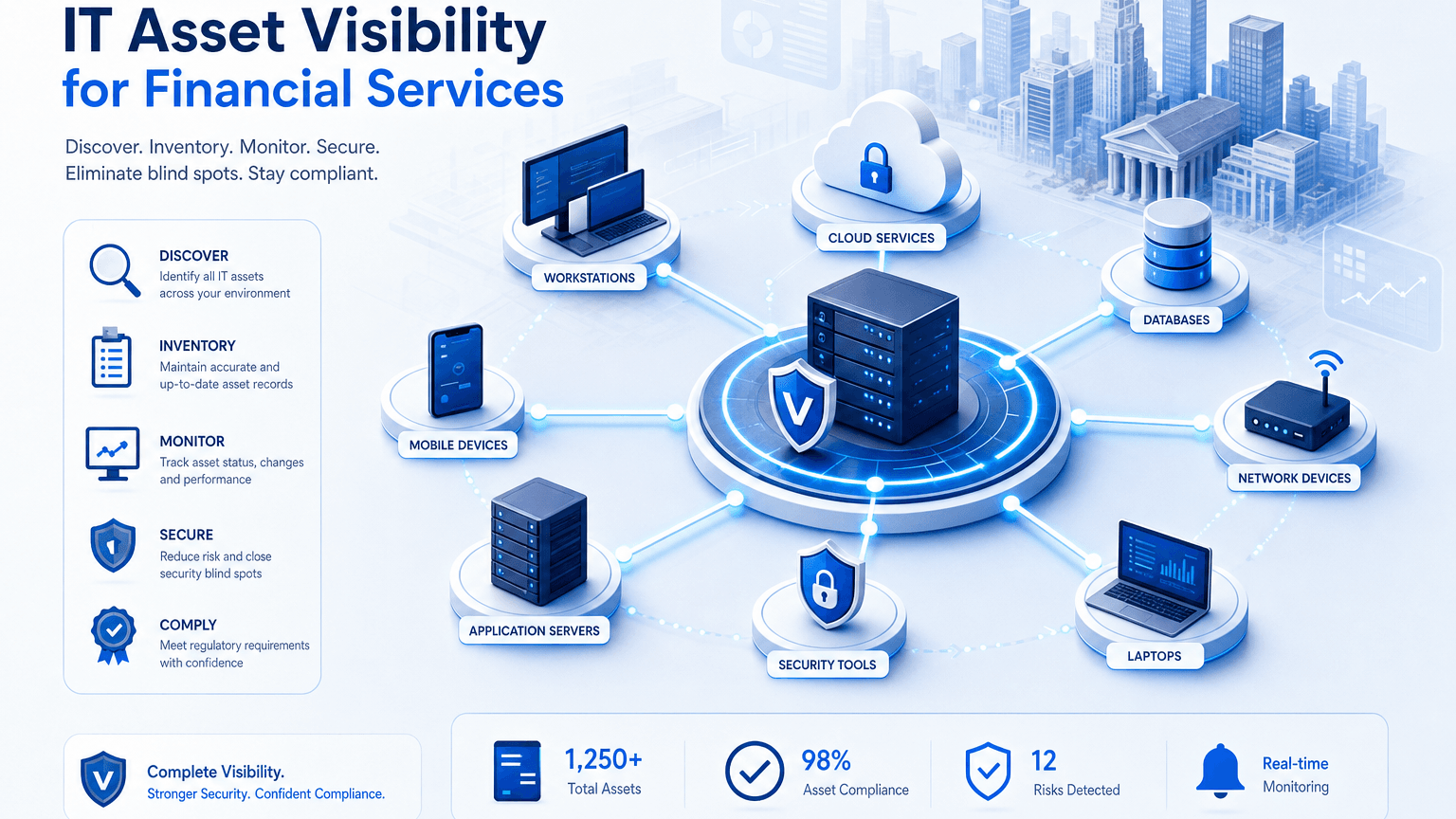
IT asset visibility for financial services is the ability to identify, inventory, and monitor every in-scope asset across branches, data centers, cloud accounts, and SaaS, with ownership and relationships attached so SecOps, CMDB, and compliance teams share one current picture.
Why asset visibility matters for cybersecurity teams
Financial services remains an expensive industry for breaches. Summaries of IBM’s Cost of a Data Breach research for the 2025 study cycle put average financial-services breach cost near $5.56 million, second only to healthcare in that industry ranking. U.S. organizations also face higher regulatory fines and detection costs than the global average. For firms operating under NYDFS, PCI DSS, and SOX at once, incomplete inventory multiplies both response cost and NYDFS compliance friction. Virima’s guide on NYDFS and PCI DSS CMDB requirements covers how these overlapping frameworks translate into inventory obligations in more depth. That same inventory discipline is what cybersecurity asset visibility NYC financial firms rely on during exams and incidents alike.
Regulatory and control frameworks that expect inventory discipline include:
- NYDFS Cybersecurity Regulation (23 NYCRR Part 500), Section 500.13: Covered entities maintain a written asset-inventory policy covering update frequency, and track each asset’s owner, location, classification, support-expiration date, and recovery time objective — a requirement in force since November 1, 2025. The Department publishes the regulation and related guidance on dfs.ny.gov.
- PCI DSS: Maintain an accurate inventory of system components in scope for cardholder data environments, per the PCI Security Standards Council.
- SOX IT control programs: Management assertions on system documentation and change control assume a complete population of relevant systems.
- ISO/IEC 27001 asset themes: Identify information assets relevant to the information security management system.
What does NYDFS Section 500.13 require for asset inventory?
NYDFS Section 500.13 requires covered entities to maintain a written asset-inventory policy covering update frequency and to track each asset’s owner, location, classification, support-expiration date, and recovery time objective. The requirement has been in force since November 1, 2025. Discovery-fed CMDB records are what keep that inventory current between validation cycles.
Four visibility failure modes
- Unmanaged or shadow IT assets. Developers and front-office teams deploy SaaS tools, third-party APIs, and data export utilities without security review. Those instances can hold client identifiers, credentials, or transaction context outside approved logging.
Result: SecOps cannot monitor what it cannot list; audit samples surface unapproved systems handling sensitive data. Virima’s breakdown of unowned IT assets and audit risk walks through how that gap compounds between audit cycles. - Incomplete network inventory. Mergers, cloud migrations, and contractor segments leave endpoints and servers outside the scanner and CMDB scope.
Result: Vulnerability coverage stops at the known list; compromised hosts in the blind spot delay detection and containment. - Stale CMDB between discovery cycles. Configuration changes land daily while the register still reflects last quarter’s cleanup.
Result: Incident bridges chase phantom hosts; change reviews approve work against outdated dependents. - Siloed asset data. Security runs a scanner inventory, IT runs the CMDB, and procurement tracks licenses in another system.
Result: Reconciliation takes weeks; the compliance officer cannot validate one complete inventory narrative.
Enterprise teams that treat visibility as a once-a-year project keep rediscovering the same gaps under exam pressure. Benchmarking where your own program stands against these four modes is the first step — Why your business needs asset inventory software walks through a scored self-assessment against Section 500.13 before your next exam cycle.
Why does IT asset visibility matter for NYDFS and financial SecOps teams?
NYDFS and related control frameworks expect covered entities to know what systems are in scope. Without reconciled inventory, SecOps triage slows, vulnerability coverage thins, and exam evidence becomes a reconstruction project instead of an export.
The real cost of asset visibility gaps
For SecOps leaders
Visibility gaps push SecOps into reactive mode. SIEM alerts arrive without device type, owner, criticality, or last-verified context, so analysts spend the first block of every ticket reconstructing whether the host is production, test, or unknown. When a compromise is confirmed, teams still rebuild dependency and data-path context by hand before isolation is safe. Vulnerability programs only scan what is listed; blind-spot assets never enter the patch queue.
Establishing trusted runtime truth across the estate is how those alerts stop arriving as orphan IPs.
For CMDB owners
CMDB owners carry accuracy accountability without enough automation. Manual reconciliation often consumes a large weekly block to keep CI records from drifting after each scan or migration wave. When compliance asks whether the CMDB matched reality in a prior quarter, “we scanned in July” is not the same as a defensible, dated inventory. Each discovery pass can surface hundreds of new, changed, or retired items; classification and relationship work then stacks into multi-week backlogs that reporting and auditing programs still have to explain.
For regulated New York environments
Banks, insurers, investment firms, and payment processors in New York operate under overlapping frameworks. A single system may need to appear the same way across NYDFS program evidence, PCI scope lists, and SOX ITGC populations.
When examiners request inventory, teams often stitch ServiceNow exports, live network scans, procurement spreadsheets, and cloud console lists. Misalignment becomes an “inventory accuracy” finding with multi-month remediation, not a one-week cleanup. Change management suffers the same fracture when tickets cannot show cross-system dependencies before a production window.
How IT asset discovery and mapping fix this
Closing visibility gaps means moving from point-in-time spreadsheets to discovery-driven configuration and dependency context. Three mechanisms map to verified platform capabilities.
- High-frequency scheduled discovery closes inventory gaps. Agent-based and agentless discovery covers on-premises servers, network devices, endpoints, and cloud instances on AWS and Azure on configurable schedules rather than annual cleanups. New and retired assets should appear within days, not at the next audit scramble. IT asset discovery for financial services teams can defend starts with that scheduled coverage, not a once-a-year sweep. For SecOps, refreshed inventory is what enriches triage with device class, owner, and criticality. For CMDB owners, scheduled discovery reduces the manual merge ritual that keeps accuracy stuck. See how IT discovery supports that estate-wide cadence.
- ViVID™ service maps reveal hidden dependencies. Asset lists answer what exists. Service maps answer how things connect once teams supply service definitions manually, by spreadsheet, or through architecture tools. After those definitions exist, ViVID™ builds application-to-infrastructure dependency maps that update as infrastructure under those services refreshes from discovery. SecOps uses that map for blast-radius questions during containment. Compliance teams use it when examiners ask what fails if a given system is compromised. Service mapping is the mechanism behind that relationship view.
- Integration with existing workflows. Visibility only helps if data lands where change, incident, and configuration work already happens. Through the integrations hub, Virima exchanges verified runtime data with platforms many financial estates already run, including ServiceNow, Jira Service Management, and Ivanti. Discovered assets and relationships can enrich tickets and CMDB records so multi-tool estates stop carrying three conflicting truths. Partner names stay plain text; the hub is the single integration destination.
| Process step | Manual approach | Discovery-driven visibility |
|---|---|---|
| Asset inventory | Spreadsheets plus occasional scans; accuracy drifts between cycles | High-frequency scheduled discovery under one estate policy |
| Shadow IT detection | Often found during audit or after an incident | New hosts and cloud resources surface on the next discovery cycle for review |
| CMDB reconciliation | Owners hand-merge conflicts after each pass | Conflicts surface; attributes resolve toward designated authoritative sources in the CMDB |
| Incident response | Context lookup per alert burns minutes that stack into hours | Owner, criticality, and dependents are already attached for triage |
| Compliance reporting | Evidence reconstructed under exam pressure | Exports carry last-verified inventory and relationship context |
Scope boundary (product-accurate): Discovery and CMDB work cover infrastructure CIs, relationships, ownership, and change context. They do not replace dedicated vulnerability scanners, DLP, or network segmentation controls. They give those controls a complete, current population to act on.
How does discovery-driven IT asset visibility help financial cybersecurity teams?
Scheduled discovery keeps inventory current across sites and cloud accounts. Service maps show blast radius after service definitions are supplied. Integrations push that context into ITSM and security workflows, so alerts and changes stop relying on spreadsheet reconstruction.
IT asset visibility for financial services in New York: practice patterns
These patterns reflect common large-estate operating rhythms. They are not named customer case studies.
M&A integration and the invisible subsidiary. A New York investment bank acquires a regional wealth firm. Network ranges expand overnight while documentation does not. Without discovery, security learns about unpatched servers months later during a scan nobody scoped correctly. With discovery configured for the inherited ranges, assets are cataloged within early discovery cycles; risk classification and ownership assignment can start while service definitions are collected for mapping; compliance can then test whether inherited systems appear in the same inventory narrative as the parent estate.
Shadow SaaS in the front office. Traders and relationship managers adopt third-party data and analytics tools that store client context. Without visibility, those tools never enter security configuration or logging standards. With discovery-fed inventory and CMDB process, new resources and installs surface for review; approved tools gain owners and criticality; unapproved use becomes a control conversation instead of an exam surprise.
Lateral movement containment. A phishing compromise on a branch workstation should not require a multi-day archaeology project before isolation. When asset context and service maps are present, SecOps sees owner, site, and downstream systems sooner and shortens the path from alert to containment. Dwell time is still an attacker and process problem; missing inventory makes it worse.
How Virima supports IT asset visibility for financial services
Virima does not replace your ITSM platform, SIEM, or vulnerability scanner, and it does not certify your NYDFS program. It supplies discovery-sourced inventory, configuration history, and dependency context that financial estates use inside their own security, change, and assessment workflows. Teams evaluating Cybersecurity Asset Management (CSAM) style programs still need that inventory and relationship layer underneath scanner and SOAR tooling.
Immediate operational impact
Discovery reach covers facilities and cloud accounts in scope, not only the best-documented campus. Agentless scanning for on-premises infrastructure, cloud API integrations for AWS and Azure, and optional agents for deeper endpoint detail feed one reconciled CMDB. SecOps queries by site, criticality, and owner instead of opening three spreadsheets when the bridge starts. CMDB owners spend more time validating exceptions and less time re-keying host lists.
Long-term accuracy and compliance readiness
Compliance programs need inventory that is complete enough for scope, accurate enough for current state, auditable enough for change history, and fresh enough for operational decisions. High-frequency scheduled discovery keeps the register from aging into a quarterly archaeology project. When an examiner asks for inventory, the goal is a timestamped export with ownership and last-verified context, not a reconstructed slide deck.
Integration with existing workflows
Through the integrations hub, Virima exchanges verified runtime data with ServiceNow, Jira Service Management, Ivanti, and related platforms. Ticket and CMDB workflows keep their home console while discovery-sourced records reduce silent last-write conflicts. Security stacks still own detection content; they gain a cleaner asset population and relationship context to enrich against.
Moving from blind spots to complete visibility
- Operational efficiency. CMDB owners redirect hours from manual merge work toward validation, risk classification, and cleaner change support. SecOps recovers triage time when alerts stop arriving as bare IPs.
- Regulatory defense. Exam packages can include categorized inventory, ownership, and dated configuration context instead of conflicting source dumps. Findings tied to inventory accuracy become harder to sustain when the export matches live discovery.
- Security posture. Scanners and controls cover a higher share of real infrastructure. Shadow IT enters a review path earlier. Service maps reduce change surprises. SIEM and ITSM workflows gain asset context without replacing the security stack.
Getting started
- Baseline current sources. List CMDB, network scans, cloud consoles, MDM, and license tools. Note where they disagree.
- Define discovery scope. Prioritize high-criticality and high-sensitivity systems across on-premises and AWS/Azure accounts first.
- Configure scheduled discovery. Set credentials and cadence (many financial teams start weekly on core ranges, then tighten).
- Supply service definitions and map dependencies. Provide service composition, then let ViVID™ build maps from discovery-backed infrastructure.
- Integrate and operationalize. Sync into ITSM workflows; define how new assets enter security review and how exports support exam requests.
Maturity is a multi-quarter journey. Better inventory reduces triage and audit friction. It does not erase every control gap on its own.
Build inventory that SecOps and examiners can both defend
New York financial services estates already run dense branch, core, cloud, and SaaS footprints. Spreadsheet compliance creates the appearance of control until a phishing ticket, an M&A integration, or an NYDFS sample exposes the gap. Operators who anchor IT asset visibility for financial services in discovery-sourced records walk into those moments with ownership, site context, and dependency maps already attached.
Cross-estate visibility is the foundation. Faster triage, cleaner change, and defensible exam evidence are the outcomes.
Frequently Asked Questions
What makes Virima discovery different from a vulnerability network scanner?
Vulnerability scanners find weaknesses on hosts they can reach. Virima discovers what assets exist, who owns them, and how they connect after service definitions exist, then feeds that inventory into CMDB and ITSM workflows that scanners and SIEM tools still use.
How does asset visibility support NYDFS compliance work?
23 NYCRR Part 500, Section 500.13 requires covered entities to maintain a written asset-inventory policy: tracking each asset’s owner, location, classification, support-expiration date, and recovery time objective, a requirement in force since November 1, 2025. Discovery-fed CMDB records give compliance teams timestamped inventory and ownership evidence instead of spreadsheet reconstruction under exam pressure.
Can Virima discover assets in AWS and Azure environments?
Yes. Virima uses cloud APIs and related discovery methods to inventory cloud resources on AWS and Azure on the same high-frequency scheduled model used for on-premises ranges, then reconciles those CIs into the CMDB.
What is the difference between IT asset management and asset visibility?
Asset visibility answers what exists, where it runs, and how it connects. ITAM adds lifecycle, entitlement, and financial control on top of that inventory. Large estates need both reconciled; see Virima’s guide on CMDB versus ITAM differences.
How long until teams see value from discovery-led visibility?
First discovery cycles typically surface unknown hosts and cloud resources within days once credentials and ranges are set. Deeper service mapping and ITSM operationalization usually mature over several weeks as service definitions and ownership processes catch up.