Agentic IT for CTOs: Strategy, Architecture Gates, and Team Design Before Autonomy

Boardrooms are pushing CTOs to demonstrate autonomous IT capabilities. AI vendors promise self-healing infrastructure, instant incident remediation, and automated change execution. The potential return on investment is substantial, but Gartner predicts over 40% of agentic AI projects will be canceled by the end of 2027 due to escalating costs, unclear business value, and inadequate risk controls.
When agentic initiatives fail, the breakdown rarely stems from the intelligence of the underlying large language model. It happens because enterprise leaders treat agentic IT as a tool rollout rather than a core architecture decision. Treating autonomous execution as a software feature skips three foundational executive responsibilities: portfolio strategy, architecture review board (ARB) promotion gates, and team ownership structure.
Technology Strategy: AI Agents Are a Portfolio Decision, Not a Tool Install
Autonomous execution fundamentally changes where operational decisions occur. Deploying an AI agent inside an IT service desk, an observability platform, or a CI/CD pipeline creates an autonomous actor capable of making infrastructure modifications. Without a macro technology strategy, enterprise environments quickly accumulate fragmented islands of intelligence.
+-----------------------------------------------------------------------+
|                       SYSTEMS OF ENGAGEMENT                           |
|       (ITSM Portals, ChatOps, Developer Workspaces, Ticketing)        |
+-----------------------------------------------------------------------+
                                   |
                                   v
+-----------------------------------------------------------------------+
|                        SYSTEMS OF ACTION                              |
|   (Security Agents, Remediation Scripts, Cloud Auto-Scalers, Orchestration)|
+-----------------------------------------------------------------------+
                                   |
                                   v
+-----------------------------------------------------------------------+
|                      SHARED CONTEXT PLANE                             |
|   (Discovery-Sourced Estate Context, Dependency Maps, Ownership, Policy) |
+-----------------------------------------------------------------------+
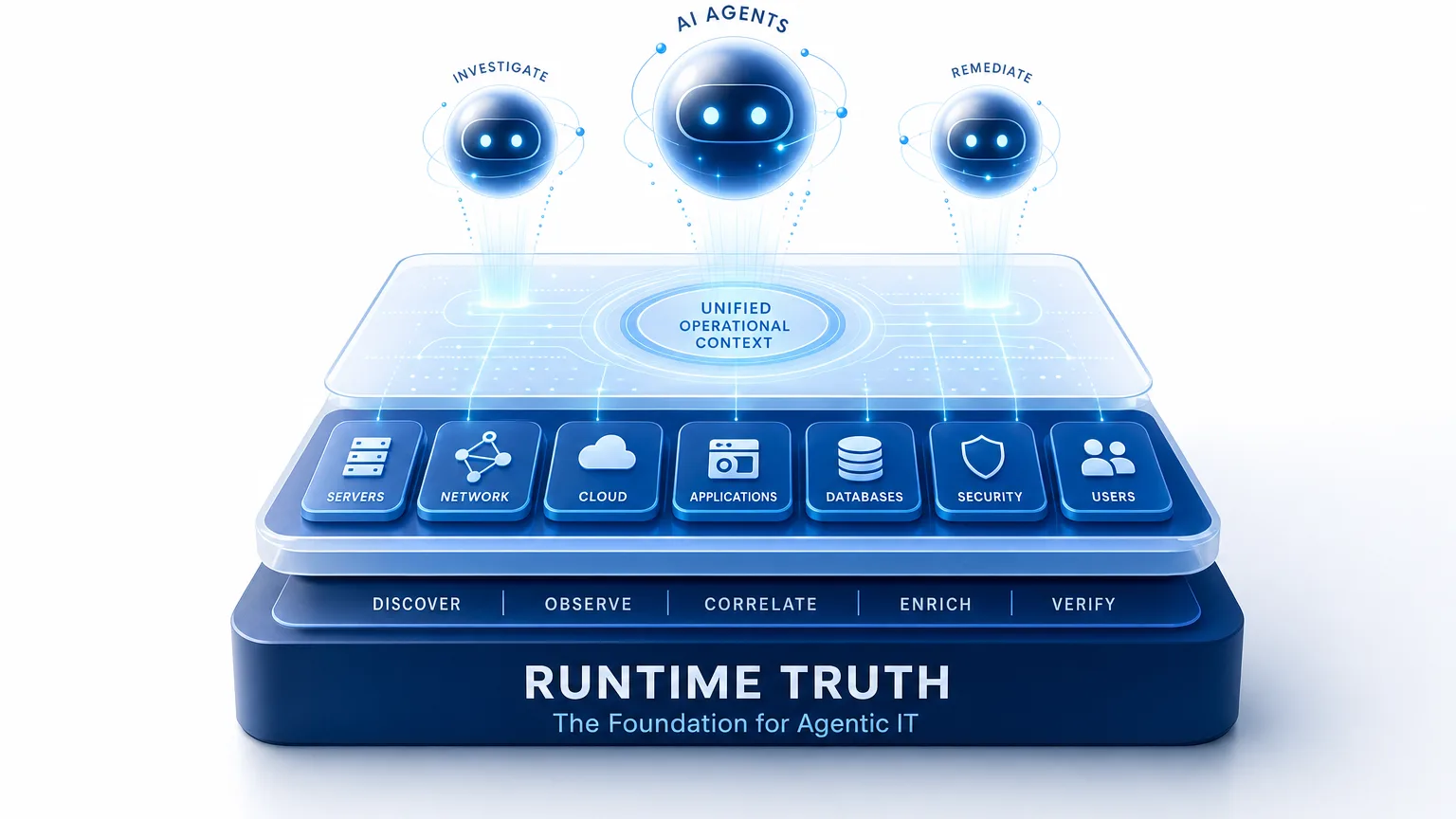
A coherent agentic strategy separates your operational technology into three distinct architectural layers:
- Systems of Engagement: The interfaces where humans and systems log requests, review proposals, and inspect audit records.
- Systems of Action: The specialized agents and automation frameworks that execute changes, run scripts, and alter infrastructure states.
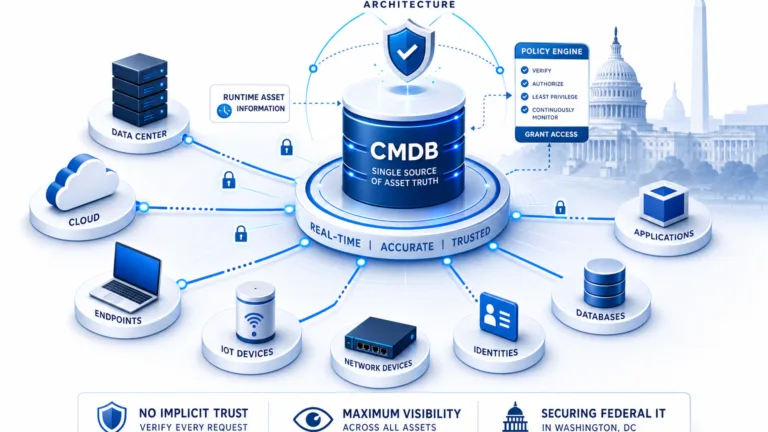
- The Shared Context Plane: The authoritative underlying environment data that informs both engagement tools and action engines about what exists, how components connect, and who owns the affected assets.
When CTOs allow individual vendor platforms to bring their own isolated context models, agent actions diverge. An observability agent might attempt to restart a database host based on memory telemetry, completely unaware that an ITSM agent is currently running a scheduled maintenance script on the same cluster.
Research from BCG indicates that successful enterprise AI scaling requires allocating 70% of effort to organizational change and talent, 20% to data and technology infrastructure, and only 10% to algorithmic models. For a CTO, treating agentic IT as a portfolio decision means funding the shared context plane as core enterprise infrastructure alongside identity access management and API gateways.
Why do CTO-led agentic IT initiatives stall after successful pilots?
Pilots prove that an AI agent can execute a specific script in a controlled sandbox. Enterprise scale requires multi-agent portfolio rules, formal ARB promotion criteria, and an organizational team with explicit authority over estate context. Initiatives stall when leadership funds tool pilots without establishing the underlying architecture gates.
Architecture Readiness: Autonomy Tiers Belong in the ARB, Not Just the Agent Console
Most enterprise Architecture Review Boards maintain strict gates for security posture, API contracts, and performance scalability. Very few have established explicit gates for operational data confidence before granting autonomous execution rights to AI agents.
Gartner defines four distinct tiers of operational autonomy: Observe, Advise, Act with Approval, and Act Autonomously. Promoting an agent from Advise to Act Autonomously is an architectural policy decision that demands formal governance.
               [ TIER 4: ACT AUTONOMOUSLY ]
                Requires: Certified ownership,
                real-time dependency mapping,
                verified blast-radius boundary.
                            ^
                            | (ARB Gate Promotion)
               [ TIER 3: ACT WITH APPROVAL ]
                Requires: Named owner routing,
                fresh relationship history,
                human approval workflow.
                            ^
                            | (ARB Gate Promotion)
               [ TIER 2: ADVISE ]
                Requires: Basic inventory identity,
                monitored execution paths.
                            ^
                            | (ARB Gate Promotion)
               [ TIER 1: OBSERVE ]
                Requires: Read-only estate access.
An enterprise ARB should evaluate four mandatory criteria before promoting an agentic workflow to a higher tier:
- Identity Verification: Does the targeted asset maintain an immutable identifier across cloud environments, container rebuilds, and physical renames?
- Dependency and Blast-Radius Mapping: Can the system trace the full upstream and downstream impact paths before a change executes?
- Accountability Routing: Are named owners and support teams mapped directly to the targeted components, guaranteeing clear escalation paths if an automated action fails?
- Currency and Freshness SLAs: Is the underlying operational data updated frequently enough to match the environment’s velocity of change?
If an enterprise infrastructure asset cannot satisfy these four criteria, the ARB must cap the agent at Observe or Advise modes. GRC and risk leaders require these exact evidence standards to verify that automated changes operate within defined regulatory boundaries. Teams looking for detailed technical specifications on operational data requirements can explore CMDB for AI agents as a practitioner companion.
What governance controls should a CTO establish before enabling autonomous IT actions?
A CTO must establish ARB promotion criteria that mandate verified asset identity, mapped service dependencies, assigned component ownership, and data freshness thresholds. These criteria act as architectural gates, automatically restricting agents to human-approval modes whenever operational data confidence drops below required levels.
Team Structure: Estate Truth Needs a Platform Owner, Not Three Competing Mandates
A primary reason agentic IT deployments break down in production is organizational misalignment. In most enterprise IT organizations, responsibility for operational data is split across three distinct teams, each operating under a different mandate:
| Team | Primary Focus | Operational Blindspot |
|---|---|---|
| Platform Engineering | Agent runtimes, LLM integration, and developer velocity | Treats asset inventory and dependency mapping as secondary administrative overhead. |
| CMDB & Config Teams | Data hygiene, reporting accuracy, and configuration management | Operates inside ITSM toolchains, often lacking budget authority or real-time infrastructure access. |
| Change Advisory Board (CAB) | Risk mitigation, scheduling compliance, and maintenance windows | Relies on self-reported change tickets and manual attestations rather than live environment state. |
When these three groups operate independently, AI agents inherit incomplete environment data. A survey from Deloitte reveals that 48% of organizations cite data searchability and 47% cite data reusability as major obstacles to achieving operational automation.
To resolve this split, the CTO must establish explicit organizational ownership. Responsibility for maintaining discovery-sourced operational context should belong to a dedicated platform team with standing equal to identity or API gateway teams. Placing data context authority inside a traditional ITSM support silo forces operational accuracy to compete against daily ticket-routing priorities.
A 90-Day CTO Operating Model for Agentic IT
CTOs do not need to pause ongoing agent pilots to build an effective operational foundation. Instead, leadership should sequence capabilities through a structured 90-day execution framework that earns autonomy incrementally:
Days 1-30: Portfolio Audit and Policy Baseline
- Audit all active AI agent pilots, ChatOps bots, and automated remediation scripts across IT departments.
- Establish a mandatory policy capping all active agents at Advise or Act with Approval status.
- Assign executive ownership of the shared context plane to a designated platform architecture team.
- Draft formal ARB entry and exit criteria for autonomous execution promotions.
Days 31-60: RACI Alignment and Context Standardization
- Define explicit RACI boundaries between Platform Engineering, SRE, Configuration Management, and GRC teams.
- Establish automated discovery mechanisms for the specific infrastructure domains targeted by early agent pilots.
- Validate asset identity accuracy, ownership coverage, and service dependency mapping against live production environments.
- Establish automated evidence generation for compliance and audit review.
Days 61-90: ARB Promotion and Operational Scorecards
- Conduct formal ARB reviews for initial agent workflows, promoting qualified workloads to higher autonomy tiers based on context confidence.
- Implement automated guardrails that demote agent permissions if underlying asset data freshness degrades.
- Track executive operational metrics: automated change rollback rates, cascade incident frequencies, and mean time to explain (MTTE) autonomous actions.
- Institutionalize a permanent platform line item to fund discovery-sourced estate visibility.
CTOs seeking a tactical roadmap for data readiness can review the AI-ready CMDB checklist to support their platform teams during Phase 2 execution.
Which team should own environment context in an agentic IT organization?
Environment context should be owned by a dedicated platform engineering team with enterprise-wide authority equivalent to identity or network architecture teams. Assigning context ownership solely to ITSM or CMDB administrators creates roadmap conflicts that compromise data freshness and lead to automated execution failures.
Where a Shared Context Layer Fits the Architecture
To enforce ARB gates and prevent multi-agent conflicts, enterprise architectures require a shared, discovery-sourced operational context plane.
+-----------------------------------------------------------------------+
|                            VIRIMA PLATFORM                            |
|                                                                       |
|  +-----------------------+  +-------------------+  +---------------+  |
|  | Multi-Method Discovery|  | ViVID Service Maps|  | Confidence    |  |
|  | (Agent, Agentless, API|  | (Dependencies &   |  |  Scoring      |  |
|  |  for AWS/Azure/On-Prem|  |  Blast Radius)    |  |  Scoring      |  |
|  +-----------------------+  +-------------------+  +---------------+  |
+-----------------------------------------------------------------------+
                                   |
                 (Unified Operational Context Plane)
                                   |
       +---------------------------+---------------------------+
       |                           |                           |
       v                           v                           v
+--------------+           +--------------+           +----------------+
| ServiceNow   |           | Jira Service |           | Ivanti / Other |
| Workflows    |           | Management   |           | ITSM Platforms |
+--------------+           +--------------+           +----------------+
Virima fulfills this architectural role by delivering Trusted Runtime Truth: live, explainable, discovery-sourced operational context that any system of action or engagement platform can consume.
Through multi-method IT discovery covering cloud environments like AWS and Azure alongside hybrid infrastructure, Virima populates a discovery-sourced CMDB with verified asset identities, dependencies, and health indicators. Once core application boundaries are defined, ViVID™ service mapping maps complex multi-tier dependencies, supplying the blast-radius context required by ARB promotion policy.
Virima integrates directly with ServiceNow, Jira, Ivanti, and other enterprise platforms. Rather than replacing existing ITSM investments, Virima acts as an authoritative context engine that prevents AI agents from executing actions based on stale or inaccurate inventory records.
For broader industry data tracking autonomous adoption trends, review our research on agentic AI in IT operations statistics and trends.
The CTO Scoreboard for Agentic Success
The technology leaders who successfully scale agentic IT will not be those who deploy agent platforms the fastest. Success belongs to CTOs who establish the governance frameworks, organizational structures, and shared context architectures necessary to make autonomous operations safe.
An effective CTO scoreboard tracks four primary indicators:
- Documented Autonomy Policy: Clear, enforceable ARB criteria governing tier promotions for every AI agent in production.
- Dedicated Platform Ownership: A funded platform team accountable for maintaining environment context as shared infrastructure.
- Active Demotion Mechanics: Demonstrated capability to automatically step agents back to human-approval modes when environment data drops below confidence thresholds.
- Risk-Indexed Reporting: Board-level visibility focused on cascade prevention, operational resilience, and verifiable automation safety.
To see how discovery-sourced dependency mapping and blast-radius visibility support enterprise autonomy gates, explore Trusted Runtime Truth or request a demo focused on your critical service paths.
Frequently Asked Questions
How should a CTO structure the agent platform portfolio against existing ITSM systems?
CTOs should maintain ITSM systems as primary platforms of engagement for human workflows, while positioning agent frameworks as specialized platforms of action. Both layers must consume operational data from a shared context plane rather than relying on isolated vendor inventory models.
Must an enterprise pause AI agent pilots while updating its CMDB architecture?
No. Organizations can continue running agent pilots in Observe or Advise modes within isolated domains. However, leadership must block promotions to fully autonomous execution until the underlying infrastructure meets ARB data freshness and relationship criteria.
What questions should a CTO ask AI agent vendors during evaluation?
Ask how the agent platform ingests external discovery and service mapping data, how it validates asset identity before taking action, and how it behaves when underlying operational data confidence drops mid-execution. Vendor evaluation should focus on policy integration capabilities rather than isolated algorithm performance.
What is the difference between agentic IT adoption and agentic IT readiness?
Adoption means installing AI agent software within an IT environment. Readiness means establishing the portfolio strategy, ARB governance gates, team ownership structures, and discovery-sourced data context necessary to execute autonomous actions without risk of cascade failures.
What operational data metrics should be reported to the board regarding agentic IT?
Board reporting should highlight the percentage of IT infrastructure operating under verified discovery, the proportion of agents bound by formal ARB autonomy gates, automated change rollback rates, and MTTE metrics for autonomous operational events.