IT Asset Visibility for Phoenix Semiconductor Manufacturers, Before the Next Outage

On August 17, 2024, Microchip Technology detected suspicious activity on its IT systems at a company headquartered on West Chandler Boulevard in the Phoenix semiconductor corridor. Two days later, leadership determined that an unauthorized party had disrupted certain servers and business operations. The company isolated affected systems, shut down others, and brought in external cybersecurity advisors. Manufacturing facilities ran below normal capacity, and order fulfillment slowed while teams restored systems. That sequence comes from the Form 8-K language the company filed with the SEC and from contemporaneous reporting that quotes that filing directly (Security Affairs).
The geography matters as much as the filing. Microchip sits minutes from Intel’s Ocotillo campus in Chandler, from TSMC’s Arizona fab buildout, and from packaging and materials neighbors such as Amkor. Greater Phoenix is already one of the densest semiconductor employment markets in the United States. When a local IDM loses server capacity and production cadence in the same week, every IT and security leader in the corridor faces the same question: which systems, vendor remote sessions, and floor-adjacent hosts would you prove you still owned if the next disruption started tonight?
IT asset visibility for Phoenix semiconductor manufacturers answers that question with a current inventory, ownership, and dependency map. The sections below cover what belongs in the fab record, why the floor stays hard to see, what recent incidents already showed, and how a discovery-sourced CMDB and dependency layer close the gap between the last audit and the next incident.
What Counts as an Asset Inside a Phoenix Fab
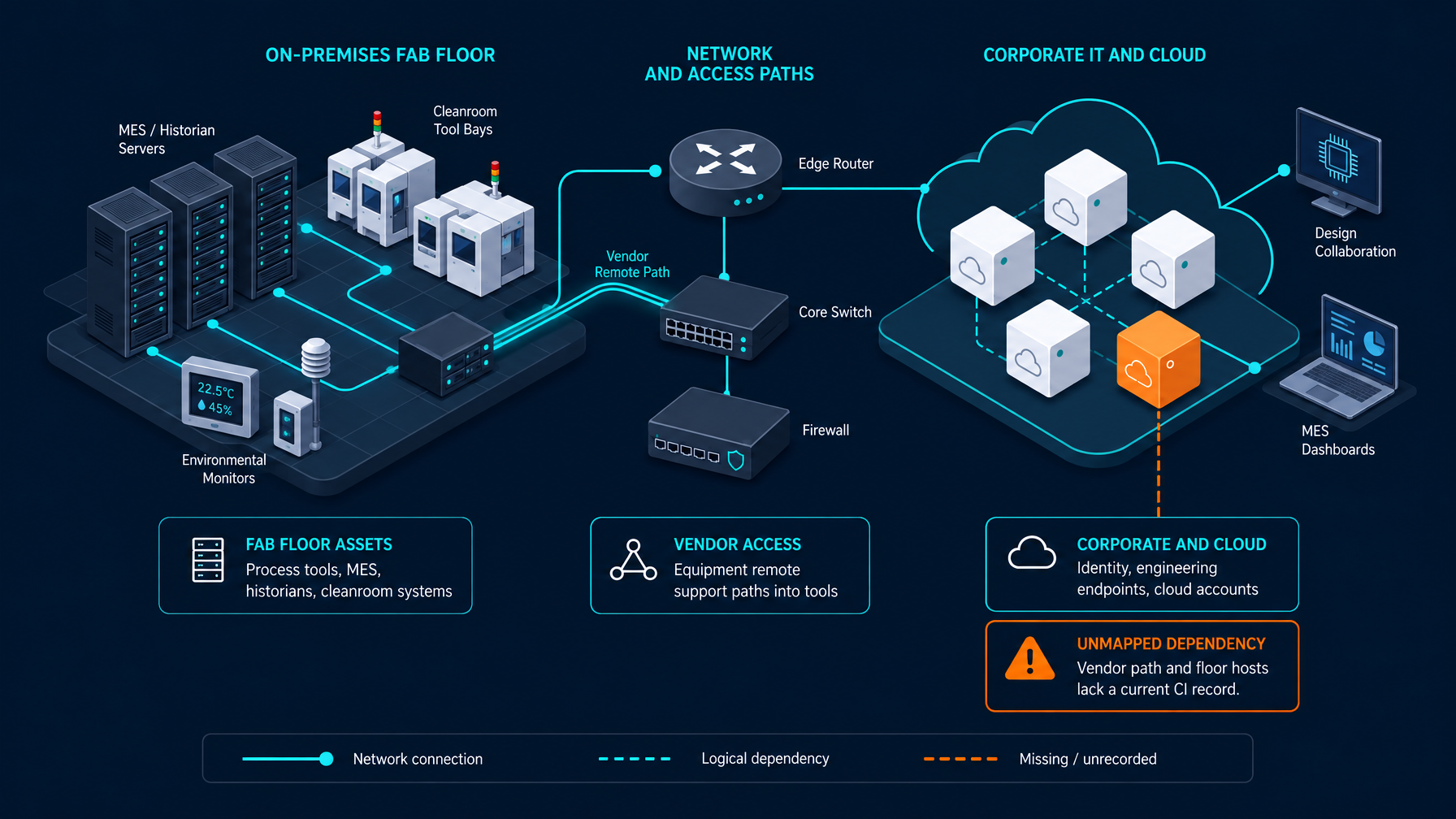
A fab’s asset scope is wider than the corporate laptop fleet and the data center rack list. In practice, the inventory boundary usually includes:
- Engineering workstations tied to process and EDA tools
- Manufacturing execution systems and historian servers
- Environmental and cleanroom monitoring systems
- Recipe and recipe-management systems
- Equipment-vendor remote access links that reach tools on the floor
- Corporate IT, identity systems, and cloud accounts for design collaboration, MES dashboards, and supplier portals
Those cloud and identity layers sit on the same risk surface even when they live outside the cleanroom.
CISA’s Critical Manufacturing Sector is one of the sixteen official U.S. critical infrastructure sectors. The sector’s core industries include electrical equipment, appliance, and component manufacturing, the category that holds semiconductor fabrication and related component production. Disruption in those plants can cascade into energy, transportation, defense, and other sectors that depend on finished components and capital equipment. That designation is why inventory gaps on a Phoenix fab floor are treated as critical-infrastructure exposure alongside day-to-day IT hygiene.
The local density raises the stakes. Greater Phoenix Economic Council positions the metro as the fourth-largest U.S. market for semiconductor manufacturing employment, with more than 30,000 semiconductor and electronic-component manufacturing jobs in the region and a long-running cluster that includes:
- Intel and TSMC production and buildout sites
- onsemi, Microchip Technology, Amkor Technology, and ASM America
- Shared equipment vendors, talent pools, and logistics corridors across the metro
A visibility failure at one site can look familiar at the next site down the freeway.
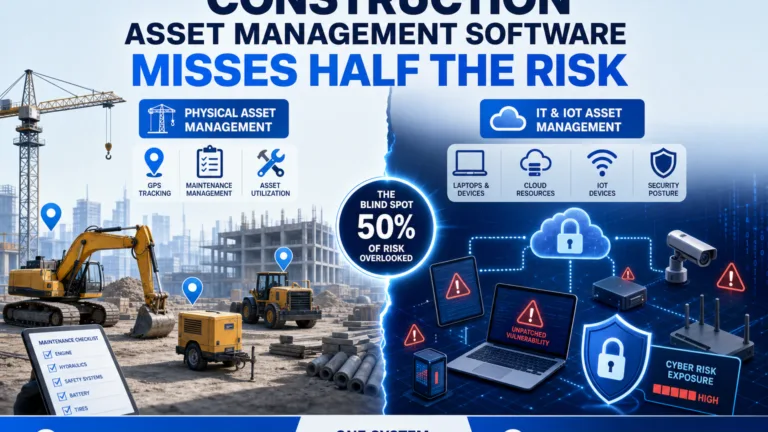
For the general mechanics of converged plant environments, Virima’s guide on manufacturing IT asset management and IT/OT convergence covers how plant-floor and enterprise systems share risk. This article stays on the Phoenix semiconductor pattern: process tools that resist casual scanning, vendor remote paths that cross the IT/OT boundary, and a metro where several large fabs and suppliers operate within the same few miles.
Why the Fab Floor Doesn’t Show Up the Way Corporate IT Does
Corporate IT discovery usually assumes managed endpoints, standard OS images, credentialed scans, and change windows that tolerate agent install or SNMP walks. A semiconductor floor breaks several of those assumptions at once:
- Process tools often speak proprietary protocols and sit behind equipment-vendor support contracts that limit who may touch the box
- A patch or configuration change can force recipe revalidation, so security teams cannot treat tool firmware like a Windows server build
- Historian and MES hosts may sit on segmented networks that corporate scanners never fully reach
- Cleanroom equipment may appear only as a vendor-managed appliance with sparse asset tags and incomplete ownership fields in the CMDB
The sharpest structural exposure is equipment-vendor remote access. Support engineers need a path into tools for diagnostics, firmware updates, and yield recovery. That path is legitimate and often required by the commercial relationship. It also creates a dependency that lives outside the fab’s day-to-day identity and asset inventory. When the vendor’s own environment is disrupted, the fab can feel the impact without a single attacker landing on the fab’s corporate domain first.
That pattern already has a named industry example. In 2023, a ransomware incident at equipment supplier MKS Instruments disrupted supplier operations and cascaded into an estimated $250 million impact on Applied Materials, as summarized in industry analysis of semiconductor supply-chain cyber risk (Kiteworks). Phoenix fabs buy from overlapping tool and materials vendors. The lesson is structural:
- Third-party access becomes first-party production risk when the dependency is real
- Third-party outage becomes first-party financial risk when the asset record is thin
- Dependency mapping is how teams answer what a vendor session or floor host actually touches before the next change or incident
Virima’s service mapping capability is built for that relationship view once service definitions are in place and discovery has populated the underlying infrastructure.

One Blind Spot, Many Entry Points
Critical manufacturing draws sustained attacker attention. Industrial and OT research coverage through 2025 repeatedly places manufacturing near the top of sectors absorbing ransomware pressure and high-severity ICS advisories, with visibility gaps cited as a recurring reason response teams lose time during triage. The operational point for a Phoenix fab is simpler than any single headline number: you cannot prioritize patching, segmenting, or isolating what the inventory still treats as unknown.
Entry points multiply when IT and OT share paths:
- A compromised engineering laptop can reach design data and, through mis-segmented routes, floor-adjacent systems
- A vendor VPN session can land on a tool network that was never fully inventoried
- A cloud-hosted MES connector can fail open while the on-prem historian still holds the last trusted process values
Each path looks like a different ticket queue until the dependency map shows they share the same CI chain.
Asset visibility is the common control under those paths. Cybersecurity IT asset visibility and CMDB practice frames the same foundation for security programs that need authoritative inventory before vulnerability and incident workflows can stay honest. On a fab, that foundation has to cover:
- Corporate IT and identity systems
- Cloud accounts that support production and design work
- OT-adjacent hosts that production actually depends on
CISA’s Binding Operational Directive 23-01 made the same priority explicit for federal civilian networks: improve asset visibility and vulnerability detection as a standing program. Private-sector fabs sit outside that directive’s legal scope, and the operating logic still transfers. Production risk rises when leadership cannot list the systems that keep a line running.
The Gap Between the Last Audit and the Next Incident
Fab environments change on a weekly cadence during ramp-up, tool install, and yield recovery:
- New process tools arrive with vendor-managed firmware
- MES and historian versions move during planned downtime
- Engineering workstations turn over with contractor and shift patterns
- Cloud connectors for design collaboration and supplier portals appear faster than annual inventory cycles can absorb
Point-in-time spreadsheet audits freeze a picture that is already aging by the time the workbook is approved. Common drift patterns include:
- Ownership fields that drift when people change roles
- Decommissioned hosts that linger as “maybe still live” rows
- Vendor remote endpoints that appear as generic VPN objects without a clear map to the tools they support
The next incident then starts with reconciliation work that should have been finished before the war room opened.
Industry pressure on manufacturing makes that lag expensive. Manufacturing absorbed a large share of global ransomware activity in 2025 according to security industry reporting summarized for industrial operators, and industrial-focused firms tracked a sharp rise in ransomware groups targeting industrial organizations year over year (The Record / Recorded Future News). Stale inventory turns those trends into longer mean time to contain, because responders spend the first hours confirming what exists.
Device risk research also shows concrete staleness signals on plant networks. Industry device-risk studies for 2026 have reported Telnet exposure in manufacturing rising from single-digit shares into the low teens, a marker that insecure services remain reachable on assets inventory programs still under-count or under-classify. When insecure protocols climb while the CMDB still lists last year’s tool set, the audit and the live estate have already diverged.
Deloitte’s 2026 semiconductor industry outlook frames the commercial side of the same pressure: record AI-driven demand paired with a mandate to manage systemic risk, supply-chain concentration, and operational resilience while capital and capacity stay tight. Yield and delivery commitments leave little slack for multi-day visibility hunts after an IT disruption. The asset record has to stay close to the estate between audits, on a schedule operations can defend.
What This Has Already Looked Like, Minutes From Here
Three recent patterns sit close enough to Phoenix operations that leadership can treat them as local rehearsal, not abstract case studies.
Microchip Technology, Chandler corridor (August 2024)
- Suspicious activity on IT systems led to isolation and shutdown of affected systems
- An unauthorized party disrupted certain servers and business operations
- Manufacturing capacity dropped below normal levels, and order fulfillment was impacted while recovery continued
- Public detail stayed limited to what the company put in its SEC disclosure and what outlets quoted from that filing, as covered earlier via Security Affairs
The operational lesson is direct: when servers that production depends on are disrupted, the first recovery bottleneck is knowing which systems are in scope, which plants they support, and which order paths they feed.
MKS Instruments to Applied Materials cascade (2023)
- A ransomware incident at a process-equipment supplier disrupted supplier operations
- The event produced a large reported financial impact downstream at Applied Materials, as summarized earlier via Kiteworks
- Phoenix fabs share the same class of equipment-vendor relationships
The cascade shows how a supplier’s IT event becomes a fab’s production and financial event when remote support paths and tool dependencies are real and poorly mapped.
Advantest ransomware response (February 2026)
- Advantest, a major semiconductor test equipment supplier, reported unusual activity in its IT environment and isolated systems
- Preliminary findings indicated an unauthorized third party may have gained access and deployed ransomware, as covered earlier via The Record
- The same reporting notes Dragos tracking about 119 ransomware groups targeting industrial organizations in 2025, nearly 50% higher than the prior year
- Earlier semiconductor-sector hits include Microchip Technology and Applied Materials
Equipment and test suppliers remain active targets year after year, and fabs that depend on those suppliers inherit the dependency risk.
Across all three, the common failure mode is incomplete runtime inventory at the moment decisions must be made:
- Teams that already hold a discovery-sourced CI list, owner map, and vendor-connection dependencies start containment with facts
- Teams that start with last quarter’s spreadsheet start containment with debate
How Virima Builds the Asset Record a Converged Fab Actually Needs
A usable fab record has four layers. Each layer has to stay honest about what it covers and what it leaves to specialized OT tools.
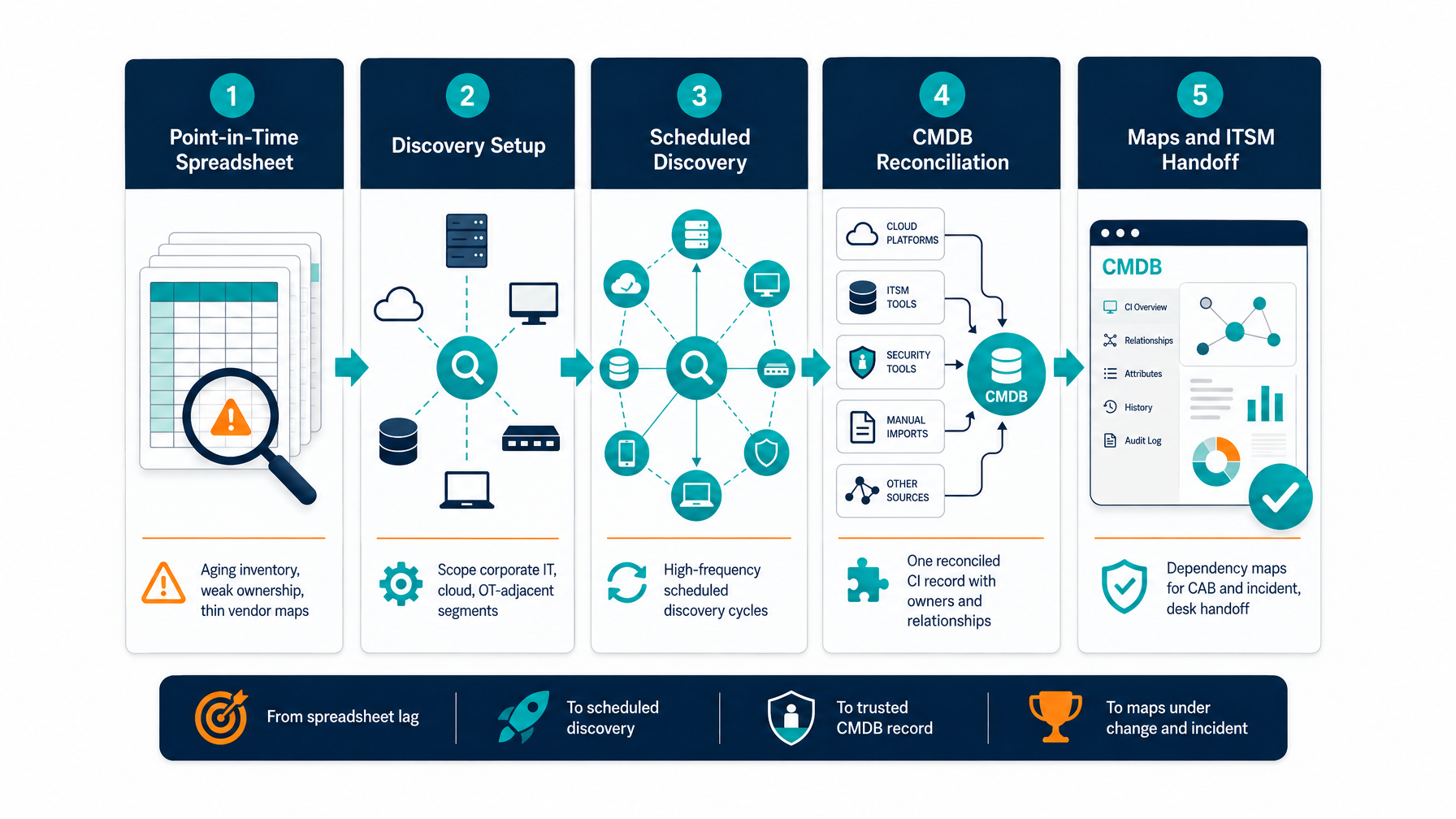
1. Discovery across corporate IT, cloud, and OT-adjacent hosts
- Agent-based discovery deepens inventory on managed endpoints
- Agentless discovery reaches network devices and systems where agents are impractical
- API-based discovery pulls cloud and SaaS account inventory that never appears on a floor switch
- Virima’s IT discovery combines those methods so the estate is collected on high-frequency scheduled discovery cycles rather than on an annual walkthrough
- Discovery covers network-connected infrastructure and cloud accounts
- Dedicated OT monitoring platforms still own process-to-protocol deep inspection on the floor
2. One CMDB that reconciles multi-source data
- Multiple discovery feeds and imports collide without identity rules and field authority
- A single configuration management database holds the reconciled CI, owner, lifecycle state, and relationship set that change and incident workflows consume
- Virima’s CMDB runs reconciliation on the same scheduled cadence as discovery, so teams operate freshness every week with named owners and a fixed cycle
3. Dependency maps for vendor paths and IT/OT boundaries
- Once service definitions are provided, ViVID™ service mapping builds application-to-infrastructure dependency views
- Those views show what a vendor session, MES tier, or historian host actually supports
- CAB and incident leads use that map to answer blast radius before they isolate a CI
- Service composition still comes from the business
- Map maintenance then follows discovery updates on the same service-mapping foundation introduced earlier for vendor paths
4. ITSM handoff so the record is used under change and incident
- Inventory that sits only in a side database ages into another spreadsheet
- Feeding reconciled CIs and relationships into ServiceNow, Jira Service Management, Ivanti, and similar desks keeps approval and response work on the same data
- Partner names stay plain text here, with one path to Virima’s integrations hub for the full connector list used under change and incident workflows
Honesty boundary
- Virima is the asset-of-record and dependency layer for IT, cloud, and OT-adjacent infrastructure that discovery can reach.
- Dedicated OT protocol monitoring still covers Modbus, DNP3, and PROFINET deep inspection.
- Pair discovery-sourced CMDB truth with specialized OT tools so each layer keeps its job.
- Lifecycle and audit reporting on the ITAM side uses the same authoritative base when hardware and software lifecycle fields need owners, status, and history under ITAM.
| Need | Point-in-time spreadsheet inventory | Discovery-sourced CMDB record |
|---|---|---|
| Vendor-connection visibility | Often a VPN name with weak tool linkage | CI and relationship path from session path to supported hosts |
| Update cadence | Audit- or project-driven | High-frequency scheduled discovery cycles |
| IT/OT boundary visibility | Split lists owned by different teams | Shared CI model with explicit relationships |
| Audit readiness | Manual re-collection under time pressure | Exportable current inventory with owners and history |
Where to Start
Phoenix fab teams that want a defensible record before the next disruption can sequence the work without boiling the ocean.
- Discover the full environment you already trust enough to scan. Cover corporate IT, cloud accounts, and OT-adjacent segments where credentials and change windows allow. Document exclusions for pure process tools that stay under vendor and OT-monitoring programs.
- Reconcile into one CMDB. Collapse duplicate CIs, assign owners, and set field authority so last-scan and authoritative sources stop overwriting each other silently.
- Map dependencies with vendor connections first. Treat equipment-vendor remote paths, MES tiers, and historian hosts as priority service definitions. Build maps that CAB and incident leads will actually open.
- Connect the record to existing ITSM and change workflows. Route CI and relationship data into the desk teams already use so impact analysis happens inside the ticket, not in a parallel spreadsheet.
- Keep currency on a standing schedule. Run discovery and reconciliation on a fixed cadence operations can defend. Peak-season installs and decommissioned hosts clear on the next cycle when ownership and schedule are explicit. Reporting and audit packaging for that standing record is covered in Virima’s reporting and auditing use case.
The payoff is operational, not theatrical. When the next suspicious-activity alert hits a Chandler or North Phoenix site, responders start with a current list of systems, owners, and dependencies. Order fulfillment and capacity conversations then rest on evidence instead of reconstruction.
Trusted runtime truth for that work starts with discovery-sourced inventory and maps leadership can defend. Explore how Virima frames that foundation at Trusted Runtime Truth. For a related city-and-vertical treatment of regulated manufacturing inventory, see Virima’s Boston biotech CMDB article on HIPAA and FDA 21 CFR Part 11 evidence layers. When you want a working session on your estate, schedule a free demo with our team today.
Frequently Asked Questions
What is IT asset visibility, and why does it matter for a semiconductor fab?
IT asset visibility is a current, owned inventory of systems, relationships, and lifecycle state across corporate IT, cloud, and floor-adjacent hosts. Fabs need it so change, incident, and security teams can act on the estate that production actually runs on.
Why does IT asset visibility matter more for Phoenix’s critical manufacturing sector specifically?
Greater Phoenix concentrates large fabs, IDMs, and suppliers in one corridor. Shared vendors and dense employment raise the cost of a local outage, so inventory gaps spread risk across neighboring plants faster than in a single isolated site.
What makes semiconductor manufacturing part of CISA’s critical manufacturing sector?
CISA lists Critical Manufacturing among the sixteen U.S. critical infrastructure sectors. Electrical equipment and component manufacturing sits in the sector core, which is where semiconductor fabrication and related component production are treated as a nationally significant industry.
How does IT/OT convergence create asset visibility gaps on a fab floor?
Process tools, historians, and MES hosts sit beside corporate IT and vendor remote paths. Different owners, protocols, and change rules leave split inventories, so dependency and ownership stay incomplete until discovery and a shared CMDB reconciles them.
What are real examples of asset visibility failures in semiconductor manufacturing?
Microchip Technology’s August 2024 IT disruption cut manufacturing capacity and order fulfillment. The 2023 MKS Instruments incident cascaded into Applied Materials. Advantest’s 2026 ransomware response shows equipment suppliers remain active targets with fab-side dependency risk.