CMDB vs ITAM: Auto-Link CIs to Hardware Assets

Auditors ask for one hardware proof package. Finance hands over the ITAM purchase row with warranty and cost center. Operations hands over a CMDB CI with dependency maps and open changes. The serials look related, yet nothing joins the two records, so the audit turns into a spreadsheet merge before anyone can answer a simple ownership question.
ITAM and CMDB serve different purposes but track the same physical hardware from different angles. Without a link between them, organizations run two separate records of the same asset with no connection, causing audit failures, budget waste, and inaccurate service impact analysis. Serial number-based auto-linking solves this by matching hardware asset records in ITAM to configuration items (CIs) in the CMDB using the device’s unique serial identifier, creating a persistent, auditable relationship between both systems. This article covers how that process works, how to resolve serial number conflicts, and best practices for maintaining linked CMDB-ITAM data at scale.
CMDB asset management bridges operational service context and financial stewardship by auto-linking Configuration Items (CIs) to physical ITAM hardware asset records using unique device serial numbers. This automated reconciliation reduces duplicate inventory, strengthens compliance audit trails, and gives change workflows warranty and contract context alongside dependency maps.
| When CMDB CIs and ITAM hardware assets describe the same device without a durable serial link, operations and finance still reconcile by hand. Explore Trusted Runtime Truth. |
What Is a CMDB and What Is ITAM
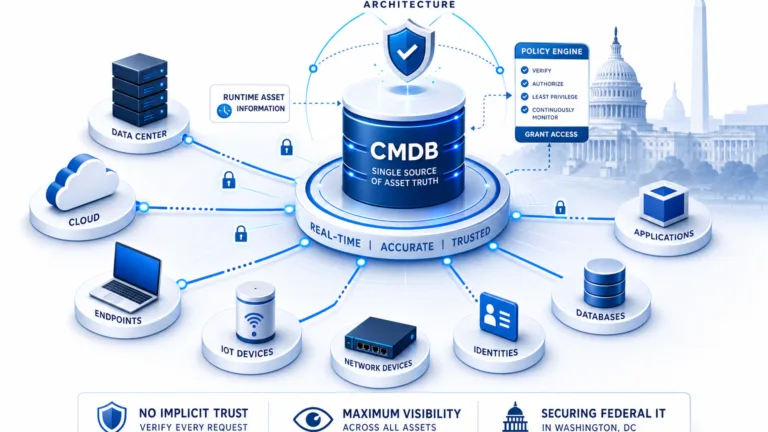
When auditors ask for one hardware record and finance and operations hand over two unlinked files, the gap is already expensive. Most enterprises still run a CMDB and an ITAM system side by side. They answer different questions on the same physical device, and without a durable link between those records, audit, refresh, and incident work all run on half the picture.
ITAM exists to track the financial, contractual, and lifecycle details of every physical and software asset the organization owns. The ITAM record for a laptop includes the purchase date, cost center, warranty expiration, assigned user, and procurement contract. The question ITAM answers is: what do we own, what did we pay for it, and when does it expire?
A CMDB exists to model how IT infrastructure components relate to each other and to the business services they support. The CI record for that same laptop includes the operating system, installed software, network relationships, open incidents, and the business service it supports. The question a CMDB answers is: how does this device function within our IT environment, and what is the impact if it fails or changes? Answering that well depends on running a modern, accurately maintained CMDB in the first place, not just any CMDB.
The two systems are not redundant — they are complementary. ITAM focuses on asset stewardship; the CMDB focuses on operational and service context. Both exist because no single system serves both purposes well. As Ivanti describes it, a CMDB CI and an ITAM asset record are like a flight number and the aircraft assigned to it — the flight number (CI) stays constant even when the physical plane (hardware asset) changes. For the definitional CMDB asset management vs ITAM contrast without the serial-join mechanics, see CMDB asset management vs ITAM key differences.
| Capability / Attribute | Standalone CMDB | Standalone ITAM | Serial auto-linked CMDB–ITAM |
|---|---|---|---|
| Core focus | Operational relationships and service impact | Contracts, cost centers, and lifecycle | Unified operational and financial ground truth |
| Primary keys | CI ID, IP, MAC | Asset tag, PO number | Canonical serial number relationship |
| Audit trail | Configuration change history | Purchase and disposal history | Immutable link history (actor, method, timestamp) |
| Conflict handling | Duplicate or stale CIs on rediscovery | Duplicate import rows | Conflict queue with review SLA |
| Incident / change context | Dependencies and blast radius | Warranty and vendor contract status | Both views in one linked record path |
The CMDB-ITAM Gap Problem
The problem is not that organizations run two systems. The problem is that, in the vast majority of cases, those two systems have no link between them.
A server gets discovered by the CMDB and becomes a CI with a unique identifier. That same server is also recorded in ITAM with its purchase order, serial number, and warranty details. But the CI in the CMDB and the asset record in ITAM are two separate, unconnected entries. There is no foreign key, no reference, no relationship — just two records describing the same physical device.
This gap creates several operational problems:
Audit failures
Software and hardware audits require a complete, traceable inventory. When auditors ask for proof that a specific hardware asset is accounted for and properly configured, organizations with an unlinked CMDB and ITAM have to manually reconcile two systems — a process that is error-prone and time-consuming. Hardware and software audits still fail when discovered CIs and procurement rows cannot be joined on a durable identifier. Flexera’s 2024 State of ITAM report found that only 53% of ITAM teams have high visibility into their IT estate, which leaves audit and refresh work dependent on incomplete inventory joins.
Why does unlinked CMDB and ITAM data cause IT audit failures?
Unlinked environments force teams to reconcile separate operational and financial inventories by hand. Gaps between discovered CIs and procurement records produce incomplete hardware proof, weak license and asset trails, and audit findings that neither system can clear alone.
Budget waste
Without a link between CMDB and ITAM, asset refresh decisions are made without a full operational context. Finance sees an asset approaching end-of-warranty but has no visibility into whether that asset is a critical CI supporting a production service, a spare on a shelf, or a device already decommissioned in operations. The result: premature hardware refreshes on non-critical assets, and missed refreshes on CIs that carry significant service risk.
Incorrect service impact analysis
When an incident occurs or a change is planned, service impact analysis depends on knowing what hardware underlies each affected CI. Without a link between the CI and its physical hardware asset record, the CMDB contains only half the picture. Engineers cannot quickly determine if a CI is running on hardware that is approaching end-of-life, under a vendor SLA, or already flagged for decommission — all factors that affect how the incident or change should be handled.
Duplicate discovery records
Automated discovery continuously creates and updates CI records. Without a link to ITAM, newly discovered CIs frequently spawn new records rather than updating existing ones. The CMDB fills with duplicate entries that the ITAM system cannot recognize as related to its own asset records. Over time, the divergence makes both systems less trustworthy.
When CMDB and ITAM stay unlinked, every incident and audit still starts with reconciliation work. See how Trusted Runtime Truth keeps discovery-sourced asset and service context aligned for operations and finance.
How Serial Number-Based Auto-Linking Works
The serial number is the most reliable common identifier across CMDB and ITAM systems. Every physical device — server, workstation, laptop, network switch — has a manufacturer-assigned serial number that does not change throughout the device’s lifecycle. Discovery tools capture it when they scan the network; procurement teams record it when they log the purchase in ITAM.
Serial number-based auto-linking works by running a matching process that compares the serial number field on every hardware asset record in ITAM against the serial number attribute on every CI in the CMDB, then creating a persistent link record between matched pairs.
The process has several key components:
Matching logic
The system reads the serial number from each CI and searches for an exact match in the hardware asset table. When a match is found, a link is created, storing the CI ID, the asset ID, the link creation timestamp, and the method (auto or manual). Matching is case-insensitive and typically strips leading/trailing whitespace to account for import inconsistencies.
Batch processing
In environments with thousands of CIs and assets, auto-linking runs as a scheduled batch job rather than in real-time for every record change. A typical batch job processes all unlinked CIs in a single pass, creating links where serial matches exist and flagging CIs where no match is found (orphaned CIs) or where multiple asset records share the same serial number (conflict state).
Conflict detection
Not every serial number produces a clean one-to-one match. When two or more asset records carry the same serial number, the system cannot safely auto-link — creating a link to the wrong asset record produces worse data than having no link at all. Instead, the system places the conflicting records in a conflict queue for manual review (covered in detail below).
Post-link actions
Once a CI and asset are linked, the relationship enables cross-system queries. A change management workflow can pull the asset’s warranty status and support contract details from ITAM and surface them alongside the CI’s service dependency map in the CMDB. Incident responders get both operational context (from the CI) and financial/lifecycle context (from the asset) in a single view.
How does serial number auto-linking connect CMDB CIs to ITAM hardware assets?
Serial number auto-linking runs batch reconciliation that matches the manufacturer serial on a CMDB Configuration Item against hardware asset records in ITAM. A match creates an auditable relationship that joins service dependency maps with financial, contract, and lifecycle data for the same physical device.
Auto-Linking vs. Manual Linking
Auto-linking by serial number covers the majority of CI-to-asset matches in a well-maintained environment. But manual linking and unlinking remain necessary in several common scenarios.
When to use manual linking:
- No serial number is present. Some CIs — particularly those representing virtual machines, containers, or legacy imported records — may not have a serial number populated. Auto-linking cannot match these. A manual link allows an administrator to associate the CI with its underlying physical asset (or the host hardware, in the case of VMs) by direct selection.
- Serial numbers differ between systems. Some hardware vendors use different serial number formats across management interfaces. A server’s BIOS serial may differ from the serial recorded on the physical chassis label that was entered into ITAM at procurement. An administrator who recognizes the devices as the same physical asset can create a manual link and flag the serial discrepancy for correction.
- Blade servers and chassis. Blade server environments often require linking multiple CIs (individual blade units) to a single chassis asset record, or linking a chassis CI to multiple hardware components. This type of composite relationship typically requires manual configuration rather than a simple serial match.
When to use manual unlinking:
- Asset refresh. When a physical server is replaced, the CI it supported should be unlinked from the decommissioned asset and relinked to the replacement. If the new device has a different serial number, auto-linking will eventually create the correct new link — but the administrator should manually remove the old link immediately at the time of the change to prevent stale data.
- Incorrect auto-link. If a batch run creates an incorrect link (due to a data entry error, for example), the administrator can manually remove it and create the correct link or resubmit the CI for the next auto-link pass after fixing the underlying serial number.
Manual link and unlink events are recorded in the audit trail with the same fields as auto-link events: actor, timestamp, method, and the specific CI and asset IDs involved.
When should manual linking be used instead of automated serial matching?
Use manual linking when CIs lack hardware serials (virtual machines, containers, legacy imports), when BIOS and chassis serials disagree, or when blade and chassis layouts need many-to-one relationships. Administrators select the correct asset, record the method, and correct serial data when the mismatch is a data-entry issue.
When Serial Auto-Linking Is Not Enough
Serial auto-linking covers most physical servers, workstations, and network devices with clean manufacturer serials. It is the wrong sole control when identity is incomplete or composite.
Legacy imports and thin discovery blueprints often leave serial blank. Virtual machines and containers usually have no durable hardware serial of their own. Blade and chassis designs may need several CIs tied to one asset row, or the reverse. Some vendors expose different serial strings in BIOS versus the chassis label used at receiving.
In those cases, keep auto-link for clean one-to-one serial matches, and use manual link or unlink with an audit trail for the rest. Treat serial normalization and import uniqueness checks as prerequisites, not optional cleanup after the first batch job.
Serial Conflict Detection and Resolution
Serial number conflicts are among the most common data quality issues in CMDB-ITAM environments. A conflict exists when two or more hardware asset records in ITAM carry the same serial number, making it impossible for the auto-linking engine to determine which asset record is the correct match for a given CI.
Common causes of serial conflicts:
- Duplicate imports. Asset management databases are typically populated through multiple channels — manual entry, spreadsheet imports, and discovery integrations. The same device can arrive through more than one channel and create two separate records with identical serial numbers.
- Asset refresh without decommission. When a hardware refresh replaces an old device with a new one, procurement teams sometimes create a new asset record for the replacement device while the old record remains active. If the replacement uses the same chassis and the serial number is recorded from the chassis (rather than a new component), both the old and new records may carry the same serial.
- Virtual and physical overlap. Some virtualization platforms report the host physical serial number as the serial number for virtual machines running on it. This causes a many-to-one conflict where a single physical serial number appears across multiple ITAM asset records.
- Blade server environments. Individual blade units in a chassis may share a chassis-level serial number if discovery or manual entry records the chassis serial rather than the blade’s own serial.
What causes serial number conflicts during CMDB-ITAM reconciliation?
Conflicts appear when two or more ITAM asset rows share one serial, often from duplicate imports, refresh without decommission, hypervisors exposing host serials on VMs, or chassis serials applied to blades. Auto-link engines should queue those rows for review instead of guessing a match.
Resolution workflow:
When the auto-linking engine detects a conflict, it places the affected records in a conflict queue rather than creating a link. The queue surfaces both asset records, the shared serial number, relevant metadata (asset name, assigned user, status, model, location), and the CI waiting for a link.
The reviewer assesses the records and takes one of the following actions:
- Retire one record. If one asset record is a genuine duplicate (same physical device entered twice), mark the duplicate as retired or merged, then allow the auto-link process to run again against the canonical record.
- Correct the serial number. If one record has a serial number entry error (a transposed digit, for example), correct the serial in the asset record and re-run the auto-link job.
- Create a manual override. In cases where both asset records are legitimately distinct but happen to share a serial (a known edge case with some vendors), the administrator creates a direct manual link and flags both asset records for a serial number audit.
- Flag for procurement review. If the conflict suggests a procurement or disposal process failure (two purchase records for the same device, or a disposed asset that was never formally retired), escalate to the ITAM process owner for reconciliation.
Prevention through import validation:
Most serial conflicts are preventable. An effective prevention strategy enforces a uniqueness check on the serial number field during every ITAM import operation. Before a new asset record is committed to the database, the system queries for existing records with the same serial. If a match exists, the import process either blocks the new record and raises a validation error or routes it to a review queue for a merge decision.
Audit Trail and Link Coverage Reporting
A linked CMDB-ITAM environment is only as trustworthy as its audit trail. Every link operation — whether created by auto-linking or manually by an administrator — should produce an immutable log entry that captures:
- The CI identifier and the asset identifier involved
- The link method (auto by serial match, or manual)
- The actor who created or modified the link (system account for auto-links, user account for manual links)
- The timestamp of the link creation or modification
- Any conflict flags present at the time of linking
How does auto-linked CMDB-ITAM data improve IT change management?
Linked CI and asset records give change boards dependency maps plus warranty, SLA, and end-of-life status in one path. Teams can see whether target hardware is under support, nearing refresh, or already flagged for decommission before approving high-risk infrastructure changes.
Link coverage reports measure the percentage of CIs and hardware assets that have an active link. A coverage report typically shows:
- Paired CIs: CIs with an active link to a hardware asset record
- Orphaned CIs: CIs with no linked asset record (due to missing or unmatched serial numbers)
- Unlinked assets: Hardware asset records with no associated CI
- Conflict queue size: The number of serial number conflicts awaiting resolution
Coverage reporting is not a one-time exercise. Organizations should run link coverage reports on a scheduled basis — monthly at minimum — and set a target coverage threshold. A coverage rate below 80% typically indicates systemic problems with serial number data quality in either the CMDB or the ITAM system, or both.
| Illustrative serial-join walk-through (not a customer claim): Discovery creates CI srv-app-14 with serial ABC123. ITAM still holds two asset rows with ABC123 from a refresh import that never retired the old PO line. Auto-link queues a conflict instead of guessing. Finance keeps paying maintenance on the stale row. Change still sees the CI without warranty context until the queue owner merges the duplicate and re-runs the batch. Coverage reporting then moves that serial from conflict to linked. |
Best Practices for CMDB-ITAM Data Integrity
1. Enforce serial number population at discovery
Configure your discovery tool to treat serial number as a required attribute for hardware CI classes (servers, workstations, network devices). CIs discovered without a serial number should be flagged rather than silently stored — a common failure mode for macOS endpoint discovery, where generic Windows-aligned blueprints often miss the Mac-specific serial number path entirely.
2. Standardize serial number format across systems
Establish a single canonical format for serial numbers (uppercase, no spaces, no dashes). Apply transformation rules during import to normalize incoming serial values before they reach the matching engine.
3. Run auto-link jobs on a regular schedule
A weekly auto-link batch is a reasonable default for most environments. Organizations with high asset velocity (frequent hardware refreshes, rapid cloud provisioning) may need daily runs. Align the schedule to your CMDB discovery cycle so new CIs are linkable as soon as they are created.
4. Assign ownership to the conflict queue
Assign a named ITAM process owner to review and close conflicts on a defined SLA — two business days is a common target. Track conflict queue size in your coverage report to ensure it does not grow faster than it is resolved.
5. Decommission asset records promptly
When hardware is retired or replaced, update the ITAM record status to decommissioned before the next auto-link cycle runs. An active asset record for a decommissioned device is a leading source of spurious conflicts.
6. Review orphaned CIs quarterly
Orphaned CIs often indicate one of three conditions: the asset was never entered into ITAM, the serial number is missing from the CI, or the physical device has been decommissioned, but the CI was not retired. Quarterly orphan reviews keep the list manageable and surface process failures early.
7. Use manual links for non-serial-identifiable assets
Virtual machines, cloud instances, and other software-defined resources do not have physical serial numbers but may still have meaningful relationships to hardware assets. Establish a manual linking convention for these cases rather than leaving the relationship undocumented.
Closing the CMDB–ITAM Gap with Serial Auto-Linking
The CMDB–ITAM gap stays expensive when CIs and hardware asset records describe the same device without a durable serial relationship. Serial number-based auto-linking closes most of that gap with batch matching, conflict queues, manual overrides, and coverage reporting, while surfacing orphans for human review.
As of Virima 6.1.1, native CMDB–ITAM auto-linking by serial number includes batch processing, serial conflict detection and resolution workflows, manual link and unlink controls, and link coverage reporting. Validate feature names against the release notes for your build before you cite them externally.
See how discovery-populated serials, CMDB CI records, and ITAM hardware assets can share one auditable link path with conflict queues and coverage reporting.
Frequently Asked Questions
What is the difference between CMDB and ITAM for the same hardware?
ITAM tracks ownership, cost, warranty, and lifecycle. The CMDB tracks how that device relates to other components and business services. Both can describe one laptop or server. Without a link, teams maintain two records with no shared key.
How do you auto-link CIs to hardware assets?
Match manufacturer serial numbers on CIs to serial fields on ITAM hardware assets, usually in a scheduled batch. Create a durable link with method, timestamp, and actor. Route multi-match serials to a conflict queue instead of forcing a link.
How do you resolve duplicate serial numbers between CMDB and ITAM?
Stop auto-link on the conflict, compare asset metadata, then retire or merge true duplicates, correct bad serials, or escalate procurement mistakes. Re-run matching only after one canonical asset row remains for that serial.
When is serial auto-linking not enough on its own?
Serial matching fails or under-covers virtual machines, containers, thin legacy imports, blade or chassis layouts that need many-to-one links, and devices that expose different serial strings in BIOS versus chassis. Those cases need manual links, alternate keys, or discovery blueprint fixes before coverage targets hold.
What should CMDB–ITAM link coverage reporting include?
Report linked pairs, unlinked CIs, unlinked hardware assets, conflict-queue depth, and link method mix (auto versus manual). Include actor and timestamp on each link change so audit can prove who joined which serial and when coverage moved after a batch run.