How Do You Securely Dispose of IT Assets and Prove Data Was Destroyed (NIST 800-88)?

You securely dispose of IT assets under NIST SP 800-88 Revision 2 by treating every storage medium as a controlled event: identify the device and media, classify the data that lived on it, apply Clear, Purge, or Destroy to match confidentiality and reuse intent, verify the result, then keep a certificate and custody log joined to a durable identity such as a manufacturer serial or cloud instance ID. You prove data was destroyed when that package still answers, months later, which unit was sanitized, which method category and technique were used, who did the work, when custody changed, and how verification passed. A wipe without those joins is an operational step, not audit evidence.
NIST SP 800-88 Revision 2, Guidelines for Media Sanitization (final September 2025), is the U.S. reference most enterprise ITAD programs map to for those decisions. Rev. 2 supersedes the long-used Rev. 1 text, so written standards and vendor contracts should cite the current publication. Hostname alone is not a durable join key across rebuilds and reimage cycles, so certificates that list only host names or pallet job IDs rarely survive a named-device inquiry.
What NIST 800-88 actually requires of a disposal program
NIST defines media sanitization as a process that makes access to target data on the media infeasible for a given level of effort. The guide helps owners choose techniques and controls from the sensitivity of the information, not from a one-size wipe script. Organizations are expected to build a media sanitization program: policy, approved methods by media type, roles, verification, and disposal handling after sanitization.
For IT leaders, that means disposal is not only an ITAD vendor contract. It is an internal control that starts while the device is still a managed asset. This matters most once a fleet crosses a few hundred devices across multiple sites — below that scale, ad hoc tracking mostly works, but past it, disposal volume outruns anyone’s memory of which drawer or drive holds what. Serial numbers, media type (HDD, SSD, hybrid, removable, embedded flash), data classification, owner, and last known location must exist before the crate leaves the dock. Without that baseline, certificates arrive with vendor job IDs nobody can join back to the devices that held regulated data.
Rev. 2 keeps the program framing and updates guidance for modern media, including cryptographic erase and secure erase paths that many teams now use alongside classic overwrite and physical destruction. Rev. 2 also drops the per-media technique tables that Rev. 1 used, pointing instead to IEEE 2883:2022 for technology-specific sanitization methods, and keeps only cryptographic erase detail in the core document. Your written standard should name the revision you follow, the IEEE 2883:2022 reference it leans on for technique detail, and the date you adopted it.
What is NIST SP 800-88 used for in IT asset disposal?
NIST SP 800-88 guides media sanitization so access to residual data becomes infeasible for a defined effort level. Teams use it to pick Clear, Purge, or Destroy by confidentiality need, media type, and reuse intent, then document verification and disposal as part of a formal sanitization program.
Clear, Purge, and Destroy: matching method to risk and reuse
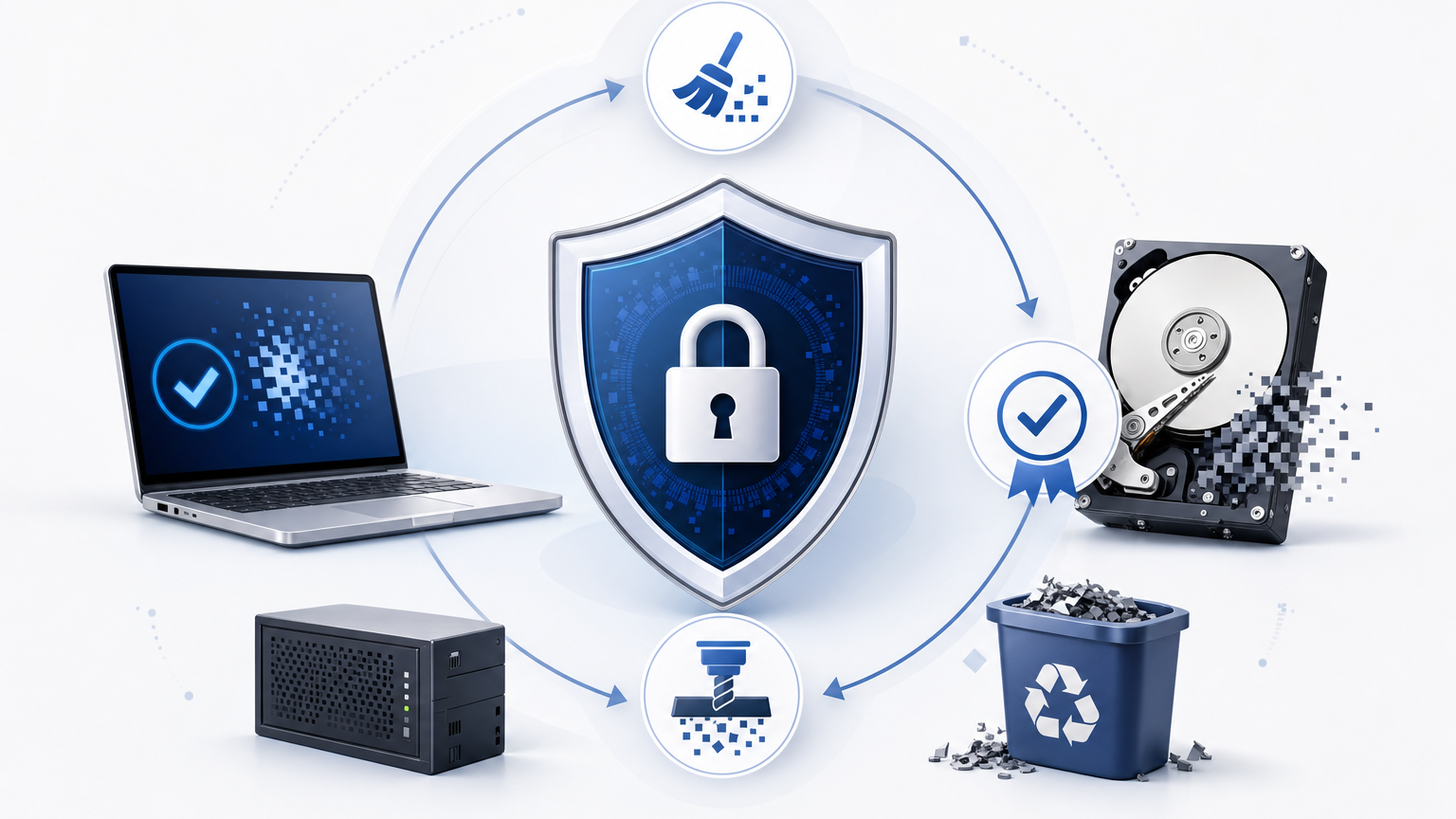
NIST’s three action categories still structure most decision trees.
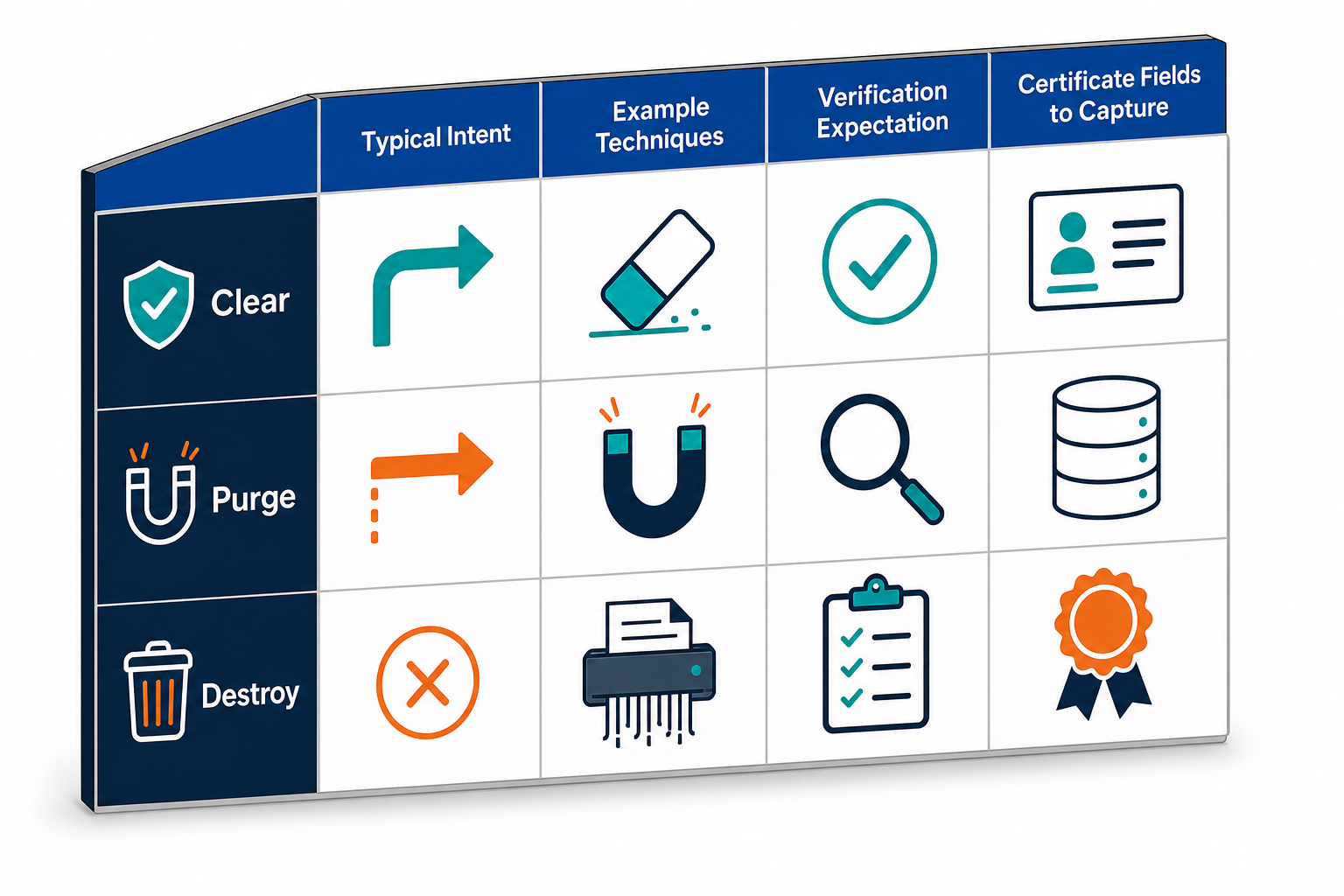
Clear protects against simple, non-invasive recovery. Typical Clear approaches include logical techniques and overwriting that remove data from standard user addressable storage so ordinary users and basic recovery tools cannot retrieve it. Cleared media may still be suitable for reuse inside the same organization when residual risk is acceptable for that classification.
Purge raises the bar so laboratory-level recovery becomes infeasible for the stated effort. Purge methods can include stronger overwrite patterns where still valid for the media, degaussing for magnetic media that supports it, secure erase commands, and cryptographic erase when keys protecting the ciphertext are destroyed under controlled conditions. Purged media is often the path when devices will leave the organization for resale or donation but still need a high confidence that prior data is gone.
Destroy renders the media unable to store data for reuse. Shredding, pulverizing, incineration, melting, and similar physical techniques apply when classification demands it, when media cannot be reliably purged, or when reuse has no value. Destroy ends the storage life of that medium; the chassis may still go through environmental recycling channels after media is destroyed.
Method choice depends on confidentiality categorization, media technology, and whether the organization intends reuse, transfer, or scrap. SSDs and flash-heavy devices often need different controls than spinning disks because wear leveling and over-provisioned areas change what a naive overwrite reaches. Cryptographic erase can be efficient when full-disk encryption was correctly deployed and key destruction is verifiable; it fails as a control when encryption was partial, keys remain recoverable, or you cannot prove the crypto state of that specific unit.
Proof is a record chain, not a vendor PDF alone
A certificate of data destruction (sanitization) only helps if it answers the auditor’s join questions: which asset, which media, which method category, which tool or standard reference, who performed the work, when, where custody changed, and how verification was done. A certificate listing only a job ID or pallet weight, with no serial number attached, is a red flag — treat it as incomplete until the vendor supplies a serialized version. NIST has long published sample certificate structures (historically Appendix material under Rev. 1 programs); many ITAD providers still issue NAID-aligned or vendor-branded certificates that you should map field-for-field to your internal control list. The stakes behind that paperwork are not abstract — IBM’s 2025 Cost of a Data Breach Report puts the average global breach at $4.44 million, and when an incident investigation names one specific device, a certificate that cannot name that device back provides no defense.
Minimum proof set per storage device or media unit:
- Durable asset identity (manufacturer serial, and for cloud-backed instances the cloud instance ID where relevant). Hostname alone is not a durable join key across rebuilds and reimage cycles.
- Media identity when separate from the chassis (disk serial, encrypted volume ID if used in crypto-erase workflows).
- Sanitization action category (Clear, Purge, or Destroy) and specific technique.
- Tool, firmware, or destruction equipment reference and operator or vendor identity.
- Verification method and result (for example, sampling read-back, crypto-erase confirmation, witness log for physical destroy).
- Chain-of-custody timestamps from unrack or desk pickup through final disposition.
- Final disposition (reuse location, resale lot, recycle stream) with environmental credentials when required.
Store those artifacts against the same CI or asset record you used in life, not only in a shared drive folder named by month. When legal holds, customer DPAs, or cyber-insurance questionnaires ask for evidence on a named device, retrieval time is part of the control’s effectiveness.
Teams that already track end-of-life hardware against Trusted Runtime Truth can attach sanitization status, certificate references, and disposition codes on the asset timeline so operations and compliance share one history.
Where disposal breaks in real estates
Most failed audits on disposal are process failures, not missing shredders, and most trace back to gaps in the media sanitization program itself rather than the sanitization equipment. The volume keeps climbing too: IMARC Group projects the global IT asset disposition market will reach $34.3 billion by 2033 — more devices moving through more vendors, and more certificates somebody has to verify.
Unknown media inventory. Spare disks in drawers and hybrid laptops with soldered and removable storage create units that never enter the sanitization queue.
Method mismatch. A Clear overwrite applied where policy required Purge or Destroy, or cryptographic erase treated as complete when full-disk encryption was never enforced on that fleet segment.
Broken custody. Devices staged in open cages, vendor pickups without sealed manifests, or mixed lots where certificates cover a pallet weight instead of serialized units.
CMDB and ITAM drift. Assets marked disposed in finance while still active in discovery, or CIs retired with no link to sanitization proof. Ghost and orphan records hide residual risk and inflate license and support noise — Virima blog post on finding and eliminating ghost assets in the CMDB walks through closing that gap. Pair disposal work with disciplined decommission tracking in the CMDB so status, owner, and evidence stay aligned.
Vendor paperwork without internal acceptance. Certificates accepted at face value without sampling verification or retention tied to regulatory periods (often multi-year, industry-specific).
A practical control is a disposal gate: no device leaves controlled space until the ticket or change record shows identity match, method approval for its classification, and a placeholder for the certificate ID that must be closed within a defined SLA after vendor completion.
Building an operational NIST-aligned disposal workflow
Use this sequence as a MOFU checklist your ITAM, SecOps, and facilities owners can share.
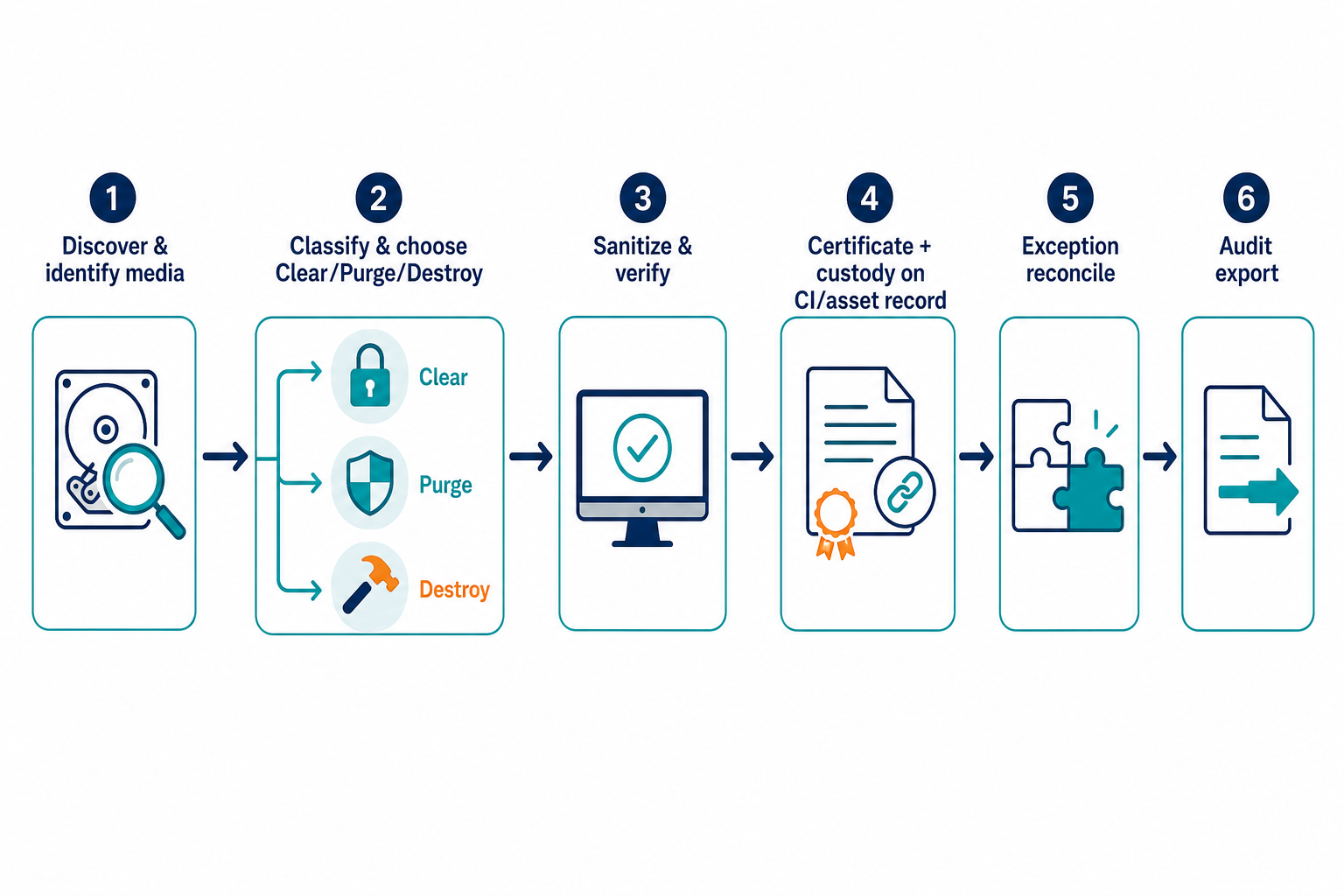
1. Discover and freeze the candidate set. Pull devices at end of lease, failed, surplus, or project teardown. Confirm serials and media with scheduled discovery and physical spot checks. Flag encryption state and data classification tags before work starts.
2. Classify and select the sanitization category. Map each unit to Clear, Purge, or Destroy from written policy. Document exceptions with security owner approval.
3. Execute under chain of custody. Prefer on-site sanitization for high-sensitivity media when policy requires it. For off-site ITAD, use sealed transport, serialized manifests, and dual control where warranted.
4. Verify. Do not equate a “job complete” email with verification. Define sampling rates for overwrite and crypto-erase batches; require witnessed destruction or plant video controls for Destroy lots when contracts call for them.
5. Record and retain. File certificates and custody logs on the asset/CI record. Update lifecycle state to disposed or recycled only after proof lands.
6. Reconcile. Run exception reports: assets financially retired without certificates, certificates without matching serials, discovery still seeing devices marked destroyed. Close exceptions on a fixed cadence.
For broader process design beyond the NIST proof layer, Virima’s guide on best practices for the disposal of IT assets covers inventory, vendor selection, and environmental handling in one end-to-end flow. Use that playbook for ITAD operating rhythm; use this article for sanitization method and evidence depth.
When service context matters, confirm whether a retiring host still sits under a defined business service before you pull it. ViVID™ service maps help owners see dependency impact so disposal does not strand undocumented dependencies in the estate. Sanitization still runs per medium; service context decides timing and communication, not the wipe algorithm.
How discovery-backed records make destruction defensible
Virima’s role in this problem is not operating the shredder. It is keeping the discovery-sourced ground truth — inventory and lifecycle state — that makes NIST-aligned disposal auditable. That is the same ground truth that anchors Virima’s wider platform: an always-current record of what exists, what changed, and who is accountable for it.
Scheduled, multi-source discovery refreshes what exists, including hardware identity attributes teams use as join keys. ITAM lifecycle fields carry procurement through disposal states. The CMDB holds configuration items and relationships so decommission is a controlled state change with history, not a deleted row. Compliance and operations can export the same serial-linked story: when the device was last seen, who owned it, when it entered disposal, and which proof artifact closed the loop.
Integrations with ITSM platforms keep disposal changes and tickets coherent, with connection options on the integrations hub. Hardware lifecycle fields that carry procurement through disposal live in Virima IT asset management.
If your current proof lives in email and shared folders, the upgrade path is straightforward: one authoritative asset/CI identity, mandatory certificate fields, and exception queues that security and ITAM review together.
Close the loop before the next lease return wave
Secure disposal under NIST SP 800-88 is method discipline plus evidence discipline. Clear, Purge, and Destroy only reduce residual data risk when they match classification and media reality. Certificates only satisfy audits when they join to durable identities your systems already trust. Build the program once, wire it to discovery-backed asset and CI records, and treat every outbound device as a controlled event with a closable proof package.
Turn the proof set and workflow above into something your team can run against the next lease-return wave: download the Virima: Leading the way in responsible IT asset disposal and map each field to your own asset records. If you want to see first how lifecycle states, discovery identity, and decommission history sit in one operational view, request a demo of Virima.
Frequently Asked Questions
What is the difference between Clear, Purge, and Destroy in NIST 800-88?
Clear makes recovery infeasible against simple non-invasive techniques and often supports reuse inside the organization. Purge targets stronger recovery efforts so laboratory-style reconstruction is infeasible for the stated level of effort, which fits many transfer and resale cases. Destroy physically or otherwise ends the media’s ability to store data for reuse when residual risk or media limits demand it.
Is NIST SP 800-88 Rev. 1 still the standard to cite?
Rev. 1 was superseded when NIST published SP 800-88 Revision 2 as final in September 2025. Revision 2 also removes the per-media technique tables Revision 1 used and instead points to IEEE 2883:2022 for technology-specific sanitization methods. New policy, contracts, and training should reference Rev. 2 and IEEE 2883:2022 together with your adoption date. Existing Rev. 1-based procedures should be gap-reviewed against Rev. 2 rather than left on withdrawn text alone.
What proof do auditors expect after IT asset data destruction?
Auditors typically expect serialized identity, sanitization category and technique, verification outcome, custody timeline, operator or vendor identity, and final disposition, retained for the period your regulations and contracts require. A generic pallet certificate without serial join usually fails when the request names a specific laptop or disk from a breach or customer inquiry.
Can cryptographic erase replace physical destruction?
Cryptographic erase can satisfy Purge-class goals when encryption covered the target data and key destruction is verified for that media unit. It does not replace Destroy when policy requires physical media elimination, when encryption was incomplete, or when you cannot prove the cryptographic state of the device. Decide per classification and media capability in written standards.
How does Virima help prove secure IT asset disposal?
Virima maintains discovery-sourced hardware identity and lifecycle context in ITAM and CMDB records so sanitization certificates and custody events attach to the same durable keys operations already use. Teams reconcile disposed status against last-seen inventory, reduce ghost assets, and export serial-linked evidence without rebuilding the story from email threads at audit time.