How CMDB Data Accuracy Fails and Why CIOs Still Have to Defend the Roadmap

A CIO walks into a quarterly board meeting with a multi-year transformation roadmap on the agenda. Progress slides look clean, and budget lines match last quarter’s plan. Then a director asks a narrow question: how many production workloads still sit outside the migration wave, and what does that do to year-two spend?
The honest answer depends on configuration data the CIO has not revalidated in months. The count in the deck came from a CMDB last touched during a staff handoff. Nobody can prove the relationships still match live infrastructure.
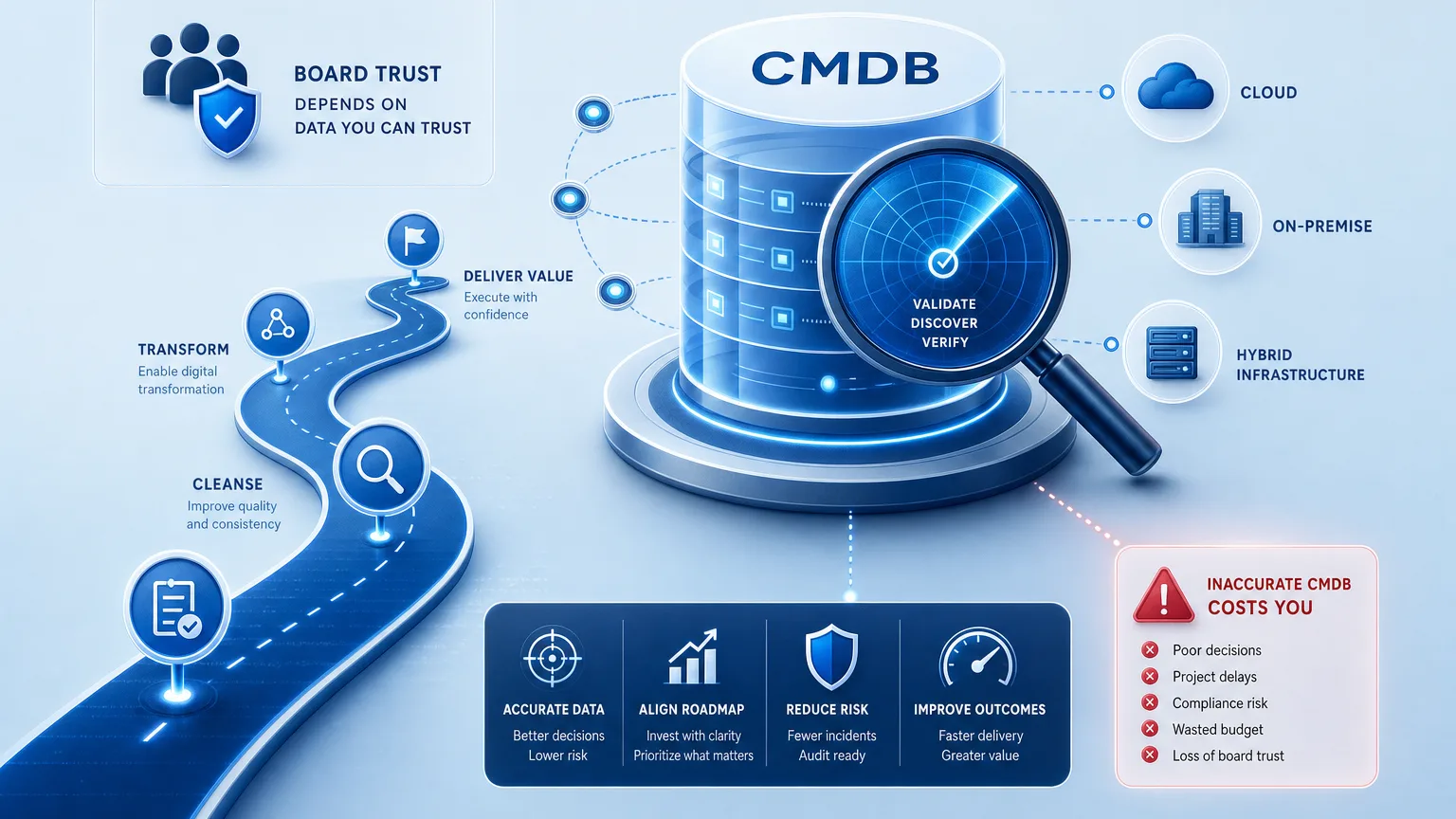
That is the quiet exposure most digital programs carry. The agentic IT era runs on Trusted Runtime Truth, not on ticket history or manual CMDB maintenance alone. CMDB data accuracy for digital transformation is not an ops hygiene score. It is the credibility of every scope, sequence, and cost claim the board already approved.
What counts as trustworthy CMDB data
Boards often treat a configuration management database as a complete, static system of record. Operators know something narrower is true. Trustworthy CMDB data means current CI state, validated relationships, and an explicit discovery timestamp you can defend in the room.
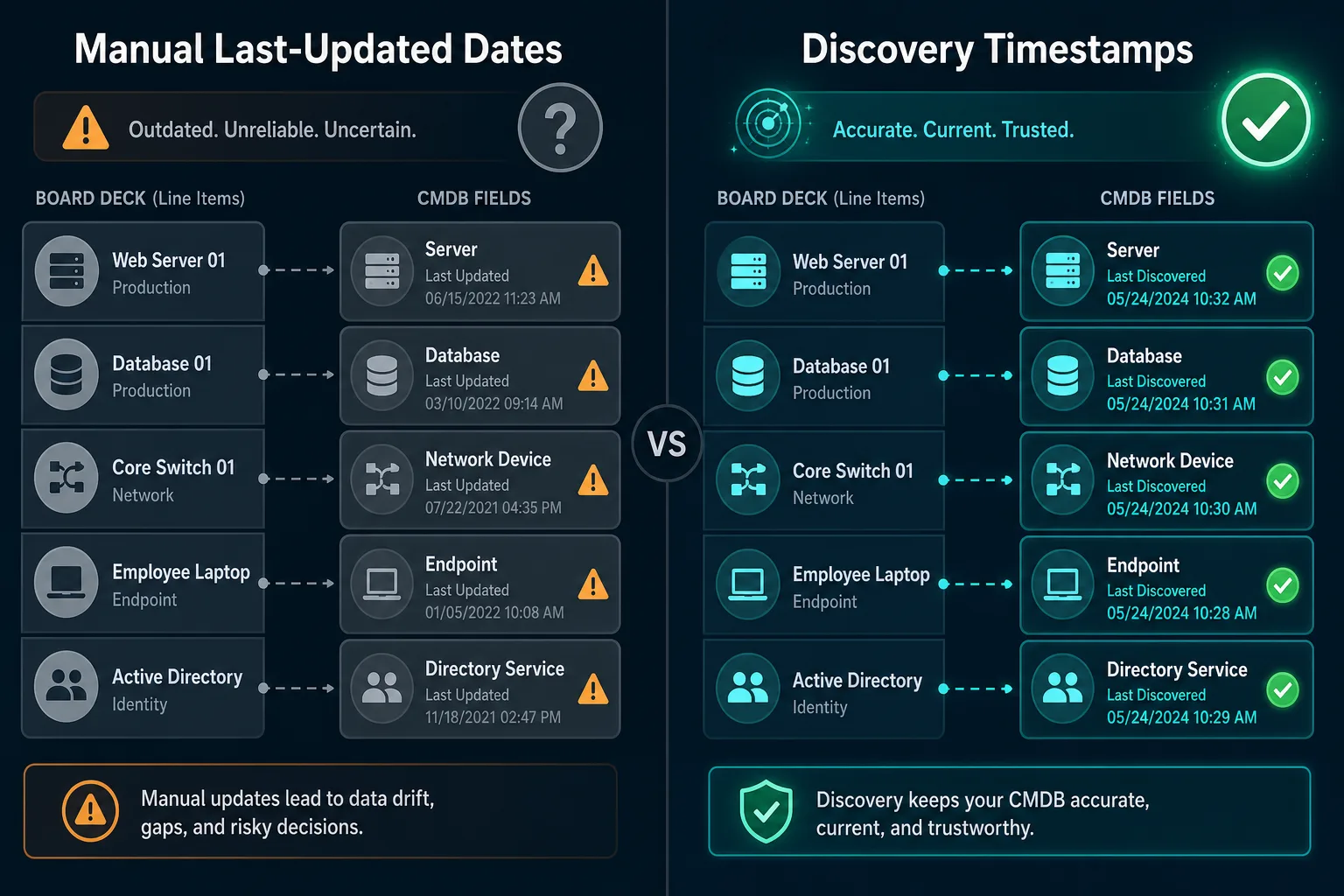
A documented CMDB and a discovery-validated CMDB are different instruments. One reflects the last human update, spreadsheet import, or ticket close; the other carries a scheduled scan with a known time, source, and reconciliation path — see how that difference plays out for board numbers in the comparison table below.
The board does not know what it is approving
| Situation | What happens |
|---|---|
| Roadmap budget scoped from a CMDB device or workload count | The count reflects the last manual update, not current infrastructure; scope can miss a material margin |
| Migration sequence built from documented architecture | Undocumented dependencies surface mid-migration, not in planning |
| Board dashboard reports “on track” against static metrics | Metrics were true when captured; nothing confirms they remain true when presented |
A configuration management database only earns board trust when the numbers in the deck can be traced to discovery-sourced ground truth. For the tactical side of that same problem, see three specific decisions this plays out in once discovery data is trusted.
What makes CMDB data trustworthy for a digital transformation roadmap?
Trustworthy CMDB data shows current CI state, validated dependencies, and a clear discovery timestamp. Boards need that freshness standard, not a static inventory snapshot that looked complete when someone last edited it by hand.
What a CIO is betting when the board signs off
A transformation roadmap is a multi-year bet on scope, budget, and sequencing. When underlying inventory is unvalidated, the CIO defends that bet without knowing the odds.
BCG Platinion summarizes BCG’s long-running research: most transformation programs still miss their objectives, and only a minority clear the bar. That’s program-level context, not proof every miss traces to CMDB fields — infrastructure data quality is one controllable input alongside leadership, funding, and operating-model risk.
Adjacent pressure shows up in data governance more broadly: Gartner predicted in February 2024 that 80% of data and analytics governance initiatives will fail by 2027 due to a lack of a real or manufactured crisis. That finding covers D&A governance programs, not CMDBs specifically, but board trust in technology data fails for the same reason when nobody owns freshness, crisis response, or decision rights.
Deloitte Insights has framed how CIOs brief boards on technology risk, drawing on multi-year board and executive interviews. Use that work for structural briefing habits, not as a 2026 pulse survey.
Where the numbers stop holding up
- Roadmap budget scoped against a device or workload count that has not been discovery-validated means the number on the slide and the number in production diverge before the first milestone.
- Dependency maps built from architecture documentation rather than live infrastructure mean migration sequencing breaks in production, and the board hears a delay story instead of a data story.
- Progress dashboards built on metrics with no freshness indicator turn “on track” into an assertion, not a verified status.
- Cloud and on-prem halves of the estate tracked with different update cadences mean hybrid milestones look funded while one side of the map ages in silence.
Who answers when the data was wrong
For the CIO
Personal exposure lands when a board-approved roadmap slips because the inventory behind it did not hold. Peer CIOs already know this conversation. It is not abstract risk language. It is the closed-door review after a wave misses and finance asks which assumption broke first.
For the board
Directors approved scope and budget in good faith. When the data was wrong, the next scrutiny hits the oversight record: what evidence sat under the vote, and who owned validation.
For the transformation program
A program office that built a twelve-month plan on unvalidated dependency data inherits the rework. Schedule buffers vanish while vendor change orders appear. The CIO still owns the narrative upstairs.
For audit and compliance
A roadmap that touched infrastructure without a validated inventory is a gap auditors are trained to find. The CMDB maps the infrastructure an audit or governance review depends on. It does not replace the control framework, the evidence pack, or the named control owner.
Flexera’s 2026 State of ITAM Report found that 64% of IT teams report challenges gaining or maintaining complete visibility of technology investments. Incomplete visibility is common, and that does not make an unvalidated board number safer. It explains why CIOs who insist on discovery timestamps are not being pedantic.
Configuration practice language in ITIL 4 and board IT governance language in COBIT both treat accurate configuration information as an input to change, risk, and assurance work. Neither framework lets a CIO outsource accountability for the numbers they present.
Who is accountable when transformation plans rest on stale CMDB data?
The CIO owns the board narrative. The board owns oversight of the vote. The program office owns rework, and audit teams test whether inventory evidence matches live systems. CMDB records map infrastructure; they do not replace named accountability.
Building a roadmap the board does not take on faith
Three mechanisms turn faith into a freshness standard.
1. Discovery that validates the numbers before they reach a board deck
Agentless, agent-based, and API-based discovery replace a manually aged CMDB row with a timestamped, current one. High-frequency discovery cycles keep the estate from drifting between quarterly packs. Use discovery-sourced data as the basis for any count that funds a milestone.
2. Dependency mapping that surfaces what a milestone will touch
Once service definitions are supplied, ViVID™ builds service maps that show blast radius before a migration or change enters the plan the board approved. Dependency mapping is how sequencing stops being a slide exercise.
3. Governance and ITSM integration that keep the record current between meetings
High-frequency discovery cycles plus bidirectional sync with the ITSM platform already in use keep board metrics from aging in a side system. CMDB governance best practices matter here. Virima integrates directly with ServiceNow, Jira Service Management, Ivanti, HaloITSM, Xurrent, and Hornbill, so discovery-validated CMDB data feeds the ITSM platform your team already uses — no separate system to maintain just to keep board metrics honest.
| Manually maintained CMDB | Discovery-validated CMDB | |
|---|---|---|
| Roadmap budget basis | Last manual update, timestamp unclear | Current scan, explicit timestamp |
| Dependency data | Documented architecture, may be stale | Live infrastructure, reconciled on a schedule |
| Board reporting | Static metrics presented as current | Metrics carry a freshness standard |
| Audit posture | Reactive reconstruction | Reporting against current records |
What this looks like before the next board meeting
- A CIO scoping a multi-year ERP transformation runs discovery validation against the CMDB device count before presenting the budget, and finds the scope differs from what the CMDB reported.
- A CIO mid-cloud migration validates dependency data before finalizing sequence and catches undocumented links that would have failed in production.
- A CIO preparing for a compliance review tied to the roadmap runs discovery ahead of the audit window and turns a potential finding into planned remediation.
If your team still debates basics, start from what a CMDB is supposed to track, then apply the freshness standard to every board-bound metric.
Where Virima fits
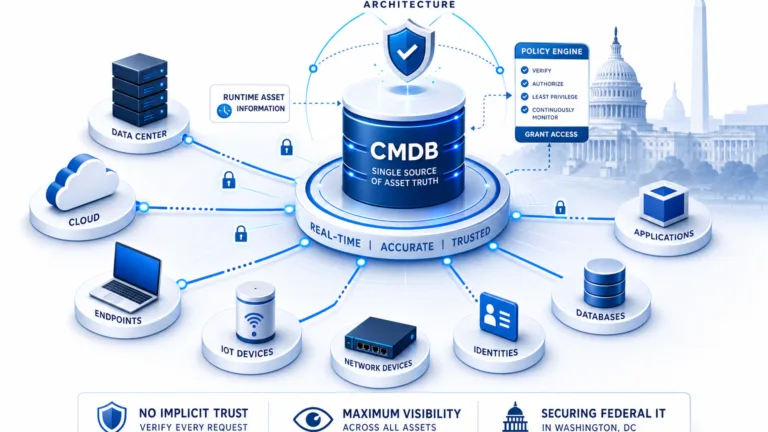
Virima is the discovery and CMDB foundation behind CMDB data accuracy for digital transformation — a system a CIO can cite in a board pack without overstating outcomes. It maps what exists, how it connects, and what changed on a schedule. Board decisions and audit opinions remain human processes layered on that map.
What changes before the next audit. High-frequency discovery closes the validation gap without a manual reconciliation project ahead of every review.
What stays defensible a year into the roadmap. Scheduled discovery cycles keep the record current as the program itself changes scope, owners, and cloud footprints across AWS and Azure estates.
Where it shows up in the tools the team already runs. Integrations keep the CIO from maintaining a second system only to keep the deck honest. Pair discovery with IT asset management when license and lifecycle facts must sit beside configuration truth.
Virima does not “ensure” board approval or audit pass rates. It supplies the infrastructure map those conversations require.
How does discovery-validated CMDB data change board reporting?
Discovery-validated CMDB data attaches an explicit freshness standard to counts, dependencies, and progress metrics. Directors review numbers tied to recent scans instead of static inventory claims that aged after the last manual edit.
What changes once the board can trust the data
| From | To |
|---|---|
| A roadmap defended on faith | A roadmap defended on a timestamp |
| Board metrics presented as current | Board metrics carrying an explicit freshness standard |
Scope deltas surface in discovery reviews instead of emergency change orders after a wave starts, so mid-roadmap surprises drop. Audit prep gets cleaner too — inventory evidence is produced on schedule, not rebuilt under interview pressure. And the board conversation shifts from after-the-fact explanation to a real discussion of risk, because directors can challenge assumptions against shared facts instead of competing spreadsheets.
Getting started
- Pick one roadmap milestone already scoped against CMDB data.
- Run a single discovery validation against that scope.
- Present the delta to the CIO’s own team before it reaches the board.
- Connect discovery data to the ITSM platform already in use.
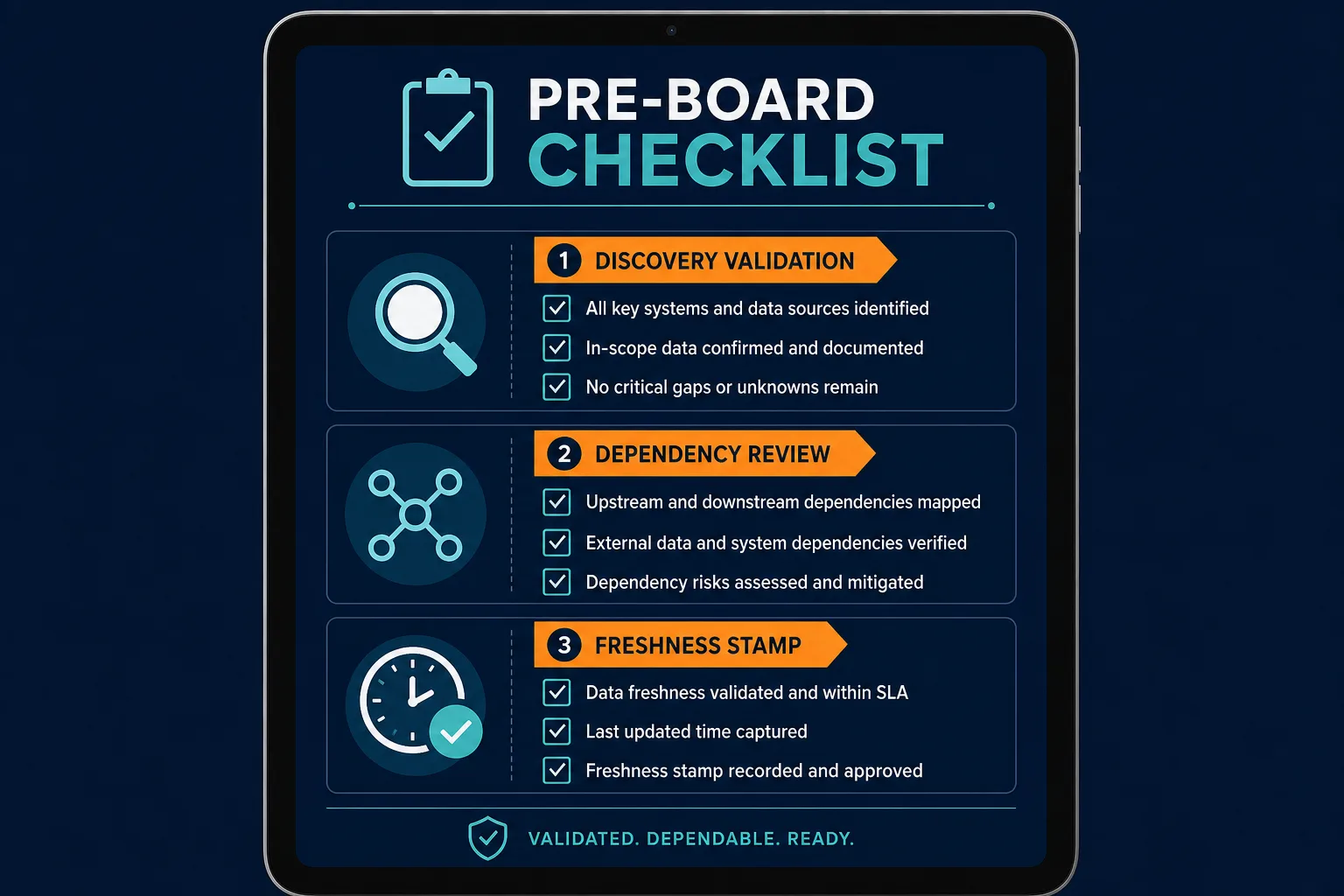
- Set a freshness standard for any data that reaches a board deck going forward.
Hybrid programs should also ask why a data-center CMDB does not automatically cover the cloud half of a transformation roadmap.
Defending the next roadmap on verified inventory
A transformation roadmap is only as defensible as the data under it. CMDB data accuracy for digital transformation is the difference between a peer-level board briefing and a defensive one. See what a discovery-validated CMDB would show your board before the next update lands on the agenda. Book a free demo today.
Frequently Asked Questions
What does it mean for CMDB data to be trustworthy during a digital transformation?
Trustworthy CMDB data means current configuration items, validated relationships, and a discovery timestamp the CIO can defend. Completeness without freshness still leaves board metrics open to challenge when infrastructure has changed since the last manual update.
How much of digital transformation failure traces back to infrastructure data quality?
BCG research summarized by BCG Platinion still shows most transformations miss objectives. Infrastructure data quality is one controllable input among leadership, funding, and operating-model factors. It is not the sole root cause, and it is one CIOs can validate before the next board pack.
What should a CIO tell the board when CMDB data has not been fully validated yet?
State the freshness gap plainly, name the milestone most exposed, and commit to a discovery validation date before the next funding decision. Boards tolerate known uncertainty with a plan. They punish silent assumptions that break after approval.
How does discovery-sourced CMDB data differ from a manually maintained CMDB?
Manual CMDB rows age with the last human edit. Discovery-sourced rows carry scan time, source method, and reconciliation history. Dependency maps built after service definitions are supplied reflect live infrastructure rather than drawings that stopped matching production.
What is the first step for a CIO who suspects a transformation roadmap rests on unverified data?
Choose one board-visible milestone, run discovery against its CMDB scope, and brief the internal leadership team on the delta before the next directors’ meeting. That single validation sets the freshness standard for every later metric.