Stop Manual CI Maintenance With CMDB Business Rules

Manual CMDB maintenance causes data drift that makes CMDB data unreliable within months of deployment. Virima 6.1.1 business rules automate CI promotion decisions, downstream sync actions, notifications, and decommissioning workflows — eliminating the manual burden that kills most CMDB programs.
TL;DR
- Most CMDB projects fail not at implementation but at maintenance — manual CI updates create data drift that makes the CMDB unreliable within 6-12 months.
- CMDB business rules automate the three most destructive manual tasks: CI promotion decisions, downstream sync actions, and asset decommissioning.
- Virima 6.1.1 business rules operate on conditions, triggers, and actions — allowing IT teams to define precise automation logic without code.
- Runbook automation executes repetitive ITSM tasks (password resets, server reboots, patch-triggered workflows) from event conditions, reducing service desk ticket volume significantly.
- The Virima Workflow Template Generator creates reusable process templates modeled on real business workflows — no development required.
Most CMDB projects begin with a strong implementation phase: infrastructure discovery, CI population, relationship mapping, and an initial data quality audit. The CMDB is accurate, complete, and trusted. Six months later, it is not.
The culprit is almost always the same: manual maintenance. IT environments change continuously — servers are provisioned and decommissioned, software versions are updated, cloud instances are spun up and terminated, and network devices are reconfigured. Each of these changes generates a delta between the actual environment and the CMDB record. When that delta is resolved by a human filling out a form, the resolution depends on the human noticing the change, having the time to record it, and knowing the correct format.
This process fails at scale. IT teams do not have the bandwidth to manually update CI records for every infrastructure change. Data drift accumulates. Within 6-12 months, the CMDB is no longer trusted as a system of record. Change management stops using it for impact analysis. Incident management stops querying it for asset relationships. The CMDB becomes a reporting artifact instead of an operational tool.
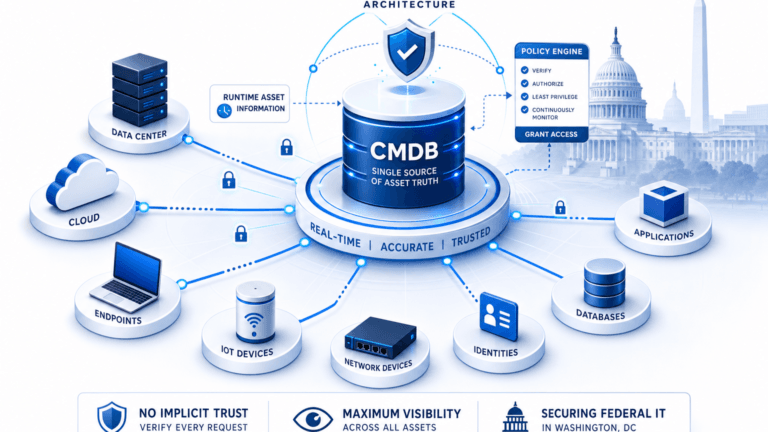
CMDB automation with business rules breaks this cycle. Business rules define the logic that governs CI maintenance decisions — which changes get auto-promoted, which trigger notifications, which kick off downstream sync actions — and execute that logic automatically at the moment a change occurs.
What Are CMDB Business Rules?
CMDB business rules are configurable logic statements that automate CI maintenance decisions. A business rule consists of three components:
- Conditions — the criteria that must be true for the rule to apply (e.g., CI type = “server”, attribute = “OS version”, new value does not match approved baseline).
- Triggers — the event that causes the rule to evaluate (e.g., Discovery scan completes and returns a changed CI attribute, an ITSM ticket is raised, a scheduled task runs).
- Actions — what the system does when the conditions are met and the trigger fires (e.g., auto-promote the CI change to the CMDB, flag the change for manual review, send a notification, trigger a downstream sync, open a change record).
Business rules allow IT teams to encode their own governance logic into the CMDB — not as a process document that humans are supposed to follow, but as automated decisions that the system executes consistently, at machine speed.
RapDev’s analysis of CMDB automation best practices consistently identifies automation at the data-intake layer — controlling what changes make it into the CMDB and under what conditions — as the single most impactful factor in long-term CMDB accuracy.
The 3 Most Common Manual CMDB Maintenance Tasks
1. Deciding Which Discovered CI Changes to Auto-Promote vs. Flag for Review
Every time Virima Discovery runs, it returns a set of discovered configuration states. Many of those states will differ from what the CMDB currently records — a software version was updated, a service was started or stopped, a network port was added.
Without business rules, a CMDB administrator must review each discovered delta and decide: is this change intentional (promote to CMDB) or unexpected (flag for investigation)?
In large environments, this review queue grows faster than anyone can process it. Administrators make inconsistent decisions. Some changes get promoted without review. Others sit in the queue for weeks.
Business rules replace this human review queue with automated decision logic. A rule that says “if CI type = ‘managed server’ and changed attribute = ‘antivirus version’ and new version is in the approved version list, auto-promote” handles hundreds of routine software update records per day without human intervention. Only the exceptions — attribute changes that do not match the defined conditions — go to the human review queue.
2. Triggering Downstream Sync and Notification Actions When Specific CI Attributes Change
A CI attribute change rarely exists in isolation. When a server’s OS version changes, the change management team should know. When a network device’s firmware is updated, the network documentation system should sync. When a virtual machine migrates to a different host, the service map should update.
Without automation, each of these downstream actions requires a human to notice the CI change, identify the downstream implications, and manually execute the appropriate actions. This is exactly the kind of task that gets skipped when teams are under pressure.
Business rules in Virima trigger downstream sync actions, notifications, and scheduled tasks automatically when specific CI attribute changes are detected. The trigger is the Discovery event; the action is the downstream consequence — no human intervention required.
3. Decommissioning Retired Assets in a Structured, Auditable Way
Asset decommissioning is one of the most inconsistently managed CMDB maintenance processes. When a server is retired, the correct process is: update the CI status, remove or archive the asset record, update any service maps that included the CI, close out any open change or incident records, and notify the affected stakeholders. In practice, many organizations do step one (update CI status) and skip the rest.
Business rules can automate the decommissioning workflow. When a CI’s status changes to “decommissioned” or Discovery no longer finds the asset, a rule triggers the full decommissioning sequence: service map update, open record closure, stakeholder notification, and archival. The result is a structured, auditable decommissioning process that does not depend on a human remembering every step.
How Virima Business Rules Work
Virima 6.1.1 provides a business rules engine within its CMDB module. The interface allows IT administrators to create rules using a no-code condition builder.
Each rule definition includes:
- Trigger type — Discovery event, ITSM event, scheduled task, or manual trigger.
- Condition set — attribute-level conditions with logical operators (AND/OR) and comparison types (equals, contains, greater than, changed from, changed to).
- Action sequence — one or more actions executed when the conditions are satisfied: auto-promote, flag for review, send notification, trigger sync, create record, execute runbook.
Rules can be prioritized and sequenced. If multiple rules apply to the same CI event, Virima evaluates them in priority order and applies the first matching rule — or all matching rules, depending on configuration.
This structure gives IT teams precise control over their CI promotion logic. A large enterprise might run dozens of business rules covering every CI type in its environment, each rule encoding a specific governance decision that would otherwise require human judgment.
Examples of Business Rules in Production
Network Device Type Changes
When Discovery detects that a network device’s device type attribute has changed (e.g., a switch reclassified as a router due to a firmware feature update), a business rule flags the change for manual review, notifies the network team, and opens a configuration review task. The change is not auto-promoted until the network team confirms the reclassification is intentional.
Software Version Updates
When Discovery detects a software version change on a managed server, a business rule checks the new version against an approved version list. If the version is on the approved list, the change auto-promotes to the CMDB. If not, the change is flagged, a notification goes to the patch management team, and a task is created to investigate the unauthorized version.
Cloud CI Lifecycle
When Discovery detects that a cloud CI (EC2 instance, Azure VM) has entered a terminated state, a business rule triggers the full decommissioning sequence: CI status update, service map removal, open ticket closure, cost allocation system notification, and archival.
Runbook Automation for ITSM Events
Virima 6.1.1 includes runbook automation capabilities that extend business rules logic into ITSM event-triggered workflows.
A runbook in Virima is an automation script that executes a sequence of IT tasks in response to a defined event condition. Runbook automation in Virima handles tasks like:
- Password resets — when a service desk ticket matches the “password reset” category, and the user is verified, the runbook executes the reset sequence automatically without agent involvement.
- Server reboots after patch updates — when a patch deployment job completes successfully on a specific CI, the runbook schedules and executes the post-patch reboot.
- Account unlocks — when an AD lockout event is detected, the runbook verifies the user identity and unlocks the account.
- Certificate renewals — when a certificate expiry alert fires within the defined renewal window, the runbook triggers the renewal process and updates the CMDB with the new certificate record.
Runbook automation integrates with the CMDB: when a runbook executes, it reads CI data from the CMDB (owner, environment, criticality, maintenance window) to determine the appropriate execution context, and writes results back to the CMDB (updated CI attributes, closed tickets, audit records).
Workflow Template Generator: Building Reusable Process Templates
Virima 6.1.1 includes a Workflow Template Generator that allows IT teams to build reusable workflow templates without code.
A workflow template models a real business process as a sequence of steps — each step with its own conditions, actions, approvals, and notifications. Templates can be parameterized: the same template applies to different CIs, different requestors, or different environments by swapping parameter values at runtime.
The Workflow Template Generator targets process owners — not developers. An IT operations manager can model their onboarding process, their standard change workflow, or their incident escalation procedure in the template builder, then apply that template consistently across every instance of the process.
Once created, templates are available in the Virima workflow catalog. Service desk agents, change engineers, and IT administrators invoke them directly from ITSM records — applying the full process template to a specific CI or ticket without manual coordination.
Business Rules vs. Manual CMDB Governance: The Total Cost Comparison
CI promotion decision speed
- Manual CMDB Governance: Hours to days
- Business Rules Automation: Seconds
Decision consistency
- Manual CMDB Governance: Variable (person-dependent)
- Business Rules Automation: 100% consistent
Maintenance FTE requirement
- Manual CMDB Governance: 1-3 FTEs for large environments
- Business Rules Automation: Near-zero FTE
Data drift rate
- Manual CMDB Governance: High (6-12 months to unreliable)
- Business Rules Automation: Low (continuously corrected)
Audit trail
- Manual CMDB Governance: Incomplete (human-logged)
- Business Rules Automation: Complete (system-generated)
Downstream action reliability
- Manual CMDB Governance: Dependent on human follow-through
- Business Rules Automation: Automatic and verifiable
The total cost difference is significant. Manual CMDB maintenance requires dedicated CMDB administrator time, generates inconsistent data quality, and still produces data drift. Business rules automation requires an initial configuration investment but delivers continuous, consistent CMDB maintenance at essentially zero ongoing FTE cost.
How to Build Your First Business Rule in Virima
Building a business rule in Virima follows five steps:
- Identify the decision. Start with the most frequent manual review task your CMDB administrators perform. What is the condition they evaluate, and what is the action they take? That is the rule.
- Define the trigger. Is this rule evaluated after every Discovery scan? After a specific ITSM event? On a schedule? Select the trigger type in the Virima rule builder.
- Set the conditions. Use the condition builder to specify the CI type, attribute name, comparison operator, and value. Add additional conditions with AND/OR operators as needed.
- Configure the actions. Select the action(s) from the available action library: auto-promote, flag for review, notify, sync, create record, run runbook.
- Test and activate. Run the rule against a test CI set in a non-production environment. Verify the conditions and actions behave as expected, then activate in production.
Start with one high-volume, low-risk rule — such as auto-promotion of approved software version updates — to build confidence in the automation framework before expanding to more complex governance decisions.
Conclusion
Manual CMDB maintenance is the primary reason CMDB projects fail over time. Data drift, inconsistent governance decisions, and insufficient administrator bandwidth turn an initially accurate CMDB into an unreliable database that IT teams stop trusting.
Virima 6.1.1 business rules replace manual governance with automated decision logic — encoding CI promotion rules, downstream sync triggers, notification actions, and decommissioning workflows into the system itself. Runbook automation and workflow templates extend this logic into ITSM event handling and process standardization.
The result is a CMDB that maintains its own accuracy, governed by rules that IT teams define and control.
Schedule a Demo at Virima to see how Virima business rules automate CMDB maintenance in your environment.
Frequently Asked Questions
What is the difference between CI auto-promotion and manual CMDB review?
CI auto-promotion means a discovered configuration change is automatically written to the CMDB when it meets the conditions defined in a business rule. Manual CMDB review means a CMDB administrator inspects the discovered change and decides whether to promote it. Virima business rules allow organizations to define precisely which types of changes are auto-promoted and which require manual review — combining the speed of automation with the control of human judgment where it matters.
Can Virima business rules trigger changes in external systems?
Yes. Virima business rules can trigger downstream sync actions to connected systems through Virima’s ITSM integrations. When a business rule detects a CI attribute change, it can notify connected service management platforms (ServiceNow, Jira, Ivanti, HaloITSM) via webhook or API-based sync. The specific integration options depend on the systems connected to the Virima deployment.
How many business rules can be configured in Virima?
Virima 6.1.1 does not impose a hard limit on the number of business rules. Organizations can configure as many rules as their CI governance requirements demand. Large enterprise deployments typically run dozens of active rules across different CI types, attribute categories, and process contexts. Rule evaluation is prioritized and sequenced, so large rule sets do not create processing conflicts.
This article is based on Virima 6.1.1 capabilities. Feature availability may vary by deployment configuration.