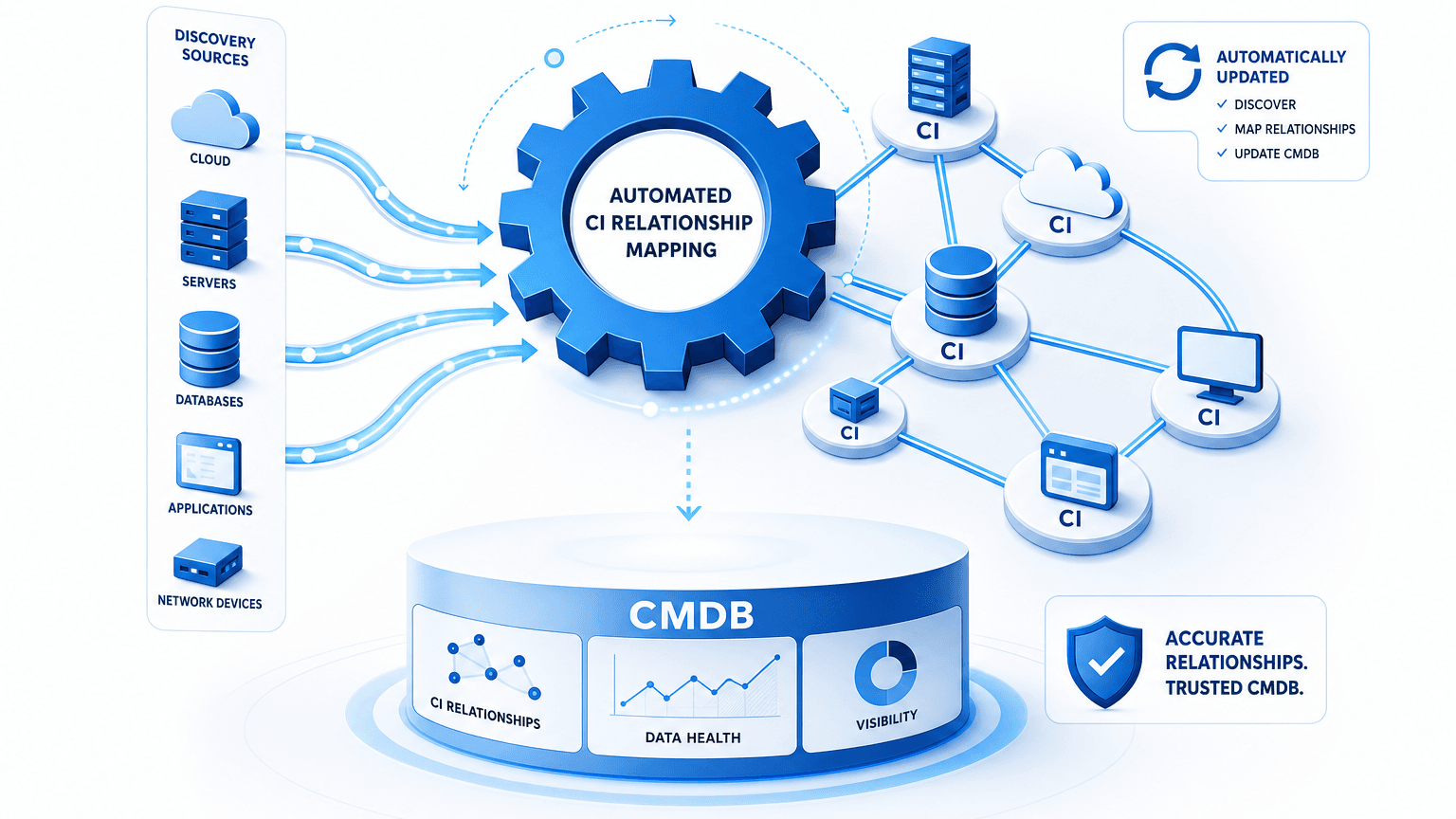
How do teams keep CI relationships accurate without full-time data stewards?

Teams keep CI relationships accurate without full-time data stewards by treating relationship edges as discovery outputs, not human data-entry jobs. Scheduled multi-source discovery refreshes what exists and how it connects. Reconciliation merges conflicting sources into one authoritative CI. Service definitions plus automated service dependency mapping keep dependency paths current for change and incident work. Humans set policy, ownership, and exception rules. Systems carry the volume of edge maintenance.
That model matters because relationship drift is where CMDB trust dies first. A server CI can look “complete” while its runs-on, depends-on, and exchanges-data-with edges still point at decommissioned hosts. Change boards then approve low-risk tickets that hit unpriced multi-hop paths. Incidents route to the wrong owner because the map still shows last quarter’s topology.
Flexera’s 2025 State of ITAM Report found complete visibility across the technology stack fell to 43% from 47% year over year among 506 global IT professionals. When inventory visibility slips, relationship accuracy slips with it. Manual stewards cannot close that gap at hybrid scale.
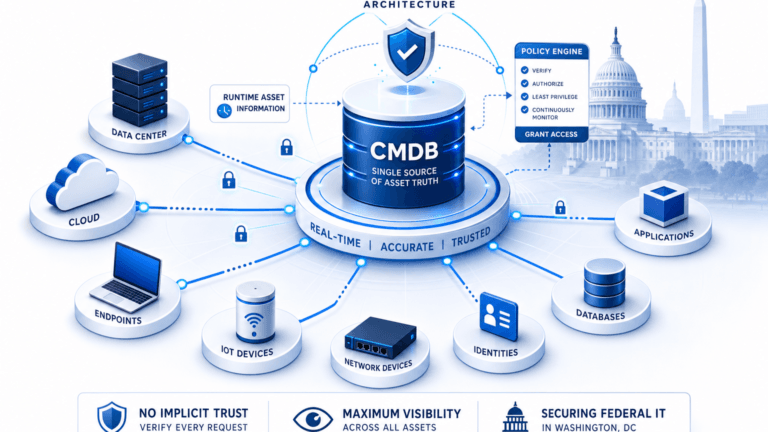
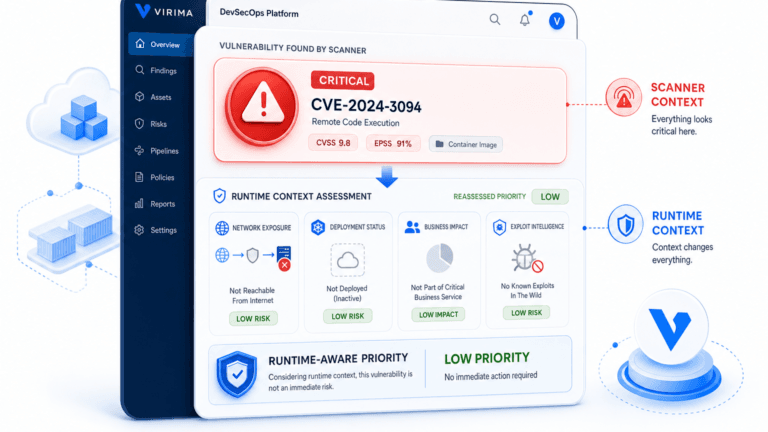
Virima’s approach is discovery-sourced Trusted Runtime Truth: authoritative multi-source discovery, reconciled CIs, and ViVID™ service maps built from defined services so CMDB relationship maintenance is operational, not a permanent headcount line.
Why full-time data stewards can’t keep CI relationships accurate at hybrid scale
Full-time data stewards fail when CI count, cloud churn, and integration sprawl outrun human edit cycles. A steward can correct dozens of edges per day. A mid-size estate creates thousands of relationship candidates per discovery cycle across on-prem, AWS, Azure, VMs, and network gear.
In practice, this shows up in five ways: relationships update only after an outage; apps move teams with no clear edge owner; cloud, hypervisor, and ITSM tools each hold a partial graph; a cleaned CMDB ages between manual campaigns; and CAB reviews CI names instead of current multi-hop impact.
Stewards remain valuable for policy, classification rules, and exception handling. They should not be the primary write path for every Installed On or Uses edge. Virima’s CMDB is built so automated CI population and relationship mapping absorb that write volume while owners govern quality rules. See the CMDB capabilities ITSM teams rely on most for the full breakdown.
Weighing this model against a steward hire? See how discovery-sourced Trusted Runtime Truth approaches CI population and relationship mapping first.
The operating model: discovery writes edges, people govern rules
Keep accuracy without full-time stewards by splitting work into four lanes. CI reconciliation merges conflicting multi-source attributes and relationships into one authoritative record, so AWS, Azure, and on-prem facts don’t create duplicate CIs.
| Lane | Owner | System job | Human job |
|---|---|---|---|
| Discover | Ops / platform | Agent and agentless scans, cloud and network inventory on a defined schedule | Credential scope, coverage targets, cycle frequency |
| Reconcile | CMDB owner | Merge multi-source attributes and relationships into one CI | Match rules, survivorship, duplicate policy |
| Map services | Service owners + CMDB | Build dependency maps after service composition is defined | Name services, import definitions, validate critical paths |
| Consume | Change, incident, SecOps | Impact views, ownership, history for decisions | Approve changes, close incidents with graph context |
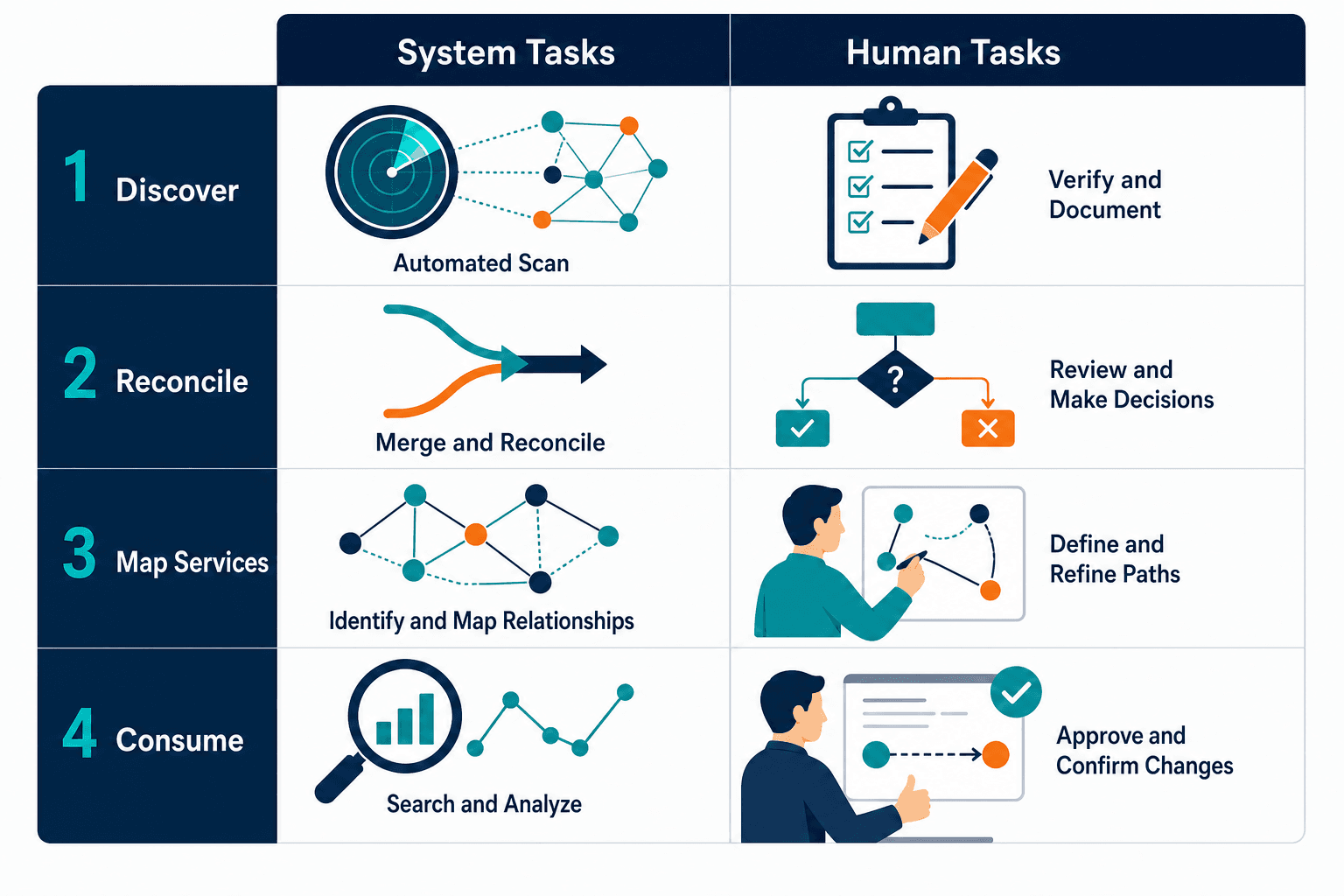
Virima implements that split with automated CI population, multi-source reconciliation, CMDB health scoring, CI lifecycle tracking, and ViVID™ map builds after service definitions exist.
How do you maintain CMDB CI relationships without full-time data stewards?
Maintain CI relationships without full-time stewards by letting scheduled multi-source discovery and reconciliation write edges, while people own match rules, service definitions, and exceptions. Service maps then keep dependency paths current for change and incident use.
Relationship types that must stay fresh (and how automation covers them)
Not every attribute needs the same refresh priority. Edges that drive blast radius deserve discovery-backed refresh first.
- Runs on / hosted on (compute to hypervisor, cloud, or bare metal): agent, agentless, cloud, and network discovery — not spreadsheet import.
- Installed on (software to hosts): inventory fingerprinting tied to the host CI.
- Depends on / uses and virtualizes / clustered with (app tiers, databases, queues, HA sets): the same discovery methods, evidenced by network path adjacency.
- Service composition: human or EA-defined; Virima auto-builds the dependency map and impact paths from that definition.
- Owned by / supported by: directory and ITSM sources with clear survivorship; humans resolve conflicts.
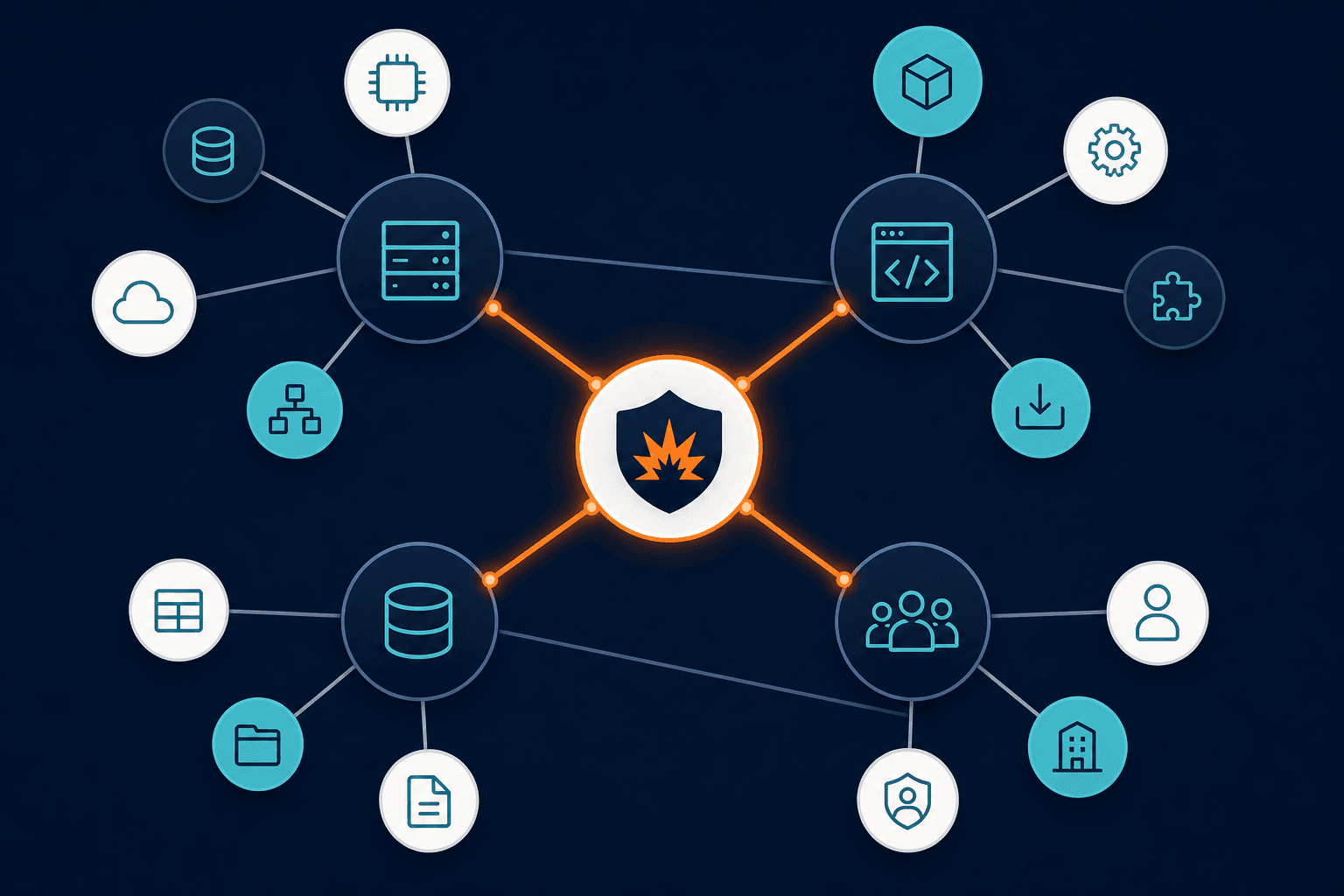
ViVID™ service mapping keeps maps current once services are defined, but it does not invent which apps form a business service — a boundary that keeps automation honest while removing most edge-maintenance labor from stewards.
Cadence: how often discovery must run when you have no steward bench
Without full-time stewards, cadence replaces heroics. Match discovery frequency to how fast topology changes in each domain.
Practical cadence bands:
- Volatile cloud and containers: Daily or multiple cycles per day where credentials and APIs allow
- Stable data center hardware: Several times per week may suffice
- Network gear: Aligned to change windows and config backup jobs
- After major migrations: Extra cycles until health scores stabilize
- Before CAB bulk windows: Fresh graph pull for impact analysis
Virima discovery is scheduled, not passive continuous event streaming, so cadence is designed around discovery cycles, tightened wherever change risk runs highest.
CMDB owners without stewards should publish a simple SLA: maximum edge age, who gets paged when health scores drop, and which edges block change approval when stale.
Governance that replaces headcount: rules, exceptions, and health scores
Automation without governance creates confident wrong graphs. Replace steward headcount with thin, enforceable controls.
Controls that scale:
- Match and merge rules for identity keys (serial, instance ID, hostname + domain, cloud resource ID)
- Survivorship when sources disagree on OS version or relationship endpoints
- Staleness thresholds by CI class
- Exception queues only for unmatched or conflicting records
- Audit history on CI and relationship changes for compliance
- RBAC so app owners can confirm service definitions without editing raw infrastructure edges
Virima supports this with multi-source data reconciliation, CMDB health scoring, audit trail and history logging, role-based access, and change impact analysis that surfaces downstream CI impact before approval. This approach aligns with ITIL-aligned CMDB practices. Stewards (or part-time configuration managers) work the exception queue, not the full graph.
What governance replaces full-time CMDB data stewards?
Replace full-time stewards with match and merge rules, survivorship policy, staleness thresholds by CI class, RBAC, audit history, and an exception queue. Automation writes most relationships; people resolve conflicts and own service definitions.
Workflow blueprint: from discovery cycle to change-ready graph
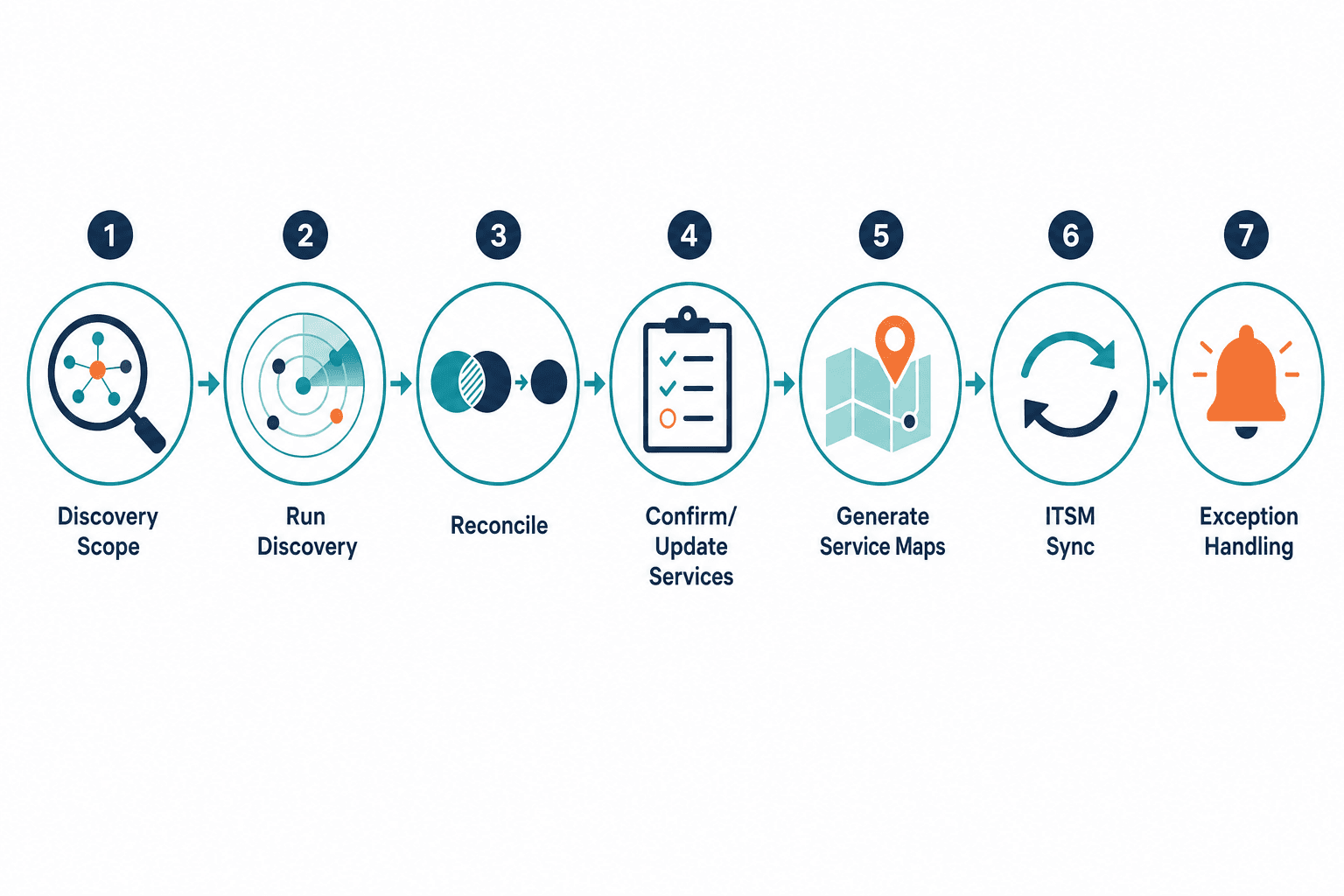
Use this repeatable workflow when relationship accuracy cannot depend on a dedicated steward team: scope, discover, reconcile, confirm services, map, sync, and exception-hunt.
Step 1, Scope credentials and targets
Cover on-prem subnets, hypervisors, AWS accounts, Azure subscriptions, and network devices that matter to priority services.
Step 2, Run discovery on the published schedule
Collect hardware, software, cloud, VM, and network facts. Prefer evidence over free-text CI notes.
Step 3, Reconcile into authoritative CIs
Deduplicate. Attach relationship edges to the surviving CI. Log history.
Step 4, Confirm or update service definitions
Service owners maintain composition lists. Import when EA tools already hold the catalog.
Step 5, Generate and review service maps
Validate critical paths for revenue and safety services. Fix definition errors, not thousands of manual edges.
Step 6, Push or sync to ITSM consumers
Change, incident, and request flows read the same relationships your ops team trusts.
Step 7, Score and exception-hunt
Health scoring directs limited human time. Only unresolved conflicts need a person.
Metrics that prove you do not need more stewards
If leadership asks for headcount, answer with graph quality metrics, not effort hours alone.
| Metric | What good looks like | Why it replaces stewards |
|---|---|---|
| Critical relationship freshness | Edges under SLA age for top services | Shows automation keeps pace with change |
| Duplicate CI rate | Trending down after match-rule tuning | Less manual merge work |
| Orphan CI rate | Hosts and apps linked into services | Map consumers trust impact paths |
| Exception queue age | Days, not weeks | Proves humans only handle leftovers |
| Change failures tied to unknown deps | Declining after map adoption | Business proof for the model |
| Audit trail completeness | Every automated and manual write logged | Compliance without spreadsheet archaeology |
For an IT Director or VP, translate these metrics into headcount and audit-risk terms: a shrinking exception queue means less time reconstructing service ownership under audit, and a declining unknown-dependency failure rate proves automation is absorbing CI growth instead of steward headcount. For the cost side of that argument, see the real cost of inaccurate CMDB data.
Where Virima fits when ITSM already owns the CMDB record
Many teams keep ServiceNow or another ITSM platform as the system of record for tickets and some CI fields. Relationship accuracy still needs a discovery-sourced CMDB layer that does not depend on stewards typing edges into forms.
Virima augments that model by discovering and reconciling CIs and relationships, scoring CMDB health, and building ViVID™ maps after services are defined, then syncing usable structure into ITSM via the integrations hub — including ServiceNow, Jira, Ivanti, HaloITSM, Xurrent, Hornbill, and TeamDynamix. The point is filtration and authority before workflow context — not that humans never touch the CMDB again.
Can you keep CI relationships accurate if ServiceNow is already the CMDB?
Yes. Keep ServiceNow (or another ITSM CMDB) as the workflow system of record while a discovery-sourced layer refreshes CIs and relationships on a schedule, reconciles multi-cloud sources, and syncs authoritative edges so stewards are not the primary write path.
Closing: accuracy is a system design choice
Teams that keep CI relationships accurate without full-time data stewards design the CMDB so machines write edges and people write rules. Scheduled discovery, reconciliation, health scoring, and service-map generation after clear service definitions remove the backlog that used to justify permanent steward roles. Humans still matter for ownership, policy, and exceptions — not for every Depends On link in a hybrid estate.
If your change board still trusts last quarter’s topology, treat relationship maintenance as an automation problem with a thin governance layer, then validate it against your own exception queue and CAB failure patterns.
Frequently Asked Questions
How often should discovery run if we have no dedicated CMDB data stewards?
Run discovery on a published schedule matched to change velocity. Use tighter cycles for cloud and volatile tiers, somewhat longer intervals for stable hardware, and extra cycles after migrations or before large CAB windows. Without stewards, freshness SLAs and health scores replace ad hoc cleanup campaigns. Virima supports scheduled agent, agentless, cloud, and network discovery rather than passive continuous event streaming.
What still requires a human when CI relationships are automated?
Humans still own credential scope, match and survivorship rules, service composition, exception queues, and change decisions. Automation should write most infrastructure and software relationship edges, so people are not re-keying routine Runs On or Installed On links after every release.
Does Virima’s ViVID™ still require me to define business services manually?
Yes. Service composition (which applications and sites make a business service) must be provided manually, by spreadsheet import, or from an EA source such as Lean IX. Once definitions exist, Virima ViVID™ automatically builds and refreshes dependency maps from discovered infrastructure. That split is what keeps maps accurate without full-time stewards redrawing diagrams.
How does Virima help keep CI relationships accurate without full-time data stewards?
Virima discovers assets across agent, agentless, cloud, and network methods, then populates, reconciles, and maps relationships between the resulting CIs. It also scores CMDB health and builds ViVID™ service maps once services are defined, then syncs into ITSM tools through the integrations hub.
What is the fastest way to prove relationship accuracy improved without hiring stewards?
Baseline duplicate and orphan CI rates, exception queue age, and change failures tied to unknown dependencies. After scheduled discovery, reconciliation, and service-map adoption, report the same metrics on a fixed interval — a declining unknown-dependency failure rate is the board-friendly proof automation replaced steward backlog.