CI Drift Between Discovery Scans: What Really Happens and How Large It Gets

CI drift between discovery scans is the accumulation of configuration changes, provisioning events, and decommissioning activity that occurs after a scan completes but before the next one runs. In a customer environment managing 3,600 CIs on a weekly discovery schedule, drift reached 4% at 24 hours, 11% at 72 hours, and 23% at the 7-day mark — 828 CIs carrying inaccurate records at the moment of highest operational reliance. Understanding how fast CI drift accumulates, and which asset classes drive it, is the first step toward a discovery schedule that keeps CMDB data operationally reliable.
Defining the drift window
The drift window is the period between a completed IT discovery scan and the next scheduled one. In weekly scan environments, that window is 168 hours. Any change to a CI’s state during those 168 hours produces a gap between what the CMDB records and what actually exists in the environment.
This is not a discovery failure. The scan ran correctly, and what it recorded was accurate at the scan timestamp. The problem is that 168 hours is a long time for infrastructure to stay still, particularly in environments with active cloud workloads, containerized services, and frequent change activity.
This measurement of configuration drift across the CMDB is what most teams underestimate. We identified four distinct mechanisms through which CI records go stale. New CIs provisioned after a scan closes fall into the provisioning category. Decommissioning covers assets retired or removed after the scan ran. Configuration changes capture attribute-level updates to existing CIs, such as OS patch status, installed software versions, or network interface settings. Relationship changes cover shifts in a CI’s connections to other CIs where the CI itself was not added or removed.
Each mechanism produces a different kind of CMDB inaccuracy, and each carries different operational consequences.
Measuring CMDB accuracy loss at 24 hours, 72 hours, and 7 days
At 24 hours after each scan, 4% of the 3,600 CIs had drifted from their recorded state. That is 144 CIs. The majority were configuration changes: patch status updates, software version increments, and network interface adjustments. A smaller number represented new CIs provisioned after the scan closed, mostly cloud instances started for short-duration workloads.
At 72 hours, drift reached 11%, or 396 CIs. By this point, decommissioning events were beginning to add to the total. In cloud environments, instances provisioned and fully decommissioned within the scan window left no trace in either the prior or current CMDB state. Services had run and been removed without a single accurate CI record reflecting their existence or removal.
At the 7-day mark, just before the next scheduled scan ran, 23% of CIs had drifted. In absolute terms, 828 CIs were carrying stale or inaccurate records at the moment teams were most likely relying on them: during change planning, incident response, and audit review.
The drift did not accumulate evenly. Roughly 40% of the total 7-day drift appeared in the first 24 hours. The next 33% built up between hours 24 and 72. The remaining 27% accumulated across hours 73 through 168. A 2025 EMA ServiceOps research report found that organizations running weekly discovery cycles reported CI inaccuracy rates of 18-22% at the point of their next scan, which aligns with our measurement.
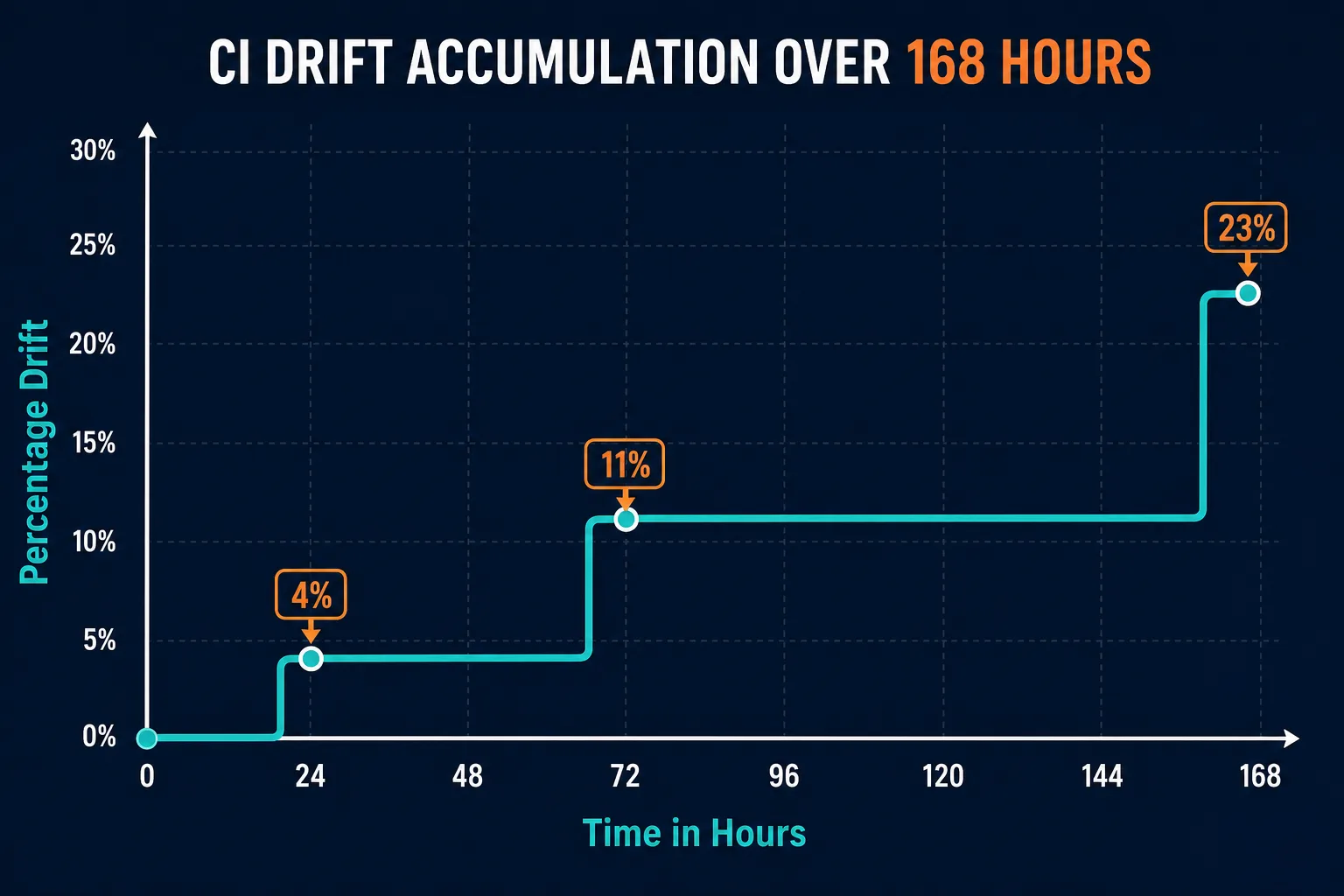
In a 3,600-CI environment on a weekly scan cycle, CI drift between discovery scans reached 4% at 24 hours, 11% at 72 hours, and 23% at the 7-day mark just before the next scan ran. That is 828 CIs carrying inaccurate records at the point of highest operational reliance — during change windows, incident response, and compliance review.
Which CI classes show the fastest configuration drift
Drift velocity varies significantly by CI type. In that environment, containers averaged 14.7 state changes per CI per week, making them the fastest-drifting class. Cloud instances averaged 6.2 changes per CI per week, driven by auto-scaling events, configuration template updates, and ephemeral workloads that cycle within the scan window. On-premises physical servers averaged 0.3 changes per CI per week, primarily from OS patch events and interface configuration updates tied to scheduled maintenance windows.
The gap between container drift velocity and physical server drift velocity is not marginal. A container environment with 200 active pods generates roughly 2,940 state change events per week. Those changes do not all produce visible breakage, but any subset touching service boundaries, ownership records, or dependency mappings has direct consequences for the teams relying on that data.
This matters for how you direct CMDB auto discovery effort. Treating all CI classes with the same scan frequency means your CMDB accuracy figures reflect the slowest-drifting portion of your environment, not the portion that changes fastest.
For agent-based vs agentless discovery planning, container drift velocity is a useful planning signal. Agent-based approaches can report state changes at the container level between scheduled scans. Agentless polling on a weekly cycle captures containers only at the endpoints of their lifecycle, missing all intermediate state.
Containers drift fastest at an average of 14.7 state changes per CI per week. Cloud instances average 6.2 changes per CI per week due to auto-scaling and ephemeral workloads. On-premises physical servers average 0.3 changes per CI per week. Aligning scan frequency to CI class drift velocity reduces CMDB inaccuracy more efficiently than a uniform scan schedule across all asset types.
Operational impact at each drift level
At 4% drift: change planning risk
At 4% drift (day 1), the primary risk sits in change management. A change approval based on 24-hour-old CI data may miss a newly provisioned dependency or a CI that has already been reconfigured. The CAB is working from an incomplete picture. CMDB best practices call for validating CI state before change approval, which is harder to fulfill when the CMDB is already a day behind the environment.
At 11% drift: incident response exposure
At 11% drift (day 3), incident response takes the larger hit. A P1 incident firing at hour 60 post-scan puts the responder in a CMDB that is 60 hours stale at the CI level. For high-drift CI classes, the actual accuracy figure at that moment is lower than the aggregate suggests. The ViVID service maps a responder uses to trace blast radius are only as accurate as the CI records they render. Stale relationship data means stale impact analysis.
Is your CMDB stale during incidents? Download the CI Drift Assessment Template — map your CI mix by type, calculate your drift exposure window, and identify which asset classes need higher-frequency scanning. Virima Use Cases
At 23% drift: compliance materiality
At 23% drift (day 7), compliance exposure becomes material. If 828 CIs carry inaccurate records at scan time, any audit sample drawn from those CIs will encounter discrepancies between recorded and actual state. For environments subject to PCI DSS, SOX, or ISO 27001, the CMDB is an artifact of record, not just an operational convenience. A discovery-sourced approach to build a CMDB that records when each CI was last verified makes the inaccuracy rate visible and the remediation plan defensible.
NIST SP 800-128, which governs security-focused configuration management for federal and regulated environments, identifies stale configuration records as a primary source of audit discrepancies. According to NIST guidance, configuration item records should be verified at intervals proportional to the change velocity of the asset class, which is precisely the tiered approach this drift measurement supports.
At 23% CI drift, 828 of 3,600 CIs carry inaccurate records when the next scan runs. In change management, missing or stale dependencies mean CABs approve changes without a complete blast radius picture. In incident response, P1 triage teams navigate service maps built on 7-day-old CI relationships. In compliance audits, samples drawn from the drifted population find discrepancies between recorded and actual state that discovery-current records would have avoided.
Reducing drift with higher-frequency discovery cycles
Discovery scan frequency is the primary lever for shrinking the drift window — the gap is a function of schedule, not a fixed property of the environment. In that environment, moving from a 7-day cycle to a daily cycle reduced peak drift at scan time from 23% to 4%. Moving to a 6-hour cycle reduced peak drift to under 1%.
High-frequency discovery cycles require an architecture that can run scans without disrupting production systems or saturating the network at operationally sensitive times. Credential management, scan scope, and protocol selection all determine whether higher frequency is achievable in practice. The active vs passive IT asset discovery decision is relevant here: passive approaches that capture change events rather than polling all CIs on a fixed schedule can track drift between scan cycles without the overhead of repeated active sweeps.
The goal is not to scan everything as frequently as possible. It is to understand which CI classes drift fastest and schedule discovery runs accordingly. Containers and cloud instances benefit from high-frequency cycles. On-premises physical servers averaging 0.3 changes per week do not need daily scans.
| CI Class | Drift Velocity | Recommended Scan Interval |
|---|---|---|
| Containers | 14.7 changes/CI/week | 6-hour cycles |
| Cloud instances | 6.2 changes/CI/week | Daily cycles |
| On-premises hardware | 0.3 changes/CI/week | Weekly cycles |
Virima’s discovery scheduling allows you to configure separate scan cycles by CI class — containers at 6-hour intervals, cloud instances daily, on-premises hardware weekly — without requiring separate scan profiles or manual coordination between teams.
A tiered discovery schedule assigns scan frequency based on each CI class’s drift velocity rather than applying a uniform interval across all asset types. Containers run at 6-hour cycles, cloud instances at daily cycles, and on-premises hardware at weekly cycles — each staying within its accuracy window. This approach reduces aggregate CMDB drift without the overhead of scanning every CI at the highest available frequency.
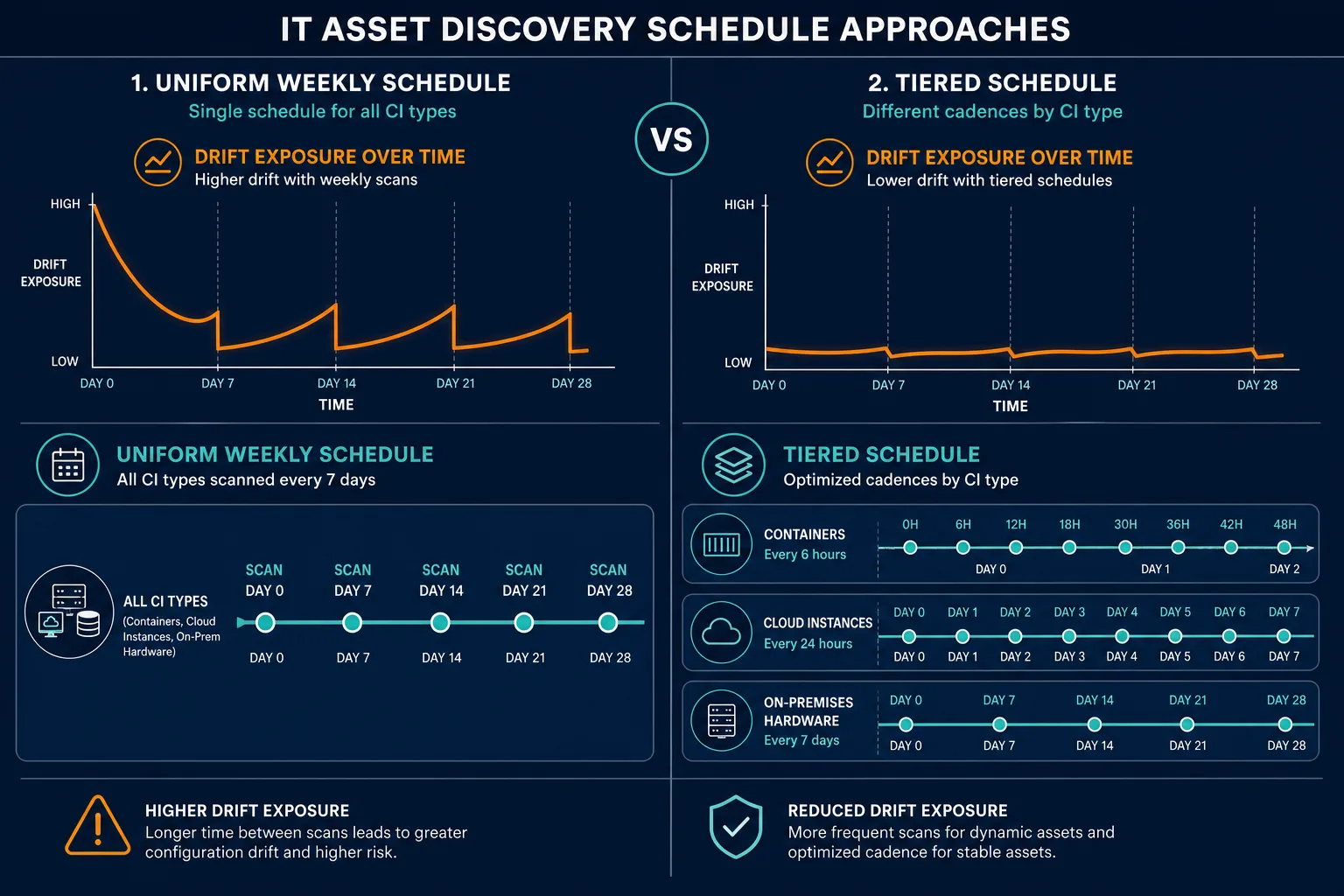
By shortening the interval between scans, the maximum drift window shrinks from 168 hours to as few as 6 hours. In that environment, daily discovery cycles reduced peak drift from 23% to 4%. A 6-hour cycle reduced it to under 1%. Tiering scan frequency by CI class drift velocity achieves low drift across the environment without uniform high-frequency scanning of all asset types.
Frequently Asked Questions
Why does CMDB data become inaccurate so quickly after a discovery scan?
Infrastructure does not pause between scheduled scans. Cloud instances spin up and down within hours. Containers cycle through states multiple times per day. Configuration changes from patch management or infrastructure-as-code pipelines apply outside the scan window. Each change that occurs between scans produces a gap between what the CMDB records and what actually exists. High-drift CI classes like containers and cloud instances widen this gap fastest.
How often should discovery run to keep CI drift manageable?
The answer depends on your CI mix. In environments where containers and cloud instances represent a significant share of the CI population, daily discovery keeps peak drift below 5%. For environments where on-premises hardware dominates, weekly scans may be sufficient for those CIs, but cloud and container workloads still benefit from more frequent cycles. A tiered schedule matched to CI class drift velocity offers the most efficient balance of accuracy and overhead.
What does a 23% CI drift rate mean for a change advisory board?
A CAB reviewing change requests at the end of a weekly scan cycle is evaluating risk against CMDB data where up to 23% of CIs may be stale. Relationships may be missing. Dependencies provisioned after the last scan may not appear. Decommissioned CIs may still show as active. Each of these gaps increases the probability that a change proceeds with an incomplete blast radius assessment.
How does CI drift affect compliance audits?
Compliance frameworks like PCI DSS and ISO 27001 treat CMDB data as a control artifact. If drift has introduced inaccurate CI records before an audit, any sample drawn from the drifted population will show discrepancies between recorded and actual state. Audit responses that rely on stale CMDB data expose the organization to findings that accurate, discovery-sourced records would have avoided.
How does Virima track CI drift between discovery scans?
Virima records the timestamp of each CI’s last verified state and surfaces CIs whose records are aging beyond configurable thresholds. Configuration managers and IT directors can see, within the CMDB, which CIs are approaching the far end of the drift window before the next scan runs, rather than discovering the gap after an incident or audit finding has already occurred.
Does Virima support tiered discovery schedules by CI class?
Yes. Virima’s discovery configuration allows different scan intervals for different CI classes, so containers and cloud instances can run on 6-hour or daily cycles while on-premises hardware runs weekly. Scan frequency matches the actual drift velocity of each asset type rather than applying a uniform schedule across the environment — reducing CMDB inaccuracy without proportionally increasing scan overhead.
Closing the drift window
How CI drift between discovery scans accumulates by CI class determines your risk exposure. For the 3,600 CIs in that customer environment, the 168-hour window between weekly scans contained 828 state changes the CMDB did not know about until the next scan ran. Some of those changes were benign. Others directly affected change planning, incident response, and compliance exposure. Understanding which CI classes drift fastest, what mechanisms drive the drift, and what each drift level costs operationally is the first step toward a discovery schedule that keeps CMDB ground truth current.