Change Impact Analysis False Negative: Why Zero Risk Isn’t Always Safe

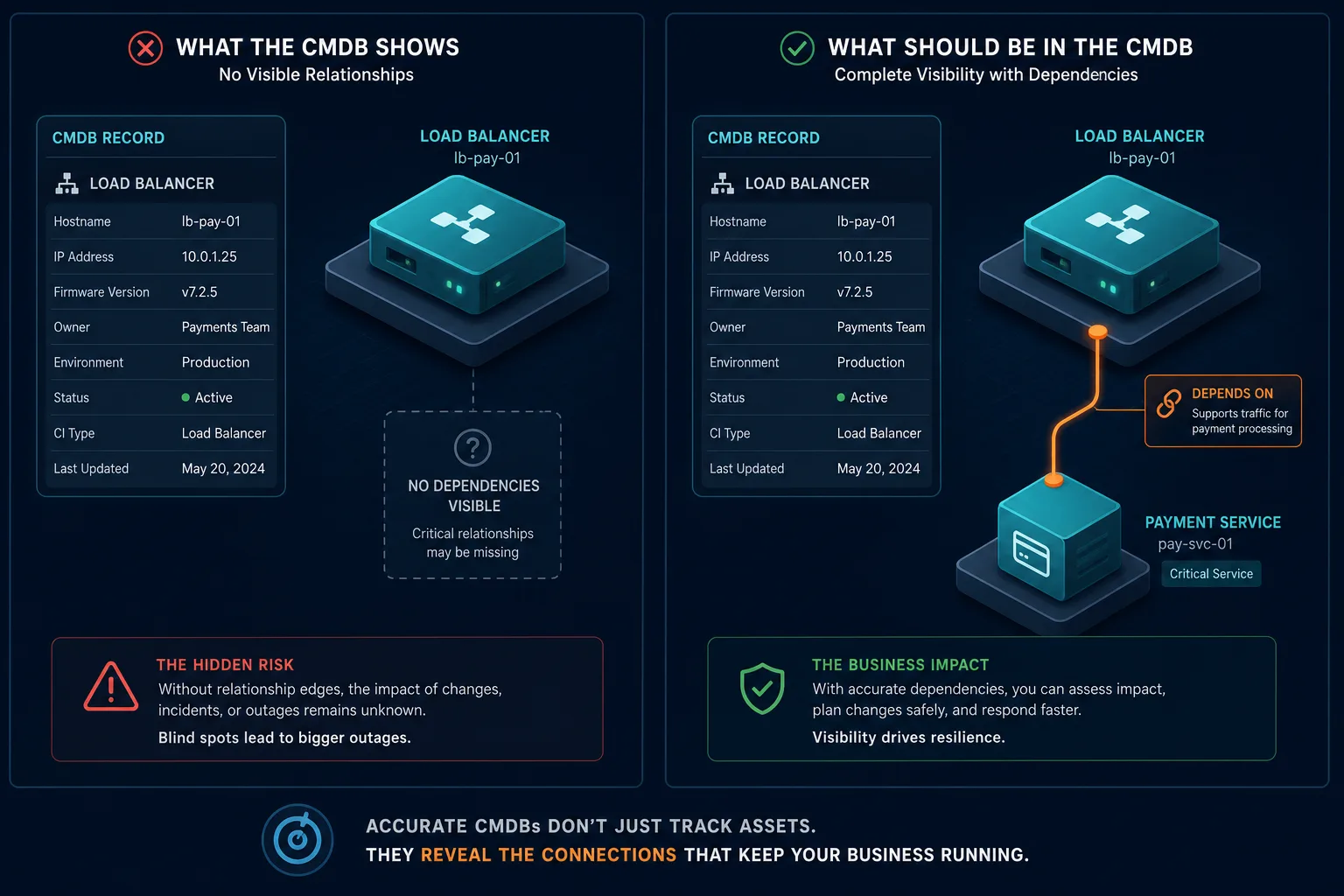
A change impact analysis false negative occurs when the analysis correctly reflects the CMDB — and the CMDB is incomplete. The CI exists, its attributes are accurate, but its relationship edges are missing. So the analysis finds no downstream dependencies to flag, the CAB approves with confidence, and the change causes an outage that the impact report gave no reason to expect.
This is what happened during a recent payment processing incident. The change advisory board reviewed it. The CAB approved it. The change impact analysis returned zero downstream risk. Then the payment processing service degraded within the maintenance window — and triage took 47 minutes, because no one could tell which services depended on the load balancer that had just been reconfigured. Not a tool failure. Not a process failure. A data failure: the load balancer’s role as a payment service gateway existed in reality. It did not exist in the CMDB.
Understanding why change impact analysis produces false negatives — and what it takes to build a CMDB that prevents them — is a practical problem every change team eventually hits.
What is a change impact analysis false negative?
This failure mode is distinct from a stale CMDB problem, where relationship records existed and decayed over time. A false negative often involves a CI that was never mapped to its downstream dependencies in the first place. The reason is usually scope: the original CMDB implementation defined success as asset inventory rather than dependency mapping. The data was never wrong; it was simply never complete. And incomplete CMDB relationship data looks identical to zero-risk change data in any impact analysis tool.
The practical consequence: a clean bill of health from change impact analysis, and a “silent blast radius” — dependencies that exist in reality but not in the CMDB — waiting to be triggered by an approved change.
According to the 2024 DORA Accelerate State of DevOps Report, elite performing engineering teams maintain a change failure rate of approximately 5%. Teams without complete dependency mapping in their CMDB tend to run well above that benchmark, because they are approving changes without the full topology picture. The gap between what the CMDB shows and what the infrastructure actually looks like is the gap where false negatives live.
The incident: what happened and why
The following incident scenario reflects a composite of post-incident reviews — the pattern and metrics represent what IT teams commonly encounter when CMDB relationship records are missing.
The load balancer CI in this post-mortem had accurate attributes in every field the CMDB tracked: correct hostname, correct firmware version, correct owner, correct location. A maintenance window was scheduled to update its configuration. Before approving, the change manager ran impact analysis against the CMDB. The query returned zero downstream CIs. The CAB approved.
Within the maintenance window, payment processing service response times spiked. The load balancer fronted the payment service — an architectural fact that had never been recorded as a relationship edge in the CMDB, because the original CMDB implementation mapped compute and network assets to the asset inventory without building service-to-CI dependencies. The load balancer’s role as a payment service gateway existed in reality. It did not exist in the CMDB.
The triage gap. With no relationship data in the CMDB, the incident response team fell back to network log analysis to trace the impact chain. Triage time: 47 minutes. For incidents where CMDB dependency chains are intact and accurate, the baseline triage time for this team was 12 minutes. The 35-minute delta was not caused by slow responders or inadequate tooling — it was caused by the absence of the relationship context that should have been discoverable immediately from the CMDB.
Already seeing this pattern in your environment? See how Virima maps CI relationships automatically →
Post-incident review identified 34 ingress-layer CIs with no relationship edges recorded. Each was a potential future false negative.
Why the CMDB didn’t have these relationships
The gap was architectural, not accidental. The original CMDB rollout defined success as asset inventory completeness: every CI with accurate attributes, a complete record, an owner assigned. Relationship mapping was out of scope. The result was a CMDB reliable for asset tracking and license compliance — and structurally blind to service dependencies.
It’s a repeatable failure mode. Mapping how those assets relate to each other — which services they support, which CIs they depend on, what breaks when they go offline — is scoped to a second phase that often doesn’t happen. The CMDB accumulates CI records without accumulating the edges between them. Change impact analysis, which traverses those edges, inherits the gap.
You can link to those existing Virima posts on this topic for supporting context: the CMDB for change management guide and the CI dependencies and relationships primer both cover why relationship records are the functional core of a change-ready CMDB.
Three conditions that produce a change impact analysis false negative
False negatives tend to trace back to one of three root causes — and in post-mortems, they usually show up together.
1. Missing relationship records
The CI exists. The downstream service exists. The dependency between them was never recorded. This happens most often when CMDB implementations scope to attribute completeness rather than relationship mapping — a common project decision that leaves the CMDB blind to service topology. Discovery tools that scan for assets without building relationship edges produce this gap systematically across every CI they add.
The challenge is that missing relationships are invisible until something goes wrong. A CMDB with 100% CI attribute completeness and 0% relationship completeness appears healthy by most CMDB health dashboards. It is not.
2. Stale relationships
A relationship was recorded accurately — and then infrastructure changed. A service migrated. A load balancer was replaced. An API was re-routed to a different backend. The relationship record in the CMDB still reflects the old state. Change impact analysis traverses the old edges, misses the new ones, and returns a partial picture that may include stale false positives while missing the current true dependencies.
This is particularly acute in hybrid cloud environments, where infrastructure topology can change faster than any manual CMDB update cycle can follow. A relationship that was accurate three months ago, in a container-heavy environment, may describe a configuration that no longer exists.
3. Narrow change scope definition
Impact analysis is only as broad as the scope defined in the change record. If the analyst doesn’t expand the query to include upstream and downstream relationship layers, dependent CIs don’t appear in the output — even when their relationship edges are accurately recorded.
This makes the change risk assessment a critical process step. When the assessment is scoped to a single CI and doesn’t traverse upstream and downstream relationship tiers, the impact report can look clean even in a multi-tier service topology. The data is correct; the query is incomplete. This is a process gap rather than a CMDB gap, but the output looks identical from the CAB’s perspective.
| Condition | Typical Cause | Detection Method |
|---|---|---|
| Missing relationships | CMDB scoped to asset inventory only | Discovery rescan before change window |
| Stale relationships | Infrastructure changed faster than CMDB update cycle | Relationship staleness flag in change review |
| Narrow scope | Change record scoped to single CI | Impact analysis query review by change manager |
How the CMDB dependency gap extends incident triage
Change impact analysis and incident triage draw on the same CMDB relationship data. When relationship records are missing and a change causes an incident, the same gap that let the change slip through is the gap that slows recovery.
In the incident described above, the missing relationship edge between the load balancer and the payment service didn’t only affect the CAB approval. It affected the incident team’s ability to construct the blast radius map after the fact. They had to go to network logs, trace connection patterns manually, and build the dependency context that the CMDB should have surfaced instantly.
This is the compounding cost of a CMDB dependency gap: not one incident prevented more slowly, but every incident in that blast radius slower to resolve. The 2024 DORA report notes that high-performing teams restore service in under one hour; low performers take days. Among the clearest separators between those cohorts is the quality of operational context available during an active incident — context that is a direct function of CMDB relationship completeness.
Virima’s ViVID™ service maps — a real-time service dependency visualization layer — surface relationship context during active incidents as well as during change review. When a blast radius is in motion, the dependency chain is visible in real time rather than reconstructed from logs — so both the CAB and the incident responder are working from the same discovery-sourced picture.
Three fixes that address the root cause
The post-incident remediation implemented three changes, each targeting one of the root conditions above.
Fix 1: Discovery-driven relationship mapping
The organization replaced manual relationship entry with automated discovery that builds relationship edges from observed network traffic and API connections — not from what was manually entered during an implementation project. Virima’s agentless discovery scans infrastructure and maps service-to-CI dependencies without requiring manual input, building the relationship graph from runtime behavior rather than configuration intent.
The 34 ingress-layer CIs that had zero relationship records were mapped within the first discovery cycle. The relationship graph also continues to update as infrastructure changes — so relationships that form between existing CIs are captured automatically, rather than waiting for a manual update that may never come. Virima IT discovery features page
This is the most durable fix, because it ties the CMDB’s relationship completeness to the actual state of the infrastructure rather than to the organization’s capacity for manual CMDB maintenance.
Fix 2: Pre-change rescans scoped to the blast radius
Before change windows, a targeted rescan of the affected CI’s relationship neighborhood was added to the change workflow. This catches relationship drift — CIs that have changed their upstream or downstream connections since the last full discovery pass — without requiring a full estate scan before change windows.
The rescan output is added to the change record as an artifact, giving the CAB discovery-sourced relationship data at the moment of review rather than cached CMDB state from a previous pass. In environments where continuous full rescans aren’t practical, a blast-radius-scoped rescan is significantly faster and gives the CAB current data where it matters most.
Pre-change rescan checklist:
- Confirm the last discovery pass for the affected CI ran within the staleness threshold (e.g., 30 days)
- Run a blast-radius-scoped rescan if the last pass exceeds the threshold
- Verify that upstream and downstream relationship layers are included in the rescan scope
- Review the impact analysis query to confirm it traverses at least two relationship tiers
- Add the rescan output to the change record as an artifact before CAB review
- Flag any relationship records unconfirmed past the threshold for manual verification
Fix 3: Relationship staleness flagging in change review output
The CMDB now tracks when each relationship record was last confirmed by discovery. If a relationship was last verified more than a configurable threshold — in this case, 30 days — it is flagged in the change impact analysis output as “unconfirmed.” The CAB knows to treat those edges as uncertain: not invalid, but not fully trusted, and subject to a targeted rescan request before approval.
This doesn’t require relationship record perfection. It requires transparency about which relationships are current and which may have drifted. That transparency fundamentally changes how the CAB interprets a clean impact analysis report — from “zero risk confirmed” to “zero risk, with the following relationship records verified within the last 30 days.”
Example change impact analysis output with staleness flags:
| Relationship edge | Status |
|---|---|
| load-balancer-01 → payment-api-gateway | ✓ Confirmed: 3 days ago via discovery |
| payment-api-gateway → auth-service | ⚠ Last confirmed: 52 days ago — rescan recommended |
Staleness flags give the CAB the context to distinguish between “no downstream risk” and “no downstream risk data.”
That distinction — between absence of risk and absence of data — is exactly what a change impact analysis false negative obscures. The three fixes above are how you make it visible again. The post-incident CMDB for this organization now reflects what was always true about the infrastructure; it just took an outage to force the mapping work that should have happened on day one.
For teams managing ITIL change processes, the CMDB accuracy and ITIL change management guide covers how CMDB drift systematically undermines each stage of the change enablement process — and why discovery-driven accuracy is the only fix that scales.