How Virima Elevates Hybrid IT Management for Jira Service Management Customers

The scale of today’s hybrid IT risk landscape is measurable. The NIST National Vulnerability Database now catalogs more than 200,000 known CVEs. Each one represents a potential exposure in your environment. Without an accurate service dependency context inside your CMDB, your team cannot tell which vulnerabilities actually threaten your highest-priority services — and which can wait.
That dependency context is exactly what the Virima and Jira Service Management integration delivers. Here are three ways Virima transforms hybrid IT management for JSM teams.
| What does Virima do for Jira Service Management customers? Virima connects to your JSM environment through a bidirectional integration that feeds discovery-sourced CMDB data directly into Jira. It also overlays ViVID™ service maps onto ITSM tickets, giving IT teams the dependency context they need for accurate incident, change, and vulnerability management across hybrid environments. |
3 Ways Virima Transforms Hybrid IT Management for Jira Service Management Customers
1. Building a Trustworthy JSM CMDB
Your CMDB is only as good as the data feeding it. JSM teams often face the same problem: the CMDB starts clean, then slowly drifts as assets change, get added, or go undocumented. Teams stop trusting it. Decisions get made on guesswork instead of facts.
Virima solves this by connecting its discovery engine directly to your JSM CMDB. It runs scheduled, high-frequency discovery cycles that capture your full IT landscape — on-premises, cloud (AWS and Azure via API-based discovery), and transitional environments — and pushes verified asset data into JSM automatically. No spreadsheets. No manual catalog updates.
Accurate asset synchronization
Virima’s discovery-driven sync keeps your JSM CMDB current across every CI type. When an asset changes, Virima captures it in the next discovery cycle and updates the CMDB record. Your team works from data that reflects your actual environment, not a snapshot from months ago.
Jira CMDB schema blueprints
Configuring the JSM CMDB schema is one of the harder parts of getting an integration right. Virima ships with a library of over 120 predefined CMDB blueprints covering desktops, servers, cloud instances, and more. These blueprints integrate directly into your JSM schema through an intuitive UI. You avoid manual CI type definitions and attribute guesswork. You can also align new blueprints to your existing JSM schemas and control exactly which attributes sync. Read more in 3 Ways Virima Delivers a True CMDB for Jira Service Management.
Agentless and agent-based discovery
Virima supports both agentless scanning and a Windows agent for environments where agentless coverage has gaps. This hybrid approach gives your IT team consistent asset data across a wide range of device types and network configurations — without requiring you to deploy agents everywhere.
Secure discovery
Virima runs on servers you control, with full data segregation and encryption both on-premises and in the cloud. Your asset data does not leave your environment without your authorization. Security in discovery is not optional — it is built into the architecture.
Want to see how Virima builds trusted runtime truth for hybrid IT teams? Explore the Virima Trusted Runtime Truth approach.
Service Mapping That Shows What Will Break Before It Does
Service mapping is where hybrid IT management becomes operationally real. When an incident hits, your team needs to know what that affected CI connects to — and what will fail if it goes down. Without a current, accurate service map, diagnosis happens in the dark.
Virima’s ViVID™ service maps build dynamic dependency maps from your discovery data. They tie IT components — servers, applications, network infrastructure, cloud resources — to the business services they support. The maps update through high-frequency discovery cycles, so they reflect your current environment rather than a stale approximation.
Incident management
When an incident fires in JSM, your team sees which CI is involved and where it sits in the service dependency chain. You know what is affected, what else might fail, and who owns the impacted service — all from inside the ticket. That context cuts diagnosis time significantly.
Change management
Before a change window opens, ViVID™ overlays show the potential blast radius of the proposed change. Your change manager sees what is connected, what is at risk, and which downstream services need notification. That context turns a guesswork decision into an informed one. For more on this, see how teams use ViVID in the context of service uptime in our post on ViVID with Jira Service Management.
Vulnerability management
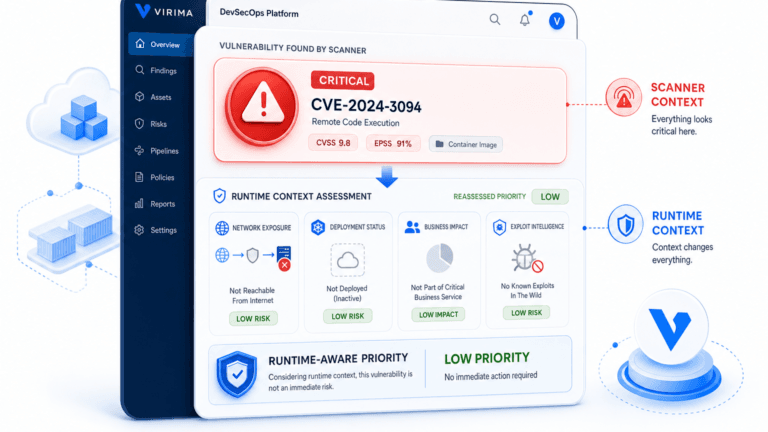
By integrating with NIST NVD lookup data, Virima links vulnerabilities to the CIs they affect and maps those CIs to the services they support. Your security team can prioritize patches based on business impact, not just CVSS score. The assets that matter most to your operations get addressed first.
3. ViVID Overlays That Surface Impact Instantly
Virima Visual Impact Display (ViVID™) sits on top of your discovery and service mapping data and brings it directly into your ITSM workflow. Instead of switching between the CMDB, a separate service map tool, and your ticketing system, your team sees everything in one visual layer — overlaid directly on the JSM ticket.
Vulnerability prioritization by service impact
ViVID uses NIST NVD integration to surface not just vulnerability severity but business impact context. A CVE affecting a low-criticality test server gets a different response priority than one affecting your payment processing infrastructure. ViVID makes that distinction visible at a glance.
Change risk visualization
Before you execute a change, ViVID highlights every connected CI and service in the impact chain. Your IT managers see potential failures before they happen. This matters especially for hybrid environments where a single change can cascade across on-premises and cloud resources simultaneously.
Cross-team collaboration
ViVID turns service maps into shared context for IT operations, security, and DevOps teams. Instead of each team maintaining its own view of the environment, everyone works from the same discovery-sourced map. This reduces back-and-forth, speeds resolution, and cuts duplicate effort across teams.
Fast root cause identification
When a service disruption hits, ViVID’s overlays help your team trace the origin in minutes. You see which CI changed, what it connects to, and where the failure propagated — without manually digging through logs.
| How does ViVID help JSM teams with incident management? ViVID overlays Virima’s discovery-sourced service maps directly onto JSM tickets. When an incident occurs, your team sees the affected CI, its service dependencies, and potential downstream impact in a single view. This replaces guesswork with verified dependency context from your latest discovery cycle, cutting mean time to resolution. |
What Trusted Runtime Truth Means for Your JSM Environment
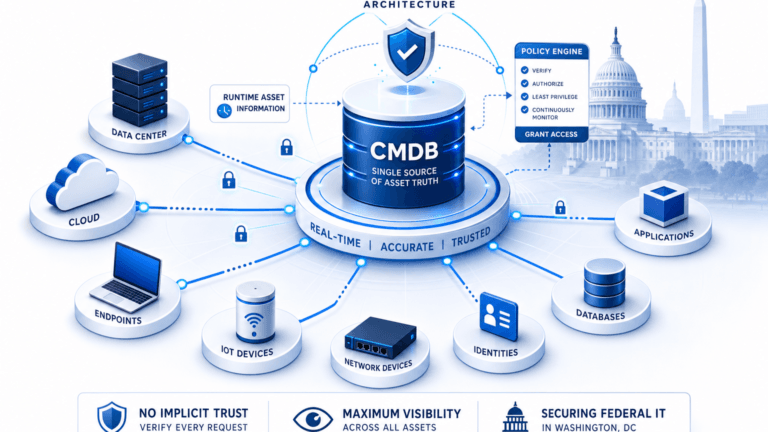
Virima’s value to Jira Service Management customers goes beyond keeping the CMDB clean. It is about giving your team the trusted runtime truth they need to act with confidence — the accurate, discovery-sourced view of what exists in your environment, how everything connects, what just changed, and what is at risk.
Shadow IT, cloud workloads, and distributed infrastructure make manual CMDB maintenance impossible at scale. Virima’s high-frequency discovery cycles replace that manual effort with a system that continuously feeds verified data into JSM. Your team stops chasing stale records and starts making faster decisions from a foundation they actually trust.
For JSM teams managing hybrid infrastructure, that foundation is the difference between reactive firefighting and proactive IT management. The EMA’s research on ServiceOps and discovery maturity reinforces this: CMDB accuracy is a primary driver of IT service operations success, not a secondary concern.
See how Virima connects discovery-sourced runtime truth to your JSM environment. Schedule a demo today.
| What is the Virima integration for Jira Service Management? The Virima integration for Jira Service Management connects Virima’s discovery engine to your JSM CMDB through a bidirectional sync. It populates and maintains CMDB records from high-frequency discovery cycles and overlays ViVID service maps on ITSM tickets, giving IT teams accurate dependency context for incident, change, and vulnerability management. |
Frequently Asked Questions
What makes Virima’s CMDB integration different from JSM’s native discovery?
Virima uses a dedicated discovery engine that runs high-frequency, scheduled scans across on-premises, cloud (AWS and Azure via API-based discovery), and hybrid environments. It feeds verified, deduplicated CI data into JSM through a bidirectional sync. The integration includes over 120 CMDB schema blueprints that map directly to JSM’s native schema, which reduces setup time significantly.
How does Virima help with vulnerability management in JSM?
Virima integrates with NIST NVD lookup data and maps CVE findings to the CIs in your CMDB. Through ViVID overlays, your team sees which vulnerabilities affect which services and can prioritize remediation based on business impact rather than severity score alone. See more in Jira CMDB and Virima: How the Integration Ensures Data Trust.
Does Virima work with both Jira Service Desk and Jira Service Management?
Yes. Whether you are on the original Jira Service Desk platform or the current Jira Service Management, the Virima integration works across both. The core functionality — CMDB sync, service mapping, and ViVID overlays — applies to both versions of the Atlassian platform.
Your JSM CMDB Should Reflect Reality — Virima Makes That Happen
Jira Service Management customers who connect Virima get more than a CMDB sync. They get a discovery-sourced foundation that makes every incident faster to resolve, every change safer to execute, and every vulnerability easier to prioritize.
Your JSM CMDB should reflect your actual environment, not the one that existed six months ago. Virima’s high-frequency discovery cycles, schema blueprints, and ViVID service maps give your team the trusted runtime truth that JSM was built to act on.
Ready to see Virima in your JSM environment? Schedule a demo today.