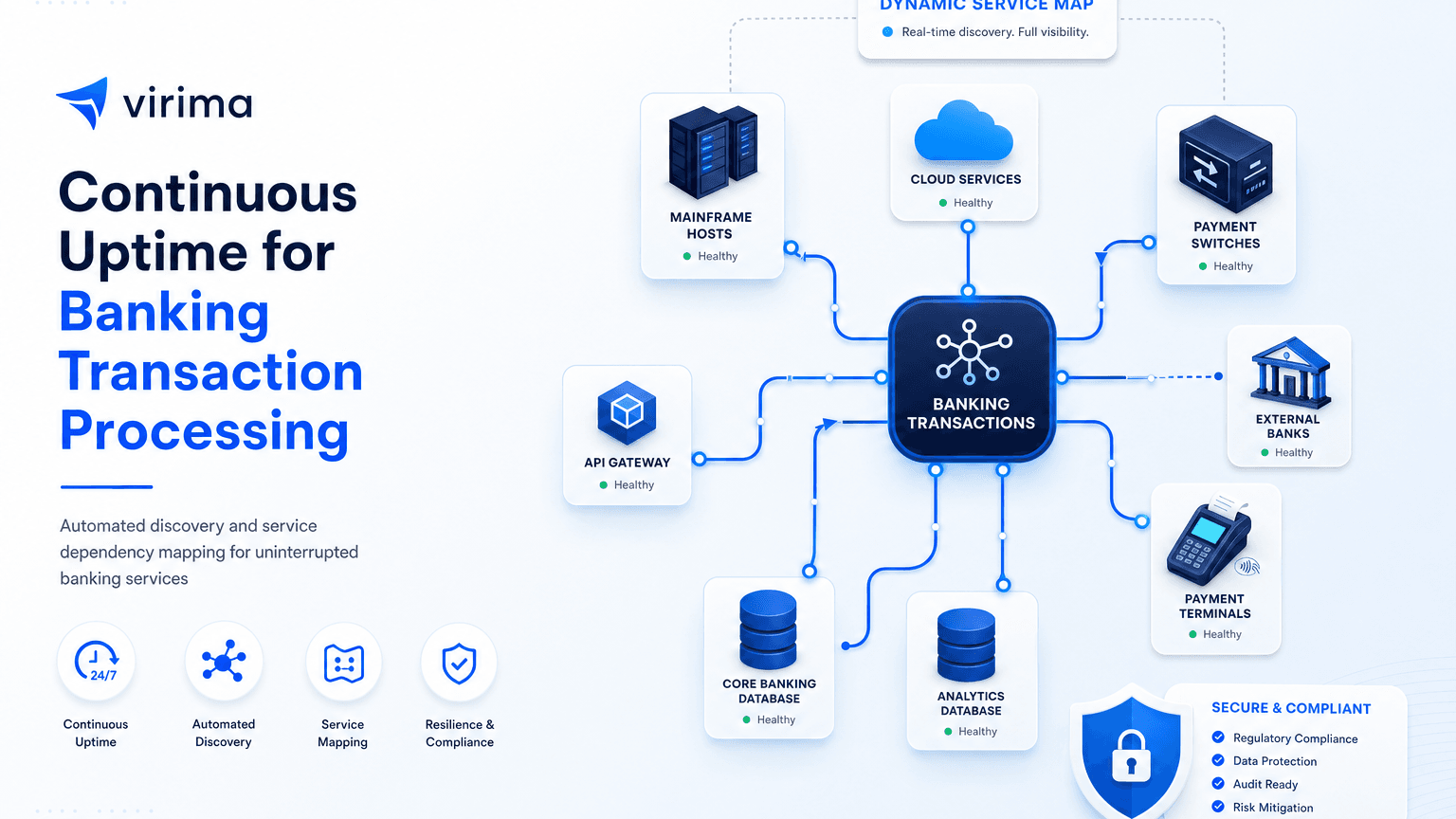
Keeping Banking Transaction Paths Up When Infrastructure Changes

When a core banking system or payment gateway goes down, the meter starts running immediately. A 2026 downtime cost benchmark for the finance sector puts losses as high as $9.3 million per hour for large institutions at peak trading load — the highest of any industry measured. That figure sits before a single regulatory penalty is added on top.
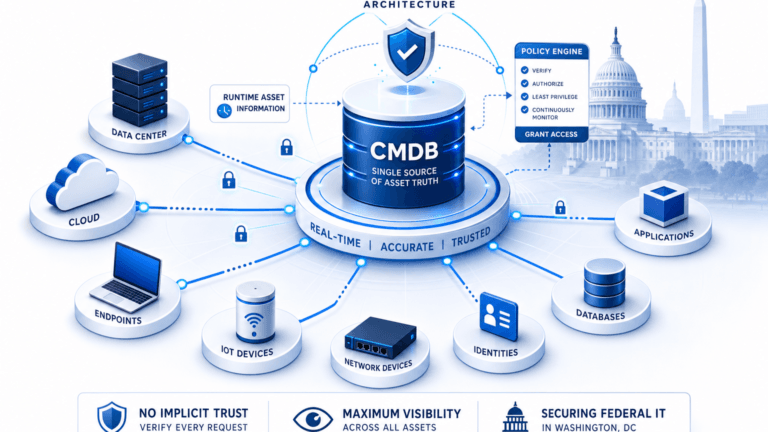
Behind every digital transaction sits a web of mainframe hosts, cloud microservices, payment switches, fraud detection engines, and middleware messaging queues. Financial IT operations teams manage that sprawl under strict regulatory oversight, including DORA in Europe and FFIEC guidelines in the United States. Keeping banking transaction processing uptime intact means moving past fragmented monitoring tools and static infrastructure inventories toward automated multi-cloud discovery, real-time configuration tracking, and service dependency mapping.
Why is maintaining uptime for banking transaction processing systems so complex?
Transaction processing depends on tightly coupled hybrid infrastructure spanning legacy mainframes, private datacenters, and public cloud environments. Lacking unified service dependency maps, unannounced database changes or network latency spikes trigger cascading payment processing failures across digital channels.
The hidden complexity of modern banking infrastructure
Financial institutions rarely run transactions through a single monolithic database. A single credit card swipe or peer-to-peer payment triggers a rapid sequence of API calls across disparate systems.
1. Ephemeral workloads and multi-cloud blind spots
To handle peak shopping events and end-of-month settlement volumes, modern banks deploy microservices on Kubernetes clusters across AWS and Azure Government environments. These containerized workloads scale up and down dynamically.
When configuration management relies on manual updates or periodic batch scripts, ephemeral cloud instances disappear before anyone catalogs them. During an active payment slowdown, site reliability engineers (SREs) waste critical minutes tracing traffic routes through unmapped cloud gateways. Ephemeral container tracking closes that specific blind spot by recording short-lived instances the moment they spin up, not after they disappear.
2. High-blast-radius infrastructure changes
In high-throughput financial environments, routine security patching and database index updates carry immense risk. A database administrator updating a configuration parameter on a shared database cluster may intend to optimize wealth management queries. They may not realize the same cluster supports real-time fraud scoring for debit transactions. This is what IT teams mean by blast radius — the scope of what breaks when one shared component changes.
Without clear service dependency context, minor infrastructure adjustments trigger unexpected payment declines, forcing emergency rollback procedures and lengthening Mean Time to Resolution (MTTR). That is the gap Virima’s CMDB is built to close: a record of what depends on what, kept current without someone manually updating a spreadsheet after every change.
How does automated discovery prevent payment processing disruptions?
Automated discovery continuously inventories physical servers, virtual machines, database instances, and network interfaces across hybrid banking environments. By mapping technical CIs directly to business payment flows, IT teams evaluate change blast radius before maintenance occurs.
Deploying automated discovery across highly regulated financial networks
Financial regulators mandate strict network segregation between payment card industry (PCI-DSS) environments, core banking ledgers, and public-facing web servers. Traditional network sweeping tools often fail because firewalls block invasive probes.
To maintain complete inventory truth while adhering to strict security policies, financial enterprises implement a multi-layered discovery framework built on Virima’s IT discovery capability.
Secure discovery architecture for financial environments
- Zero-Footprint Agentless Probes: Situated within secure datacenter zones, agentless probes use secure protocols (WMI, SSH, SNMP) to inspect core banking servers, SAN storage arrays, and network switches without installing local software footprints.
- Encrypted Gateway Collectors: Placed inside isolated PCI-DSS subnets, dedicated gateway collectors perform localized asset discovery and transmit configuration metadata over encrypted channels to the central CMDB. Zero trust segmentation depends on this kind of visibility: security teams struggle to enforce segmentation for assets they cannot see.
- API-Driven Cloud Connectors: Direct integrations with AWS, Azure, and Google Cloud APIs capture auto-scaling events, load balancer adjustments, and serverless execution environments in real time.
By consolidating these discovery feeds into a unified CMDB, bank infrastructure leads maintain complete visibility across every transaction path. Unlike platform suites that require a full migration to get that visibility, this approach layers onto the ITSM tools banks already run, extending existing service desks rather than replacing them. To see how automated discovery interfaces with enterprise service desks, explore the Virima integrations hub.
Financial service dependency mapping: connecting technical assets to payment flows
A flat inventory list of database servers cannot explain why mobile payment authorizations are failing. Financial IT operations need service dependency context to prioritize incidents based on business impact, which is what ViVID™ service maps are built to provide.
Mapping the core transaction topology
Service dependency mapping automatically analyzes active network connections, process dependencies, and configuration files to build interactive topology maps. These maps visualize the entire transaction chain: it starts at consumer touchpoints — mobile banking APIs, ATM network gateways, and web portals — and flows into the processing and fraud engine layer, where payment switches, clearinghouse connectors, and real-time AML screening services operate. From there it reaches the data and core banking layer: mainframe transaction ledgers, relational database clusters, and HSM encryption modules.
When a hardware fault occurs on a SAN switch in a secondary datacenter, IT operators instantly see from the service map that primary authorization services for online merchant clearing are at risk. Technicians initiate targeted failover procedures before payment queues back up.
What DORA and FFIEC actually require
Under the EU’s Digital Operational Resilience Act, financial entities must demonstrate that they can identify, manage, and mitigate ICT risks across critical business functions. Article 8 breaks that down into four concrete obligations, laid out in Hyperproof’s DORA compliance guide:
- Identify and classify ICT assets
- Map dependencies between those assets
- Assess risk before changes
- Review legacy systems annually
FFIEC guidance in the US covers similar ground, though it is enforced more selectively than DORA’s binding requirements.
An automated CMDB is an auditable record that satisfies both. It records asset configurations, baseline drift, and change histories continuously, so it reflects what is actually running rather than what someone documented during last year’s review. This same inventory discipline is what supports broader financial services IT asset compliance work, not just DORA specifically. During regulatory audits, compliance teams generate full dependency reports quickly, showing that failover paths and redundancy controls function as intended. SOX IT general controls rest on that same underlying system inventory, so the CMDB work done for DORA carries over directly into other financial compliance frameworks.
To discover how financial institutions achieve complete operational visibility across complex infrastructure, visit Trusted Runtime Truth.
Best practices for operational resilience in financial IT operations
Achieving continuous transaction uptime requires combining intelligent automation with disciplined IT service management workflows. Leading financial IT organizations follow five essential operational practices:
- Prioritize High-Value Payment Rails: Begin service mapping initiatives by modeling core credit, debit, and instant payment flows before expanding to internal back-office applications. This is where an outage costs the most, so it is where dependency context pays off first.
- Enforce Pre-Change Blast Radius Reviews: Require Change Advisory Boards (CABs) to inspect automated service dependency maps before approving maintenance tickets on core transaction infrastructure, catching the kind of shared-cluster conflict described above before it reaches production.
- Standardize Configuration Item Governance: Establish clear ownership guidelines across cloud engineers, mainframe operators, and database administrators to ensure consistent CI taxonomies across teams that rarely share tooling today.
- Integrate Discovery Data with Incident Management: Connect CMDB data directly to ITSM platforms like ServiceNow or Jira Service Management, enriching incident tickets — including payment gateway outages — with real-time dependency context instead of forcing technicians to reconstruct it during an outage. This works alongside the ITSM platform your bank already runs; it enriches ServiceNow or Jira SM with discovery-sourced data rather than replacing either one.
- Test Resilience on a Schedule, Not Only After an Incident: DORA’s Article 8 review requirement is not a one-time exercise. Rerun dependency and failover validation on a fixed cadence so an accurate CMDB stays accurate as infrastructure changes.
When planning core banking modernization projects or preparing for operational resilience audits, evaluating enterprise discovery capabilities helps your organization maintain uncompromised uptime. To evaluate automated discovery for your infrastructure, request a Virima product demo.
What are the primary financial benefits of CMDB automation in banking?
CMDB automation reduces transaction downtime, prevents costly regulatory non-compliance fines, accelerates incident recovery during payment outages, and eliminates manual effort during annual SOC and PCI-DSS compliance audits.
Safeguarding the future of digital financial services
As financial institutions accelerate digital transformation and adopt open banking architectures, the underlying technology stack becomes increasingly interconnected. Relying on manual spreadsheets or static asset repositories exposes financial organizations to catastrophic outage risks and regulatory sanctions.
By deploying automated multi-cloud discovery, core-aware configuration tracking, and service dependency mapping, financial enterprises build real operational resilience. They protect critical transaction flows, maintain regulatory compliance, and deliver the reliable banking services their customers demand.
Frequently Asked Questions
How does automated discovery ensure PCI-DSS compliance during asset scanning?
Automated discovery uses read-only, non-intrusive scanning protocols and localized gateway probes within isolated cardholder data environments (CDE). Configuration data is encrypted in transit and at rest, preserving PCI-DSS compliance while maintaining complete asset visibility.
Can dynamic service mapping track transaction dependencies across hybrid mainframe and cloud environments?
Yes. Advanced service mapping platforms correlate network traffic, active process connections, and API endpoints across legacy mainframe middleware, on-premises servers, and multi-cloud containerized workloads into a single, unified service dependency map.
How does service dependency mapping assist with DORA compliance in financial institutions?
DORA mandates clear mapping of ICT-supported critical business functions. Dynamic service mapping provides documented, automatically updated maps linking physical and virtual IT assets directly to business services, satisfying regulatory requirements for operational risk management.
What does DORA Article 8 specifically require for ICT asset and dependency mapping?
Article 8 requires financial entities to identify and classify ICT assets, map dependencies between those assets and the business functions they support, assess risk before changes, and review legacy systems annually. An automated CMDB with dependency mapping addresses all four requirements from a single source of record.
Does Virima’s CMDB integrate with ServiceNow and other ITSM platforms already used in banking IT operations?
Virima integrates directly with ServiceNow, Jira Service Management, and other major ITSM platforms to enrich existing incident and change workflows with discovery-sourced CMDB data, working alongside current tooling rather than replacing it.