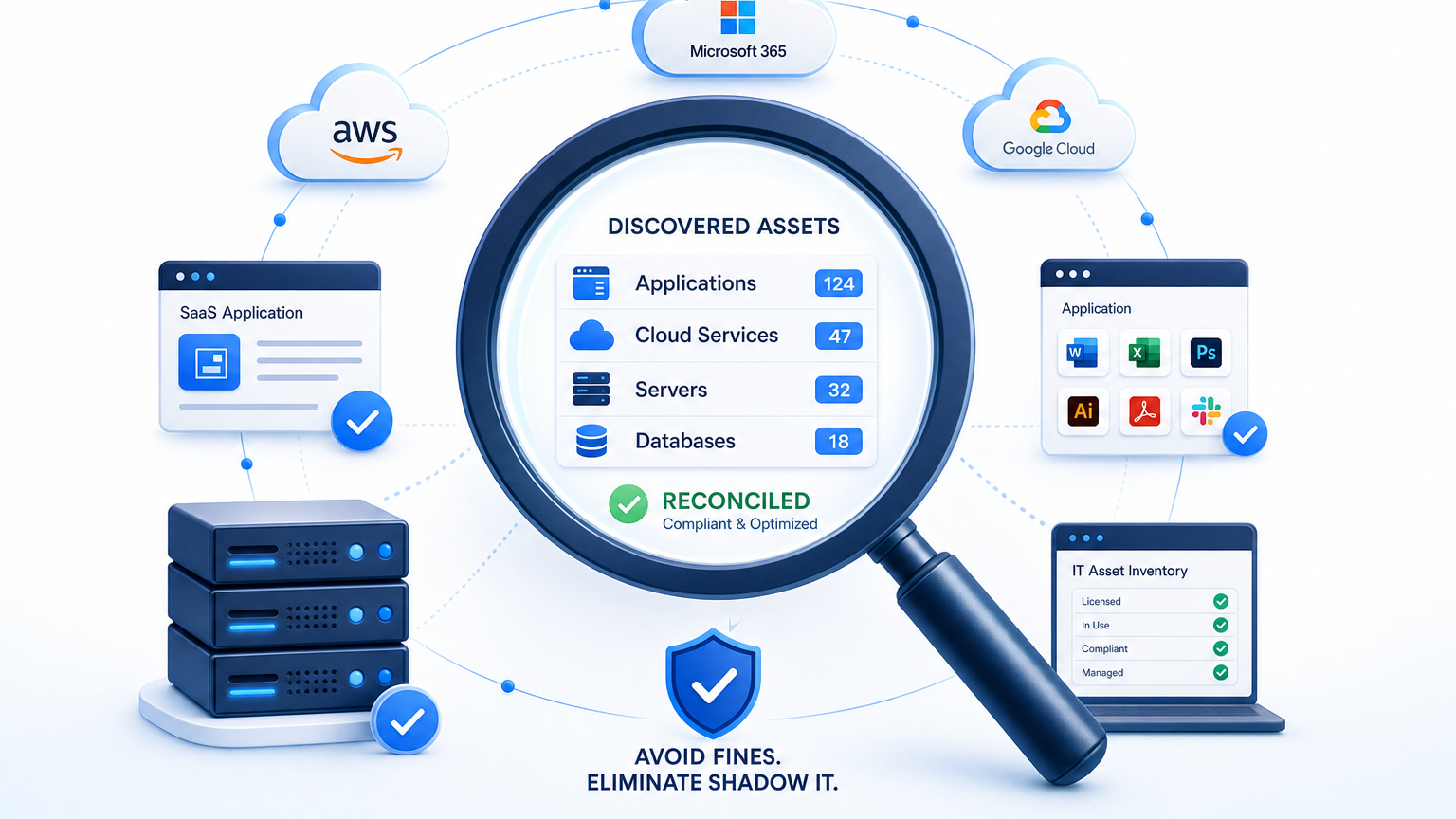
How Do You Avoid Software Audit Fines and Shadow IT?

A vendor audit notice lands in your inbox, and finance wants exposure numbers by Friday. If license records have not been reconciled against actual deployments in months, your team is rebuilding entitlement counts from spreadsheets while a true-up demand threatens to erase a quarter’s IT budget. Layer in the SaaS subscriptions individual teams signed up for without IT’s knowledge, and the audit risk compounds into assets nobody can even see. Organizations avoid software audit fines and shadow IT the same way. They treat discovery and entitlement reconciliation as a monthly routine instead of an annual scramble, so discrepancies surface before an external auditor ever asks.
For an end-to-end framework on the governance policies behind that routine, review the foundational software asset management guide. To evaluate specialized tools for tracking license terms, consult the roundup of top software license management software.
What software audit fines look like (true-ups, penalties)
Software audit penalties rarely arrive as surprise court fines. They arrive as formal true-up demands following an external vendor audit or third-party licensing review. When an enterprise deploys three hundred instances of a database engine but holds entitlements for two hundred, the vendor assesses retroactive licensing fees, back-maintenance surcharges, and contractual non-compliance penalties. A 2025 Unisphere Research survey found roughly 32% of audited companies paid more than $1 million in true-up costs, up from about 10% in 2023. A single assessment like that can erase a quarter’s IT discretionary budget.
Once a true-up demand arrives, resist purchasing extra licenses or uninstalling software before legal counsel reviews the audit findings — premature action can weaken your negotiating position and lock in costs before the scope of the discrepancy is even confirmed.
The financial risk compounds when unmanaged subscriptions multiply across business units. NIST SP 1800-5 says asset tracking has to span physical, virtual, and cloud systems. Without it, unverified software keeps running unnoticed, creating operational vulnerabilities IT can’t see until an audit or incident surfaces them. When discovery is irregular, IT leaders discover duplicate licenses only after renewing unneeded multi-year agreements.
That blind spot usually traces back to ownership, not technology. When no single team is accountable for monthly reconciliation, discovery findings pile up in a spreadsheet nobody reviews until legal forwards an audit letter.
Shadow IT introduces regulatory liabilities alongside direct licensing fines. Unvetted applications processing customer data bypass organizational security controls, violating governance frameworks like SOC 2 and ISO 27001. CISA’s Binding Operational Directive 23-01 requires continuous visibility into operational network assets and software assets to maintain an acceptable organizational risk posture.
How do software audit penalties and license true-ups happen?
Software audit penalties occur when actual deployments exceed purchased entitlements. During vendor reviews, discrepancies trigger mandatory license true-ups that include full retail purchases, retroactive maintenance fees, and non-compliance fines. Establishing a monthly reconciliation process identifies and remediates overages before external audit requests arrive.
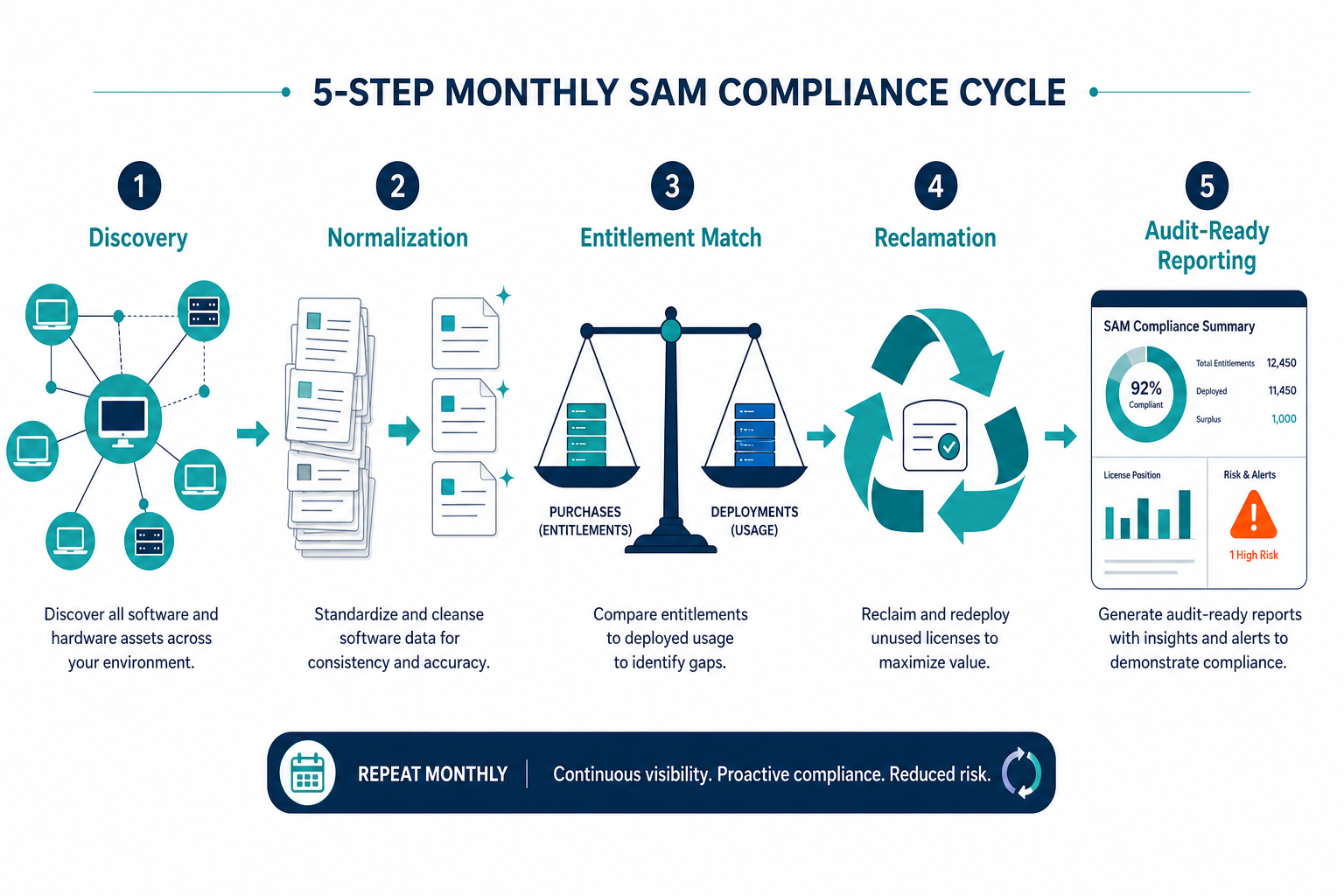
5-step automated SAM compliance routine
Reconciling software compliance once a year guarantees compliance drift and unexpected true-up costs. The same Unisphere Research survey found more than a third of software audits take three to six months to resolve, time most IT teams do not have once a vendor notice arrives. Some organizations reconcile quarterly instead of monthly — that’s workable, but a monthly cadence closes the entitlement gap faster and leaves more runway before a vendor notice arrives. Establishing a license true-up routine on a structured monthly cadence gives IT managers room to uninstall idle software and true up licenses on their own terms, before that clock starts.
- Execute scheduled multi-source discovery. Run automated agent and agentless discovery passes across local endpoints, server subnets, and cloud infrastructure to catalog installed software binaries and active service instances.
- Normalize software inventory records. Clean raw executable signatures, version numbers, and vendor strings into standardized software titles and release editions to prevent duplicate application entries.
- Compare active installations against purchase orders. Ingest current license certificates, maintenance agreements, and SaaS subscription counts from procurement systems to establish precise legal entitlement baselines.
- Identify variance and calculate financial exposure. Generate an entitlement delta report separating over-allocated installations requiring licenses from underutilized software seats eligible for reclamation.
- Enforce remediation workflows. Reclaim unassigned licenses, harvest abandoned seats from deactivated user accounts, and execute purchase requests for verified deficits before closing the monthly audit cycle.
Adhering to this operational routine keeps licensing documentation continuously audit-ready. Teams seeing unmonitored browser extension and cloud workspace growth should read why shadow SaaS grows faster than manual tracking.
Entitlement vs. installation comparison example
Software compliance hinges on the mathematical variance between proof of purchase and physical deployment. The following table shows how a mid-size enterprise evaluates compliance exposure across varied licensing metrics:
| Software Product | License Metric | Purchased Entitlements | Discovered Active Deployments | Variance Delta | Compliance Status | Action Required |
|---|---|---|---|---|---|---|
| Relational DB Enterprise | Per Core | 64 Cores | 80 Cores | -16 Cores | Non-Compliant | Purchase 16 core licenses or consolidate database workloads |
| Productivity Cloud Suite | Named User | 500 Seats | 430 Active Users | +70 Seats | Over-Licensed | Downgrade unused seat tier during next contract renewal window |
| Virtual Desktop Client | Concurrent Device | 250 Endpoints | 295 Endpoints | -45 Endpoints | Non-Compliant | Restrict pool access policies or expand license allocation |
| Endpoint Security Agent | Per Device | 1,200 Nodes | 1,185 Nodes | +15 Nodes | Compliant | Reallocate available licenses to new onboarding batches |
| Engineering CAD Suite | Floating Network | 50 Concurrent | 48 Concurrent | +2 Concurrent | Compliant | Maintain current license limits and monitor utilization peaks |
Reviewing licensing balance sheets reveals that surplus licenses on one tool never offset deficits on another. Every publisher conducts audits independently, and a vendor rarely credits an over-licensed product against a different under-licensed one during a true-up negotiation. Each row in a table like this needs its own remediation path and its own renewal timeline. Tracking granular allocation metrics in tandem with technical configuration items is covered in the guide to software license management in ITAM.
Automated SaaS and shadow IT discovery
Shadow IT discovery works best as a standing process, not a one-time audit response. Department credit cards and self-service cloud signups allow business teams to deploy specialized software without central IT review. This creates significant security blind spots and duplicate software spend across siloed departments. JumpCloud’s SaaS usage research found shadow IT now accounts for more than 33% of all SaaS applications in use, so the exposure shows up in application count and access, not only in dollars spent.
Effective shadow IT governance combines network inspection, identity provider single sign-on logs, endpoint agent auditing, and expense or procurement record matching. Matching procurement and expense records against the approved software list surfaces subscriptions bought outside IT entirely — a channel that discovery alone cannot see. Scheduled discovery cycles capture background processes and unauthorized web applications running on corporate hardware. When an unapproved application appears on an endpoint, the system logs the host details, user account, and local installation timestamp.
Once unapproved applications are surfaced, IT organizations can evaluate their business utility and security posture. Safe applications can be transitioned into approved corporate agreements with volume discounts. Insecure or redundant applications can be systematically blocked at the network perimeter and endpoint layer. Security governance standards outlined in NIST SP 800-53 Rev 5 require continuous software identification to enforce strict configuration baselines and prevent unauthorized software execution.
How does automated discovery identify shadow IT and unapproved SaaS?
Automated discovery audits endpoint processes, local service configurations, and identity provider access logs on scheduled cycles. It flags applications operating outside approved procurement channels, alerting administrators to unauthorized tools so security teams can inspect data risks and consolidate redundant subscription costs.
How Virima supports software asset governance
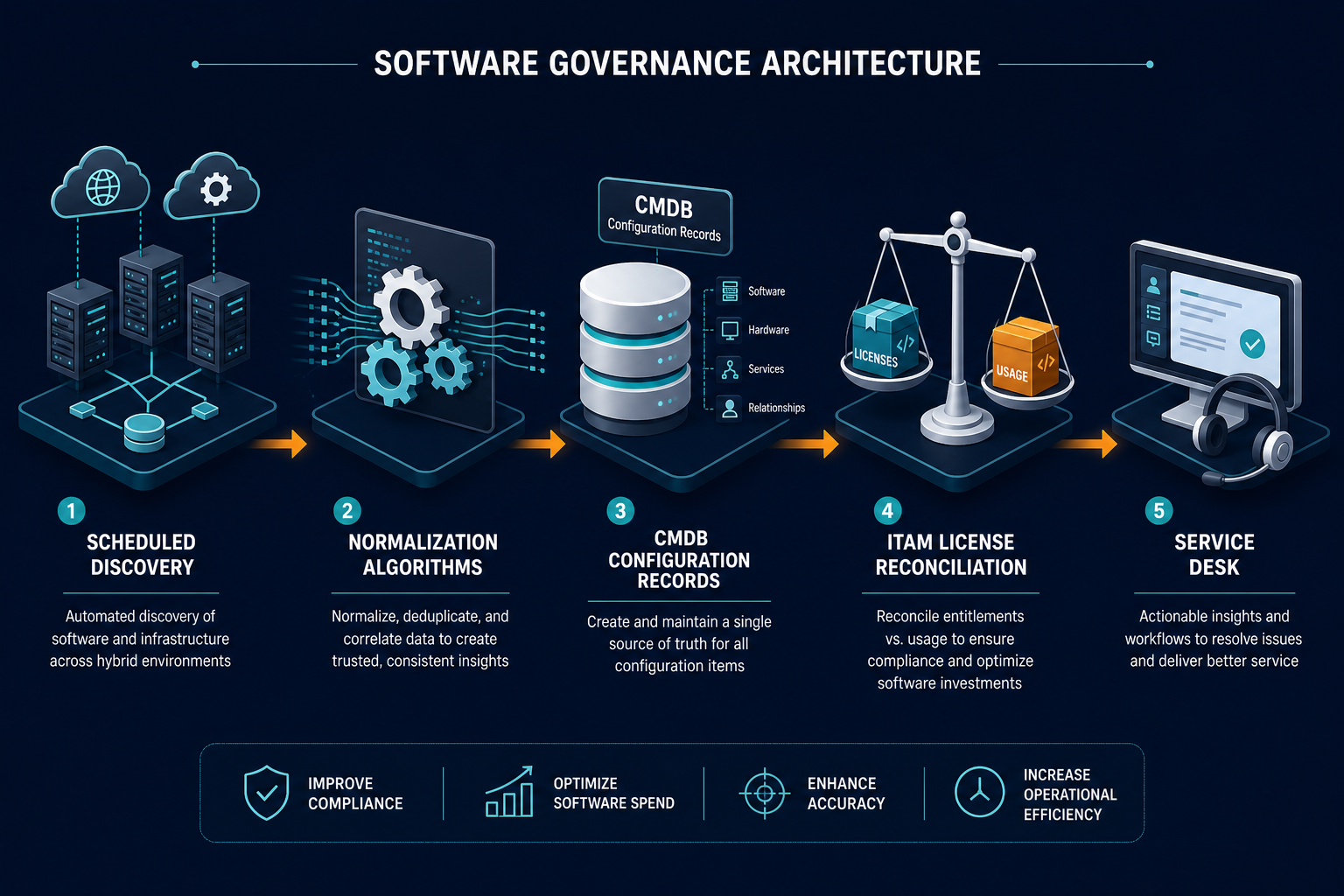
Virima provides the discovery-sourced foundation that reduces software audit risk and shadow IT exposure. Scheduled discovery scans hybrid estates, data centers, and cloud environments to uncover hardware assets and installed software applications without relying on error-prone manual spreadsheets. That scheduled cadence matters because entitlement data decays fast. A single quarter of untracked onboarding, offboarding, and ad hoc SaaS signups is enough to make a six-month-old inventory unreliable for an actual audit response.
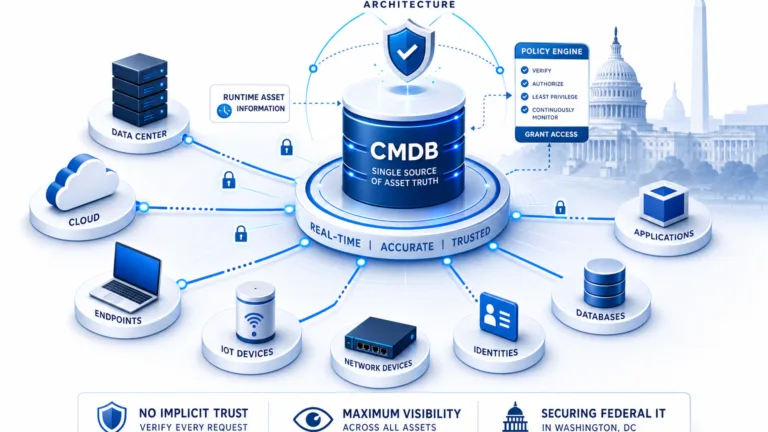
Discovered assets populate the native CMDB with verifiable configuration details and source tags. The IT asset management feature set attaches purchasing contracts, warranty terms, cost allocations, and license counters directly to discovered configuration items. Once administrators supply business service definitions, ViVID™ displays interactive dependency maps showing which business services depend on specific licensed software hosts.
ITSM platforms such as ServiceNow, Jira Service Management, Ivanti, HaloITSM, Xurrent, Hornbill, and TeamDynamix operate as systems of engagement for requests and change governance. Virima feeds validated configuration items into these platforms through connectors accessible on the integrations hub, without requiring a platform migration.
Before committing to expensive external licensing consultancy retainers, see how Trusted Runtime Truth provides explainable data that reconciles software assets across your entire operational estate.
Tired of surprise software audit true-ups and unmonitored shadow IT? Explore how Virima combines scheduled discovery and ITAM governance to keep software estates audit-ready.
Shift from reactive audits to defensible governance
Software audit defense is an operational discipline rather than an emergency response drill. Organizations that establish scheduled multi-source discovery, normalize software titles, and compare deployments against entitlement records every month avoid catastrophic financial penalties and regain control over shadow IT. A monthly routine is the only way to beat that clock before an auditor starts it — once a true-up demand lands, there usually isn’t time to rebuild months of untracked deployments inside the typical three-to-six-month audit resolution window.
When licensing documentation is backed by verifiable technical records, vendor audit notices transition from organizational emergencies into routine data validations.
Ready to establish clear visibility over your deployed software and cloud applications? Schedule a demo today to see how Virima can surface your software footprint and reduce audit exposure.
Frequently Asked Questions
What causes software audit penalties?
Software audit penalties occur when active installations, processor core counts, or user accounts exceed the entitlements documented in vendor licensing agreements. Unrecorded hardware upgrades, untracked virtualization expansion, and decentralized software purchases commonly create these unmonitored compliance deficits.
What is a license true-up?
A license true-up is a contractual reconciliation between a software vendor and customer to settle deployment discrepancies. Organizations must purchase additional licenses and retroactive maintenance fees to cover all unlicensed deployments discovered during operational reviews.
How often should we reconcile software licenses?
Organizations should execute automated discovery and license reconciliation every month. Monthly cycles prevent unapproved installations from compounding over time, giving teams sufficient window to uninstall unused software before official vendor audit requests are initiated.
Does Virima’s discovery process detect unapproved SaaS apps without installing agents everywhere?
Yes. Virima’s agentless and agent-based discovery methods track local application processes, browser integrations, and identity provider single sign-on logs to identify SaaS tools operating outside formal IT procurement channels — without requiring an agent on every endpoint. This visibility allows security teams to review data handling risks promptly.
Who owns software compliance?
Software compliance is a shared operational responsibility owned by IT asset managers, enterprise procurement, and infrastructure engineering leads. ITAM professionals manage entitlement records, engineering maintains discovery pipelines, and procurement handles vendor contract renewals.
How does Virima’s CMDB support software audit readiness?
Virima’s CMDB stores discovery-sourced configuration details and source tags for every software asset, so entitlement counts, purchasing contracts, and license terms stay attached to verified deployment records instead of a separate spreadsheet. That gives audit teams a single, defensible source when a vendor true-up request arrives.