From Discovery to Regulatory Audit: How Automation Keeps You Audit-Ready All Year

Keeping up with compliance can feel like an endless race. Between changing regulations, expanding digital environments, and constant security risks, staying audit-ready isn’t easy. For most organisations, that means juggling regulatory requirements while trying to keep daily operations moving.
Many organisations find themselves scrambling right before an audit — tracking down asset lists, verifying configurations, and trying to prove that everything is secure and compliant. But by then, it’s often too late to fix blind spots or outdated data, and the audit process becomes more about last-minute firefighting than real assurance.
That’s where automated discovery and real-time CMDB (Configuration Management Database) updates come in. These technologies give you continuous compliance visibility into your IT environment — so you’re always ready for an audit, not just once a year.
Automated discovery for IT audit ensures that visibility stays consistent, accurate, and aligned with compliance expectations year-round.
Let’s break down how it works, why it matters, and how it can make compliance a whole lot easier.
1. The Problem: Hidden Assets and Outdated Information
Modern IT environments are constantly changing. New devices are added, cloud services come and go; applications update automatically; it’s a living, breathing system. Without strong access controls, asset sprawl can grow quietly in the background.
If you’re relying on spreadsheets or manual processes to track assets, chances are your inventory is out of date the moment you create it.
This creates three big problems:
| 1. Blind spots: You can’t secure or audit what you can’t see. 2. Compliance gaps: If your asset data is incomplete, you can’t prove compliance with frameworks like ISO 27001 or SOC 2. 3. Stressful audits: Without current, accurate information, every audit becomes a scramble. |
In short, manual tracking can’t keep up with modern IT. You need a smarter, automated approach that helps maintain compliance as things change.
2. The Shift: From Manual to Automated Discovery
Automated discovery tools continuously scan your IT environment — servers, networks, cloud platforms, endpoints, and applications — to detect every asset and configuration.
Instead of waiting for someone to log a new device or update a spreadsheet, the system identifies changes in real time. This is where automated controls replace repetitive human checks and reduce manual effort.
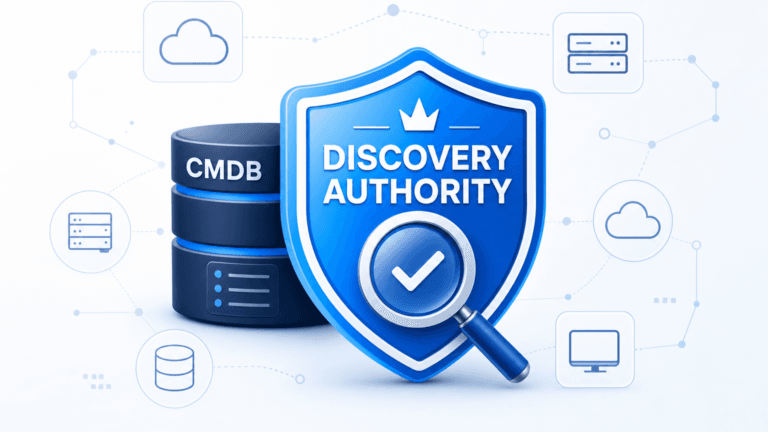
When this data flows into a Configuration Management Database (CMDB components), it creates a single source of truth for your organization’s technology landscape. With version control layered on top, you also get a reliable record of what changed, when, and by whom.
This is the foundation of Automated discovery for IT audit, because auditors expect a complete and current inventory at all times.
Here’s what that looks like in practice:
| 1) Every new asset (like a virtual machine or laptop) is automatically discovered and logged. 2) Configuration details — such as software versions, IP addresses, and ownership are captured instantly. 3) When something changes or is removed, the CMDB software updates automatically. 4) No guesswork. No missing data. Just a clear, current picture of your entire environment that supports ongoing compliance management. |
3. How This Helps with Compliance and Audits
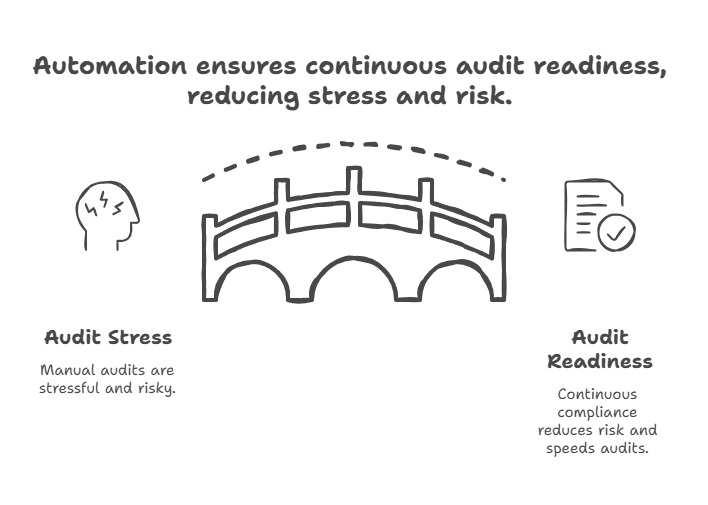
Audits don’t have to be stressful. When your discovery process is automated, and your CMDB management is always up to date, you’re essentially audit-ready all the time.
Automated discovery for IT audit makes sure compliance evidence is continuously collected instead of being rushed at the last minute through structured evidence collection and easier audit prep
Here’s how automation simplifies compliance:
a. Continuous Asset Visibility
Auditors often ask, “Can you show us all the assets under your control?”
With automated discovery, you know exactly what exists, where it lives, and how it is configured a core part of regulatory compliance.
b. Stronger Governance
Compliance frameworks like ISO 27001 and SOC 2 require organizations to maintain control over their assets and configurations. Automation ensures that these controls are always being monitored and maintained, not just checked once a year. This supports both internal policy enforcement and external regulatory requirements.
c. Reduced Compliance Risk
When every change is logged automatically, you can quickly spot non-compliant configurations or unauthorized devices before they become problems. That means fewer surprises during audits and fewer findings to fix afterward, especially for stretched compliance teams.
d. Instant Audit Trails
Automated discovery tools record every update, change, and removal. So, when auditors ask for proof of control, you already have a complete, timestamped history at your fingertips, making the full audit process smoother.
4. Real-World Benefits: Beyond the Audit
Continuous visibility isn’t just compliance; it strengthens your entire IT ecosystem.
Here’s what organizations gain by automating discovery and CMDB updates:
| Fewer blind spots: You always know what’s on your network. Faster incident communication and response: When a security threat appears, you can quickly identify which systems are affected. Smarter decision-making: With accurate data, IT and security teams can prioritise resources and investments. Consistent governance: Every asset follows the same security and compliance standards. |
This turns compliance from a reactive process into an ongoing advantage and helps you maintain compliance without constant disruption.
5. Aligning with Key Compliance Frameworks
Automated discovery directly supports many major governance and security frameworks. Here’s how it aligns with some of the most common ones:
| Framework | Key Focus Area | How Automation Helps |
| ISO 27001 | Asset management in IT and operations security | Keeps asset inventories accurate and supports risks assessments. |
| SOC2 | Security, availability, and confidentiality | Provide continuous monitoring and documented evidence of controls. |
| NIST CSF | Identify and Protect functions | Strengthens asset identification and configuration management. |
| CIS Controls 1 & 2 | Inventory of hardware and software assets | Inventory of hardware and software assets |
By aligning these automated systems with your compliance goals, you create a living compliance framework, one that evolves as your organisation does while meeting broader regulatory frameworks and expectations.
6. Making Compliance Effortless (and Continuous)
Think about the difference between cramming for an exam and learning continuously throughout the semester.
In the first case, you rush to memorize everything at once. In the second, you stay ready all the time, no panic, no surprises.
That’s exactly what automated discovery and CMDB updates do for compliance. They turn it from a one-time event into an ongoing practice backed by continuous compliance monitoring.
You’re not gathering evidence when auditors arrive; you already have it through ongoing evidence collection. You’re not guessing which assets are in scope; you know. And you’re not worried about outdated data, because it’s always current.
7. Building an “Always Audit-Ready” Culture
Automation is powerful, but it’s not just about technology. It’s about creating a culture where compliance, security, and IT work together.
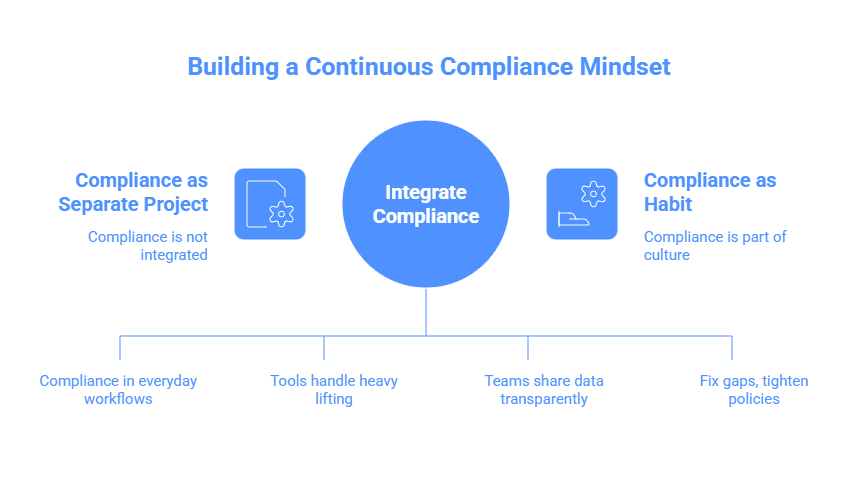
Here’s how organizations can build that mindset:
- Integrate compliance into daily operations: Don’t treat it as a separate project; make it part of everyday workflows.
- Use automation as an enabler, not a replacement: Automated tools do heavy lifting, but human oversight ensures policies are applied correctly.
- Keep communication open across teams: Compliance, security, and IT should share the same data and dashboards for transparency.
- Continuously improving: Use insights from discovery and audits to tighten policies, fix gaps, and strengthen controls. When issues surface, teams can trigger corrective action immediately rather than waiting for the next audit cycle.
When everyone shares responsibility and visibility, staying compliant becomes natural and not forced.
8. The Payoff: Confidence and Control
By moving from manual discovery to automated, real-time visibility, organizations gain something far more valuable than just audit readiness; they gain confidence.
- Confidence that every asset is accounted for.
- Confidence that every configuration is compliant.
- Confidence that when an auditor shows up, you’re already prepared for regulatory compliance checks.
This shift doesn’t just save time and reduce stress but also builds trust with customers, partners, and regulators. And in a world where security and transparency matter more than ever, trust is priceless.
Audit-Ready, Always: The Outcome of Intelligent Discovery
In a constantly changing digital world, static compliance approaches no longer work.
Automated discovery and CMDB (CMDB definition) synchronization transform compliance from a reactive burden into a proactive advantage.
Automated discovery for IT audit helps sustain that advantage by ensuring that evidence, inventory, and configuration accuracy never fall behind.
You get:
- Continuous asset visibility
- Real-time updates and audit trails
- Reduced compliance risk
- Stronger governance across all frameworks
Being audit-ready year-round isn’t about doing more work — it’s about working smarter. With automation handling the data accuracy and visibility, your teams can focus on what really matters: keeping your organization secure, compliant, and always ready for whatever comes next.
In summary:
Automated discovery and CMDB updates give organizations a simple but powerful advantage: clarity. When you know exactly what you have and how it’s configured, compliance becomes an ongoing state, not a seasonal event.
And that’s the real goal: turning discovery into assurance, and auditing into confirmation of what you already know — that your systems are under control.