Application Dependency Mapping vs Service Mapping: What’s the Difference?

Why these two terms keep getting confused
Ask five IT operations professionals to define application dependency mapping and service mapping, and you will probably get five different answers — some of which describe the same thing.
That is not a knowledge gap. It is a terminology problem the industry has never quite resolved. Vendors use the terms interchangeably. ITIL treats them as adjacent concepts without drawing a hard line. And plenty of tools attempt to do both under a single label, which muddies things further.
For IT Operations Managers and Directors running hybrid environments, the distinction is not academic. A single business service might span on-premises infrastructure, cloud workloads, SaaS platforms, and containerized applications. Get it wrong and your incident response is working from an incomplete picture. Change approvals go out without blast radius data. Your CMDB fills up with relationships that look right but do not reflect how services actually behave at runtime.
The rest of this article draws a clear line between the two and explains why the full operational picture requires both working together.
Application dependency mapping (ADM) documents component-level connections: what talks to what across apps, APIs, data stores, and infrastructure. Service mapping organizes those dependencies around a named business service so teams see blast radius, ownership, and impact during incidents and changes. ADM without service context is a technical graph without business consequence. Service maps without discovery-sourced ADM rest on stale relationships. Mature operations run both on one governed CMDB.
What is application dependency mapping?
Application dependency mapping (ADM) is the process of identifying and documenting how an application’s components interact with each other and with the infrastructure they run on.
Think of it as a technical inventory of connections. ADM answers one core question: what talks to what, at the component level?
What ADM shows you
ADM captures relationships between:
- Application modules, libraries, and services within a single application stack
- APIs and integration points between applications
- Databases, message queues, and caching layers that applications depend on
- Network ports, protocols, and communication paths
- Underlying compute, storage, and network infrastructure components
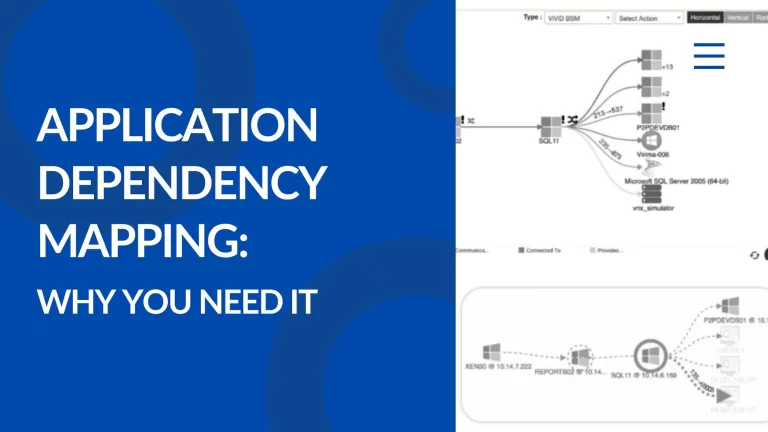
The output is a dependency map — a structured record of how components connect, what they call, and what they rely on to function. This data lives at the configuration item (CI) level in your CMDB, describing individual components and their direct relationships.
When ADM matters most
ADM is most valuable during the build and change phases of the IT lifecycle:
- Architecture decisions: Before you redesign or replace a component, you need to know what depends on it and what it depends on.
- Change management: A proposed change to a database instance or middleware layer needs dependency data to assess risk accurately.
- Security risk assessment: Knowing which components carry known vulnerabilities and what they connect to starts with accurate dependency mapping.
- Migration planning: Moving workloads to a new environment without ADM is guesswork. You need to know every dependency before anything moves.
ADM gives your teams the component-level ground truth they need to make informed decisions before something is deployed or changed.
What is service mapping?
Service mapping takes dependency data and organizes it around business services. Where ADM answers “what connects to what,” service mapping answers “how does this business service depend on the infrastructure beneath it, and what breaks if a specific component fails?”
It is an operational view. A service map traces the path from a named business service (your customer-facing payment portal, your internal HR system) down through every application component, middleware layer, server, network device, and cloud resource keeping it alive.
What service mapping shows you
A service map shows:
- The end-to-end dependency chain from business service to underlying infrastructure
- Which CIs are in scope for a given service
- The blast radius of a failure or change — which services are affected if a specific CI goes down or is modified
- Ownership and accountability at each layer of the service
- Change history and vulnerability exposure across the service’s dependency chain
What does blast radius mean in service mapping?
Blast radius is which business services sit above a CI if it fails or changes. Service maps answer that before approval or triage. ADM lists technical neighbors. Service mapping names who feels the outage and who owns the response.
This is not a static diagram. Effective service mapping reflects live, discovery-sourced ground truth — the actual state of your environment at runtime, not what someone documented six months ago.
When service mapping matters most
Service mapping is most valuable during the operate phase of the IT lifecycle:
- Incident response: When an alert fires, you need to know immediately which business services are affected, who owns them, and what the full scope of impact looks like. Service mapping gives you that context without manual investigation.
- Change approvals: Before approving a change, you need to see which services sit above the CI being modified. Service mapping shows you the blast radius before you approve or reject.
- Audit readiness: Demonstrating that you understand your service dependencies, and can show the evidence, is a requirement for SOC 2 Type 2, ISO 27001, and similar frameworks.
- SLA management: If you do not know which infrastructure components underpin a service with a defined SLA, you cannot manage that SLA with any real confidence.
The core distinction: component-level vs service-level
Here is the simplest way to hold the distinction:
Application dependency mapping is component-level. It describes the technical relationships between individual CIs — what calls what, what depends on what, at the granular level of ports, processes, and software components.
Service mapping is service-level. It organizes those component relationships into a business-meaningful view, showing how a named service depends on the infrastructure beneath it and what the operational consequences are when something in that chain changes or fails.
ADM provides the raw dependency data. Service mapping puts that data to work for the people responsible for keeping services running and managing risk.
One without the other leaves a gap. ADM without service mapping gives you a detailed technical picture with no business context. Service mapping without accurate, discovery-sourced ADM data gives you a business view built on incomplete or stale foundations. That is more dangerous than having no map at all, because it creates false confidence.
Can teams start with ADM before full service mapping?
Yes as a phase. ADM first cuts migration and change blind spots at the component layer. Service mapping becomes mandatory when CAB, major incident bridges, SLAs, or audit need business impact, not only CI links. Plan both on one discovery-fed CMDB so you do not rebuild trust later.
Three maps people call “service mapping”
Search results mix three different ideas under similar labels. Treating them as one toolset creates the wrong buy and the wrong workflow.
ITOM / CMDB service mapping starts from a named business service and walks the dependency chain through applications, middleware, hosts, network, and cloud CIs. The system of record is the CMDB. Primary jobs: incident impact, change blast radius, ownership, audit evidence.
Application dependency mapping stays at the component graph: processes, ports, APIs, data stores, and infrastructure edges. It feeds service maps and change design. It does not by itself name which payroll or payments service fails when a CI drops.
APM “service maps” show runtime calls and latency between instrumented services. They help performance debugging. They are not a substitute for CMDB-backed business service maps used in CAB and major incident bridges.
Network topology maps are a fourth cousin: switches, routers, and subnets. Useful input to a full service map, not a replacement for business-service impact.
When practitioners ask for the difference between service mapping and a CI dependency view, they usually mean top-down business service scope versus a horizontal graph of related CIs. Both matter. Only the service view answers who is affected in business terms.
Build phase vs operate phase: a practical framing
A useful way to think about where each capability fits is to map them to the IT lifecycle.
Build phase (design, develop, deploy, change):
- ADM is your primary tool here
- You need to know what a component connects to before you change it, move it, or replace it
- Dependency data feeds change impact assessments, architecture reviews, and migration plans
- Security teams use ADM data to trace vulnerability exposure across the component graph
Operate phase (monitor, respond, manage, audit):
- Service mapping is your primary tool here
- When an incident occurs, you need a service-level view of impact, not a raw list of CI relationships
- Change approvals need blast radius context, not just a dependency list
- Audit evidence requires a clear, traceable line from business service to underlying infrastructure
In practice, these phases overlap. A change that starts in the build phase has operational consequences that play out in the operate phase. Both capabilities need to draw from the same underlying data source: your CMDB. And that data needs to reflect the live state of your environment, not a snapshot from the last discovery cycle.
From ADM to business service maps: a practical maturity path
Teams rarely jump from blank slides to trusted service maps. A clear path reduces “we need both” from a slogan into a build plan.
Level 1, Manual inventories. Spreadsheets and tribal knowledge. Fine for a pilot app. Rotates stale the week after a release.
Level 2, Traffic and connection evidence. Discovery and flow data show what talks to what at the host and port layer. This is classic ADM fuel for migration and change design.
Level 3, Deeper application identity. Fingerprint middleware, data stores, and app roles so edges mean more than raw sockets.
Level 4, Hybrid coverage. Extend the same relationship model across on-prem, cloud, and containers so maps match how services actually run.
Level 5, Business service composition. Architects and service owners define which apps and entry points form each business service. Mapping software then builds the service-to-CI chain from those definitions plus ADM data.
Level 6, Operate-time overlays. Incidents, changes, and prioritized risk signals sit on the same map so CAB and incident commanders do not swivel-chair across tools.
Stopping at Level 2 is valid during a migration factory. Staying there after you promise SLA-backed services leaves operations teams without blast radius. Climb the ladder on one CMDB so each level reuses the last.
Why you need both — not one or the other
The teams that get the most value from dependency and service data treat ADM and service mapping as complementary, not competing. ADM-only is a valid phase when the main risk is migration or redesign of a bounded stack, and nobody is yet routing major incidents or CAB by business service. The failure mode is freezing there: operate, audit, and automation still need service-level impact on the same data. Here is what that looks like in practice:
- Recurring discovery scans capture dependency data across hybrid environments using agentless methods, optional agents, and API integrations.
- That data populates your CMDB with accurate, discovery-sourced ground truth at the CI level (ADM)
- Service mapping organizes those CI relationships into service-level views that reflect current runtime state
- When an incident fires, your operations team sees the affected service, the dependency chain, the blast radius, and ownership without manual investigation
- When a change is proposed, the approver sees which services sit above the affected CI and what the risk exposure is
- When an auditor asks for service dependency documentation, you can produce it from the same continuously updated source that drives your day-to-day operations
This is not a theoretical architecture. It is the operational model mature IT organizations are building right now: to reduce MTTR, prevent failed changes, and maintain audit-ready visibility across hybrid environments.
Looking ahead, AI-assisted operations will only amplify this need. Any automation that triggers remediation must know the blast radius before it acts, which requires both ADM (what connects to what) and service mapping (which services are affected) working from the same live, governed data.
See how discovery-sourced dependency data becomes service-level blast radius
How Virima delivers both in one platform
Virima delivers trusted runtime truth for agentic IT — live, explainable, discovery-sourced ground truth across assets, services, dependencies, ownership, change history, and blast radius. For teams that need both ADM and service mapping, Virima provides both in a single platform built on automated multi-source discovery and an always-accurate CMDB.
Automated discovery
Virima’s discovery engine runs recurring scheduled scans across your hybrid estate with agentless methods, optional agents, and API integrations. Each cycle records component-level dependency relationships as they exist at scan time, not as they were written in last quarter’s architecture deck. That discovery-sourced data is the ground truth both ADM views and service maps rely on.
Always-accurate CMDB
Virima’s CMDB stores and normalizes that discovery data, maintaining accurate CI records and relationships across your entire estate. It is the single source of truth that feeds both dependency mapping and service mapping with consistent, governed data.
Service mapping at the business-service level
Virima’s service mapping organizes CI-level dependency data into service-level views. It shows how business services depend on underlying infrastructure, and what the blast radius is when something in that chain changes or fails. Teams define each business service (manually, by spreadsheet import, or via architecture integrations). Virima then builds the service-to-infrastructure dependency map from those definitions plus discovery-sourced CI relationships.
ViVID™: live operational overlays on every service map
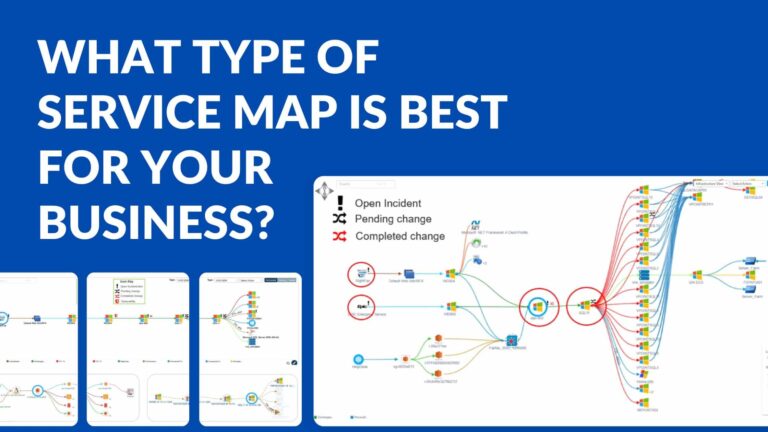
Virima Visual Impact Display (ViVID™) brings these views to life. It overlays open incidents, recent changes, pending changes, and known vulnerabilities directly onto your service maps. You see the service, the dependency chain, the affected CIs, and the operational events on each one in a single live view. Each status is mapped to the specific CI it applies to, not shown as a generic alert.
Because all of this draws from the same discovery-sourced data layer, you are not maintaining two separate systems with two separate data models. ADM and service mapping are two views of the same continuously updated infrastructure intelligence.
Quick comparison: ADM vs service mapping
| Dimension | Application dependency mapping | Service mapping |
|---|---|---|
| Primary question | What connects to what? | How does this business service depend on infrastructure, and what breaks if a CI fails? |
| Level of view | Component / CI level | Business service level |
| Typical entry point | Host, app stack, IP range, observed connections | Named service, catalog ID, or defined entry point |
| Primary lifecycle phase | Build, change, migrate | Operate, respond, audit |
| Data grain | Processes, ports, APIs, modules, infrastructure edges | Service → app → infra chain with ownership and impact |
| Human input | Validate noisy edges and scope | Define service composition and boundaries |
| Refresh expectation | After each discovery cycle | After discovery cycles plus service definition updates |
| Key use cases | Change impact, architecture, security exposure paths, migration | Incident response, change approval, SLA confidence, audit evidence |
| Output | Dependency graph of CIs and relationships | Service-to-infrastructure map with blast radius |
| Who uses it most | Architects, engineers, security, config managers | IT ops, service desk, change managers, auditors |
| Risk when missing | Blind spots in change risk and exposure | Slow incident response, weak CAB decisions, audit gaps |
| Fails-open risk | Missed edge → surprise outage after change | Wrong service boundary → wrong blast radius |
Start With Trusted Runtime Truth
The difference between application dependency mapping and service mapping is not just semantic. It is the difference between knowing what connects to what and knowing what breaks (and for whom) when something in that chain changes.
Both capabilities are necessary. Neither works well without accurate, live, discovery-sourced data underneath them. As IT operations teams take on more automation, and as audit, security, and compliance requirements tighten, the quality of that underlying data is not a nice-to-have. It is the foundation everything else depends on.
Virima gives you both ADM and service mapping in one platform — built on recurring multi-source discovery and an always-accurate CMDB, with ViVID™ overlaying live trusted runtime truth onto every service map so your team can see exactly what exists, what’s connected, and what will break before they act.
Read more in our whitepaper Discovery and Service Mapping: how they create value for IT, or request a demo at Virima.com.
FAQs
Q: Is application dependency mapping the same as service mapping? No. Application dependency mapping operates at the component level, documenting how individual application components, services, and infrastructure elements connect to each other. Service mapping operates at the business service level, showing how a named service depends on the full underlying stack and what breaks when a component in that chain fails. They are related, but they serve different purposes.
Q: Do I need both ADM and service mapping, or can I get by with one? You need both for a complete operational picture. ADM without service mapping gives you detailed technical data with no business context. Service mapping without accurate ADM data gives you a business view built on shaky foundations. The two capabilities work best when they draw from the same live, discovery-sourced CMDB data.
Q: What is blast radius in the context of service mapping? Blast radius describes the scope of impact when a specific CI fails or is changed. A service map shows which business services sit above a given CI, so you can assess how far a failure or change would propagate before you act. This is essential for change approvals and incident triage.
Q: How does automated discovery relate to application dependency mapping? Automated discovery is what keeps ADM accurate and current. Without continuous discovery, dependency maps go stale quickly, especially in hybrid environments where workloads shift frequently. Discovery captures the live state of component relationships and feeds that data into your CMDB, which is the foundation for both ADM and service mapping.
Q: Can service mapping work without a CMDB? Not reliably. Service mapping depends on accurate, normalized CI data to build trustworthy service-to-infrastructure views. Without a CMDB as the underlying data store, service maps are typically built manually or from point-in-time snapshots, both of which degrade quickly and create the kind of false confidence that leads to missed blast radius during incidents and change approvals.
Q: How does service mapping support audit readiness? Service mapping provides traceable, documented evidence of how business services depend on underlying infrastructure. For frameworks like SOC 2 Type 2 and ISO 27001, auditors want to see that you understand your service dependencies and can back that up with current, accurate data. A service map built on discovery-sourced ground truth satisfies that requirement far more effectively than manually maintained documentation.
Q: What is the difference between a dependency map and a service map in a CMDB? A dependency map in a CMDB describes relationships between individual CIs — for example, an application server depends on a specific database instance. A service map organizes those CI relationships around a business service, showing the full dependency chain from the service down to every CI that supports it, including ownership, change history, and vulnerability exposure at each layer.
Q: How is service mapping different from network mapping? Network mapping shows physical and logical network topology: switches, routers, subnets, and the connections between them. Service mapping shows how a business service depends on every component beneath it, which includes network devices but also application layers, databases, cloud services, and middleware. A network map answers “how is the network laid out?” A service map answers “what breaks the payroll service if this component fails?” The two are complementary. Network mapping is one input into a complete service map, not a substitute for one.