AI on a Stale CMDB: A CIO’s Honest Account

The assumption we mistook for risk management
Deploying AI on a stale CMDB produces confidently wrong recommendations, not random errors. According to Gartner, poor data quality is one of the leading reasons data and analytics initiatives fail — a challenge that becomes critical when AI systems operate on stale CMDB records. Industry research consistently places initial CMDB accuracy between 60% and 75%, well below the 90% or higher threshold that AI-driven incident correlation typically requires. This is what happened when we ignored that gap.
I made that call. My CMDB was at 61% accuracy when we deployed AI-assisted incident correlation across a 4,000-node enterprise environment. The team called it a “known risk we would manage.” In the first 30 days, the AI generated 340 correlation recommendations. I pulled a random sample of 100 for manual review. Thirty-seven were built on stale or incorrect CI data. Twenty-three of those 37 would have caused additional outages or delayed resolution if followed without override.
A 61% CMDB accuracy rate does not mean 39% of AI outputs will be wrong. It means the error distribution is unpredictable. One incorrect service relationship corrupts every recommendation that includes that CI in its dependency graph. This is why Trusted Runtime Truth — a discovery-sourced, governed CMDB — is a precondition for AI operations, not a post-deployment improvement goal. |
The CMDB accuracy question came up in the pre-launch review. The team discussed it, noted the 61% figure, and categorized it as a known risk to be managed with human-in-the-loop review gates. That framing felt rigorous. In retrospect, it was the decision that made the next 30 days inevitable.
Here is the critical distinction: a 61% CMDB accuracy rate does not mean 39% of AI outputs will be wrong. It means the error distribution is unpredictable. An incorrect service relationship in one CI affects every recommendation that includes that CI in its dependency graph. When the AI model processes that stale record, it treats it as fact, and every output touching that record inherits the inaccuracy. The model works correctly. The data layer does not.
This is where the concept of Trusted Runtime Truth becomes essential.
Trusted Runtime Truth: The CMDB is discovery-sourced, explainable, and governed before any AI system operates on top of it. It is the data quality prerequisite for AI operations, not a post-deployment improvement goal.
Industry research consistently places initial CMDB accuracy measurements between 60% and 75%, significantly below the 90% or higher threshold that AI-driven automation typically requires. If you are starting this conversation, that framing changes how the whole problem looks.
What 340 AI recommendations looked like in practice
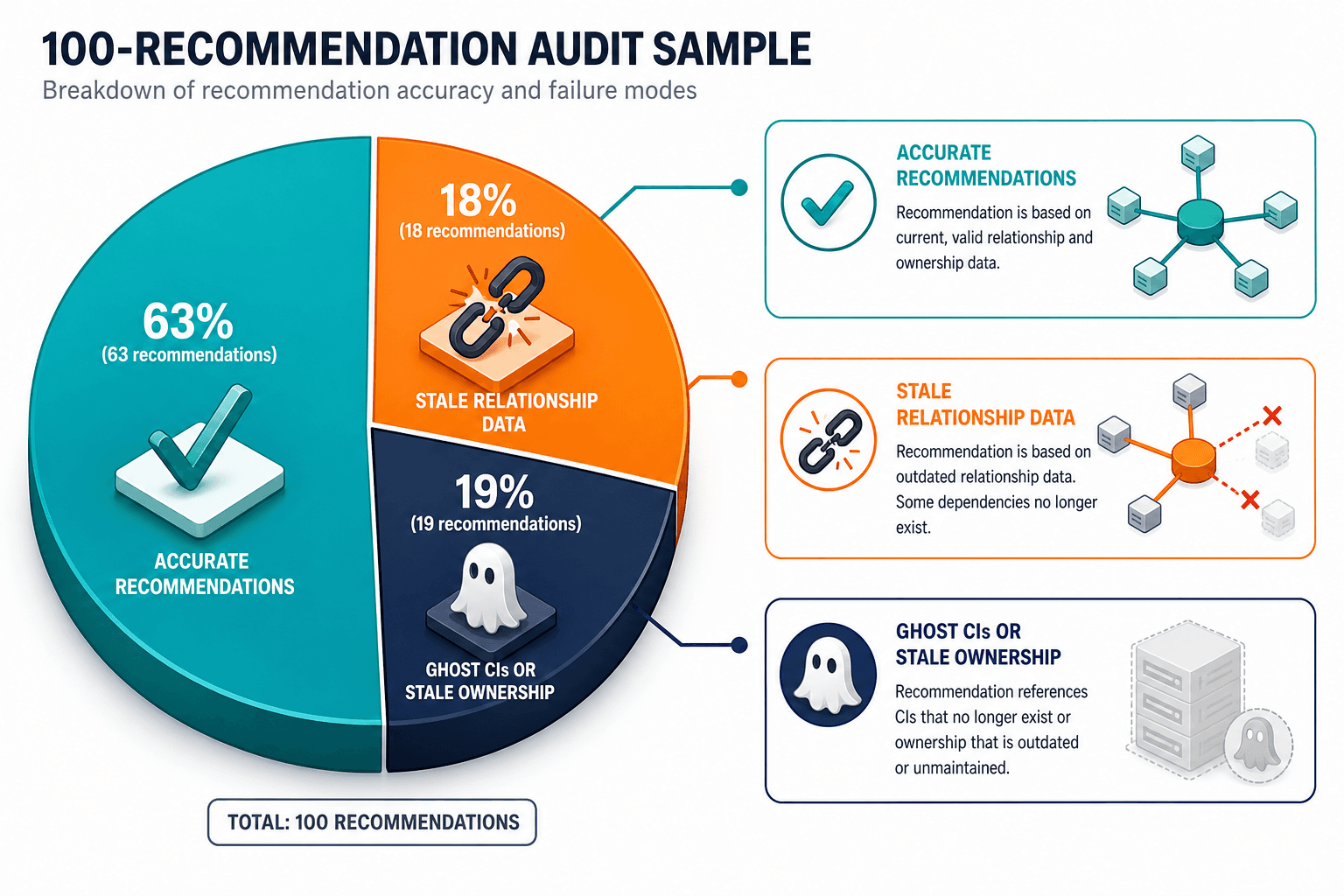
A sample audit of 100 AI recommendations found 37 were wrong, broken into three categories: rerouted service relationships, ghost CIs, and stale ownership fields. Twenty-three of those 37 would have caused additional outages if followed without human override. These are not model failures. They are data failures. |
I ran a sample audit: 100 recommendations drawn at random from the first 30 days of production. Thirty-seven of the 100 were wrong, broken into three categories.
- Rerouted service relationships — the model cited dependency paths between CIs that had been rerouted or decommissioned in the live environment. These were not missing relationships. They were relationships that had changed but were not reflected in the CMDB.
- Ghost CIs — seven recommendations involved assets that no longer existed in the production environment. They had been removed during a recent infrastructure refresh, but the CMDB still carried them as active. Ghost CIs are configuration items that remain in the CMDB as active records after the corresponding asset has been decommissioned.
- Stale ownership — twelve recommendations routed escalations to owners who had left the organization. The ownership field had been updated in Active Directory but not in the CMDB. Stale ownership occurs when AD updates are not synced back to CMDB owner fields.
Of the 37 incorrect recommendations, 23 would have caused additional outages or delayed incident resolution if followed without human override. That is not a risk management scenario. That is a system failure waiting for the right incident to expose it.
Research on AIOps solutions for incident management confirms that AI model accuracy in correlation tasks is highly sensitive to the quality of underlying topology data. The models perform exactly as designed. The input layer determines reliability. So the decision came down to this: treat the AI layer as fundamentally unreliable or fix the data layer.
The decision to pause
Pausing the AI correlation layer was a CIO decision, and I made it without ambiguity about where the problem sat. The CMDB had been deployed as an AI input layer while carrying a 39% data failure rate. That decision had been made in the pre-launch review with my sign-off. The harder conversation was explaining to the executive team that the AI model worked correctly; the data foundation did not.
Restarting would require fixing the data layer first. No shortcuts.
Before AI can act on your infrastructure, the data layer has to be accurate. See how Virima’s Trusted Runtime Truth gives AI agents the governed, explainable data foundation they need. |
Twelve weeks of remediation
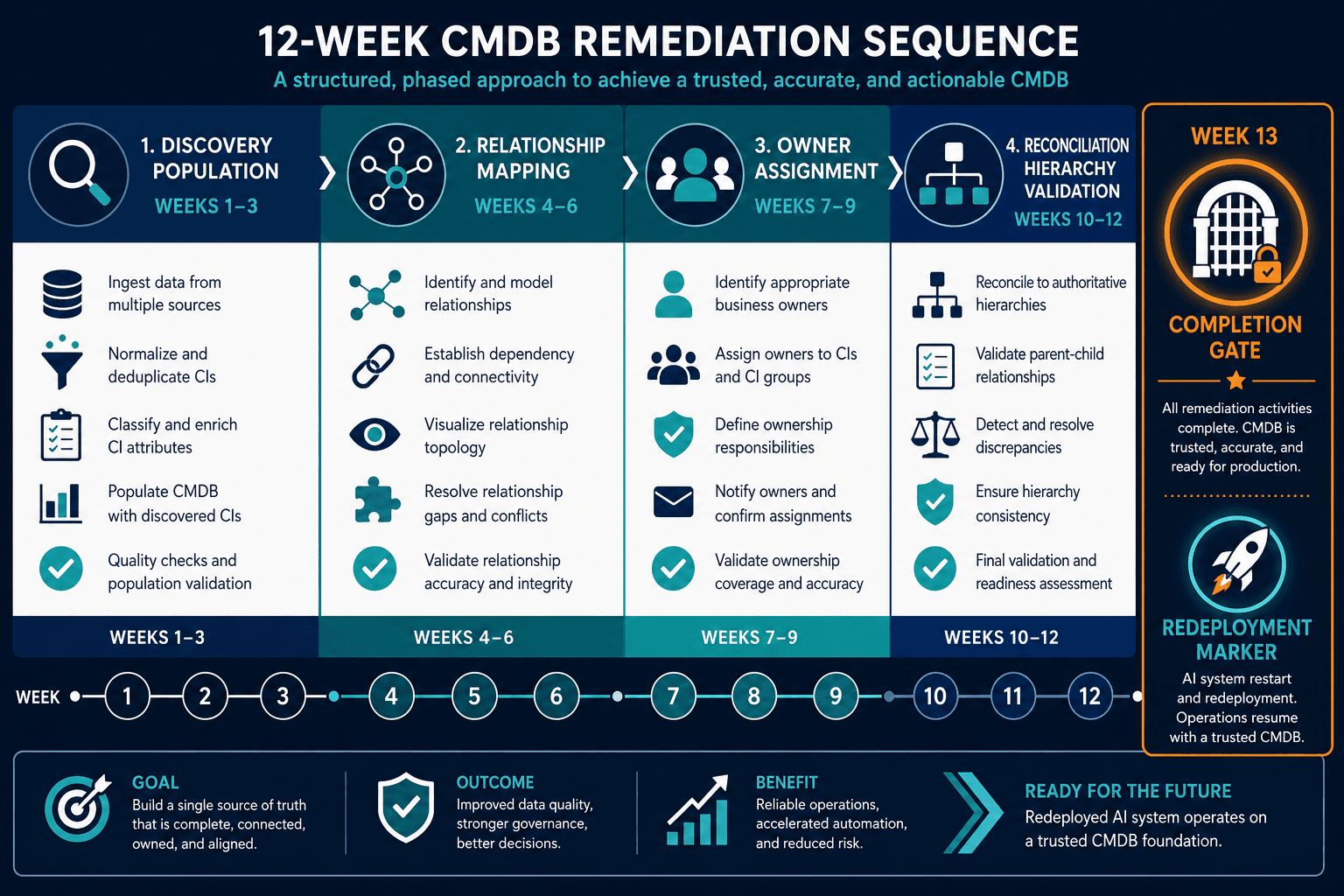
A structured CMDB remediation for a 4,000-node environment ran 12 weeks across four phases: discovery-sourced population, relationship mapping, owner assignment, and reconciliation hierarchy validation. Each phase required a measurable exit criterion before the next began. No phase was optional. |
Phase 1: Discovery-sourced population
A full IT discovery scan established the authoritative baseline. Ghost CIs were retired. Manual imports that contradicted discovery data were flagged for review and corrected.
See how Virima’s discovery-driven approach shortens this remediation timeline by establishing a discovery-sourced baseline without manual data entry: Virima IT Discovery vs. Device42: Discovery Agent Feature Comparison
Phase 2: Relationship mapping
Every CI within scope was audited against live discovery data. Virima’s ViVID service maps made this step visual, rendering changed dependency paths directly from the discovery scan rather than requiring a manual cross-reference. We identified which relationships had changed and updated the CMDB to match live environment topology.
Phase 3: Owner assignment
Owner assignment was resolved by cross-referencing Active Directory with a team survey, not elegant, but thorough. Every Tier 1 and Tier 2 CI had a verified owner before we moved to the next phase.
Phase 4: Reconciliation source hierarchy
We defined and enforced a source priority rule. For integration feeds coming from ITSM platforms, precedence rules were documented and validated before the AI layer was reactivated.
These four phases were not optional. Each one had a measurable exit criterion.
What redeployment revealed
At week 13, the AI correlation layer redeployed on the cleaned CMDB. In the next 30 days, it generated 312 recommendations. The operations team rated 94% as accurate—a shift from the pre-remediation sample of 63%.
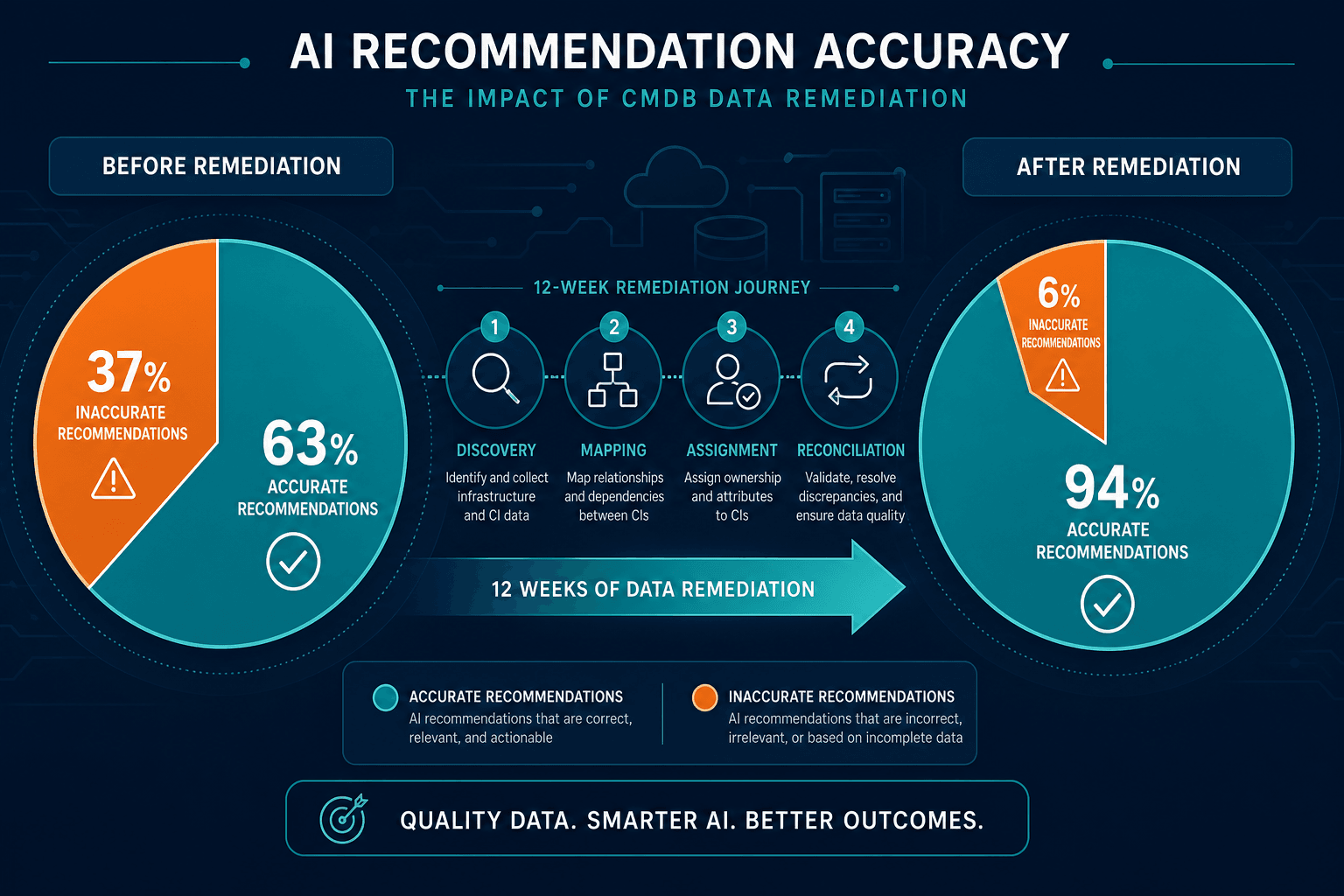
That improvement was not a model improvement. The model was identical. Every algorithmic change, every tuning parameter, every feature weight remained the same. It was a data quality improvement. The operations team now had reliable input, and the model’s output became reliable as a result.
That 31-point accuracy swing confirmed what the CMDB cleanup had cost us to learn: AI-assisted incident correlation works when the data it operates on is trustworthy, and it breaks in ways that are hard to detect without manual audit when the data layer is not.
See how Virima strengthens Xurrent’s CMDB with discovery-sourced data to close the gap between your current CMDB accuracy and the threshold AI operations require.
Ready to scope a CMDB data readiness assessment? Schedule a demo |
What I would tell any CIO starting this conversation now
The core mistake is treating CMDB accuracy as an IT hygiene problem and AI reliability as a model problem. They are the same problem. AI does not fix data quality. Data quality enables AI. Any CIO deploying AI into incident correlation or change management should treat CMDB readiness as a precondition, not a parallel track. |