We Deployed an AI Co-Pilot for Incident Management. Here Is the First Thing It Got Wrong.

An AI co-pilot for incident management can reduce root cause identification from minutes to seconds. But its accuracy is set entirely by the CMDB it queries. Ghost CIs and missing CIs create opposite failure modes: one sends engineers toward a device that no longer exists; the other makes the actual failing device invisible. Both failures stem from CMDB data gaps, not from the AI model itself.
An AI co-pilot for incident management can fail when the CMDB it queries contains ghost CIs (active records for decommissioned devices) or missing CIs (live infrastructure with no CMDB record). These two failure modes produce opposite errors: ghost CIs generate false-positive recommendations; missing CIs make actual failing devices invisible. The sequence below is drawn from real post-incident reviews and shows how discovery-driven CMDB remediation resolved both.
When you deploy an AI incident co-pilot, initial success feels immediate. The first six incidents, all P1 or P2 severity, were processed correctly. The co-pilot identified root causes in seconds, ranked probable solutions by impact, and handed engineers and SRE teams the exact context they needed. Then incident #7 arrived. The co-pilot recommended rolling back a configuration change on a load balancer that no longer existed. An engineer spent 22 minutes chasing that recommendation before manual inspection confirmed the device had been decommissioned six weeks earlier.
That is not a model problem. It is a data problem. Two distinct CMDB failures caused it, operating in opposite directions, both invisible to incident triage until the AI co-pilot brought them into sharp relief.
An AI co-pilot for incident management sits between your monitoring stack and your response team. It ingests alert data, queries your CMDB and runbooks, and surfaces probable root causes with ranked remediations in seconds. Its accuracy ceiling is set entirely by the quality of data it can que.
The Recommendation That Cost 22 Minutes
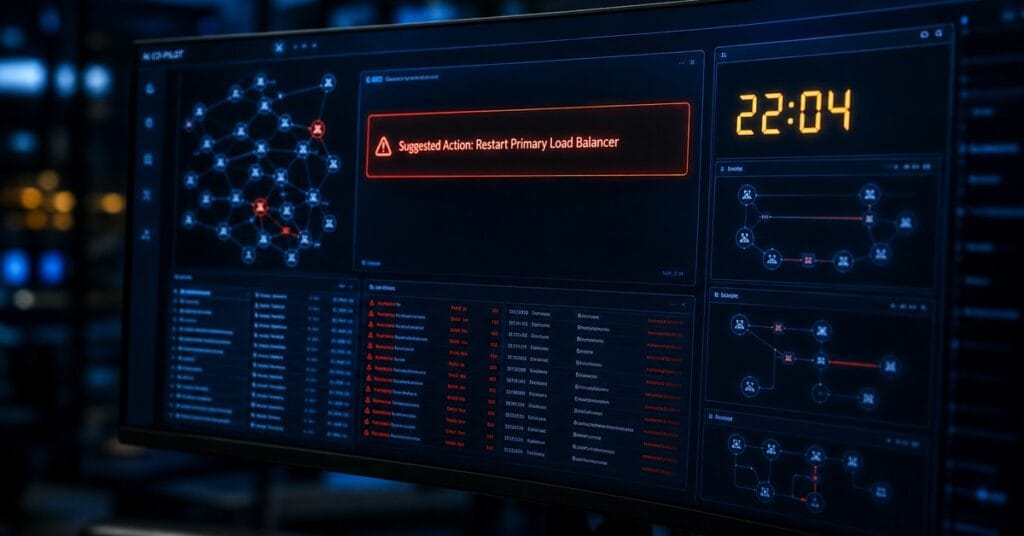
| shows what happens when a ghost CI enters the AI recommendation chain. The co-pilot processed the P2 alert in 8 seconds and surfaced a load balancer rollback as the fix. That device had been decommissioned six weeks earlier. The engineer spent 22 minutes on a false lead. The actual failing device had no CMDB record at all. |
It started at 14:37 on a Wednesday afternoon. Application performance degradation, customer-facing web tier, severity P2. The AI co-pilot for incident management processed the alert in 8 seconds. It surfaced three items: probable root cause (load balancer misconfiguration), affected services (two identified), and recommended remediation (roll back the most recent configuration change on that load balancer).
The engineer on-call accepted the recommendation. At 14:59, they were deep in the rollback process when manual inspection of the actual device revealed the hard truth: the load balancer did not exist.
A second engineer joined at 15:01 and started manual investigation from scratch. The real root cause emerged quickly: the replacement load balancer, provisioned six weeks earlier as an emergency replacement, had a misconfigured health check. That device existed in live infrastructure but held no CMDB record.
The P2 resolved at 15:17. Total incident time: 40 minutes. Time wasted on the co-pilot’s recommendation: 22 minutes.
What the post-mortem found
AI incident management tools surface root causes from the data they can access. When that data contains ghost CIs or missing CIs, the recommendations reflect those gaps directly. The co-pilot was not wrong given what it could see. The CMDB was the problem.
Two CMDB Failures Exposed in a Single Incident
Ghost CIs and missing CIs are distinct failure modes with opposite effects. A ghost CI causes false-positive recommendations: the AI identifies a device that looks credible but no longer exists. A missing CI causes false-negatives: the AI cannot identify the actual failing device because it has no record the device exists. Incident 7 exposed both simultaneously. |
The post-incident review identified two distinct failures, each creating opposite accuracy hazards.
The first was a ghost CI: an active CMDB record for a device that no longer existed in live infrastructure. The decommissioned load balancer had been removed from the environment, but the decommission process included no CMDB retirement step. The record remained active, flagged with failed relationships, waiting to trap the next incident triage into a false lead.
The second was a missing CI: the replacement load balancer had no CMDB record at all. The infrastructure team provisioned it through a rapid-deployment workflow designed for emergency replacements. No change ticket, no formal CI creation step, no CMDB update. The team noted the CMDB update as a follow-up task. Six weeks later, that task remained incomplete.
Ghost CIs produce false-positive recommendations: the AI identifies a device that looks like a credible problem source when it no longer corresponds to real infrastructure. Missing CIs produce false-negatives: the AI cannot identify the actual problem source because it has no record the device exists. The impact of ghost CIs extends to any co-pilot reasoning over stale records. In incident #7, both were present. One pulled the investigation in the wrong direction. The other made the actual failing device invisible.
Not sure whether your CMDB has ghost CIs? CMDB Audit Essentials: Ensuring Data Accuracy and Compliance walks through the key steps.
The post-mortem raised a harder question: if the co-pilot could not see decommissioned devices and could not see devices that were never formally registered, how many other hidden gaps existed in the CMDB? And how many future incidents would be misdiagnosed by incomplete data?
| What is a ghost CI in CMDB, and why does it matter for AI incident management? A ghost CI is an active CMDB record for a device that no longer exists in live infrastructure. For an AI co-pilot for incident management, a ghost CI causes false-positive root cause recommendations. The co-pilot recommends rollbacks or changes on a decommissioned device, sending engineers on false investigations and extending incident resolution time significantly. |
The Discovery Fix and What It Found
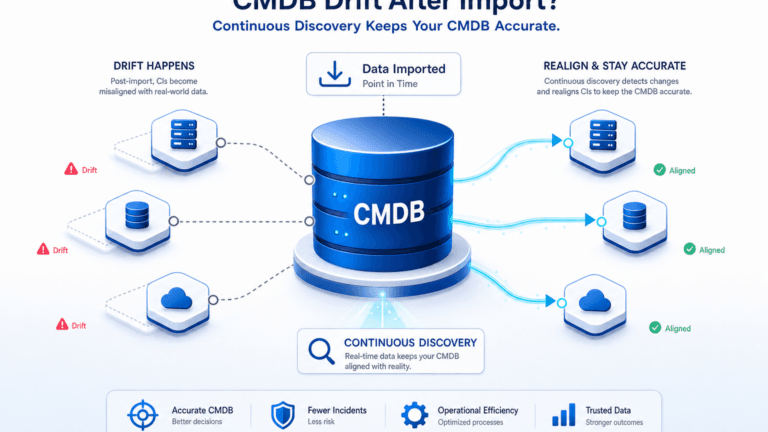
- The remediation after incident #7 was a targeted discovery scan across the load balancer and network segment using agentless methods (SNMP, SSH). The goal was direct: scan live infrastructure independently of the change management process and capture every device the scanner could reach.
- The scan identified the replacement load balancer immediately, six weeks in production with zero CMDB representation. The ghost CI for the decommissioned predecessor was retired from the database. A new CI was created for the replacement device with full attribute capture: model, IP address, firmware version, interface configuration, and all the context a future incident triage might need.
- The same discovery scan also surfaced three other devices in the same network segment with no CI records. Before the scan, a future incident affecting any of those devices would also have produced an incomplete diagnosis. Discovery had revealed not just the immediate problem but a structural gap in CMDB coverage.
- Virima’s discovery approach uses both agentless (SNMP, SSH, WMI) and agent-based methods across on-premises and cloud environments. The key difference from manual CI registration is independence from the change process. Infrastructure provisioned outside formal channels gets discovered regardless, because the scan reads the network directly, not a change ticket log. See how IT Discovery Software closes these gaps automatically.
Co-Pilot Performance After CMDB Remediation
- IBM’s January 2026 analysis found that data quality concerns are a leading barrier to scaling AI initiatives for nearly half of business leaders. That finding maps precisely to what incident #7 demonstrated: the AI model worked as designed, but the data it queried was unreliable.
- Over the 30 days following the discovery remediation, the AI co-pilot for incident management processed 10 additional P1 and P2 incidents. Engineers rated 8 of the 10 root cause recommendations as accurate. That is an improvement from the 60% baseline that had made the co-pilot barely trustworthy.
- Nothing changed in the co-pilot itself. The model ran on the same parameters, the same algorithm, the same training. No model updates were made. Only the CMDB was remediated. AI root cause analysis tools tend to need precision targets above 80% to sustain engineer confidence. Below 70%, teams often begin to lose trust in co-pilot recommendations and fall back to manual triage.
- The improvement after CMDB remediation shows that Virima’s discovery-driven approach, using high-frequency scans to detect and retire ghost CIs and to capture infrastructure provisioned outside formal processes, directly addresses the data quality gap that was degrading co-pilot reliability. Virima integrates natively with ServiceNow, Jira Service Management, Ivanti, and Halo, so the CMDB improvement flows automatically into the ITSM platform where incident management happens. Once the replacement device was registered, Virima’s ViVID Service Mapping updated the dependency chain. The AI co-pilot could then see the replacement load balancer and its relationship to the affected web tier.
| How does CMDB data quality affect AI co-pilot accuracy for incident management? An AI co-pilot for incident management is only as accurate as the CMDB it queries. Ghost CIs generate false-positive recommendations by pointing the AI at devices that no longer exist in live infrastructure. Missing CIs create false-negatives by hiding actual failing devices from the co-pilot’s reasoning. Both failure modes originate in CMDB data gaps, not in the AI model itself. |
Why Infrastructure Often Escapes Formal Change Processes
- Emergency infrastructure replacements, rapid-provisioning workflows for critical failures, and ad-hoc provisioning by infrastructure teams are common practice when uptime is under threat. When a load balancer fails at 2 AM, the team replaces it. The change management workflow waits until morning.
- The problem is that CMDB updates tied to change tickets often fail to keep pace. By the time a follow-up task is created, days have passed. By the time it reaches an engineer’s backlog, weeks. By the time someone updates the CMDB, the original incident is a distant memory, along with any urgency to close the gap.
- This is why high-frequency discovery scans that run independently of the change process are among the most reliable mechanisms to surface infrastructure that exists but has no formal registration. High-frequency scanning catches emergency replacements, shadow infrastructure, and provisioning workflows that bypass governance. The discovery-sourced CMDB becomes a reflection of what actually runs, not what the change log says should run. For more on discovery method tradeoffs, see Agent-Based vs. Agentless Discovery: Which Is Best for Your Business?.
- Ghost CIs are detected when a discovery scan stops finding a device that holds an active CMDB record. Missing CIs are identified when discovery finds a live device with no existing CI. Both are resolved in the next discovery cycle. For environments with frequent emergency provisioning or rapid infrastructure turnover, weekly scans tend to be the practical minimum. CMDB practitioners often cite a 60-day staleness window as the threshold below which CIs become unreliable for AI-driven reasoning. For structural guidance on reducing these gaps before they affect incident outcomes, see CMDB best practices.
- Understanding how these patterns affect AI-driven operations is also covered in 5 CMDB Questions Before Running AI Agents on ServiceNow, which examines discovery-sourced CMDB as a prerequisite for safe AI agent operation.
| How can high-frequency discovery scans fix ghost CIs and missing CIs? High-frequency discovery scans compare live infrastructure directly against CMDB records, independent of the change management process. Ghost CIs are flagged when a scan no longer detects a device with an active record. Missing CIs are captured when discovery finds a live device with no existing CI. Both are remediated in the next discovery cycle, without manual intervention. |
| See how Virima’s Trusted Runtime Truth foundation keeps your CMDB aligned with live infrastructure before your next incident. Explore Trusted Runtime Truth |
When the Data Is Right, the AI Works
Incident #7 showed that AI co-pilot accuracy is a data foundation problem, not a model problem. An AI co-pilot for incident management is only as reliable as the CMDB it queries. A CMDB built on manual maintenance and change-ticket registration tends to develop blind spots that grow over time.
If you are deploying or evaluating an AI incident management co-pilot, start with a CMDB audit. Ghost CIs and missing CIs will handicap any co-pilot regardless of model quality. For SRE teams, the lesson is consistent: the data foundation comes first. Virima’s Trusted Runtime Truth foundation, discovery-sourced, verified through high-frequency cycles, and relationship-mapped through ViVID Service Mapping, gives incident automation the accurate data it needs to perform reliably from day one.
| Move faster. Act safely. Get live, explainable runtime truth across your entire estate, without platform lock-in. Schedule a Demo |
Frequently Asked Questions
What causes an AI incident management co-pilot to recommend incorrect root causes?
Ghost CIs and missing CIs are the most common causes. A ghost CI exists in the CMDB but not in live infrastructure, leading the AI co-pilot for incident management to recommend changes on a device that no longer exists. A missing CI exists in live infrastructure but has no CMDB record, making the co-pilot unable to identify the actual failing device.
How do ghost CIs accumulate in a CMDB?
Ghost CIs accumulate when decommission processes do not include a mandatory CMDB retirement step. When a device is removed from live infrastructure, the CMDB record often persists indefinitely unless someone explicitly retires it. Emergency decommissions are particularly prone to leaving ghost CIs because the process is compressed and follow-up tasks are frequently incomplete. ServiceNow, Ivanti, Halo, Jir.
How can teams discover infrastructure provisioned outside the formal change process?
High-frequency discovery scans that run independently of change management tend to be the most reliable detection mechanism. These scans connect directly to the infrastructure via SNMP, SSH, WMI, and APIs, and surface devices regardless of whether they were formally registered. Infrastructure provisioned outside governance channels shows up in the scan, not in the change log.
How does Virima improve AI incident management co-pilot accuracy?
Virima runs high-frequency discovery scans to detect ghost CIs (devices no longer in live infrastructure) and identify missing CIs (live devices with no CMDB record). Both are remediated in the next discovery cycle. Virima’s ViVID Service Mapping builds dynamic service dependency maps that give incident co-pilots the full relationship context they need for accurate root cause analysis.
Does Virima detect ghost CIs and missing CIs automatically?
Yes. High-frequency discovery scans compare live infrastructure against CMDB records. Ghost CIs are flagged when a scan stops finding a device that holds an active record. Missing CIs are captured when discovery finds a live device with no CI. Both are remediated in the next discovery cycle without manual intervention.
Why does discovery frequency matter for AI accuracy?
The longer the gap between discovery scans, the more likely the CMDB diverges from live infrastructure. Ghost CIs persist longer. Emergency replacements go undetected longer. For AI co-pilots to maintain reliable accuracy, discovery should run frequently, weekly at minimum for environments with regular infrastructure changes. For a CIO-level account of how CMDB staleness compounds across AI initiatives, see AI on a Stale CMDB: A CIO’s Honest Account.
What is the relationship between CMDB data quality and AI incident co-pilot performance?
An AI incident co-pilot’s performance is directly bounded by CMDB data quality. Ghost CIs send the co-pilot toward false leads; missing CIs hide the actual root cause. Improving CMDB accuracy through high-frequency discovery cycles raises co-pilot precision without changing the AI model. The model was functioning correctly all along. The data was the constraint.