
Home > Learning Center > What is ITAM

What is IT Asset Management ( ITAM)?
A Complete Guide for IT Teams

TL;DR

IT asset management (ITAM) is the set of business processes that govern the full lifecycle of every hardware, software, and cloud asset an organization owns, from procurement and deployment through maintenance, license compliance, and eventual retirement. Done well, ITAM gives IT teams a single, authoritative record of what exists, what it costs, who owns it, and what state it’s in.

ITAM depends on the same underlying data CMDB and ITOM already use. A configuration management database (CMDB) records what a server connects to and what breaks if it fails. ITAM records what that same server costs, who owns it, and when it needs replacing. Neither record is complete without the other, and both are only as good as the discovery data feeding them.

On this page

What Is IT Asset Management?

IT asset management (ITAM) is the discipline of tracking every hardware, software, and cloud asset an organization owns across its full lifecycle: procurement, deployment, maintenance, license compliance, and eventual retirement. It answers a different question than the CMDB and ITOM already answer about the same infrastructure.

Take a server supporting a customer support portal as an example. A CMDB records that server as a configuration item, connected to an application server, an authentication service, and a database. IT operations management (ITOM) monitors it in real time and responds when it fails. ITAM tracks something neither of those covers: what the server cost, which cost center owns it, when its warranty expires, and when it’s due for replacement.

A bare inventory, one that just confirms a server exists, is ITAM at its most basic. What separates a mature ITAM program from that starting point is everything layered on top: what the server cost, who’s accountable for it, and when it needs to be replaced, before that decision gets made in an emergency instead of a budget cycle. A CMDB tracks something inventory alone never captures: what breaks if that same server goes down.

ITAM Illustration

Hardware Asset Management (HAM) and Software Asset Management (SAM)

ITAM splits into two practical sub-disciplines, and most organizations run both simultaneously without always naming them separately.

Hardware asset management (HAM) covers physical assets: servers, laptops, network equipment, mobile devices. HAM tracks make, model, serial number, warranty status, physical location, and assigned user for each one. When a laptop’s warranty lapses or a server hits end-of-life, HAM is the record that catches it before it becomes an unplanned outage or an unbudgeted replacement.

Software asset management (SAM) covers licenses: what’s owned versus what’s actually deployed. Under-licensing creates compliance exposure the moment an audit happens. Closing that gap depends on two things working together, not one: software metering or discovery tools that detect what’s actually installed and running, and SAM’s own entitlement records of what was purchased. Reconciliation is the comparison between the two, and it only holds up if the installation side comes from live discovery data rather than a manual count.

Cloud and software as a service (SaaS) assets extend the same logic to instances and subscriptions rather than physical hardware or installed software, tracking what’s provisioned against what’s actually running, since cloud waste follows the same pattern as license waste: resources are easy to spin up and easy to forget.

How ITAM Works

ITAM runs as a continuous lifecycle, not a one-time inventory count.

Number 1

Request and procurement

A need gets identified, and an asset gets acquired to meet it.

Number 2

Discovery and registration

The asset enters the record, but only after a validation check confirms it's current and real, not a duplicate scan or a device that's already been retired. Automated discovery catches new hardware and software far more reliably than manual entry, but registration shouldn't be fully automatic, a device that pings once and disappears, or a stale virtual machine snapshot with a reused identifier, needs to clear a validation rule or a human review before it becomes part of the permanent record instead of noise.

Number 3

Assignment and classification

Ownership, cost center, and criticality get assigned, so the asset has an accountable owner from day one rather than becoming an orphaned record later.

Number 4

Maintenance and lifecycle tracking

Warranty status, patch level, and upcoming end-of-life get flagged proactively rather than discovered during an incident.

Number 5

Reconciliation

Physical and deployed reality gets checked against the record. This stays a distinct stage rather than folding into general maintenance, the same way reconciliation is its own stage in how a CMDB stays accurate, because the risk it catches (an asset that's been moved, decommissioned, or quietly replaced without the record updating) is specific enough to need its own dedicated check.

Number 6

Retirement and disposition

The asset reaches end of life and gets decommissioned, which raises its own set of obligations covered next.

ITAM Roles and Responsibilities

ITAM works only when specific people are accountable for it, not when it’s treated as everyone’s part-time job.

An IT Asset Manager typically owns the discipline day to day: maintaining the asset record, running reconciliation, and flagging license or warranty risk before it becomes an incident or an audit finding. Procurement controls what enters the record in the first place, since every purchase decision either feeds accurate data into ITAM or creates a gap that surfaces later as an asset nobody can account for. Finance depends on that same record for budget planning and depreciation schedules, treating it as a financial input rather than a purely operational one. IT operations and the service desk consume ITAM data rather than maintain it, pulling ownership and configuration context during an incident instead of logging assets themselves. Security uses the record to scope vulnerability exposure, since prioritizing patching by asset criticality only works if ITAM already knows which assets matter most.


Team size changes how these roles get distributed: a small IT shop often folds IT Asset Manager duties into a generalist’s existing role, while enterprises typically split asset management responsibilities across dedicated headcount in procurement, security, and IT operations.

ITAM vs. ITOM vs. ITSM vs. CMDB

Four disciplines, one overlapping set of underlying data, four different questions.
itsm

ITSM

IT service management (ITSM) is the umbrella discipline covering the entire IT service lifecycle, strategy, design, transition, operation, and continual improvement.

Graph icon

ITOM

IT operations management (ITOM) is the operation stage specifically, monitoring, incident response, and change management, keeping services running day to day.

icon-database

CMDB

A configuration management database (CMDB) records what exists and how it connects, the relationship data ITOM queries during an incident.

what-is-CMDB-selection (8)

ITAM

Tracks ownership, cost, and lifecycle stage of the same assets CMDB and ITOM track from a different angle.

The overlap is real and by design. A CMDB entry for a server carries operational attributes ITOM needs (patch level, uptime, dependencies) sitting alongside lifecycle attributes ITAM needs (purchase date, warranty status, owner) in the same record. Virima’s ITAM vs ITOM comparison and ITAM vs CMDB breakdown both walk through where each discipline’s boundary actually sits, worth the deeper read if a specific edge case needs sorting out.

What Happens When an Asset Retires: ITAD

Retirement isn’t the end of ITAM’s job, it’s the start of a distinct discipline: IT asset disposition (ITAD).

ITAD covers the secure, compliant, and environmentally responsible disposal of retired IT assets. ITAM manages an asset while it’s in service. ITAD takes over once retirement begins: wiping or destroying data to a defensible standard, meeting e-waste regulations that vary by jurisdiction, and maintaining chain-of-custody documentation that proves what happened to a decommissioned asset and when.

The compliance stakes are specific and often underestimated. A retired laptop that still holds customer data is a breach waiting to surface. An asset disposed of without documentation is an audit finding waiting to happen, not a completed task. Building disposition into the ITAM lifecycle from the start, rather than treating it as an afterthought once an asset is already unplugged, is what turns retirement from a risk into a routine step.

CI dashboard

The Three Layers of Trusted Runtime Truth

ITAM doesn’t generate its own data. It depends on two layers underneath it, and Virima names this stack explicitly: the three layers of Trusted Runtime Truth.

icon scan

IT Discovery

Finds what exists across hybrid environments, on a scheduled, high-frequency cadence rather than a one-time sweep. Without accurate IT discovery, ITAM has nothing reliable to build a record from.

icon-database

CMDB

Stores what discovery finds, live, reconciled configuration item records with source attribution. A CMDB that's stale in one direction is stale in every direction, including the ITAM record built on top of it.

what-is-CMDB-selection (8)

ITAM

Sitting on top of both, answers what exists, who owns it, what it costs, and what lifecycle state it's in. This is a narrower stack than the five-layer model that runs all the way through to ITOM on Virima's operations pillar, it stops at the asset record rather than extending into day-to-day operations, but it's the same underlying principle: each layer is only as trustworthy as the one beneath it.

This distinction matters most once AI agents start acting on the data. An agent executing on a decommissioned configuration item because the ITAM record never caught up causes downstream errors nobody planned for. None of these are hypothetical, they’re the direct consequence of ITAM data that hasn’t been refreshed against what discovery and the CMDB actually show, for assets still active and reachable on the network. A stolen or lost device breaks that mechanism entirely: it simply stops appearing in scans rather than triggering a flag, which is why a mature ITAM program tracks last-seen gaps as a separate risk signal rather than assuming discovery will catch every asset that goes missing.

Healthcare and Biotech
“We use VIRIMA as our CMDB software to gather information from all our network devices such as servers, desktops, and laptops. The Discovery part of the software is very intuitive and works perfectly. We use it to manage and track assets.”
Christopher Rodriguez

Christopher Rodriguez

IT Asset Manager · Healthcare and Biotech

Core Benefits of ITAM

what-is-CMDB-selection (8)

Financial

License waste and hardware underutilization are large, well-documented costs. Flexera's 2025 State of ITAM Report puts license waste alone at up to 30 percent of IT budgets. Accurate ITAM data turns that from an abstract risk into specific, actionable reclamation targets, seats that can be reassigned, hardware that can be redeployed instead of repurchased.

icon

Compliance

A software audit doesn't ask what an organization believes it owns, it asks for evidence. An ITAM record with current entitlement and install data answers that directly. Without one, audit prep becomes a manual scramble across spreadsheets, and audit findings tend to land exactly in that gap.

icon

Security

Unmanaged devices and shadow IT are risks specifically because nobody's tracking them. ITAM built on discovery data, rather than procurement records alone, catches assets that were never formally requested but are running in the environment anyway.

Vulnerability Prioritization

Cybersecurity

A vulnerability disclosed for a specific software version becomes actionable the moment ITOM can query which running services are exposed. Security teams patch by business impact instead of working through an alphabetical list.

Graph icon

Operational

When an incident hits, a technician who can see an asset's ownership, installed software, and warranty status alongside the alert spends less time investigating and more time resolving it, the same context ITOM draws on for correlation, now available to the service desk directly.

Every benefit above depends on the same thing every CMDB, service mapping, and ITOM benefit depends on: data that reflects the environment as it actually exists. This is the third layer of Trusted Runtime Truth, an ITAM record built on discovery-confirmed attributes rather than procurement assumptions, ready for both IT teams and AI agents to act on with confidence.

ITAM Best Practices

Number 1

Automate discovery instead of relying on manual audits

A record that depends on someone remembering to update it will always lag behind what's actually deployed.

Number 2

Link asset records to the service desk

Tagging tickets with the assets involved gives technicians full context at a glance, and mean time to recovery drops when they're not starting from zero.

Number 3

Track financial data alongside operational data

Cost, warranty, and contract terms belong in the same record as configuration and ownership, not a separate spreadsheet nobody cross-references.

Number 4

Set proactive lifecycle alerts, not reactive ones

An asset flagged as approaching end-of-life six months out is a planning input. The same asset discovered as end-of-life during an outage is a crisis.

These four are a few of the practices mature IT teams follow. Most programs rely on a comprehensive set of best practices that transform a scattered asset management effort into a proper ITAM function.

Common ITAM Challenges

Shadow IT is the challenge that undercuts every other ITAM effort before it starts. An organization can’t govern assets its discovery process never found, and unsanctioned software, personal devices, and unauthorized cloud subscriptions accumulate specifically in the gaps procurement-based tracking leaves open. The fix isn’t a stricter policy, it’s discovery that finds what’s actually running rather than relying on what was formally requested.

Infrastructure sprawl across on-premises, cloud, and SaaS compounds the visibility problem. Each environment generates asset data in its own format, on its own schedule, and without a unified view, ITAM ends up tracking pieces of the estate separately rather than one coherent record.

Software license compliance risk sits on both sides of the same coin: under-licensing exposes an organization during an audit, and over-licensing quietly wastes budget every renewal cycle. Both stem from the same root cause, entitlement data that doesn’t match actual deployment.

Decommissioning and disposal risk shows up when retirement isn’t built into the lifecycle from the start. An asset that’s unplugged without a documented disposition process leaves data destruction unverified and compliance obligations unmet.

And underneath all of these sits the same staleness problem that undermines CMDB, service mapping, and ITOM records too: an ITAM record that isn’t refreshed against current discovery data drifts from reality with every passing week. For AI agents specifically, that drift has three concrete failure modes: acting on an asset that’s already been decommissioned, missing an owner tag and routing an action to the wrong team, or making a license decision against entitlement data that no longer matches what’s actually deployed.

ITAM Software and Tools Landscape

icon-boxes

Platform-native

ITAM modules ship inside a broader IT service management (ITSM) platform, sharing that platform's data model and workflows.

icon share

Standalone

Tools prioritize discovery breadth and cross-platform reconciliation, feeding asset data into whichever ITSM platform an organization already uses rather than requiring a switch.

icon-cloud

Cloud-native

Tools focus specifically on cloud and SaaS asset tracking, which scales and changes differently than physical hardware or on-premises software.

The right ITAM management software depends on what an organization is solving for: platform consolidation, discovery coverage across a hybrid estate, or cloud-specific tracking depth, each with different tradeoffs in setup complexity and how much of an existing ITSM investment it requires giving up. For those considering open source ITAM software, here is our comprehensive list of open source IT asset management software. However, open source ITAM software have their own set of challenges.

a US-based Bank

“Auditors demand clear evidence of data flow and system communications. With ViVID™, we have complete visibility into every connection, helping us strengthen business continuity, prioritize critical services, and deliver the transparency auditors value.”

Robert Hanson

Robert Hanson

IT Manager and Director
How Virima Delivers ITAM

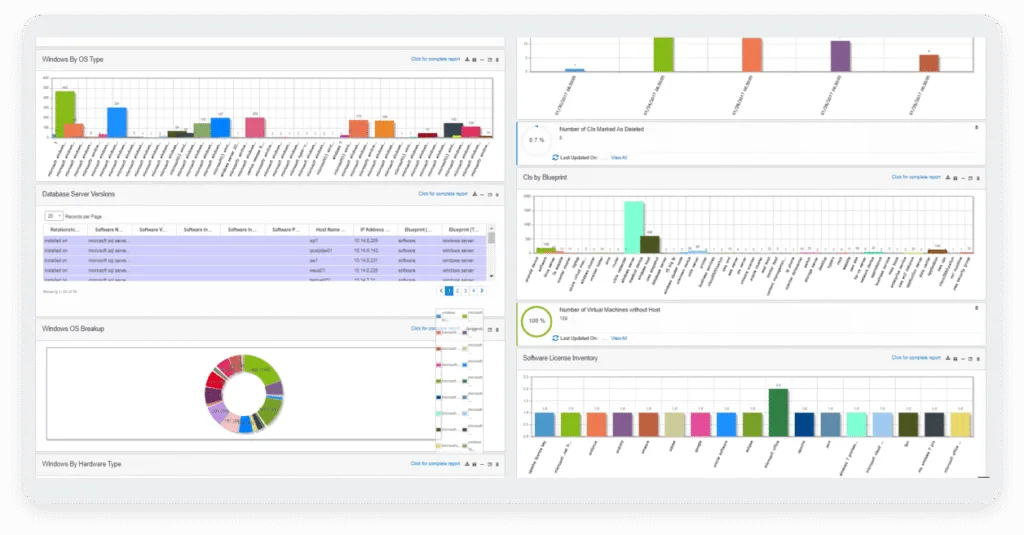
Virima’s ITAM platform runs on its own six-stage cycle: plan, procure, deploy, monitor, operate, and retire, covering hardware, software, and cloud assets across data center, edge, cloud, and stockroom inventory in one record.

That record starts with procurement and ownership data, and stays accurate because discovery continuously confirms it against what’s actually deployed, rather than waiting for the next manual audit to catch drift. Virima’s discovery agents for Windows, Mac, and Linux, including a Work from Anywhere (WFA) mode for remote devices, track configuration changes and actual software usage continuously, so license metering reflects what’s really running rather than what was installed once and forgotten. Warranty status gets checked automatically by serial number, with direct support for HP, Dell, and Lenovo hardware, and vendor and contract management keeps service level agreements and renewal timelines in the same record rather than a separate spreadsheet.

Integration runs bi-directionally with the ITSM and cloud platforms already in place: Ivanti, Cherwell, ServiceNow, Jira Service Management, and HaloITSM on the service management side, AWS and Azure on the cloud side. No platform displacement required. The platform is SOC 2 Type II certified with multi-region AWS hosting, and includes vulnerability lookup against the NIST National Vulnerability Database (NVD) directly inside the asset record.

This same current, discovery-confirmed data is what makes ITAM safe to hand to AI agents. An agent provisioning resources, executing a runbook, or approving a decommissioning request needs a verified record of what an asset is, who owns it, and what lifecycle state it’s in, not just permission to act. Accurate, discovery-enriched ITAM data has become a prerequisite for governed agentic IT operations, not only a procurement and compliance discipline.

ITAM_ITAM
The Bancorp
“Virima’s integration with ServiceNow has allowed us to
enhance and fully integrate our CMDB into all of our ITIL
processes. The seamless integration gives us the ability to
leverage the best of both Virima and ServiceNow.”
Keith Lee

Keith Lee

VP Disaster Recovery and IT Risk

— Frequently asked questions

ITAM Questions, Answered.

What is IT asset management?
IT asset management (ITAM) is the set of business processes that govern the full lifecycle of hardware, software, and cloud assets, from procurement through deployment, maintenance, license compliance, and retirement.
ITAM stands for IT asset management, the discipline of tracking what IT assets an organization owns, what they cost, who owns them, and what lifecycle stage they’re in.
IT operations management (ITOM) monitors assets and responds when something breaks. ITAM tracks what those same assets cost, who owns them, and when they need replacing. Both operate on overlapping data but answer different questions.
A configuration management database (CMDB) records what exists and how it connects. ITAM records what it cost, who owns it, and its lifecycle stage. Many ITAM programs use CMDB relationship data as their foundation rather than maintaining a separate, disconnected record.
ITAM manages an asset while it’s actively in service. IT asset disposition (ITAD) takes over once an asset is retired, covering secure data destruction, e-waste compliance, and chain-of-custody documentation.

ITAM certification programs validate professional expertise in IT asset management practices, commonly offered through industry bodies that certify skills in software licensing, hardware lifecycle management, and compliance.

Software asset management (SAM) is the sub-discipline of ITAM focused on licenses: reconciling what’s owned against what’s actually installed and used, to manage both under-licensing compliance risk and over-licensing budget waste.
Hardware asset management (HAM) is the sub-discipline of ITAM focused on physical assets: servers, laptops, network equipment, and mobile devices, tracked by make, model, warranty status, location, and assigned user.
ITAM tracks the lifecycle, cost, and ownership of IT assets broadly. Cybersecurity Asset Management focuses specifically on the security posture of those same assets, exposure, vulnerability status, and attack surface, drawing on the same underlying discovery and CMDB data ITAM already relies on.

— Get started

Move faster. Act safely.

Get live, explainable runtime truth across your entire estate —
without platform lock-in.