Bad Data in Asset Management: Causes, Costs & Fixes

Bad data in enterprise asset management is inaccurate, incomplete, stale, or duplicate asset records that cause faulty change decisions, audit failures, and unreliable AI outputs. It rarely announces itself. A license audit reveals 200 seats nobody knew existed. A change takes down a production service because the CMDB said the server was decommissioned. An AI tool produces unreliable recommendations because the data feeding it was last updated six months ago. The problem is not that IT teams fail to care about data quality — it’s that the processes most organizations use to build and maintain their asset inventories are structurally designed to produce bad data. This article walks through why that happens, what it costs, and what a sustainable fix looks like.
What “bad data” actually means in an ITAM context
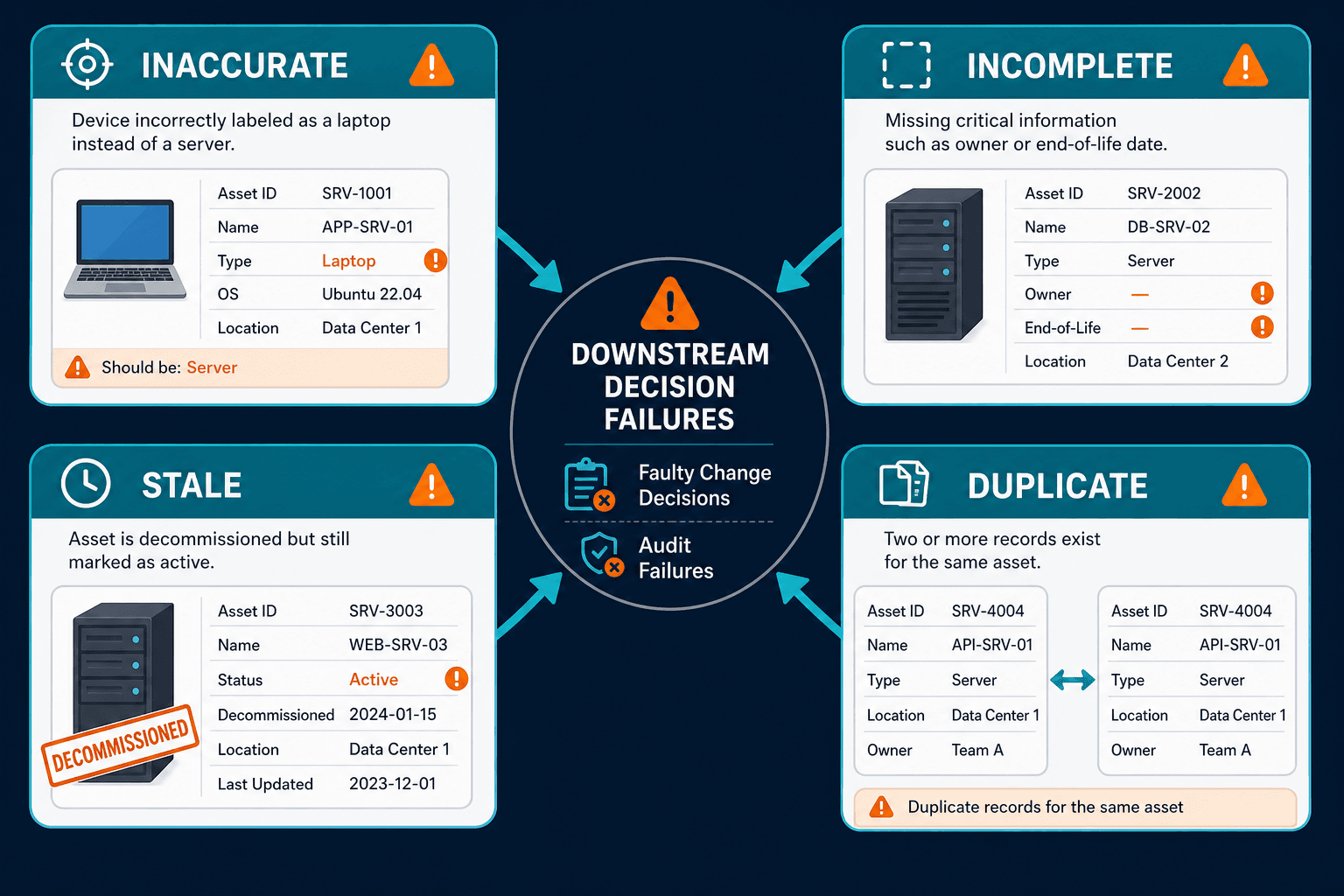
Bad data in enterprise asset management is not a single condition. It is a family of related failures, each producing different downstream consequences.
Inaccurate data means a field contains a wrong value: a device recorded as a laptop that is actually a server, a software version recorded as 14.2 that is actually 14.6, or a license count that does not match what the publisher finds when they audit you.
Incomplete data means fields are missing entirely: no owner assigned, no end-of-life date, no contract expiry, no cost center attribution. Decisions made from incomplete records look reasonable until they aren’t.
Stale data means values that were once correct but no longer reflect reality. An asset record showing a server as active when the server was decommissioned eight months ago is stale data. Stale data is particularly dangerous because it looks like good data on the surface.
Duplicate data means the same asset appears under multiple records: two CI entries for the same physical server, or two license records for the same publisher created by different teams at different times. Duplicates inflate counts, distort spend analysis, and cause reconciliation failures at audit time.
All four failure modes exist simultaneously in most enterprise asset inventories. They do not cancel each other out. They compound into asset inventory errors that surface exactly when accuracy matters most — at audit, at change approval, or when an AI tool queries the record.
The root cause: how enterprise asset inventories get built
Most IT asset inventories start as spreadsheets. A team member walks the floor, asks department heads what hardware they have, pulls a software list from an endpoint management tool, and assembles the results in a shared file. That inventory is accurate for approximately one business cycle. Then something changes.
A device gets swapped. A new SaaS subscription gets expensed by a business unit. A server gets moved. A license gets renewed under a different vendor agreement. Each change creates a gap between the inventory and reality, and most of those gaps never get reported back to whoever owns the spreadsheet.
According to the Flexera 2025 State of ITAM Report, only 43% of IT teams report having complete visibility into their IT assets. That means a majority of enterprise ITAM programs are making decisions from inventories they themselves acknowledge are incomplete. The problem is not awareness — it’s that manual processes cannot keep pace with infrastructure change.
Shadow IT widens the gap continuously
Even teams that run regular inventory sweeps face a structural blind spot: assets acquired outside the formal procurement process never enter the inventory at all.
Shadow IT is not a fringe behavior. Business units adopt SaaS tools independently. Employees expense subscriptions on corporate cards. Cloud workloads get spun up by development teams without notifying IT operations. Each of these events creates an asset that exists in production but has no record in the ITAM system.
IBM’s Institute for Business Value research found that 43% of chief operations officers identify data quality issues as their most significant data priority. That finding predates the current wave of AI-native application adoption, which has only accelerated how fast new tools enter enterprise environments. Shadow IT ensures that the asset inventory reflects only what IT knows about, not what IT is actually responsible for.
Multi-source conflicts corrupt the records that do exist
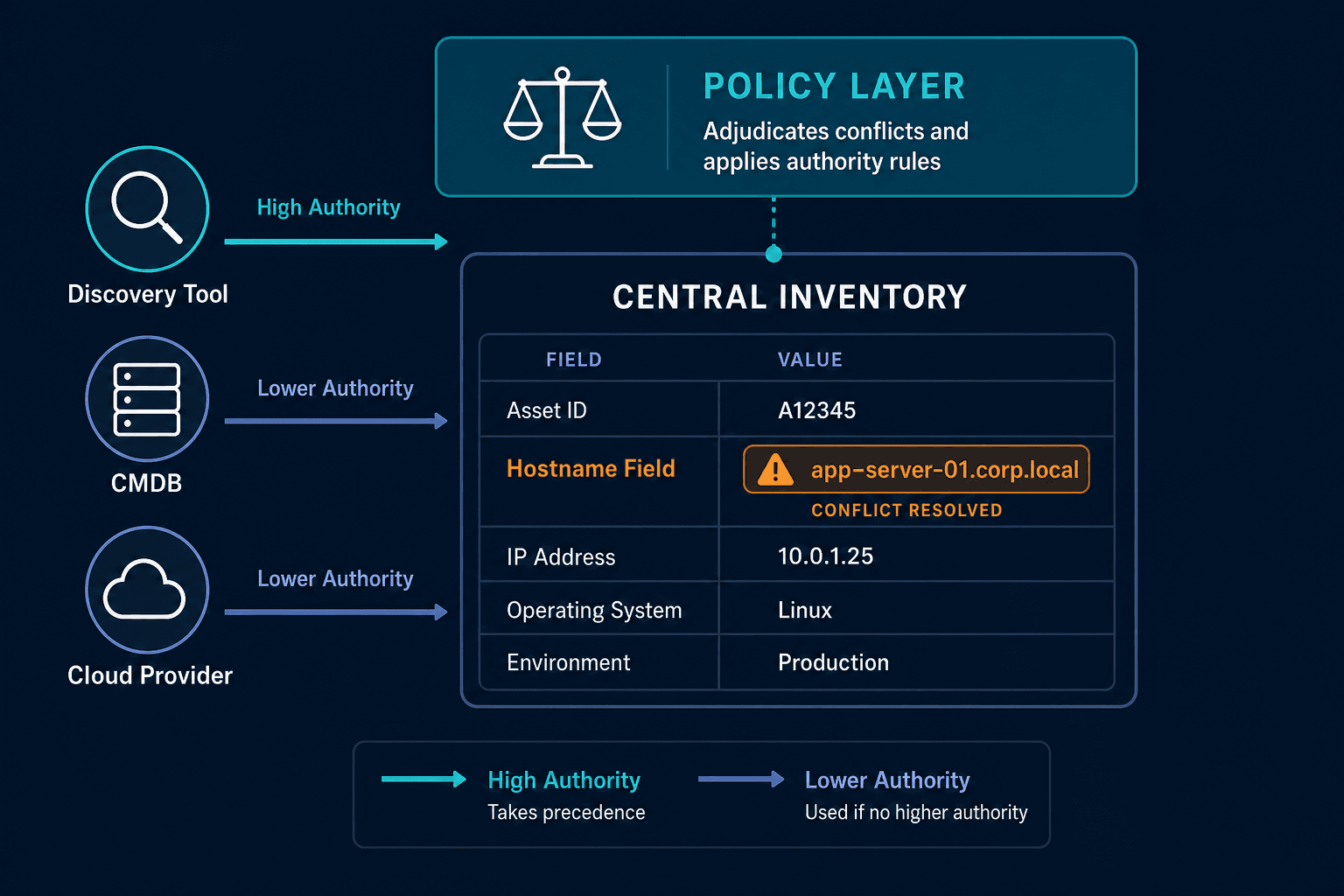
Many organizations run multiple discovery tools, endpoint management platforms, and configuration management databases simultaneously. Each source produces its own view of the same asset. When those views disagree, showing different hostnames, different IP addresses, or different installed software lists, someone has to decide which version wins.
Without a defined reconciliation policy, the default answer is whichever source ran most recently. This is the last-scan-wins problem. A scan from a low-authority source overwrites a clean record from a higher-authority source, degrading data quality with every update cycle.
Virima’s IT asset discovery uses a source-priority reconciliation model that weights incoming data by the authority and recency of the contributing source, rather than defaulting to whichever scan ran last. This prevents low-quality data from overwriting verified records while still incorporating updates from high-frequency discovery cycles.
What enterprise asset management bad data actually costs
The financial impact of bad ITAM data surfaces across four domains, and most organizations never attribute the cost correctly because it lands in different budgets.
Software audit penalties
Inaccurate license counts produce compliance exposure at renewal. The Flexera 2025 State of ITAM Report found that 23% of organizations paid more than $5 million in a single software audit, and 45% paid more than $1 million across audits in a three-year period. The root cause in almost every case is asset data that did not match what the publisher found when they ran their own audit.
Operational outages
When asset records are stale, change planning breaks down. A change advisory board approves a change based on CMDB data showing no active dependencies, but the asset was not actually decommissioned, and the change causes a downstream failure. EMA’s 2025 ServiceOps research found that 32% of IT leaders are experiencing longer and more expensive outages, with configuration drift and change velocity among the primary causes.
Wasted spend
Ghost assets (devices or licenses recorded as active but no longer in use) continue consuming budget. Duplicate license records cause over-purchasing at renewal. Untracked assets miss hardware refresh cycles and generate unexpected support costs when they fail outside warranty.
Enterprise-wide data costs
Beyond IT-specific impacts, poor data quality carries a substantial enterprise-wide cost. IBM Institute for Business Value research found that more than a quarter of organizations lose over $5 million per year to bad data, and 7% lose $25 million or more. These figures span enterprise data broadly, but ITAM data is often the source layer: errors in the asset inventory propagate into financial systems, procurement systems, and ITSM platforms downstream.
What does bad data in asset management cost?
Bad asset data costs organizations through software audit penalties, unplanned outages, ghost asset spend, and compliance failures. IBM Institute for Business Value research finds more than a quarter of organizations lose over $5 million per year to bad data, with 7% losing $25 million or more. In IT asset management specifically, license audit penalties alone can exceed $1 million per year for organizations running incomplete inventories.
Bad asset data creates a compounding AI risk
In 2026, the cost of bad ITAM data extends beyond operational and financial impact into a newer category: AI risk.
Most enterprise AI deployments (from ITSM copilots to agentic IT automation) pull asset and configuration data to ground their decisions. An AI agent that recommends a change path, validates a configuration, or triggers an automated remediation is only as reliable as the data it reads. If that data is stale, incomplete, or conflicted, the agent makes bad decisions with the confidence of a system that thinks it has good data.
IBM Institute for Business Value found that 45% of business leaders rank data accuracy concerns as a leading barrier to scaling AI initiatives. The asset inventory is often the specific data layer holding organizations back. It is used for planning, compliance, and operations, making it one of the highest-impact datasets to get right before AI-assisted workflows go into production. For more on preparing asset data for AI-assisted IT operations, see CMDB Readiness for Agentic AI: The 7 Discovery-Sourced Data Requirements.
How does bad asset data affect AI initiatives?
AI tools in IT operations rely on asset and configuration data to ground their recommendations. When that data is inaccurate, incomplete, or stale, AI systems inherit those errors and propagate them at scale. IBM research finds that 45% of business leaders cite data accuracy concerns as a leading barrier to scaling AI initiatives, and the asset inventory is frequently the specific layer causing the problem.
Why asset management data hygiene projects alone don’t fix this
The instinctive response to an asset management data hygiene problem is a one-time data cleanup project: export the inventory, assign a team to verify and correct records, import the cleaned data, and close the ticket.
This works for about three months. Then infrastructure changes, shadow IT acquisitions, and multi-source conflicts rebuild the same errors the cleanup removed. A one-time remediation effort cannot keep pace with a live IT environment.
Gartner research notes that 59% of organizations do not measure data quality on an ongoing basis. That means most cleanup efforts have no success criteria and no mechanism to detect when quality degrades again. The sustainable fix is not a cleanup project — it’s a discovery-led inventory foundation. When an inventory is built from continuous, automated discovery rather than manual entry, the discovered state of the environment becomes the authoritative record. Changes surface in the inventory within the discovery cycle, not when someone remembers to update a spreadsheet.
Virima’s CMDB is built on multi-source discovery data, reconciled against a defined source priority policy. Asset records reflect what discovery actually finds, updated on a high-frequency cycle, with conflict resolution governed by rules rather than arbitrary last-scan-wins defaults. The result is an inventory that stays accurate between manual review cycles because discovery is doing the maintenance work continuously. For a deeper look at why perpetual cleanup projects fail, see Alternative to Cloudaware CMDB Explore Virima CMDB for multi-cloud environments.
What is the best way to fix enterprise asset management data quality?
The most durable fix is replacing manual entry with automated discovery as the primary data source. Discovery-led inventories surface asset changes within the discovery cycle rather than waiting for manual updates. Layering source-priority reconciliation on top prevents low-quality sources from overwriting verified records. One-time cleanup projects without automated discovery revert to poor quality within months.
Connecting IT asset data accuracy to ITSM workflows
IT asset data accuracy problems don’t stay contained in the ITAM system — they propagate into every workflow that consumes asset information: incident response, change management, software license management, and compliance reporting.
When an incident is raised, responders need to know what the affected asset depends on, who owns it, and when it was last changed. When a change is planned, the change advisory board needs to know the actual state of the asset, not the state recorded six months ago. Virima’s software license management reconciles installed software against purchased entitlements using discovery-sourced data, removing the spreadsheet reconciliation step that produces most license compliance gaps.
Virima integrates with ServiceNow, Jira Service Management, Ivanti, HaloITSM, Xurrent, and Hornbill. That means asset data accuracy improvements flow directly into the ITSM tools where responders and planners work, so clean asset data at the source propagates clean data downstream, rather than each tool team maintaining its own reconciliation workaround for the same underlying inventory errors.
How does asset data quality affect ITSM processes?
Asset data quality directly affects incident response, change management, and software license compliance. Incidents take longer to resolve when asset ownership and dependency data is wrong. Changes cause outages when CMDB records show decommissioned assets as active. License compliance gaps widen when installed software records don’t match entitlement data. Clean asset data at the source improves outcomes across every downstream ITSM workflow.
What good ITAM data quality looks like in practice
Organizations with mature ITAM data quality share a few visible characteristics. Their inventories are sourced from automated discovery, not populated by manual entry. Changes to the IT environment surface in asset records within the same discovery cycle, not at the next quarterly audit. Reconciliation conflicts are resolved by policy, not by whoever ran a scan most recently.
Data quality dimensions are measured, not assumed. Gartner’s data quality framework includes dimensions such as accuracy, completeness, timeliness, consistency, and uniqueness, but most ITAM programs track none of them formally. Mature programs set thresholds for the dimensions that matter to their use cases and monitor them on a recurring basis.
The result is an asset inventory that ITSM teams, finance, compliance, and AI tools can trust, because it reflects the actual state of the environment rather than the state someone recorded at some point in the past.