Snipe asset management: Features, limitations, and alternative

The Snipe-IT checkout sheet looks complete. Assignments, locations, and barcodes match what the help desk expects. Then CAB asks which business services still depend on the laptop or server you are changing, and whether discovery refreshed that map after last week’s cloud moves. Custody records do not answer blast radius.
That is the Snipe asset management decision in practice. Snipe-IT fits teams that need web-based IT asset custody: check-in and check-out, assignment history, barcode or QR identification, and license or warranty alerts, especially when self-host control matters. Teams evaluate an alternative when inventory still depends on manual entry, hybrid estates drift, or change risk needs service dependency maps and multi-source discovery under ITSM. Virima is a discovery-sourced ITAM and CMDB layer. It does not replace Snipe-IT as a pure checkout system for every team.
Snipe-IT covers custody ITAM well. This guide lists its features and limits, and when to stay, pair, or add Virima.
| When change and incident decisions need current IT CIs and service paths, not only a custody register, the missing layer is discovery-sourced runtime accuracy. Explore Trusted Runtime Truth. |
When is Snipe-IT enough, and when do teams evaluate an alternative?
Snipe-IT fits teams that need web-based IT asset custody with check-in and check-out, assignment history, barcode or QR identification, and license or warranty alerts. Teams evaluate an alternative when inventory still depends on manual entry, hybrid estates drift, or change risk needs service dependency maps and multi-source discovery under ITSM.
Overview of Snipe-IT asset management
Snipe-IT is a web-based IT asset management application used to track hardware and related records across assignments, locations, and lifecycle history. Many teams run it self-hosted, with a mobile-friendly interface for desk-side work. Teams often evaluate Slack notifications and endpoint tools such as JAMF or Kandji during setup. Confirm current packaging and integrations on official Snipe-IT materials before a bake-off.
Features of Snipe-IT asset management
Snipe-IT centers custody and desk-side operations. Capabilities organizations commonly evaluate include:
- Comprehensive asset tracking for assignments, locations, and full asset histories.
- One-click check-in, check-out, and audit actions for day-to-day custody work.
- Custom fields to capture unique asset attributes beyond defaults.
- Email alerts for expiring warranties, licenses, or low stock.
- Barcode and QR code support for fast physical identification.
- License management for multi-pack licenses with expiration alerts.
- Digital signatures for approvals and compliance workflows.
- Mobile-friendly interface for managing assets away from a desk.
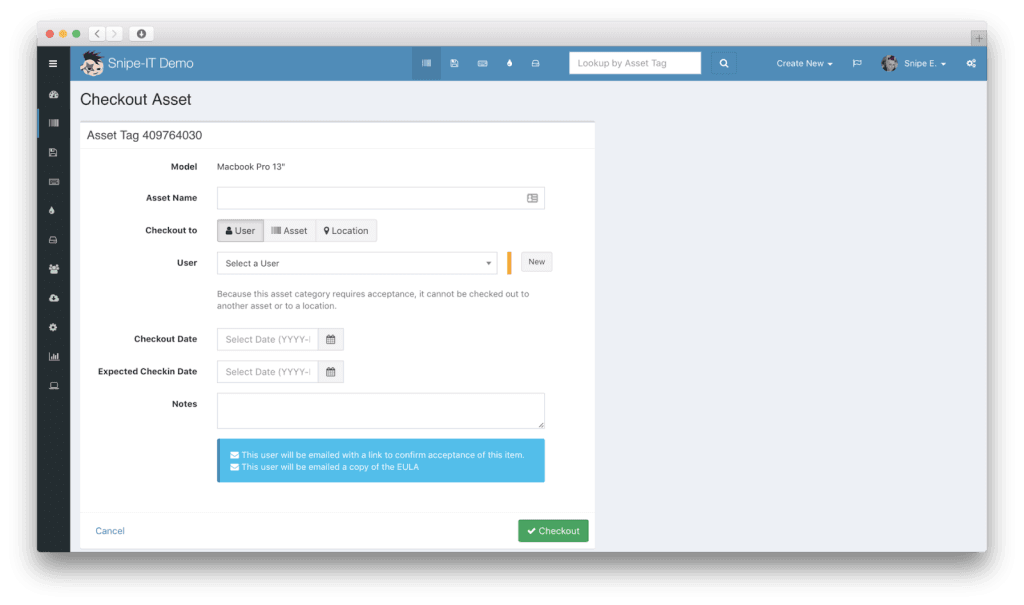
Benefits of Snipe-IT for custody-focused teams
For small and mid-size teams that prioritize assignment accuracy over automated estate discovery, common benefits include faster check-in and check-out, clearer asset availability for the help desk, flexible custom fields, multi-language and remote access, renewal alerts for licenses and overdue check-ins, and digital signatures plus history for compliance conversations. Treat pricing as a diligence item on current plans, not as a fixed public score.
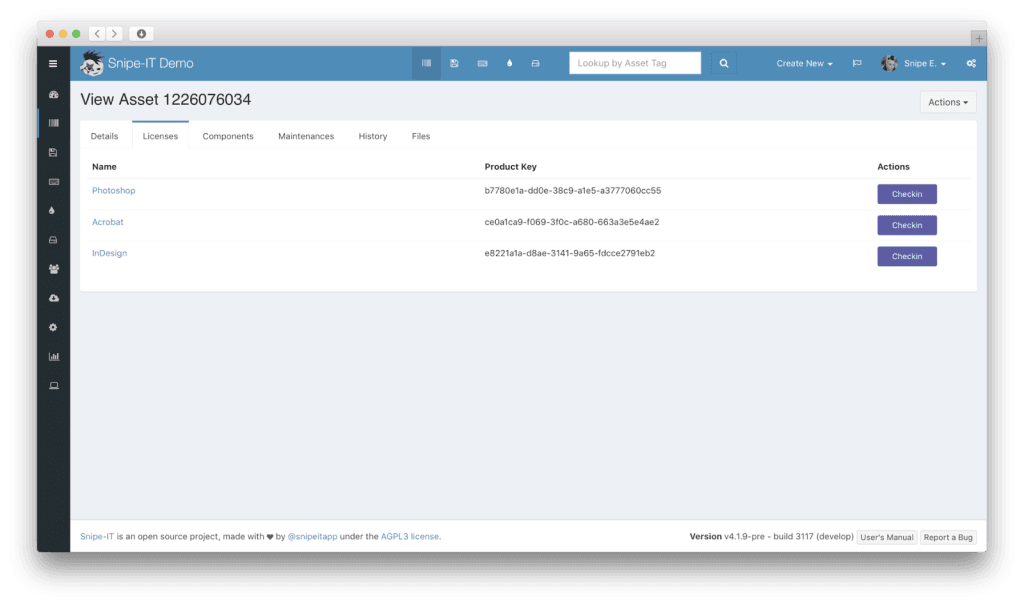
What does Snipe-IT do well for custody ITAM?
It keeps assignment, location, check-in and check-out, barcode or QR identification, and warranty or license alerts close to help desk workflows. That cohesion is strongest when the primary job is who has which device, not hybrid discovery or service dependency maps for change risk.
Limitations when the job expands beyond custody
Snipe-IT is a strong custody register for many shops. Evaluation gaps appear when the constraint is modern hybrid IT rather than checkout sheets.
- Population model: Many deployments still rely on manual entry or imports for large parts of inventory, which raises error and drift risk when the estate changes faster than operators can type.
- Discovery depth: Specialist agent-based and agentless discovery with API coverage across on-prem, AWS, and Azure is usually a separate evaluation when runtime CI truth is required.
- Service and dependency maps: Change and incident teams need relationships among applications, infrastructure, and business services. Custody graphs rarely substitute for IT service maps.
- Scale and operations: Self-hosted growth can need scripts, custom integrations, and ops expertise. Treat setup and documentation quality as diligence topics on your estate, not as fixed public scores.
- Data consistency: Missing or incorrect entries make any ITAM database unreliable. Process discipline matters as much as the product.
Sysadmin community discussions often surface themes around manual load, self-host maintenance, and UX friction. Validate those themes on a pilot rather than treating any single thread as product truth.
When a Snipe-IT alternative needs discovery and CMDB (not another check-out grid)
Snipe-IT earns its place when the job is custody: check-in and check-out, assignees, and a clean trail for hardware that still lives under a barcode. Lean IT teams feel that win early. The pain shifts when hybrid discovery, last-seen freshness, and ticket enrichment become weekly work instead of a one-time import.
That is the moment buyers search for a Snipe-IT alternative and mean something precise. They are rarely hunting another check-out grid. They need discovery-backed inventory and CMDB-grade joins so the register survives off-site devices, untagged network gear, and cloud accounts that never received a label.
Stay, pair, or add Virima
| Path | When it fits | What you keep | What is still missing |
|---|---|---|---|
| Stay on Snipe-IT | Custody and assignment are the main weekly jobs, and the estate is small and mostly tagged | Check-out workflows, labels, simple exports | Network last-seen, multi-source discovery, typed relationships after service definitions |
| Pair Snipe-IT with discovery and CMDB | You want barcodes and handoffs plus estate truth under tickets | Physical custody process | A clear rule for which tool owns last-seen and owners, or you create a second system of record |
| Add Virima as the discovery-sourced layer | Hybrid refresh, CMDB context, and ITSM handoff matter more than another custody seat | Option to keep Snipe-IT for cage workflows | Virima does not replace barcode printers or facility GPS trackers |
What lean IT still needs after custody
- Durable identity: serial number, cloud instance ID, or an equivalent join key, not a friendly asset tag or hostname alone.
- High-frequency scheduled discovery cycles across the hybrid paths you run, so last-seen does not wait for the next manual audit day.
- CMDB-grade owners and relationships for change and incident work that needs more than an assignee field.
- A handoff into the help desk you already run, so tickets carry device and owner context instead of inventing a second inventory.
Virima provides that capability for growing IT estates: discovery-sourced CMDB and ITAM, ViVID™ maps after service definitions are provided, and Windows Server NIST NVD overlays on maps where that signal applies. Virima adds to Snipe-IT and does not replace checkout tooling for teams that only need custody.
Snipe-IT vs Virima: decision table
Virima delivers discovery-sourced ITAM, CMDB population, and service mapping. It does not replace Snipe-IT as a barcode-first checkout tool for every team.
| Criterion | Snipe-IT | Virima | Choose when… |
|---|---|---|---|
| Primary job | Custody / checkout ITAM | Discovery-sourced ITAM and CMDB/maps | Assignments vs runtime truth |
| Population model | Manual, import, and integrations | Agent-based and agentless methods plus APIs, high-frequency scheduled cycles | Estate change rate |
| Identification | Barcode / QR, custom fields | Discovery attributes plus ITAM records | Desk-side vs network and cloud |
| Software | License packs and expiry alerts | Hardware and software ITAM with usage context | Alerting vs metering depth |
| Dependencies | Limited service maps | ViVID™ maps after business service definitions are provided | Change blast radius |
| Hosting model | Self-host and web app options | Specialist discovery and CMDB platform | Control vs managed discovery |
| ITSM | Integrations vary by setup | Integrates with ITSM platforms; does not replace them | System of engagement |
| Best fit | Teams prioritizing custody UX | Hybrid visibility under ITSM | Path selection below |
Three practical paths: (1) Stay on Snipe-IT when checkout, assignment history, and barcode workflows are the constraint. (2) Augment Snipe custody with discovery-sourced CIs and maps where runtime accuracy is the bottleneck. (3) Take the Virima path when hybrid inventory, software usage context, and ViVID™ maps under ITSM tickets are the binding gap.
Should you replace Snipe-IT or add a discovery-sourced ITAM layer?
Most teams should not frame this as ripping out custody ITAM. Stay on Snipe-IT when assignment and checkout are the job. Add a discovery-sourced ITAM and CMDB layer when hybrid drift and weak dependency context are the constraint. Virima is evaluated as that data layer under ITSM, not as a pure barcode checkout clone.
Virima as a discovery-sourced alternative to Snipe-IT
Virima focuses on IT infrastructure management: what exists in the estate, how it is configured, how it connects, and how that truth supports ITAM and ITSM work.
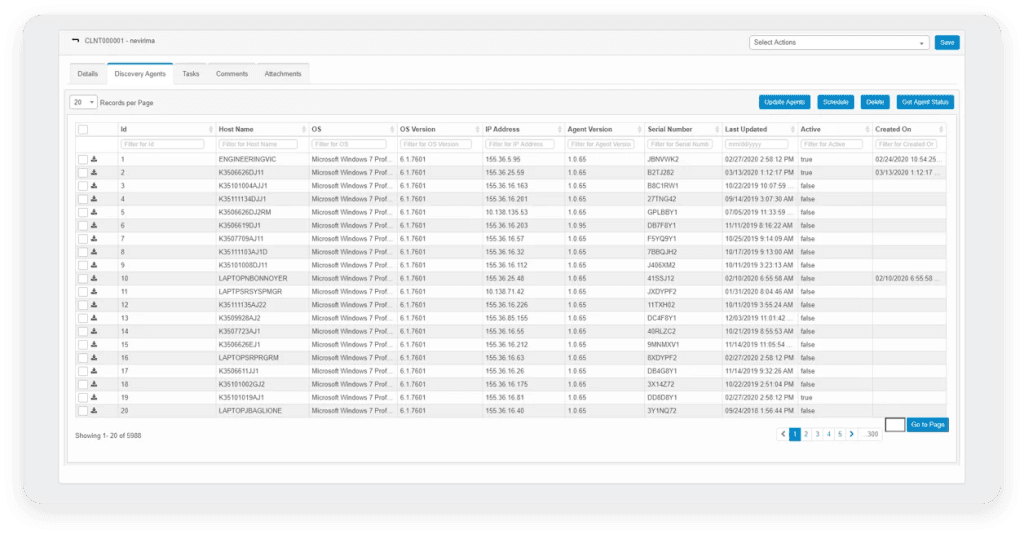
High-frequency scheduled discovery and asset inventory
An agent-based and agentless IT discovery engine covers hardware, software, and cloud resources through scans and API integrations across environments such as AWS and Azure. Discovery runs on high-frequency scheduled cycles so inventory reflects estate change without pure manual entry. Current public positioning does not claim passive event-driven discovery as shipping product.
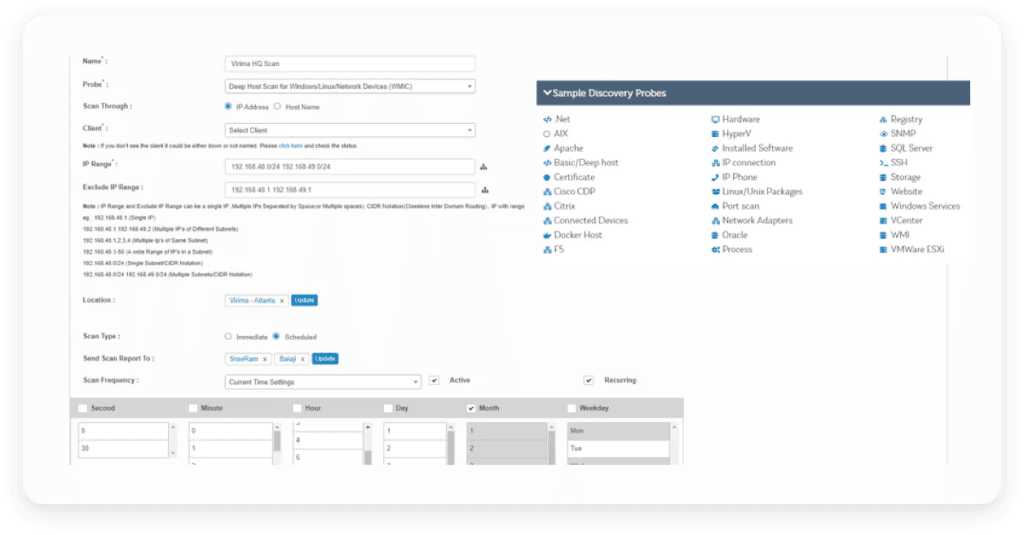
Hardware and software ITAM
Virima provides a centralized path to manage hardware assets and software licenses with configuration detail for ITSM and security workflows. Software usage context helps teams spot over-licensing and underuse when metering is supported on the estate. See IT asset management for product scope.
Service mapping after definitions are provided
Business services are defined by your team through manual entry, import, or architecture tools. ViVID™ then builds dependency maps from those definitions and discovered infrastructure. It does not invent service composition without that input. Maps can carry ITSM incident and change context, plus vulnerability intelligence where product supports it, for example NIST NVD overlays associated with Windows Server findings, on service maps for blast-radius and remediation prioritization.
ITSM integration without replacing the service desk
Virima integrates with ServiceNow, Jira, Ivanti, HaloITSM, and other ITSM platforms so discovery-sourced CIs and maps support the system of engagement you already run. See the integrations hub.
Warranty, license, and vendor context
Renewal alerts and audit-oriented reporting help teams prepare evidence from owned inventory when data quality and process stay strong.
How does Virima approach IT discovery and service mapping?
Virima populates IT CIs through scheduled discovery using agent-based and agentless methods, with multi-source reconciliation for authoritative attributes. Business services are defined by the customer. ViVID™ then builds dependency maps from those definitions and discovered infrastructure and does not invent service composition without input.
If your Snipe-IT evaluation is stuck on whether custody sheets can keep up with hybrid change risk, shift the proof from brochure features to a short discovery and mapping pilot on a critical IT service path while Snipe keeps checkout workflows where they still fit.
If custody tools still leave hybrid drift and service dependencies unproven, explore how Business Pro adds discovery, CMDB, and ViVID™ maps beside Snipe-IT without replacing checkout.
Making the right choice for your ITAM path
Snipe-IT is a solid path for custody-focused IT asset management. Virima is the alternative when you need high-frequency scheduled IT discovery, software and hardware ITAM context, and ViVID™ maps under ITSM tickets. Outcomes teams chase include fewer surprises from stale IT inventory, clearer change blast radius, tighter license conversations, and stronger compliance evidence from owned IT inventory.
When you want a hands-on walkthrough, request a demo.
Disclaimer: Product capabilities change. Confirm current Snipe-IT features in official documentation before purchase decisions.
Frequently Asked Questions
Is Snipe-IT enough if we mainly need check-in and check-out?
Often yes when assignment history, barcode or QR workflows, and license or warranty alerts are the primary job and the estate is manageable with imports and process discipline. Revisit when hybrid drift and service dependency questions become the binding constraint.
Does choosing Virima mean replacing Snipe-IT?
No. Virima is positioned as a discovery-sourced ITAM and CMDB layer. Many evaluations keep custody tools for desk-side assignment and improve runtime truth under ITSM.
What is the difference between custody ITAM and discovery-sourced ITAM?
Custody ITAM centers who has which device and related history. Discovery-sourced ITAM centers automated inventory of hardware, software, and cloud CIs, plus configuration relationships used in operations and audits.
Can Snipe-IT and a discovery layer coexist?
Yes. Coexistence is common: Snipe-IT remains strong for checkout while discovery feeds IT CIs and maps into ITSM for change and incident work.
How does Virima handle service mapping?
You define business services. ViVID™ builds dependency maps from those definitions and discovered infrastructure. Maps become useful for incident and change work when definitions and discovery stay current.