IT Discovery in Healthcare: The Devices Your Network Doesn’t Know It Has

On May 8, 2024, Ascension Health detected unauthorized network activity across its digital environments, declaring a major cybersecurity event. The Catholic health system spans 140 hospitals across 19 states. The operational fallout escalated rapidly across regional clinical facilities. Critical electronic health record systems, patient management portals, and local administrative phone systems went offline. Emergency dispatchers diverted ambulances from affected trauma centers to competing facilities, while clinical staff paused elective surgical procedures.
The resulting operational shutdown lasted weeks while forensic recovery personnel worked through clinical endpoints manually. Independent investigators later linked the intrusion to the Black Basta ransomware syndicate, which ultimately compromised the personal and medical records of roughly 5.6 million individuals. In subsequent public financial disclosures, Ascension cited the prolonged operational remediation as a material driver of its annual net loss, alongside extensive clinical remediation expenses verified by reporting from the Associated Press.
Ascension’s initial intrusion stemmed from a malicious file download on an administrative workstation rather than an undocumented infusion pump. The incident demonstrates the catastrophic clinical and financial consequences when a healthcare digital network loses operational integrity. Managing clinical risk requires establishing Trusted Runtime Truth across hospital environments, answering what exists, how it is connected, what changed, what will break, and who owns it. Establishing authoritative IT discovery in healthcare ensures clinical engineering, biomedical teams, and security responders maintain verified asset reality before disruptions cascade into patient wards.
What Is IT Discovery in Healthcare?
In enterprise infrastructure management, IT discovery represents the automated process of scanning, cataloging, and re-verifying physical hardware, virtual machines, and application relationships across a network estate. The NIST Cybersecurity Framework 2.0 establishes asset management under the Identify function (ID.AM) as foundational to enterprise defense. Subcategories ID.AM-01 and ID.AM-02 explicitly require organizations to maintain detailed inventories of physical devices and software platforms. In a healthcare network, discovery translates abstract technical inventories into clinical operational reality.
IT discovery in healthcare is distinct from two unrelated compliance and legal functions that frequently appear in search inquiries. It does not involve electronic discovery (eDiscovery), which entails locating stored documents for litigation proceedings. It also differs from Protected Health Information (PHI) content discovery, which scans databases and file repositories to flag sensitive clinical records. IT discovery focuses strictly on establishing live, explainable runtime truth across physical hardware, virtual infrastructure, software revisions, and topological dependencies that make clinical care delivery operational.
The Hidden Problem
Healthcare organizations manage device visibility through divided organizational silos. Clinical engineering and biomedical teams track medical equipment through dedicated healthcare computerized maintenance management software. Meanwhile, enterprise IT engineering teams manage corporate servers, virtual machines, and employee laptops inside general service desks. These parallel systems rarely communicate, creating significant visibility blind spots across patient-care units.
| Hospital Operational Situation | What Happens on the Ground |
|---|---|
| A physiologic patient monitor resides on an isolated clinical VLAN | Standard enterprise network scanning tools fail to discover the endpoint, leaving it documented solely inside disconnected biomedical maintenance records |
| A smart infusion pump communicates via proprietary legacy protocols | Enterprise agent-based discovery software cannot interrogate the firmware, returning empty records |
| Biomedical engineering retires and replaces an anesthesia machine | The central enterprise CMDB continues listing the decommissioned device as an active network endpoint |
| A medical vendor field technician installs an updated diagnostic imaging scanner | The equipment connects to hospital switches before enterprise security evaluates firmware compliance |
When clinical and IT teams lack a unified discovery mechanism, healthcare organizations operate with fragmented device records. Resolving these operational blind spots requires understanding the systemic medical device management challenges that undermine connected hospital environments.
What is IT discovery in a hospital network?
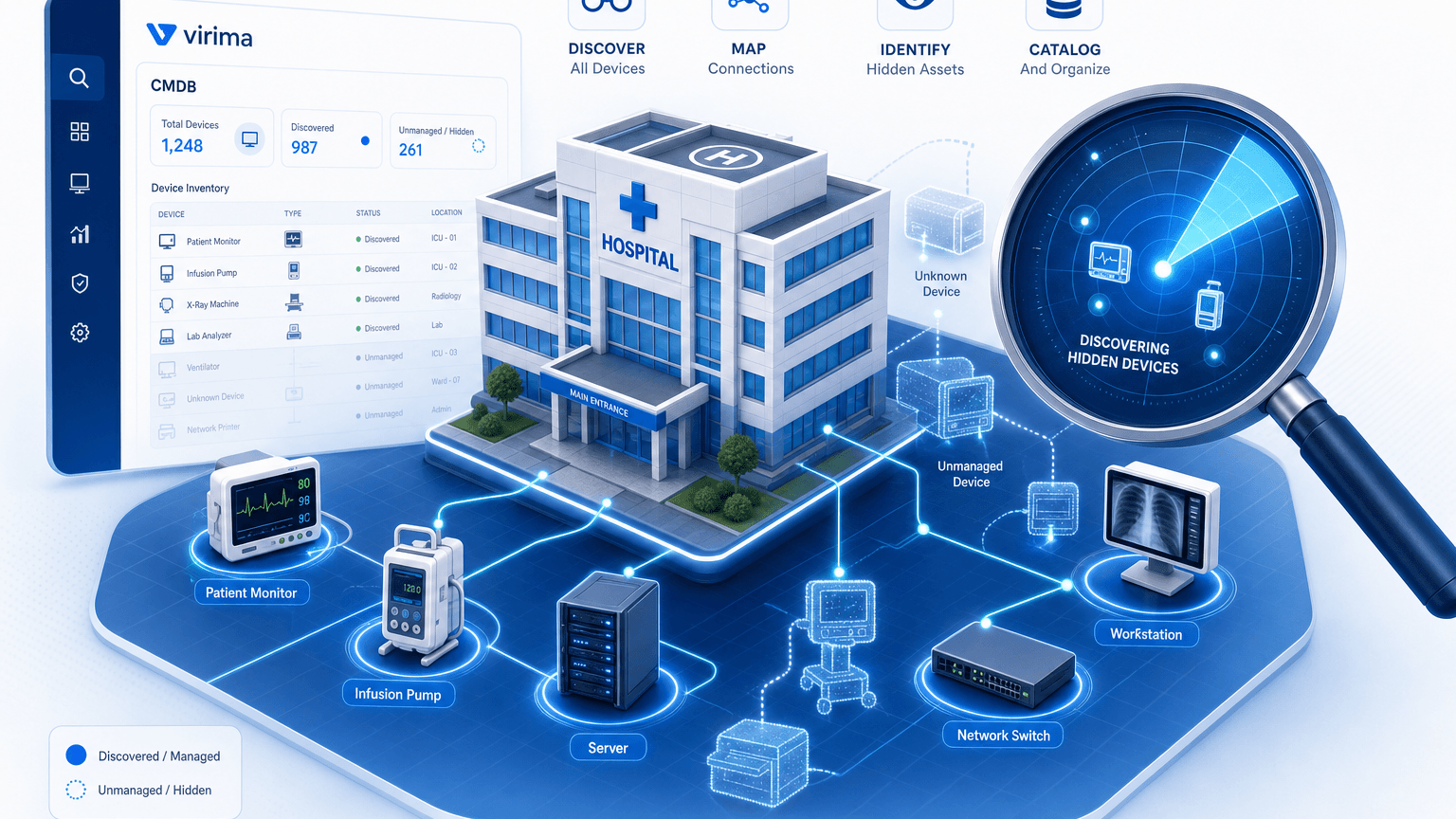
IT discovery in a hospital network is the process of finding, identifying, and verifying every device connected to the IT estate. It catalogs hardware, operating systems, and service dependencies across servers, administrative workstations, and connected medical equipment.
Why Is IT Discovery Important in a Hospital?
Hospitals maintain complex network environments where legacy mainframe systems operate alongside sensitive IoMT endpoints. According to the IBM Cost of a Data Breach Report, healthcare data breach expenses reached an average of $6.64 million per incident. This represents the costliest average across all global industries for the thirteenth consecutive year. When clinical endpoints remain undocumented, security teams cannot evaluate vulnerability exposure across hospital wards.
Device density complicates hospital infrastructure management. Leading industry market forecasts from Juniper Research on smart hospital infrastructure project that connected healthcare facilities deploy thousands of IoMT devices per location, totaling millions globally. Standard IT scanning practices struggle to track this expanding digital volume, creating systematic operational breakdowns.
4 Failure Modes
- Clinical network segmentation creates invisible asset segments. Network administrators segment hospital VLANs to isolate sensitive biomedical telemetry from corporate internet traffic. While clinical segmentation protects equipment from generic malware, standard enterprise discovery tools cannot traverse these secure boundaries. Result: vulnerable diagnostic endpoints operate as anonymous hardware addresses in network switch logs, completely lacking identified system owners, patch histories, or software versioning records.
- Biomedical engineering and IT operations maintain divergent asset databases. Biomedical technicians manage patient-connected equipment inside specialized maintenance databases, while IT departments maintain enterprise IT asset records. When clinical assets enter production, teams rarely synchronize serial numbers, IP assignments, or maintenance schedules across platforms. Result: during critical security alerts, incident responders waste hours debating whether a flagged IP address corresponds to a patient monitor or a nurse workstation.
- Medical equipment rejects intrusive active scanning techniques. Traditional enterprise vulnerability scanners utilize aggressive packet interrogations to identify running services and open ports. Sensitive clinical equipment, including dialysis units and patient ventilators, often suffer interface lockups when receiving non-standard scanning commands. Result: security administrators deliberately exclude mission-critical clinical subnets from discovery scans, leaving large device segments unmonitored.
- Hospitals rely on static annual asset inventory audits. Many health systems perform physical device inventories once every twelve months to satisfy regulatory accreditation requirements. Hospital staff continually reassign mobile infusion pumps across different departments, while biomedical vendors regularly attach temporary diagnostic equipment. Result: the hospital asset baseline is obsolete within days of completion, concealing unmonitored configuration drift and unpatched vulnerabilities.
Resolving these vulnerabilities requires structured asset discovery programs. Implementing disciplined hospital asset management best practices provides the operational framework necessary to track expanding clinical technology portfolios.
Why is connected medical device inventory important in healthcare?
An accurate device inventory allows clinical engineering and security teams to maintain full visibility into active hospital endpoints. Without verified inventory records, unauthorized equipment and unpatched clinical devices remain undetected until security disruptions or compliance audits reveal them.
What Happens if You Get Device Visibility Wrong
Failing to maintain accurate device discovery exposes healthcare systems to regulatory penalties, extended operational outages, and serious clinical risks. Different institutional stakeholders experience these visibility blind spots through distinct professional challenges.
For Hospital IT and Security Leaders
For Chief Information Officers and Chief Information Security Officers, device opacity creates severe institutional liability. When a hospital suffers an endpoint intrusion, forensic remediation costs multiply across incident response teams and regulatory disclosures. The federal NIST SP 800-66r2 HIPAA Security Rule implementation guidance instructs covered entities to document every hardware and software asset handling patient information. When regulatory investigators uncover unmapped network endpoints during breach reviews, health systems face substantial administrative penalties and mandatory remediation agreements.
For Biomedical and Clinical Engineering Teams
Biomedical engineers focus primarily on patient safety and medical equipment availability. When devices lack unified network tracking, clinical engineering teams must conduct physical floor searches across hospital facilities to locate recalled equipment. The FBI Cyber Division medical device alert highlighted that more than half of evaluated hospital IoT and medical endpoints contain known critical software vulnerabilities. When equipment vulnerabilities are disclosed, biomedical teams without accurate network records cannot determine which physical machines require immediate remediation.
The Impact of Compounding Clinical Device Volume
The scale of modern hospital infrastructure accelerates these management challenges. Global healthcare research indicates that connected medical devices represent an expanding segment of modern institutional capital budgets. Automated telemetry, robotic surgical instruments, and wearable patient monitors enter clinical service faster than manual tracking processes can accommodate. When healthcare systems attempt to track dense digital estates using manual inventory methods, operational oversight degrades rapidly.
How Discovery Fixes This
Resolving hospital infrastructure fragility requires moving past fragmented spreadsheets, tribal assumptions, and manual audit cycles. Modern healthcare IT operations require Trusted Runtime Truth, built upon three core operational pillars that transform static asset lists into governed action.
- Discover with authority across sensitive clinical endpoints. Hospital networks contain diverse technology architectures that cannot be cataloged using a single scanning approach. Virima combines agentless network scanning, passive log and DHCP interrogation, and API integrations to capture unmapped hardware. When sensitive medical instruments reject direct command queries, passive connection tracking catalogs the asset safely, delivering thorough IT discovery capabilities.
- Understand in context to reconcile biomedical and IT records. Inconsistent naming conventions and duplicate MAC addresses frequently cause hospital asset databases to fall out of alignment. Virima reconciles multi-source discovery records using configurable normalization rules, source-specific credibility weighting, and operational dependency tracking. Every discovered attribute retains an authoritative timestamp, demonstrating the foundational architecture of why Virima resolves asset conflicts.
- Govern every action with dynamic CMDB service mapping. Device visibility requires far more than collecting disconnected hardware lists. Virima automatically connects discovered physical endpoints, software versions, and clinical workflows into live relationship maps. Integrating discovery output into ViVID™ Service Mapping allows engineers to evaluate how infrastructure anomalies impact clinical services, establishing what will break before changes occur.
| Hospital Operational Dimension | Manual Spreadsheet Tracking | High-Frequency Scheduled Discovery |
|---|---|---|
| Inventory baseline accuracy | Accurate on audit day, degrading steadily thereafter | Verified regularly through scheduled discovery scan cycles |
| Biomedical and IT alignment | Disconnected spreadsheets reconciled manually during audits | Consolidated CMDB records with verified source timestamps |
| Rogue and unknown devices | Discovered during emergency investigations or physical audits | Identified during the next scheduled discovery sweep |
| Device census response time | Days of manual spreadsheet collation across departments | Seconds via unified queryable CMDB consoles |
Understanding how structured scanning mechanisms overcome network complexity is why healthcare technology leaders invest in automated IT discovery tools to eliminate manual administration. In parallel, technology teams review mastering IT asset discovery strategies to address unique clinical operational risks.
What is agentless discovery, and why does healthcare rely on it?
Agentless discovery identifies network equipment using standard communication protocols and API queries without installing software on the device. Healthcare relies on agentless scanning because certified medical equipment cannot support third-party software agents without risking clinical disruption.
IT Discovery Examples in Practice
Real-world deployments illustrate how automated device visibility resolves operational challenges across modern health systems.
- Franciscan Health uncovered tens of thousands of hidden endpoints. Operating across 14 hospitals and hundreds of clinical facilities in Indiana and Illinois, Franciscan Health sought thorough visibility across its regional environment. In published trade interviews with Intelligent Health. tech, Vice President of Technology and Chief Technology Officer Chuck Christian confirmed that automated discovery revealed approximately 96,000 corporate network endpoints. The discovered estate encompassed clinical engineering systems, connected medical equipment, and IoT gear, exposing significant infrastructure that manual inventories had previously obscured.
- Main Line Health addressed persistent medical asset blind spots. Pennsylvania-based health system Main Line Health recognized that its traditional asset-tracking processes were insufficient for complex clinical networks. In an interview published by Network World, Chief Information Security Officer Aaron Weismann stated that their prior approach could not effectively identify outdated, unpatched, or underutilized endpoints across low six-figure device volumes. Implementing automated device discovery identified critical visibility gaps, enabling security personnel to locate unmanaged clinical assets and safeguard patient care environments.
- Regional health systems eliminate parallel biomedical spreadsheets. Clinical engineering departments often spend thousands of manual hours reconciling inventory differences against IT service desk records. Implementing scheduled agentless discovery cross-references IP assignments, MAC addresses, and vendor firmware revisions automatically, allowing cross-functional teams to resolve asset ownership conflicts before scheduled audits occur.
How Virima Powers Discovery in Healthcare Environments
Implementing discovery-driven visibility transforms how healthcare IT operations, biomedical engineering, and information security teams maintain operational control through Trusted Runtime Truth.
Immediate Operational Impact
When deploying Virima across healthcare networks, IT teams immediately eliminate the operational disconnect between biomedical and enterprise asset records. Discovery engines scan subnets using non-disruptive scheduled cycles, collecting hardware configurations, network adapters, and running services. Operations engineers and SecOps responders access a reconciled device catalog that correlates clinical hardware with registered operational owners, revealing what exists, what changed, and who owns it during live incident investigations.
Long-Term Accuracy Across Mixed Infrastructures
Healthcare technology estates combine modern cloud environments with legacy on-premises clinical management servers and proprietary medical firmware. Virima maintains high-frequency scheduled discovery cycles that detect configuration drift as equipment moves between clinical wards. Automated data normalization reconciles overlapping discovery feeds, ensuring the central configuration management database reflects verified runtime truth without requiring manual engineering interventions.
Workflow Integration Without Replacing Existing Consoles
Hospitals maintain substantial investments in enterprise IT service management frameworks. Virima functions as an authoritative discovery and runtime data normalization engine that integrates bidirectionally with ServiceNow, Jira Service Management, and Ivanti. Discovery outputs enrich the service desk tools clinical teams use daily, while providing structured data for reporting and auditing compliance across healthcare regulatory mandates.
How does a CMDB help with hospital device visibility?
A healthcare CMDB stores configuration details and dependency relationships discovered across hospital networks. It gives clinical operations and security teams a unified record of active equipment, supporting rapid incident triage and accurate compliance reporting.
Moving from Two Spreadsheets to One Verified Record
Transitioning from siloed departmental spreadsheets to an authoritative discovery baseline establishes sustainable operational hygiene across hospital facilities.
| Traditional Healthcare IT Practice | Modern Discovery-Driven Hospital Operation |
|---|---|
| Biomedical and IT teams maintain separate spreadsheets that diverge | One reconciled CMDB record established through automated discovery rules |
| Device inventories are updated once annually during formal audit periods | Infrastructure baselines refresh on high-frequency scheduled discovery cycles |
| Emergency incident triage relies on physical searches across hospital floors | Endpoint network locations and operational dependencies appear on dynamic maps |
Operational benefits across hospital departments
- For IT Operations: engineers eliminate hours spent cross-referencing conflicting asset spreadsheets, focusing instead on system availability.
- For Security and Compliance: incident responders access current, verified device baselines during vulnerability alerts and regulatory audits.
- For Biomedical Engineering: clinical technicians verify equipment network connectivity and patch status without manual paperwork.
Getting started in 5 steps
- Document existing departmental inventories across clinical engineering, biomedical maintenance, and enterprise IT databases to identify initial gaps.
- Identify sensitive medical device classes that cannot support endpoint software agents or aggressive network polling commands.
- Deploy agentless and API-based discovery to scan clinical subnets safely without interfering with active patient care systems.
- Establish recurring discovery schedules that refresh configuration data frequently to capture device reassignments and network changes.
- Synchronize reconciled discovery baselines into enterprise service management tools to inform daily maintenance and security operations.
Establishing dependable operational visibility across complex hospital networks begins with verified asset intelligence. Discover how Virima IT Discovery replaces fragmented departmental spreadsheets with high-frequency discovery cycles that keep clinical operations secure and audit-ready.
Frequently Asked Questions
What is IT discovery in a hospital network?
IT discovery in a hospital network is the process of finding, identifying, and verifying every device connected to the IT estate. It catalogs hardware, operating systems, and service dependencies across servers, administrative workstations, and connected medical equipment.
Why is connected medical device inventory important in healthcare?
An accurate device inventory allows clinical engineering and security teams to maintain full visibility into active hospital endpoints. Without verified inventory records, unauthorized equipment and unpatched clinical devices remain undetected until security disruptions or compliance audits reveal them.
What are examples of IT discovery in healthcare practice?
Health systems use automated discovery to catalog tens of thousands of clinical endpoints across regional hospitals. Deployments at organizations like Franciscan Health and Main Line Health demonstrate how automated scanning resolves visibility blind spots across complex medical device fleets.
What is agentless discovery, and why does healthcare rely on it?
Agentless discovery identifies network equipment using standard communication protocols and API queries without installing software on the device. Healthcare relies on agentless scanning because certified medical equipment cannot support third-party software agents without risking clinical disruption.
How does a CMDB help with hospital device visibility?
A healthcare CMDB stores configuration details and dependency relationships discovered across hospital networks. It gives clinical operations and security teams a unified record of active equipment, supporting rapid incident triage and accurate compliance reporting.