Service Definition Gaps: What IT Discovery Found

A service definition gap is the difference between the infrastructure components listed in a business service record and the components actually running in production. For IT operations teams managing hybrid environments with multiple business-critical services, this gap tends to be the default operating condition, not the exception. When discovery mapped seven submitted service definitions against production, three were missing entire infrastructure tiers: a middleware message broker, a load balancer cluster, and a caching layer that had run unrecorded for two years. IT discovery found all three.
| A service definition gap is the difference between the infrastructure components listed in a service record and those actually running in production. For IT operations teams managing hybrid environments, this gap tends to be the default operating condition, not the exception. This case study shows how discovery mapped seven submitted service definitions against production and found three were missing entire infrastructure tiers — and how ViVID™ service maps surface exactly those gaps. |
What the Team Submitted Versus What Lived in Production
- The team followed a standard process. Application owners completed a structured template identifying front-end components, application servers, and the database layer for each of seven services. The process took three weeks and involved sign-off from technical leads across four departments. From a governance standpoint, it looked complete.
- When service-mapping built the actual dependency maps from discovery data, the picture changed immediately. Three of the seven services had significant service definition gaps between what the definition described and what discovery found running in the environment.
- The first service definition gap: a middleware message broker sitting between the application layer and the database. The application owner understood the application communicated with the database, but the message queue brokering those requests had never appeared in any service definition. A performance optimization project installed it 18 months earlier, and nobody added it to any service record.
- The second service definition gap: a load balancer cluster in front of the application servers for the customer portal service. The network team provisioned the load balancer. Because the application owner’s definition template asked about application components, a component managed by a different group never appeared in the definition.
- The third service definition gap: a caching layer on a third service. The operations team deployed it as a temporary fix for a performance issue. That temporary fix ran for two years while every service definition ignored it.
Three Missing Tiers, Three Different Root Causes
Service tier discovery surfaced three separate root causes across these gaps: a component installed by a team that did not own the service definition, a component added outside the formal change process, and a component no one classified as part of the service. These patterns are common in organizations with hybrid IT environments.
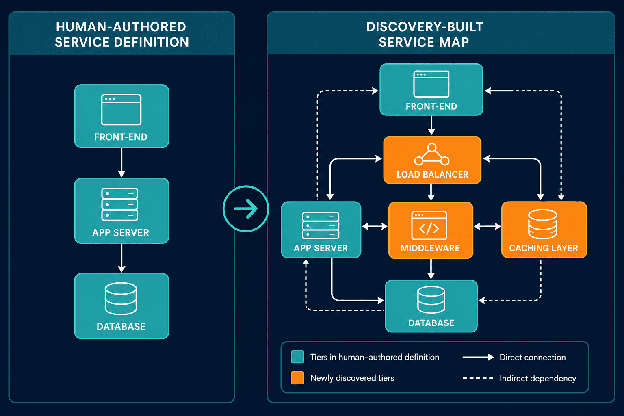
Conceptual diagram showing the contrast between a human-authored service definition with only front-end, app server, and database layers versus the discovery-built map that includes the middleware message broker, load balancer, and caching tier.
| A service definition gap is the difference between the infrastructure components listed in a service definition document and the components actually participating in that service in production. Gaps arise from components managed by separate teams, components added outside formal change processes, and architectural changes that outpace documentation. Discovery-built service maps surface these gaps by mapping relationships from live infrastructure data rather than relying on human recall. |
Human-authored service definitions tend to produce gaps because they capture only what people know and remember at the time of writing. Components managed by other teams, informal fixes, and undocumented architectural changes all escape the manual process. Discovery reads live infrastructure relationships instead of relying on human recall. |
Why Human-Authored Service Definitions Tend to Produce Gaps
Service definitions depend on people remembering, and production infrastructure evolves faster than documentation. Several structural forces make service definition gaps difficult to avoid in organizations of any size.
Team Ownership Boundaries Create Blind Spots
Application owners define services from their layer of the stack. A network appliance managed by the network team won’t appear in a definition template designed for application components. The boundary isn’t anyone’s fault; it is simply a gap the process does not cross. The load balancer in this example is typical: the network team managed it, so the application owner assumed it fell outside their responsibility.
Informal Changes Skip the Paper Trail
Performance optimizations deployed by operations teams, emergency fixes that persisted long after the incident closed, and configuration changes made during a bridge call tend to bypass the formal change management workflow. A caching layer installed during incident response and never formally requested through Jira Service Management does not appear in any service record. It can run for years while every service definition ignores it.
Architectural Evolution Outpaces Documentation
Services evolve. Message queues replace synchronous database calls. API gateways replace direct application connections. Each architectural shift should trigger a service definition update, but in most organizations it does not. Service definitions end up describing a version of the service that no longer exists.
The Visibility Ceiling of Manual Definition Work
Human-authored service definitions have a ceiling: they capture only what the people writing them know and remember at the time of writing. The EMA Research Report, ServiceOps 2025: Outages, AI, and What’s Next (Enterprise Management Associates, 2025) identifies undocumented dependencies as one of the leading contributors to extended mean time to resolution during major incidents. Discovery has a much higher ceiling. IT discovery scans the actual network, reads running processes, maps TCP connections, and traces communication between components. It finds the middleware because the middleware is there, communicating on a specific port at a measurable frequency. No memory required.
This is also why cmdb-with-automated-discovery outperforms manual documentation as a data quality strategy: the discovery process does not degrade over time the way human recall does.
| Human-authored service definitions cannot capture components managed by other teams, components added outside formal change processes, or components introduced during architectural changes that were never documented. Discovery-based service mapping finds these components by reading live infrastructure relationships, not by asking people what they remember about services that have been running for years. |
| Discovery-built service maps close service definition gaps by mapping active infrastructure relationships from live network and process data. Instead of asking what should be in a service, discovery maps what is communicating with what, then surfaces any component that communicates with a defined service CI but is absent from the service definition. |
How Discovery-Built Relationship Mapping Closes the Gap
- ViVID™ service maps work from the opposite direction of a human-authored service definition. Instead of asking ‘what should be in this service?’, discovery asks ‘what is communicating with what, and what does that pattern reveal about service structure?’
- When Virima’s IT discovery runs across a hybrid environment, it identifies every active configuration item and maps the relationships between them, combining network traffic analysis, process dependency tracing, and configuration data. The resulting model reflects what is actually running, not what someone documented. When that discovery data feeds ViVID™ service map construction, the resulting maps include every tier participating in the service, whether or not anyone included it in the submitted definition.
- This does not render service definitions irrelevant. Teams still define services, specifying which CIs belong to which named business service. But discovery validates and enriches those definitions. When a submitted definition is missing a tier, discovery flags the anomaly: CIs that communicate with defined service components but are not themselves part of any defined service appear as relationship orphans in the map.
- Virima supports both agent-based and agentless discovery methods, which means it surfaces components whether or not they allow agent installation. Cloud-native CIs, network appliances, and legacy middleware are all discovered through agentless network scanning and API-based methods.
What the Team Found After the Maps Were Built
After ViVID™ built the maps from both the submitted definitions and the discovery-sourced relationship data, the team had a clear view of three service definition gaps. They updated those service definitions to include the previously undocumented components. The message broker moved from invisible to fully mapped. The load balancer joined the customer portal service record. The caching layer became part of the formal service definition it had always silently belonged to.
The team then ran change impact analysis for an upcoming infrastructure maintenance cycle using the corrected service maps. The analysis surfaced dependencies the original incomplete definitions would have hidden. That maintenance cycle completed without a service disruption.
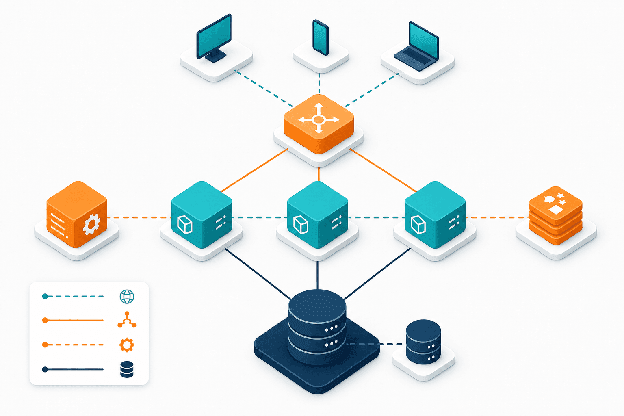
Illustrative example of a corrected ViVID™ service map with middleware, load balancer, and caching tier shown as mapped CIs within the service boundary.
| See the gaps in your service definitions. ViVID™ builds discovery-sourced maps that surface relationship anomalies before they cause an incident. Explore Trusted Runtime Truth |
| Discovery-built service maps close service definition gaps by mapping active infrastructure relationships from live network and process data. When a component communicates with a defined service CI but is absent from the service definition, the map surfaces it as an unmapped relationship anomaly — a clear signal that the service definition needs updating before that gap causes an incident or a failed change window. |
| A service map built on an incomplete service definition creates risk in three scenarios: incident triage misses the undocumented component, change impact analysis approves changes without full visibility into the impact area, and compliance audits find gaps in control coverage. All three failures trace back to a service definition gap that discovery could have surfaced. |
The Operational Risk of Service Maps Built on Incomplete Definitions
A service map is only as useful as it is accurate. IT ops teams reach for service maps in exactly three scenarios: incident triage, change impact analysis, and compliance audits. When the service map omits a tier, all three operations fail in the same direction.
The financial stakes are real. According to the Uptime Institute 2025 Annual Outage Analysis, 54% of outages cost organizations more than $100,000, and 20% exceed $1 million. Many of those outages trace back to changes approved without full visibility into downstream dependencies. A service definition gap is a direct contributor to that risk.
An incomplete service definition CMDB record creates exactly this scenario: the component handling the highest transaction volume isn’t in the map, so no risk flag fires during change review. The missing message broker in this example processed every database transaction for the application. Every change impact assessment for that service ran without flagging it as a downstream risk. A change to the application server tier would have passed impact review without identifying the message broker. That is how preventable outages start during planned maintenance.
Connecting discovery-sourced maps to your CMDB ensures that the CI relationships recorded in your change management system match production reality. When you approve a change window based on impact analysis, that analysis includes every component that will actually be affected. The gap between a submitted definition and production reality is where incidents live.
Service maps grounded in accurate CMDB best practices and discovery-sourced relationship modeling provide the foundation that change management, incident triage, and compliance evidence all depend on.
Compliance Scope Implications of Missing Tiers
Service maps with missing components create compliance exposure that auditors will find. Regulatory frameworks including SOC 2, ISO 27001, and PCI DSS require organizations to maintain accurate records of the systems processing or storing regulated data. If a middleware component processes payment data or stores session tokens and that component is absent from the service definition, it is also absent from compliance scope. Auditors reviewing service maps for evidence of control coverage will not find controls applied to a component that does not appear in the documented service.
| service maps built from incomplete definitions create risk across three domains: incident triage misses the undocumented component, change impact analysis approves changes without full blast radius visibility, and compliance scope excludes components that should be in scope. Discovery-driven service maps prevent all three by building maps from live infrastructure data rather than human-authored definitions alone. |
From Incomplete Definitions to Infrastructure-Grounded Service Maps
The solution is not more thorough service definition templates or longer review cycles. Both still depend on the same constraint: human knowledge and memory. The solution is to build service maps from discovery data and treat human definitions as a starting point that discovery validates and corrects.
When IT teams connect Virima’s IT discovery to their environment, the mapping process changes. Teams define services, specifying which CIs belong to which business service. Discovery runs against the same environment and builds a relationship model checking those definitions against what actually exists in production. When the two diverge, the divergence surfaces before the map is used for anything that depends on accuracy. If you want to build-a-cmdb that reflects production rather than paperwork, discovery is the foundation. When discovery-sourced ground truth feeds your service mapping process, every map reflects the infrastructure as it runs, not the infrastructure as someone remembers it.
When to Reconcile Service Definitions Against Discovery
- Three events should trigger an immediate reconciliation of your service definitions against discovery data: a cloud migration or infrastructure consolidation (new components appear without formal change records), a platform or ITSM consolidation (services are redefined across team boundaries), and any post-major-incident review (emergency fixes run during the bridge call often persist and need formal registration).
- Beyond these trigger events, a periodic discovery reconciliation cadence (running discovery against defined services after significant change windows) catches the slow drift that accumulates between incidents. The three missing tiers in this example were not failures of process design. They were the natural result of assuming that human memory can keep pace with infrastructure that changes constantly. Discovery closes service definition gaps that no manual process can catch.
- For IT operations teams managing hybrid environments with multiple business-critical services, the distance between a service definition and production reality tends to be the operating condition. Schedule a demo to see how Virima’s ViVID™ service maps surface the tiers your service definitions are currently missing.
Frequently Asked Questions
What is a service definition gap in IT service management?
A service definition gap is the difference between the infrastructure components listed in a service definition document and the components actually running and participating in that service in production. Gaps form when components are managed by different teams, installed outside the formal change process, or added during architectural changes that were never captured in documentation updates. ServiceNow, Ivanti, Halo, Jira service management, Xurrent.
Why do IT service definitions become incomplete over time?
Service definitions become incomplete because they depend on human knowledge at a specific moment in time. Components installed by other teams, informal performance optimizations, emergency fixes that persisted, and architectural changes all modify the running environment without necessarily triggering a definition update. The longer a service runs, the larger the typical service definition gap tends to become.
How does IT discovery identify components missing from service definitions?
IT discovery maps active relationships between all CIs in an environment using network traffic analysis, process dependency tracing, and configuration data. When a component communicates with a known service CI but is not part of any service definition, it appears as a relationship anomaly in the service map, flagging a potential service definition gap for review before it causes operational problems.
What risks does an incomplete service definition create for change management?
When a service definition is missing a component, change impact analysis treats that component as a non-participant in the service. Changes to adjacent tiers pass review without flagging the undocumented component as a downstream risk. Change approvals proceed without full visibility into the impact area, which is a primary cause of unplanned outages during planned maintenance windows.
How does Virima’s ViVID™ surface service definition gaps?
ViVID™ builds service maps from discovery-sourced relationship data. When Virima’s IT discovery runs across an environment, it identifies every active CI and maps its communication relationships. Components that communicate with defined service CIs but are absent from the service definition appear as anomalies in the ViVID™ service map. Teams review these anomalies to find and close service definition gaps before those gaps cause operational problems.
Does Virima’s discovery work with components that don’t allow agent installation?
Yes. Virima supports both agentless and agent-based discovery, which means it surfaces components whether or not they allow agent installation. Cloud-native CIs, network appliances, and legacy middleware are all discovered through agentless network scanning and API-based methods.
Find the Tiers Your Service Definitions Are Missing
Service definition gaps are not a documentation problem. They are a structural challenge: human-authored definitions capture what people know, while production infrastructure captures what is actually running. The gap between those two pictures is where incidents start and compliance audits unravel.
Discovery-built maps close that gap. Every component that communicates with a defined service CI but sits outside the definition becomes visible before it causes a problem. Your change reviews, incident responses, and compliance audits all work from a foundation that reflects production reality.
| Get live, explainable runtime truth across your entire IT estate, without replacing your existing ITSM stack. Schedule a Demo |