Keeping Service Maps Accurate When Infrastructure Changes 40 Times a Day

| Service map accuracy measures how closely a dependency map reflects live infrastructure topology. In hybrid environments where auto-scaling, container orchestration, and cloud provisioning generate 30 to 40 topology changes per day, maps can become outdated within hours of a scan. This article explains how infrastructure-paced discovery cycles maintain accuracy, why documentation-based approaches fall short, and what service map staleness costs during incidents and change windows. |
Service map accuracy has become one of the harder problems in IT operations. In hybrid environments where auto-scaling, container orchestration, and cloud provisioning generate 30 to 40 topology changes per day, a service map built from a morning discovery scan can be missing active components by midday. Keeping service maps accurate in these environments requires discovery that runs at the pace infrastructure changes, not the pace IT teams document changes.
How Fast Do Modern IT Environments Actually Change?
| Modern IT environments with Kubernetes, auto-scaling cloud services, and CI/CD pipelines accumulate dozens of topology changes in a single business day. These changes are often invisible to change management workflows because they happen outside formal change requests, making documentation-based approaches structurally unreliable for maintaining service map accuracy. |
- Infrastructure change frequency has increased sharply with containerized workloads, cloud-native architectures, and infrastructure-as-code tooling. An environment running Kubernetes alongside cloud-managed services and on-premises servers can accumulate dozens of topology changes in a single business day, often without anyone triggering a manual change request.
- Auto-scaling adds capacity during peak load and removes it when demand drops. Container orchestration restarts pods on new nodes when existing nodes fail health checks. Cloud provisioning creates and destroys resources based on pipeline triggers. Network security policies update in response to threat detection or compliance scans. Each of these events changes the actual dependency graph that ViVID™ service maps must reflect to remain useful for change impact analysis.
- A 2025 analysis published in the EMA ServiceOps 2025 report directly links service map staleness to extended incident resolution times, because teams consult maps that no longer match production. The Uptime Institute’s 2025 Annual Outage Analysis similarly identifies software and configuration-related failures as a leading cause of outage severity, reinforcing the cost case for keeping infrastructure baselines current.
The 40-Change-Per-Day Baseline
Forty infrastructure changes per day is not an outlier in modern IT environments. For organizations running microservices, public cloud resources, and containerized workloads alongside traditional on-premises infrastructure, it is a representative baseline. This figure aligns with patterns documented in the EMA ServiceOps 2025 report and observed across enterprise environments managing hybrid IT at scale.
Each change is a potential discrepancy between the service map and production. Over eight hours of business operations, 40 daily changes produce a service map that deviates from reality at a rate of one topology change every 12 minutes. The map your CAB consults at 4 PM may already be missing components added after the morning scan.
The compounding effect matters. An auto-scaling event that adds two application servers creates two new CIs. Those CIs should appear in the service map with links to the load balancer, database, and monitoring system. If the next discovery cycle runs six hours later, those CIs remain absent from the service map for six hours. Any change impact analysis run during that window operates on a map that excludes components actively serving production traffic.
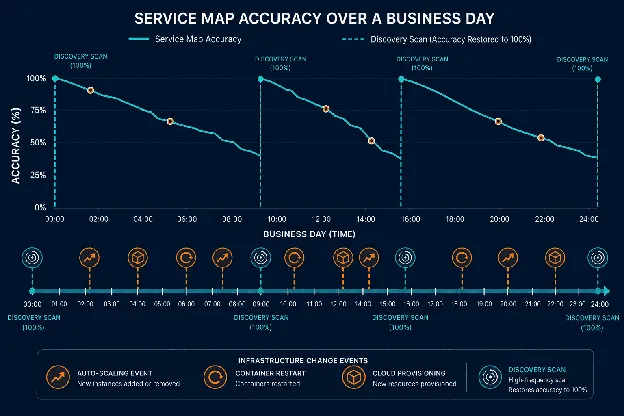
Conceptual diagram showing a timeline of infrastructure change events across a business day, with auto-scaling events, container restarts, and cloud provisioning mapped against a discovery scan baseline.
| Service map accuracy degrades as soon as infrastructure changes in ways not yet captured by the most recent discovery scan. In environments with 30 or more infrastructure topology changes per day, a service map built from a six-hour-old scan may be missing multiple active CIs and their relationships. High-frequency discovery cycles maintain service map accuracy by updating the relationship model at a pace that matches the rate of actual infrastructure change. |
What Happens to Service Maps Between Discovery Cycles
| A service map is accurate the moment discovery completes, then begins to drift immediately. In environments that change frequently, the gap between scans allows topology changes to accumulate. When teams use stale maps for change impact analysis or incident triage, they work from an incomplete picture of production, which extends resolution times and increases change risk. |
A service map is accurate at the moment discovery completes and immediately begins to drift. The rate of drift depends on how frequently the environment changes. The three most common uses of service maps in IT operations are all sensitive to accuracy. Change impact analysis uses the service map to identify which services will be affected by a proposed change. Incident triage uses the service map to identify which upstream or downstream components may be contributing to a reported symptom. When triage relies on a stale map, diagnostic paths extend. Gartner estimates unplanned downtime costs enterprises an average of $5,600 per minute, making service map accuracy a direct cost variable. Audit evidence uses the service map to demonstrate the scope of control coverage for a service. Each of these uses produces a wrong answer when the map omits a CI actively participating in the service.
Auditors reviewing change records expect service maps to reflect the infrastructure that was actually running during the change window. NIST SP 800-128 defines security-focused configuration management as requiring current, continuously refreshed baseline records of active CIs. A service map last updated six hours ago may not satisfy that standard in a high-change environment. The CMDB relationship records that feed service maps inherit the same staleness. A CMDB updated only when someone submits a change request capture planned changes but misses auto-scaling events, container orchestration decisions, and cloud provisioning triggered by CI/CD pipelines. The CMDB auto-discovery approach addresses this by replacing the dependency on manual updates with relationship mapping from live scan data.
The Accuracy Decay Curve
Service map accuracy does not decay at a uniform rate. Environments with stable, manually managed infrastructure decay slowly. Environments with Kubernetes, auto-scaling cloud services, and active CI/CD pipelines decay fast enough to render a six-hour-old service map operationally unreliable for high-stakes decisions.
IT teams working without infrastructure-paced scanning often discover the staleness problem during an incident or a failed change. The service map that looked complete during the CAB review turns out to have been missing the containerized middleware tier that restarted on a new node two hours before the change window started. That missing CI is not a documentation failure. It is a timing failure.
Virima’s discovery run logs record every topology delta: new CI, retired CI, changed relationship. Teams can reconstruct exactly what the service map looked like at the time of any change advisory review, not just what it looks like today.
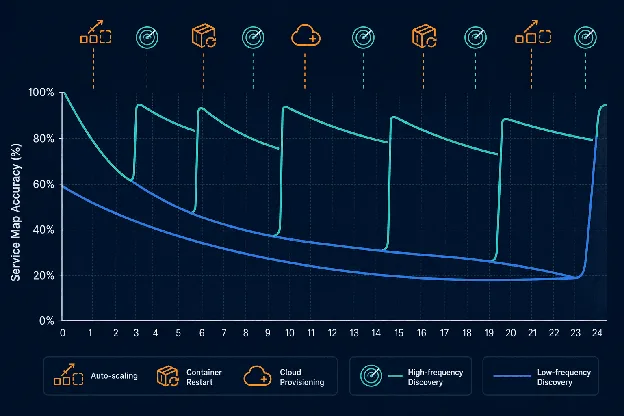
Illustrative example of a service map accuracy decay curve over 24 hours, showing accuracy at 100% immediately post-scan and the compounding gap as topology changes accumulate between discovery cycles.
| Service map accuracy decays as infrastructure changes accumulate between discovery scans. Environments with auto-scaling, container orchestration, and cloud resource provisioning can produce topology changes every few minutes. A service map updated only every six to twelve hours is likely missing active CIs during any given query. Frequent discovery cycles reduce this decay window by running scans at intervals short enough to capture infrastructure changes before they produce meaningful staleness. |
| Want to see how quickly your service maps go stale? Download the EMA ServiceOps 2025 report to see how service map staleness affects incident resolution times across enterprise IT environments. |
Why High-Frequency Discovery Cycles Are the Most Effective Approach
| Change-triggered and manual CMDB updates fall short in high-change environments because they depend on formal processes capturing every infrastructure event. Auto-scaling, container orchestration, and CI/CD pipeline actions occur outside change management workflows and produce no change records. High-frequency discovery cycles resolve this by scanning actual network state directly, regardless of whether a change record exists. |
- The alternatives to high-frequency discovery cycles are change-triggered updates and manual updates. Both fall short in environments with high infrastructure change frequency for the same reason: they depend on someone or something noticing the change and initiating a discovery or documentation action.
- Change-triggered updates depend on the change management process capturing every relevant infrastructure event. Auto-scaling events, container restarts, and cloud provisioning by CI/CD pipelines do not generate change records in most ITSM platforms. These events happen outside the change management workflow. The CMDB records the events it is told about. It does not record the events it is not told about.
- Asking teams to document faster does not solve this. Manual updates cannot keep pace with auto-scaling events, container orchestration decisions, and cloud provisioning actions that fire without human review.
Why Change-Triggered Updates Fall Short
According to the CNCF 2024 Annual Survey, 82% of organizations run Kubernetes in production, each generating a stream of container lifecycle events that most ITSM change management workflows never capture. Understanding the ServiceNow Discovery vs. service mapping distinction helps clarify why cycle frequency matters: discovery reads live network state, while service mapping builds the dependency model from those reads. When discovery runs infrequently, both the CI data and the map derived from it lag behind production.
Virima’s IT Discovery addresses this by scanning the actual environment rather than waiting for events to be reported. Each discovery cycle reads the current state of the network, identifies active CIs and their relationships, and compares the result to the previous run. New CIs, retired CIs, and changed relationships all appear in the updated service map. The frequency of the discovery cycle determines how quickly those changes appear.
What High-Frequency Discovery Actually Looks Like
Frequent discovery scans run at intervals calibrated to the rate of change in the environment. This is what dynamic service mapping looks like in practice. For environments with aggressive auto-scaling and active container orchestration, discovery cycles running every few hours produce substantially more accurate service maps than scans running daily or weekly. Current service mapping trends confirm that infrastructure-paced discovery is becoming the baseline expectation in enterprise hybrid environments, not an advanced configuration.

| Environment Type | Recommended Cycle Frequency | Expected Staleness Window |
| Stable (manual infrastructure, minimal auto-scaling) | 24 hours | Low — planned changes captured through change management |
| Moderate (some cloud services, limited CI/CD automation) | 4 to 8 hours | Medium — same-day changes captured before end of business |
| High-change (Kubernetes, active CI/CD, cloud auto-scaling) | 1 to 4 hours | Low — topology changes appear in service maps within the same operational period |
Virima supports both agent-based and agentless discovery methods. Agentless discovery scans reach cloud-native resources, network appliances, and containerized workloads, including Kubernetes pods and cloud-managed services that may not support agent installation. Agent-based discovery provides deeper process and dependency data from managed endpoints.
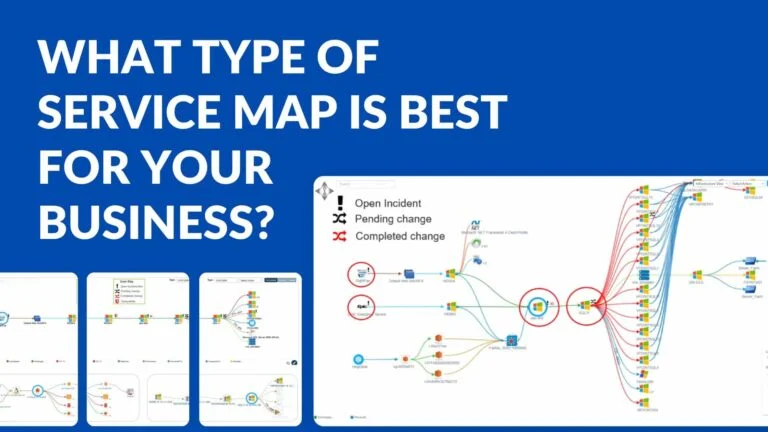
ViVID™ service maps display CI status, active incidents, and change records directly on the dependency graph. ViVID™ extends ServiceNow service mapping with live ITSM overlays and change risk context, so change impact analysis does not require switching between tools when a new discovery cycle completes. For organizations already using ServiceNow or Jira Service Management, Virima integrates directly to enrich your CMDB with discovery-sourced service maps. High-frequency discovery cycles mean the CI relationship data feeding change impact analysis reflects a recent scan rather than a weeks-old snapshot.
| High-frequency discovery cycles maintain service map accuracy by scanning infrastructure at intervals short enough to capture topology changes before they produce meaningful staleness. In practice, this means running discovery cycles every few hours rather than daily or weekly, so that auto-scaling events, container restarts, and cloud provisioning appear in the service map within the same operational period in which they occurred. |
Service Map Accuracy as a Prerequisite for Change Management
| Change management depends on service maps for impact analysis. When a service map is missing CIs that are actively participating in a service, the change advisory board approves changes based on an incomplete view of affected services. In environments that change 40 times a day, this gap can translate directly into unplanned outages for services that should have been flagged. |
Change management depends on service maps for impact analysis. If the service map is missing components actively participating in a service, that assessment is incomplete. In environments that change 40 times a day, a service map used for change impact analysis at end of business may be missing components added by auto-scaling that morning. Service map accuracy also determines the quality of service dependency mapping used in audit evidence. Auditors reviewing change records expect service maps to reflect the infrastructure that was actually running during the change window, not the infrastructure documented weeks before it.
The Risk in Multi-Team Hybrid Environments
The risk compounds in hybrid environments where teams from different organizational units manage different infrastructure tiers. An infrastructure team manages the compute layer. A database team manages the data tier. A cloud operations team manages cloud-native services. Each team’s changes affect the service map, but none of them necessarily triggers a discovery cycle in another team’s domain. Infrastructure-paced scanning across all domains closes this gap.
When an incident occurs in a multi-team environment, the affected service map may reflect only the changes each team chose to document formally. Components introduced by auto-scaling or CI/CD pipelines in other domains remain invisible. Business service mapping for incident management requires that all domains feed into a shared dependency model, and high-frequency discovery is the mechanism that makes this achievable without relying on cross-team documentation discipline.
Stale Maps Produce False Change Impact Results
A change impact analysis run against a service map that is six hours out of date in a 40-change-per-day environment may be missing dozens of active CIs from its impact assessment. That is a structurally false result. Components actively serving production traffic drop out of the risk calculation entirely.
The 2025 EMA ServiceOps analysis finds that CMDB inaccuracy directly extends incident resolution times, as teams work from dependency maps that no longer reflect production reality. Teams that discover the staleness problem during an incident rather than before a change window face the worst version of this trade-off. The post-incident review reveals that the change impact analysis would have flagged the affected component if the service map had been current. The recommendation is consistent: update the CMDB more frequently. Infrastructure-paced discovery is how that recommendation gets implemented without requiring sustained manual effort.
| Stale service maps produce false change impact results by excluding CIs that are actively participating in a service but were added or changed after the most recent discovery scan. In environments with 40 or more daily infrastructure topology changes, a service map used for change impact analysis can miss components added within hours of the change window. High-frequency discovery cycles prevent this by keeping the service map current at a rate that matches infrastructure change pace. |
Accurate Discovery, Not Faster Documentation, Keeps Your Service Maps Current
Asking teams to document changes more promptly does not solve this. Manual documentation processes cannot keep pace with auto-scaling events, container orchestration decisions, and cloud provisioning actions that occur without human review. The solution is discovery that runs at infrastructure pace. To understand the full scope of service mapping benefits in dynamic environments, the starting point is always the discovery cycle.
When Virima’s IT Discovery runs infrastructure-paced scanning across a hybrid environment, every cycle compares the current topology to the previous result. That scan result feeds directly into ViVID™ service maps, so the dependency graph teams consult for change impact reflects Trusted Runtime Truth: what is running in production, not what someone documented hours ago.
For organizations managing environments where infrastructure changes at 40 or more events per day, service map accuracy is not achievable through documentation processes. It requires discovery-sourced data updated at the rate infrastructure changes. If you want to build a CMDB that stays accurate in dynamic environments, infrastructure-paced discovery cycles are the architectural requirement.
| Download the EMA ServiceOps 2025 report to see how service map staleness affects incident resolution times across enterprise IT environments. |
Frequently Asked Questions
Why do service maps become inaccurate so quickly in modern IT environments?
Modern IT environments change through auto-scaling events, container orchestration decisions, cloud resource provisioning, and software deployments. Each of these events modifies the actual infrastructure topology that service maps must reflect. When discovery cycles run infrequently, the gaps between scans allow topology changes to accumulate, producing service maps that exclude CIs actively serving production traffic. ServiceNow, Ivanti, Halo, Jira service management, Xurrent.
What is a high-frequency discovery cycle?
A high-frequency discovery cycle is a scheduled IT discovery scan that runs at intervals calibrated to the rate of infrastructure change in the environment. Instead of scanning once per day or once per week, high-frequency cycles run every few hours, capturing topology changes from auto-scaling, container restarts, and cloud provisioning before they produce significant service map staleness.
How does service map staleness affect change management?
Change management relies on service maps for impact analysis. When a service map is missing CIs that are actively participating in a service, the impact assessment excludes those CIs from the risk calculation. The change advisory board approves changes based on an incomplete view of affected services, which can result in unplanned outages for services that should have been included in the assessment.
Can change-triggered CMDB updates replace high-frequency discovery in dynamic environments?
Change-triggered updates only capture changes that go through the formal change management process. Auto-scaling events, container orchestration decisions, and CI/CD pipeline provisioning actions do not generate change records in most ITSM platforms. These events change the actual infrastructure topology without triggering any CMDB update. High-frequency discovery cycles capture these events by scanning the actual network state regardless of whether a change record exists.
How does Virima maintain service map accuracy in high-change environments?
Virima runs high-frequency IT discovery cycles that scan the hybrid environment at scheduled intervals and compare each scan result to the previous one. New CIs, retired CIs, and changed relationships all produce updates to the CMDB and to ViVID™ service maps. This keeps the service map current at a rate that matches the actual pace of infrastructure change, rather than depending on manual updates or infrequent scheduled scans.
Does Virima update ViVID™ service maps automatically after each discovery cycle?
Yes. When a discovery cycle completes, Virima compares the new topology to the previous scan result and writes updates to the CMDB. ViVID™ service maps build from those CMDB relationship records, so changes detected in a discovery cycle appear in the dependency graph after the cycle completes. The frequency of the discovery cycle determines how quickly topology changes appear in the maps.
What discovery cycle frequency is right for my environment?
The right frequency depends on how fast your environment changes. Stable environments with mostly manual infrastructure can run discovery cycles daily. Moderate environments with some cloud services typically benefit from four to eight hour intervals. High-change environments running Kubernetes, active CI/CD, and cloud auto-scaling generally require one to four hour cycles to keep service maps operationally current.
What is the relationship between CMDB accuracy and service map accuracy?
Service maps are built from CMDB relationship records. When the CMDB is stale, the service map is stale. High-frequency discovery cycles improve CMDB accuracy by refreshing CI records and relationships from actual network scans, which directly improves the accuracy of every service map built from those records.
| Then schedule a demo to see how Virima keeps your CMDB and ViVID™ service maps current for fast incident response and confident change management. |