Revolutionizing IT operations: The intersection of Virima and ServiceNow™ AIOps

When your IT operations team runs ServiceNow for ITSM and ITOM, the quality of every workflow depends on the data feeding those processes. Incident routing, change approvals, event correlation: all of it falls apart when the underlying asset and relationship data are stale or incomplete. Virima integrates directly with the ServiceNow platform to deliver accurate, continuously updated asset and relationship data that ServiceNow™ AIOps needs for reliable event correlation, root cause analysis, and incident routing.
AIOps (Artificial Intelligence for IT Operations) uses machine learning and data analytics to solve IT issues faster. In fact, modern AIOps platforms can reduce alert noise by up to 95% and cut incident resolution time by 30–70%. It helps you detect problems in real time and improve operational efficiency. You also get better visibility into your overall service health. This means you can act quickly before small issues grow bigger.
ServiceNow™ AIOps brings these benefits into ITOM. It automates incident detection, root cause analysis, and event correlation. As a result, you spend less time chasing alerts and more time fixing problems. It also helps your team stay focused and work smarter.
However, AIOps is only as good as the data it uses. If your CMDB data is outdated or incomplete, results will suffer. For example, missing dependencies can lead to wrong correlations. Because of this, you may miss the real root cause and delay resolution.
This post covers how Virima and ServiceNow™ AIOps work together, what each contributes, how the integration works in practice, and what that means for incident resolution times, change management confidence, and CMDB trust.
What ServiceNow™ AIOps brings to IT operations
IT environments keep getting more complex. More cloud services, more interdependencies, more configuration changes happening faster than any team can track manually. ServiceNow™ AIOps addresses this by applying machine learning to the operational data flowing through ITSM and ITOM. Today, about 84% of organizations have already explored or piloted AIOps in some form.
Here’s what that looks like in practice, especially when supporting modern service operations:
- Aggregates data from ITSM tickets, ITOM events, and CMDB records as key data sources to correlate issues that would otherwise be investigated separately
- Groups related alerts and incidents, cutting noise so ops teams focus on actual problems instead of duplicate tickets
- Uses ML-driven analysis to identify probable root causes faster than manual investigation
- Learns from historical incident patterns to flag potential problems before they escalate
- Automates routine triage and routing, freeing your team to spend time on resolution instead of categorization
How ServiceNow™ AIOps improves incident management
ServiceNow™ AIOps detects incidents automatically, assesses their potential business impact, and routes them to the right team. For an ops manager, that translates to fewer misdirected tickets and faster time-to-resolution. Think of it as the difference between a 15-minute fix and a 2-hour escalation chain, driven by clearer key performance insights.
Proactive problem management with AIOps
Instead of waiting for users to report issues, AIOps uses analytics to spot patterns that signal emerging problems, leveraging metric data to surface potential issues before they escalate. When your monitoring data shows a storage array trending toward capacity limits across three dependent services, AIOps flags it before the outage happens.
Automated root cause analysis
When incidents hit, AIOps traces the event chain to identify root causes quickly. It connects alerts to affected CIs, related changes, and upstream dependencies, then surfaces the probable cause for your team to validate and act on through intuitive AIOPS dashboards.
From reactive to data-driven decision-making
Beyond resolving individual incidents, AIOps gives ops leaders visibility into patterns: which services generate the most incidents, where change management failures cluster, and which infrastructure components are chronic problem sources. These insights help you prioritize improvements that reduce incident volume over time and strengthen operations management strategies.
What is the difference between AIOps and traditional IT monitoring?
Traditional monitoring tells you what happened. A server is down, a threshold was breached, a service is unresponsive. AIOps goes further by correlating those signals across your infrastructure, including modern digital services, grouping related alerts, identifying root causes, and learning from past incidents to predict future ones. Where monitoring generates alerts, AIOps helps you understand why something happened and what else is likely affected. For ops teams drowning in alert noise, that shift from detection to correlation and prediction is what makes ServiceNow™ AIOps valuable.
How Virima makes a difference with ServiceNow™ AIOps
ServiceNow™ AIOps handles event correlation, root cause analysis, and predictive incident detection, but all of those capabilities depend on accurate, complete data in the CMDB. If your CMDB is missing assets, showing stale relationships, or lacking dependency data, AIOps correlates against an incomplete picture.
Virima fills that gap with three capabilities that directly improve AIOps outcomes and overall service operations maturity:
- IT discovery: Agentless and agent-based scanning help you discover assets across on-prem, AWS, and Azure environments. In addition, IP-based scans and API integrations cover hypervisors, cloud platforms, networks, and storage systems. As a result, nothing slips through, even in complex setups with many monitoring tools. This gives you a more complete and reliable view of your environment. For remote and roaming devices, Virima’s Discovery Agent supports Windows, macOS, and Linux. It also includes a Work from Anywhere (WFA) feature for better tracking. With this, you can monitor daily configuration changes and software usage over the internet. So, you don’t need a corporate network connection to stay updated.
- Service mapping: Virima Discovery uses machine learning techniques to automatically map application dependencies, infrastructure relationships, and service topologies. Service mapping organizes these discovered relationships into business service maps; you name the service, point it to a logical starting point like an application or web server, and all related dependencies become part of the map. These maps feed directly into the ServiceNow CMDB, enriching knowledge-based decision-making for AIOps workflows, giving AIOps the dependency context it needs for accurate root cause analysis.
- ViVID™ (Visual Impact Display): an overlay layer that visualizes CMDB data, service dependencies, ITSM records, and vulnerability data on interactive maps. ViVID™ doesn’t build the maps. It makes the data your team already has visible, actionable, and shareable.
The integration is 100% codeless, configured through Virima’s web admin portal with over 100 blueprints that map to ServiceNow CMDB tables. Virima supports bidirectional CI synchronization with ServiceNow; discovered assets, relationships, and attributes flow into ServiceNow, and CI updates made within ServiceNow sync back to Virima. Granular business rules let you control which updates get promoted and when, so both systems stay aligned without manual reconciliation.
What data does Virima discover that ServiceNow doesn’t?
ServiceNow has its own discovery tools. However, you may still see gaps in complex environments. This often happens in hybrid setups with on-prem systems, multiple clouds, and older technologies. As a result, some assets and relationships may stay hidden.
Virima helps you close these gaps. It uses agentless discovery to scan across your entire environment. For example, it uses IP-based scanning, SNMP, WMI, SSH, and REST APIs. Because of this, it often finds assets and dependencies that ServiceNow might miss
Beyond technical discovery, Virima’s Autonomic Social Discovery (ASD) captures information that no scanner can find automatically: asset ownership, business criticality, lifecycle status, compliance policies, and SLAs. ASD automates this human intelligence gathering by notifying the listed owner when required data is missing. Assignees can reassign ownership or individual tasks, and the system adapts to determine the best resource for future intelligence gathering. Its Data Integrity Check ensures completeness across tagged attributes. The result is a CMDB with higher attribute authority, supporting more advanced use cases, including generative AI, not just accurate asset records but complete ones with the business context that makes them useful for change planning, incident triage, and compliance audits.
Benefits of combining Virima with ServiceNow™ AIOps
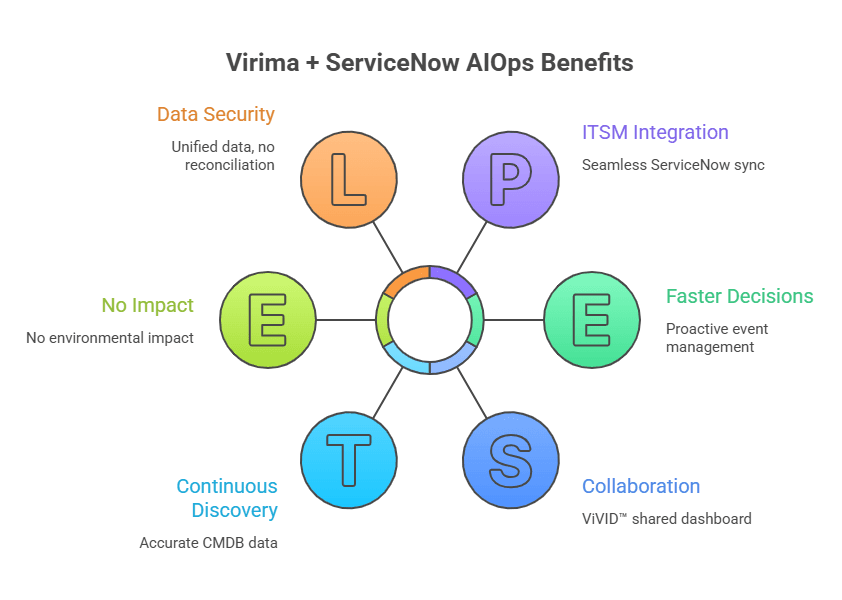
When you use both together, you get better data, clearer insights, and faster decisions.
Enhanced visualization for impact analysis
When your change advisory board reviews a proposed infrastructure change, they need to see what depends on the affected CIs. ViVID™ overlays planned change records, open incidents, and monitoring alerts directly onto service dependency maps. Instead of digging through CMDB tables, your team gets a visual answer aligned with critical business indicators: if we take this server offline, here’s every application, service, and business process that’s affected.
That accelerates change risk assessment and cuts the time spent in CAB meetings debating potential impact.
High data accuracy through continuous discovery
Virima keeps your ServiceNow CMDB accurate through recurring scheduled scans, not a one-time import that goes stale. Discovery runs on configurable schedules, detects new assets, updates changed configurations, and flags decommissioned devices. Any change to the configuration management data, whether automatically discovered or manually entered, is immediately reflected in the service maps, keeping your dependency views current without requiring a separate map rebuild. Communication views let your team confirm CMDB comprehensiveness by verifying that no orphaned relationships exist and flagging suspect communications with external systems.
ASD adds a layer that scanners can’t replicate. For every CI, ASD tracks lifecycle status, ownership, business criticality, and policy compliance. These are the attributes that turn a bare asset record into one your ops team can actually use for decision-making. Its Data Integrity Check validates completeness across these attributes and flags gaps, keeping CMDB data quality consistently high.
How does Virima handle configuration drift in the CMDB?
Configuration drift, where the actual state of an asset diverges from what the CMDB records, is one of the biggest threats to CMDB reliability. Virima addresses this through recurring scheduled discovery scans that compare current asset configurations against stored CMDB records. When a server’s installed software, IP address, or hardware configuration changes, Virima detects the difference and updates the CI accordingly.
For ops teams, this means the CMDB your change management process relies on reflects reality, not a snapshot from three months ago. Fewer change failures, fewer surprise dependencies during incidents, and audit evidence that actually matches your production environment.
ViVID™ as a collaboration hub
ViVID™ acts as a heads-up display for IT operations, cybersecurity, and DevOps teams, consolidating incidents, change records, alerts, and vulnerability data onto a single visual layer.
When a service disruption hits, your incident response team sees the same dependency map as the infrastructure team and the service delivery manager. Everyone works from the same picture: which CIs are affected, what changes happened recently, and where the probable root cause sits.
For change management discussions, ViVID™ shows proposed changes in the context of live incidents and monitoring alerts so your CAB can assess risk with full operational context.
How does ViVID™ help during a major incident?
Picture this: your customer-facing application goes down at 8 AM. The service desk is flooded with tickets. Your ops team opens ViVID™ and immediately sees the application’s full dependency tree, including the web servers, the load balancer, the database cluster, and the network path connecting them. ViVID™ overlays open incidents and recent changes onto this map. You spot it right away: a network switch that was changed last night now shows a monitoring alert. That’s your probable root cause. Instead of spending 45 minutes tracing dependencies through CMDB tables, your team identified the likely culprit in under 5 minutes. From there, you trigger a re-scan of the affected service assets directly from ViVID™ to confirm what’s online and check for any unapproved or undocumented configuration changes, giving your team validated evidence before escalating the fix.
Root cause and impact analysis with service maps
Virima’s service mapping works with discovery and CMDB to identify every CI that supports a given service and the specific relationships between them. When an incident occurs, these maps let your team trace upstream from the symptom to the cause and downstream to assess business impact.
ViVID™ accelerates this by pinpointing disruption origins visually. For change management, its overlays show potential risks before infrastructure modifications go live, giving IT managers the confidence to approve changes faster when the impact is clear and the evidence to push back when it isn’t.
Proactive event management
ViVID™ places monitoring alerts from tools like SolarWinds, Nagios, and LogicMonitor onto service maps. This helps you see how each alert affects your business services. You can also view both upstream and downstream impact in one place. As a result, you understand the full picture faster.
Next, your team can prioritize response using Service Value Rating (SVR) and key performance data. This means you focus on what matters most to the business. Instead of treating every alert the same, you act where the impact is highest. So, your response becomes faster and more effective.
In addition, Virima shows NVD vulnerability data directly on ViVID™ maps. You can see known CPEs and CVEs along with alerts and ITSM records. Because of this, you don’t need to switch between tools. Everything stays in one view for easier decisions.
Finally, when AIOps flags an issue with a CI, you instantly see its risk level. You can check vulnerabilities, asset importance, and affected services right away. This helps you assess risk quickly and take the right action without delay.
Seamless ITSM integration with ServiceNow™ AIOps
Virima identifies which business services and service assets have open incidents in ServiceNow, enabling rapid root cause identification during service interruptions. The integration also surfaces monitoring alerts from connected tools directly within the ViVID™ overlay, making alert data accessible without switching between platforms. While this post focuses on ServiceNow, Virima offers the same codeless integration and bidirectional CI synchronization with Jira Service Management, Ivanti, HaloITSM, Cherwell, Xurrent, and Hornbill; so the capabilities described here extend across your ITSM stack if your environment uses multiple platforms.
Does Virima support bidirectional sync with ServiceNow?
Yes. Virima’s ServiceNow integration supports bidirectional CI synchronization. CIs, relationships, and attributes discovered by Virima populate ServiceNow CMDB tables, and CI updates made within ServiceNow sync back to Virima. Configurable business rules control which updates get promoted and when, eliminating the “two CMDBs” problem where data diverges between systems. For ops teams, it means you don’t need to manually reconcile records or wonder which system has the current data; both stay aligned through the integration.
Stronger ServiceNow™ AIOps outcomes start with better data
The real value of combining Virima with ServiceNow™ AIOps isn’t the features alone. It’s the operational impact. AIOps makes smarter decisions when its CMDB data is complete, current, and relationship-rich. Virima delivers exactly that: continuous IT discovery with ML-driven relationship detection, dynamic service mapping, ASD-driven attribute completeness, and ViVID™ visualization that turns raw data into operational intelligence.
For IT ops teams managing complex hybrid environments, this combination means faster incident resolution, more confident change management, and a CMDB that earns your team’s trust instead of undermining it.
Ready to see how Virima strengthens your ServiceNow™ AIOps investment? Request a demo with our team today.