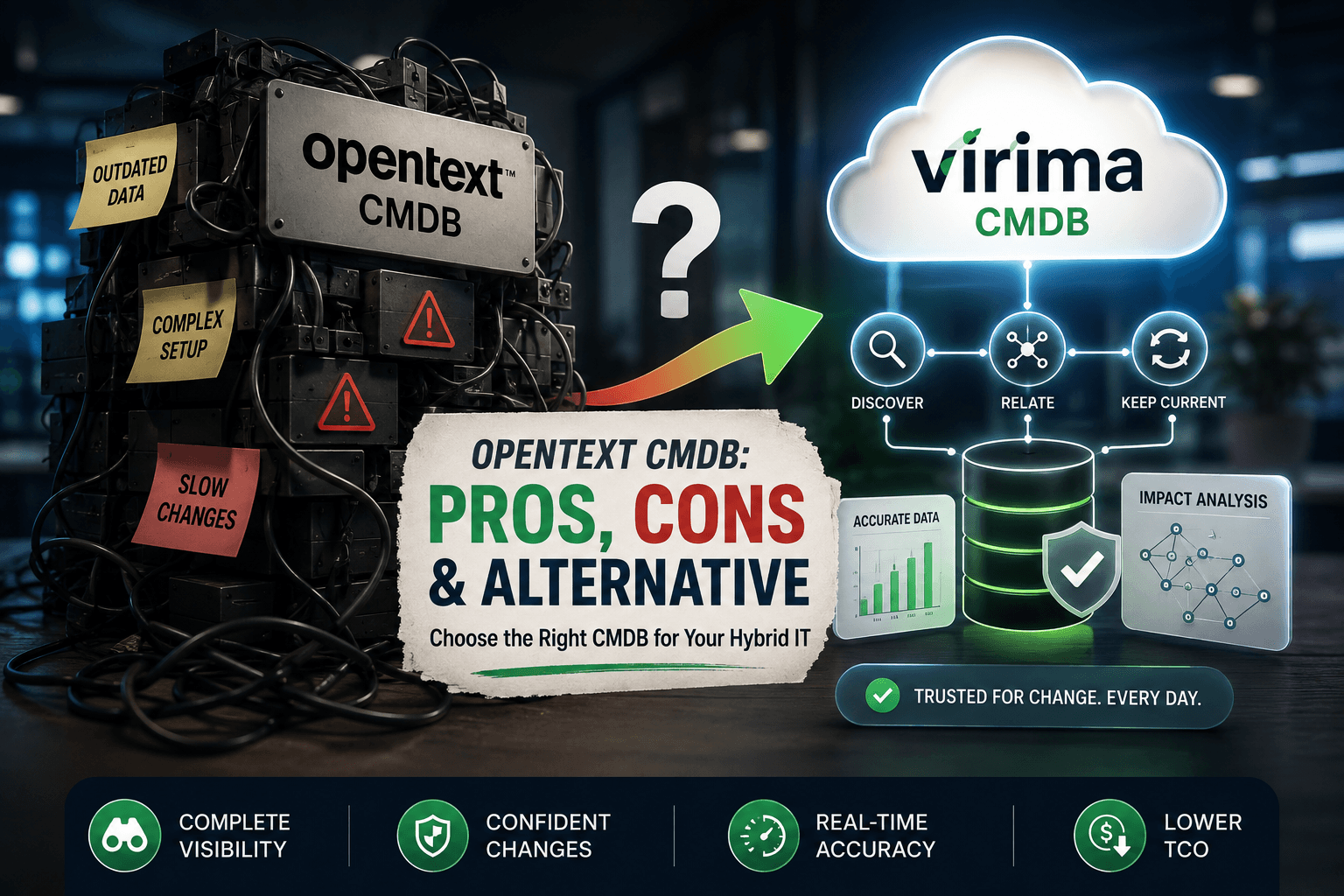
OpenText CMDB: Features, Limitations, and Alternative

Your change window is tonight. The CAB packet lists three servers. Nobody can swear which business service still depends on the third one. The ticket history is clean. The spreadsheet is a week old. The CMDB says the relationship is current. Operations does not believe it.
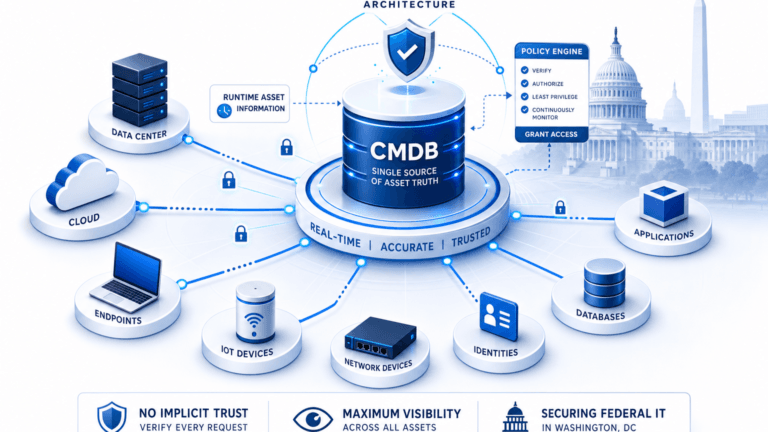
That is the moment OpenText Universal Discovery and CMDB gets judged, not on brochure feature lists, but on whether configuration data is trusted enough to approve the change. OpenText CMDB is the configuration management database inside OpenText Universal Discovery and CMDB (formerly Micro Focus / HPE uCMDB). It stores configuration items, relationships, and discovery data used for impact analysis, change risk, and ITSM workflows across hybrid estates.
OpenText remains a serious enterprise option for vendor-neutral discovery feeding ITSM platforms. Many teams still hit the same wall: specialist upkeep, model rigidity, and a gap between inventory that was discovered once and data trusted every day. This guide covers what OpenText CMDB delivers, where buyers report friction, and when a discovery-backed path like Virima CMDB fits better for hybrid IT that needs explainable runtime truth for change and incident work under the desk you already run.
| When change and incident decisions need current hybrid CIs and service paths under ITSM, not only a populated enterprise CMDB graph, the missing layer is discovery-sourced runtime accuracy. Explore Trusted Runtime Truth. |
When is OpenText Universal Discovery and CMDB enough?
OpenText fits large estates that need deep, vendor-neutral discovery and enterprise modeling, and that can staff probe, content pack, and reconciliation operations. Stay when multi-method discovery, network depth, and ITSM feeds are trusted under CAB and incident pressure with the operating model you can sustain.
What OpenText Universal Discovery and CMDB is built to do
OpenText positions Universal Discovery and CMDB as vendor-neutral discovery plus an enterprise CMDB. The product line descends from HPE / Micro Focus Universal CMDB (uCMDB). The pitch is clear: discover hybrid and multicloud estates, map services, and push stronger configuration data into tools you already run, including ServiceNow, BMC, and Jira Service Management, without a full rip-and-replace of the service desk.
On paper, that solves a real problem. Many ITSM CMDBs starve without deep discovery. OpenText sells the discovery layer and the CMDB together, with network depth, software content, and service modeling as core pillars. Visibility still fails more often than catalogs admit. The Flexera 2025 State of ITAM Report found IT teams are still losing visibility across sprawling estates. A CMDB only pays off when discovery, reconciliation, and relationship quality keep pace with that sprawl. Product scope for Universal Discovery and CMDB is described on the OpenText product page.
OpenText CMDB features that matter in evaluation
These capabilities show up consistently in OpenText product materials and buyer conversations. Treat them as the checklist against which you run a proof of concept, not as proof the data will stay trusted after go-live.
- Vendor-neutral discovery for ITSM: Designed to feed existing CMDBs and ITSM stacks rather than force a single-suite path.
- Agentless, agent-based, and change-driven discovery: Multiple collection methods for on-premises systems, multicloud resources, networks, and intermittent endpoints.
- Advanced network discovery: Broad vendor coverage for Layer 2 detail across physical and virtual network gear, including SDN, SD-WAN, firewall, and wireless contexts.
- Dynamic software discovery: Large software title library with end-of-life context for compliance and risk views.
- Service mapping and modeling: Models how infrastructure supports applications and services for change and MTTR work.
- Multicloud resource discovery: IaaS and PaaS inventory across major public clouds without treating cloud as an afterthought (OpenText positioning).
- Reporting and dashboards: Widget and stakeholder reporting for operational and executive audiences.
- Configuration compliance signals: Helps surface misconfigured or noncompliant infrastructure when discovery depth is strong.
What are the main features of OpenText CMDB?
Main OpenText CMDB features include multi-method discovery, deep network inventory, large software content libraries, service mapping and modeling, multicloud resource discovery, dashboards, and vendor-neutral feeds into ITSM platforms such as ServiceNow and Jira Service Management.
Where OpenText CMDB creates pain in production
Enterprise CMDB platforms rarely fail on day one. They fail when the environment keeps moving and the operating model cannot keep the graph honest. OpenText is powerful. Power has a cost structure teams underprice during selection.
Specialist dependency and operating load
Universal Discovery and CMDB environments often need dedicated expertise for probes, content packs, reconciliation rules, and model changes. When only a few people can safely adjust discovery jobs, backlog grows. Stale CIs follow. Migration and alternative narratives around uCMDB repeatedly cite expert-heavy administration as a reason teams look elsewhere.
Rigid models in fast-changing estates
Classic enterprise CMDB architectures excel at controlled, well-classified infrastructure. Microservices, short-lived cloud resources, and frequent topology churn stress older modeling patterns. If relationship updates lag deployment velocity, impact analysis becomes theater. The CAB still meets. The map is late.
Licensing and total cost complexity
OpenText markets large-estate economics and deep discovery value. Buyers still need a hard TCO model: discovery licenses, content maintenance, professional services, and the people who run the platform. For mid-market and lean enterprise IT ops teams, that stack can exceed the budget for the outcome they actually need: trusted CIs inside the ITSM system of record. Do not treat any vendor list price you saw in a deck as current without a formal quote.
Trust gap between inventory and action
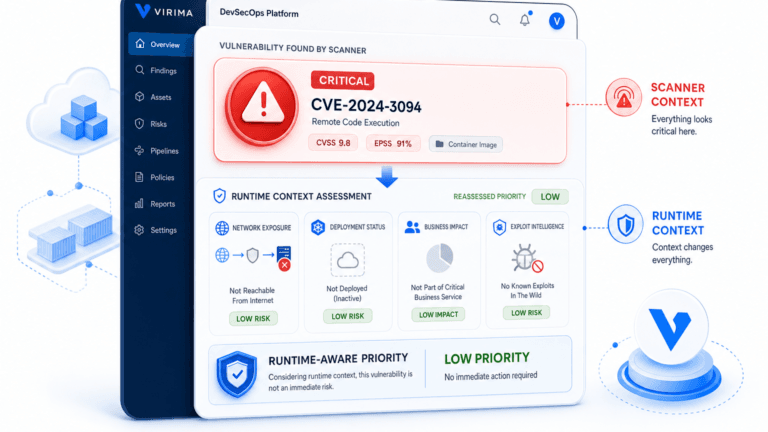
A populated CMDB is not the same as trusted runtime truth. Incident and change work needs ownership, dependency paths, and freshness the on-call engineer will use under pressure. When teams stop opening the CMDB during Sev-1s, the product has already lost, whatever the feature matrix says.
That trust gap shows up in outage research as well. The EMA ServiceOps 2025 Report highlights that inaccurate CMDB data directly causes extended downtime, while the IBM Cost of a Data Breach Report 2024 demonstrates how visibility gaps delay resolution times.
Comparing OpenText CMDB with Virima
Virima delivers discovery-sourced ITAM, CMDB population, and service mapping under ITSM. It does not replace OpenText for every large estate that still needs deep Universal Discovery operations. It does not replace ServiceNow, BMC, or Jira Service Management as the system of engagement.
| Criterion | OpenText CMDB | Virima | Choose when… |
|---|---|---|---|
| Primary job | Enterprise Universal Discovery plus CMDB with vendor-neutral ITSM feeds | Discovery-sourced ITAM and CMDB/maps under ITSM | Staffed Universal Discovery specialty model vs full discovery-sourced CMDB and maps with a leaner operating model |
| Discovery model | Multi-method discovery (agent, agentless, change-driven) with deep network and software content | Agent-based and agentless methods plus APIs, high-frequency scheduled cycles | Estate change model and ops skill mix |
| Service and dependency mapping | Modeling-heavy service definition and relationship workflows | ViVID™ maps after business service definitions are provided | CAB blast radius under tickets |
| Operating model | Often specialist-heavy for probes, packs, and reconciliation | Lower generalist upkeep for hybrid discovery and CMDB hygiene | Whether dedicated CMDB ops staff exists |
| ITSM coexistence | Designed to feed ServiceNow, BMC, Jira, and similar stacks | Integrates with Jira Service Management and other ITSM platforms; does not replace them | System of engagement stays |
| Cloud scope | Broad multicloud positioning in OpenText materials | On-premises plus AWS and Azure discovery feeding a unified CMDB baseline | Cloud estate and product scope fit |
| Best fit | Large controlled estates that can staff Universal Discovery operations | Teams that outgrew specialist graph maintenance for hybrid change risk | Path selection below |
Three practical paths: (1) Stay on OpenText Universal Discovery and CMDB when multi-method discovery, network depth, and enterprise modeling are staffed and trusted under CAB pressure. (2) Augment your ITSM system of record with a lighter discovery-sourced CMDB where specialist load or stale relationships are the bottleneck. (3) Take the Virima path when operating complexity and the inventory-to-action trust gap bind the evaluation.
How should teams choose between OpenText CMDB and a discovery-sourced alternative?
Choose OpenText when deep vendor-neutral discovery and enterprise modeling are staffed and the graph stays honest at CAB speed. Choose a discovery-sourced alternative like Virima when specialist admin load, relationship lag, and untrusted CIs under tickets are the binding constraint, while keeping ITSM as the system of engagement.
How Virima supports CMDB accuracy under ITSM
Virima offers a configuration management layer built around discovery-sourced ground truth, clear dependency context, and lower administrative overhead for many hybrid teams. Business Pro packages discovery, CMDB, and ViVID™ maps for growing estates. It is an alternative path when OpenText operating load exceeds the outcome you need, not a claim that every uCMDB estate must rip and replace tomorrow.
- Automated discovery-sourced truth: High-frequency scheduled discovery cycles keep configuration items refreshed across on-premises, cloud (AWS and Azure), and hybrid network assets through agent-based and agentless methods plus APIs. Current public positioning does not claim passive event-driven discovery as shipping product.
- ViVID™ service mapping: Business services are defined by your team through manual entry, import, or architecture tools. ViVID™ then builds dependency maps from those definitions and discovered infrastructure. It does not invent service composition without that input.
- ITSM integration: Virima integrates with ServiceNow, Jira Service Management, Ivanti, HaloITSM, Xurrent, and Hornbill so your primary service desk can consume discovery-sourced CIs and relationships. Partner names stay plain text. See the integrations hub for current platform coverage. Confirm sync direction and object mapping on a pilot.
Use Virima CMDB capabilities when the evaluation is about trusted hybrid CIs under change and incident tickets, not about replacing a fully staffed Universal Discovery program that still meets CAB standards.
Can Virima feed ServiceNow or Jira without replacing OpenText ITSM?
Virima is evaluated as a discovery-sourced ITAM and CMDB layer under ITSM. Teams commonly keep ServiceNow, Jira Service Management, or another desk for tickets and workflow while improving hybrid CI accuracy and dependency maps. Confirm integration scope on a pilot service path.
If your OpenText CMDB evaluation is stuck on whether specialist administration and modeling velocity can keep the graph honest under hybrid change risk, shift the proof from feature matrices to a short discovery and mapping pilot on a critical IT service path while ITSM keeps ticket and approval workflows.
See how discovery-sourced ITAM and ViVID™ maps support CMDB accuracy under your ITSM desk without forcing a false rip-and-replace of OpenText. Bring a critical hybrid IT service path and leave with a clearer stay, augment, or Virima path decision. Explore Business Pro for how Virima packages that path.
Evaluating your next step
OpenText Universal Discovery and CMDB is a solid path for large estates that need deep, vendor-neutral discovery and can staff the operating model. Virima is the alternative when you need high-frequency scheduled IT discovery, hybrid ITAM and CMDB context, and ViVID™ maps under change and incident tickets while keeping your ITSM platform as the desk. Outcomes teams chase include fewer surprises from stale hybrid inventory, clearer change blast radius, and stronger evidence from owned IT configuration data.
Review how Business Pro packages that discovery-sourced CMDB path for growing estates, then request a demo when you want a hands-on walkthrough.
Disclaimer: Product capabilities, packaging, and licensing change. Confirm current OpenText Universal Discovery and CMDB features and commercial terms in official OpenText documentation before purchase decisions.
Frequently asked questions
What is the difference between OpenText uCMDB and Virima CMDB?
OpenText Universal Discovery and CMDB descends from Micro Focus / HPE uCMDB and targets enterprise discovery plus CMDB depth with multi-method collection and modeling. Virima CMDB is a discovery-sourced platform with high-frequency scheduled discovery and ViVID™ maps after service definitions for many hybrid teams under existing ITSM. Growing estates often evaluate that full stack through Business Pro.
When should teams stay on OpenText CMDB?
Stay when multi-method discovery, network depth, software content, and enterprise modeling are staffed, and the graph stays trusted under CAB and incident pressure. Path fit matters more than brochure feature count.
Can Virima CMDB integrate with ServiceNow?
Yes. Virima integrates with ServiceNow as well as Jira Service Management, Ivanti, HaloITSM, Xurrent, and Hornbill so ITSM can consume discovery-sourced CI data. Confirm current sync behavior on a pilot.
How does service mapping work in Virima?
Once business service definitions or application endpoints are provided, ViVID™ builds visual dependency maps from underlying discovery data for blast radius and change impact. It does not invent service composition without that input.
Is Virima suitable for hybrid cloud environments?
Yes. Virima performs agent-based and agentless discovery across physical data centers, virtualized infrastructure, and public cloud workloads in AWS and Azure on high-frequency scheduled cycles.