Multi-Cloud CMDB Azure AWS: Why the Gap Hits PNW First

A change advisory board on the Eastside reviews one ticket that touches three inventories. The application tier lives in Microsoft Azure. The data pipeline that feeds it runs in Amazon Web Services (AWS). Remaining on-premises hosts still sit under the plant or campus network that never fully left the estate. Each team opens its own console and treats the configuration item list as current. None of those lists agree on ownership, dependency edges, or blast radius.
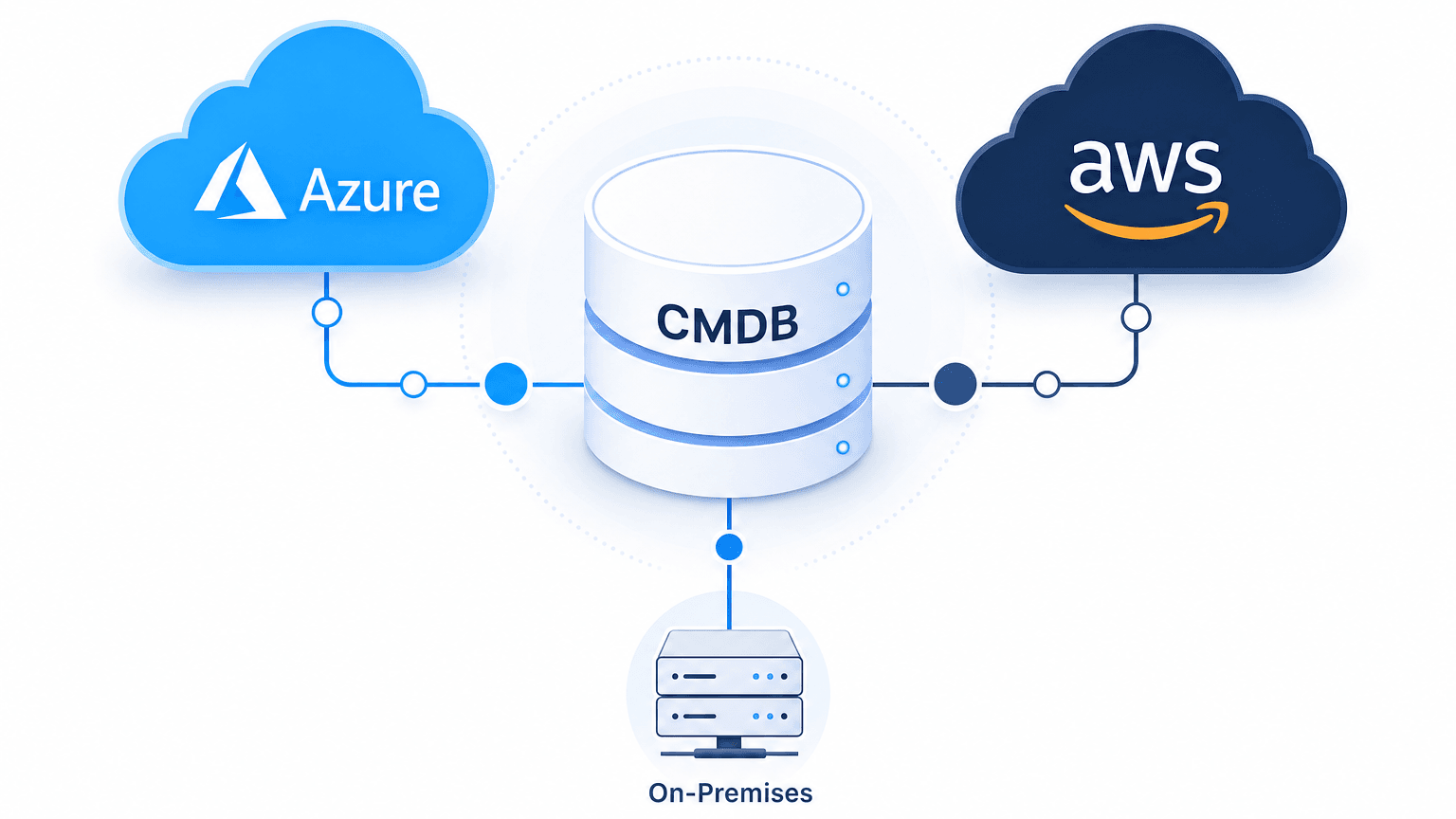
That hybrid pattern appears in many regions. It is structural in the Greater Seattle corridor, where both major public clouds share one labor market. Configuration management database (CMDB) owners and IT operations directors need one multi-cloud CMDB Azure AWS picture, while Azure subscriptions, AWS accounts, and leftover data centers keep separate truth.
This guide treats multi-cloud CMDB Azure AWS work as a reconciliation problem, then maps discovery, service context, and IT service management (ITSM) alignment when Azure inventory alone is not enough.
Why Greater Seattle produces dual-cloud estates by default
Greater Seattle Partners’ 2025 Technology and AI Industry Report describes more than 187,900 direct technology jobs and about $174.7 billion in gross regional product. The same report states that the region is home to AWS and Microsoft Azure, two of the world’s largest cloud and AI platforms, plus dense engineering centers for global technology employers.
That dual-hyperscaler home base shapes architecture choices. Product teams hire AWS-native talent in Seattle. Corporate stacks pull Azure skills and subscription sprawl on the Eastside. One legal entity often funds both patterns. The result is rarely a pure Azure shop or a pure AWS shop. It is a dual-cloud default with on-premises systems that still hold production truth for parts of the business. A multi-cloud CMDB Azure AWS program that only mirrors one provider portal looks complete to one team and hollow to everyone else.
The CMDB failure mode: subscription truth, account truth, plant truth
Azure Resource Manager can list what exists inside a subscription. AWS can list what exists inside an account. Neither list is a CMDB until records reconcile across boundaries, carry relationships, and stay fresh enough for change and incident work. This is not a Pacific Northwest quirk. Flexera’s 2026 State of the Cloud Report found 73% of organizations now run hybrid cloud, and another 14% run multi-cloud without a private cloud component. Most enterprises face this reconciliation gap whether or not they planned for it. Virima’s AWS and Azure CMDB discovery guide covers the discovery mechanics behind closing that gap for each cloud individually.
Three failure surfaces repeat here.
Subscription truth
Azure subscription CMDB records end at subscription or management-group edges. Tags and owners differ by team. Ephemeral compute moves faster than a weekly spreadsheet load into the CMDB.
Account truth
AWS multi-account layouts create the same silo on the other side of the house. Billing views and operations inventories still diverge by account.
Plant and campus truth
Industrial campuses and large headquarters networks keep durable on-premises servers, virtualization, and network gear beside cloud platforms. Those configuration items (CIs) do not appear in either cloud portal.
Infrastructure-as-code pipelines widen the gap when they provision outside ticket-triggered CMDB updates. The change record may name a service. The live estate may already use a different resource ID. CMDB owners become the most questioned people in the room when blast radius guesses fail.
This article stays on the Pacific Northwest dual-cloud pattern when Azure is only half of the picture.
What breaks first when Azure and AWS inventories never reconcile into one CMDB?
Change impact and incident triage lose a shared CI identity. Teams debate which console is authoritative while dependency edges between clouds and remaining on-premises hosts stay missing. Tickets then reference partial ownership and stale resource IDs instead of a single reconciled configuration record.
Aerospace and industrial hybrid: when Azure CMDB alone cannot see the shop floor
Greater Seattle’s second industrial spine is aerospace. Greater Seattle Partners’ 2025 aerospace overview reports roughly 113,500 aerospace jobs, more than 900 companies, and about $38.2 billion in regional gross product, and Washington’s Employment Security Department has described Boeing’s Washington footprint at roughly 66,000 employees during large 2024 workforce reductions.
That scale explains a durable hybrid pattern, not a single cloud design: production-adjacent infrastructure often stays on premises while engineering and analytics move into Azure or AWS, so a CMDB that only imports Azure virtual machines misses hosts and network paths next to manufacturing systems.
Shop-floor operational technology discovery remains a separate discipline, but the hybrid cloud CMDB job is still large: join cloud CIs to on-premises servers, network devices, and virtual machines with current relationships so industrial and corporate IT stop treating each other as unknown black boxes.
What CMDB integration for Azure must mean in a multi-cloud PNW estate
Azure integration is often sold as a connector that dumps resource records into a table. For multi-cloud CMDB Azure AWS programs, integration has to mean a fuller operating model, tuned for multi-cloud configuration management rather than single-cloud reporting.
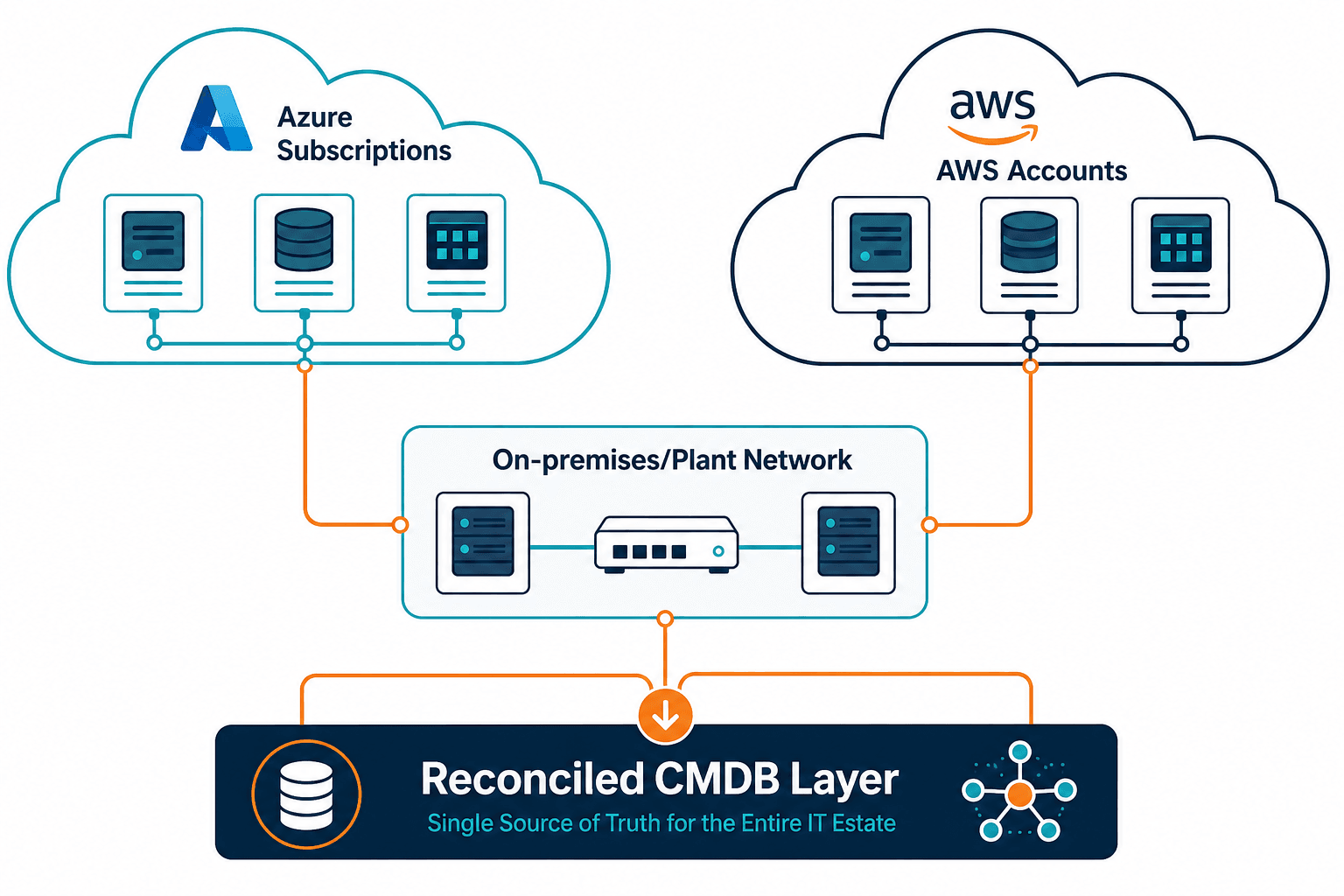
API-based cloud discovery must cover Azure resources across authorized subscriptions, scoped by subscription-level credentials, on a schedule that matches change speed. Matching discovery for AWS must cover the second half of the estate through account-scoped API access. On-premises agent-based and agentless discovery must cover hosts and network gear that never left campus. Multi-source reconciliation must stop one logical CI from appearing as three conflicting rows, and ITSM workflows must reference those same CIs.
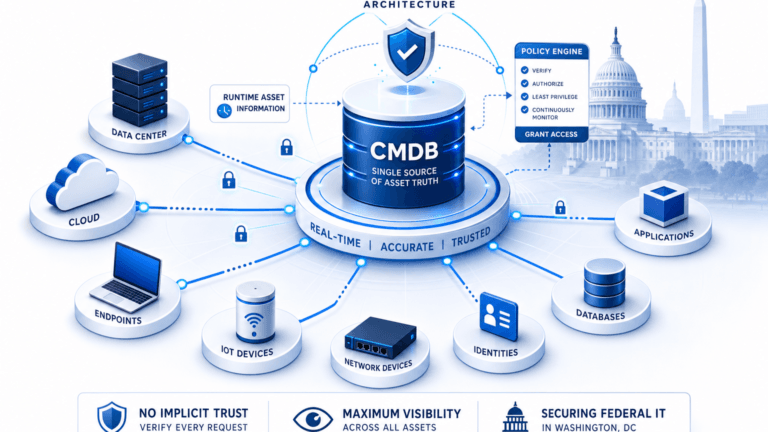
Virima’s product model follows that shape: reconciliation happens inside one CMDB layer rather than a federated satellite database or a single cloud-native inventory promoted to system of record. Cloud asset discovery covers AWS, Azure, and GCP environments. Agent-based and agentless discovery cover endpoints and network infrastructure. The CMDB layer supports automated CI population, multi-source reconciliation, health scoring, lifecycle tracking, and change impact analysis. Discovery runs as high-frequency cycles rather than passive continuous event streams.
Eliminate data decay with discovery-sourced Trusted Runtime Truth so change advisory boards and incident teams share one runtime picture across clouds. Explore that foundation at Trusted Runtime Truth.
How often should multi-cloud discovery run for CMDB accuracy?
Match cycle frequency to how fast your shortest-lived production resources change, then reconcile across Azure subscriptions, AWS accounts, and on-premises sources into one CI record. Weekly bulk loads leave auto-scaled and short-lived resources invisible. High-frequency scheduled discovery closes more of that gap without claiming passive real-time event capture.
Service context: maps, blast radius, and CAB decisions across clouds
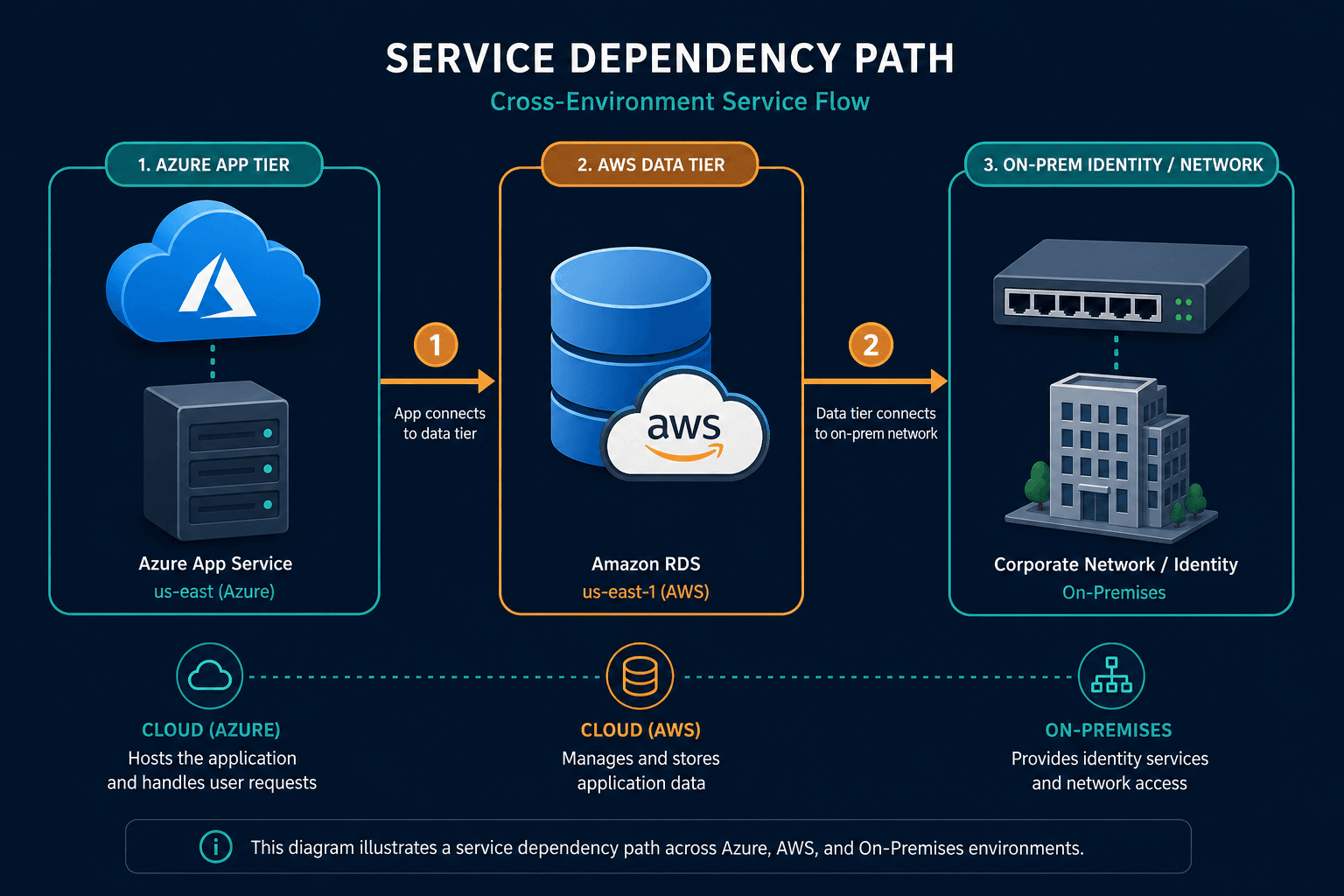
Inventory without service context still fails a change advisory board. Knowing that an Azure app tier and an AWS database both exist does not answer which named business service fails if either one is patched poorly.
Virima’s ViVID™ service mapping builds application-to-infrastructure dependency maps after service definitions are provided. Those definitions come from manual entry, spreadsheet import, or integrations such as Lean IX.
Automation applies to map building and maintenance as infrastructure changes. It does not invent which apps constitute each business service on its own. Once definitions exist, impact path tracing can follow a failing CI toward the affected service across multi-tier stacks.
That bridge is what multi-cloud CMDB owners need in the Pacific Northwest pattern: Azure and AWS become nodes in the same blast-radius conversation, joined to on-premises tiers once those tiers are discovered and related.
Keeping ITSM and the CMDB aligned
A multi-cloud CMDB that never reaches the ITSM platform creates a second source of truth problem. Incident and change records then point at names people remember rather than CIs that match runtime discovery.
Virima supports bi-directional CMDB synchronization with ServiceNow. It can push discovered CIs and relationships into the ServiceNow CMDB so platform workflows consume fresher runtime data. Virima’s guide on ServiceNow bidirectional CMDB sync write access conflicts covers the most common failure mode: both systems claiming write authority over the same field. The correct public frame is augmentation and data foundation for teams that already invested years in ServiceNow process design. It is not a call to rip out the platform. The same discovery-sourced CI layer can feed other service management tools. When partner names appear together, point once to Virima’s integrations hub: ServiceNow, Jira Service Management, Ivanti, HaloITSM, Xurrent, and Hornbill.
For CMDB owners, here is the test that matters: can a change ticket open with the same CI identifiers your cloud CI reconciliation process recently produced across Azure and AWS? If the answer is no, multi-cloud visibility is still stuck in export files.
Practical checklist for PNW IT leaders evaluating multi-cloud CMDB readiness
Use this scorecard before you buy another connector or fund another manual clean-up wave for multi-cloud configuration management.
| Check | Question to answer | Pass signal |
|---|---|---|
| Subscription coverage | Which Azure subscriptions are in scope for production services? | Named list with owners, not “all of IT” |
| Account coverage | Which AWS accounts host shared or production workloads? | Mapped to the same business services as Azure |
| On-premises remainder | Which campuses, plants, or data halls still hold critical CIs? | Discovery credentials and network paths documented |
| Discovery frequency | How fast do production resources change? | Scheduled high-frequency cycles matched to that rate |
| Reconciliation rules | How do duplicate cloud and tool records become one CI? | Documented match keys and surviving source rules |
| Relationships | Do you store dependency edges or only asset rows? | Edges usable in change impact reviews |
| Service definitions | Who maintains which apps form each business service? | Owners named; maps rebuild from those definitions |
| ITSM field mapping | Do tickets reference the same CI IDs discovery produces? | Sample changes open without manual CI hunting |
| Health metrics | How do you measure staleness and completeness? | CMDB health views reviewed on a fixed cadence |
If several rows fail, the gap is not more Azure screenshots. The gap is multi-cloud CMDB Azure-AWS operating design: coverage, frequency, reconciliation, relationships, and workflow feed. Reconciliation rules deserve the closest scrutiny on that list; Virima’s breakdown of CMDB authoritative source logic covers why most-recent-wins matching quietly corrupts CI data instead of flagging the conflict.
Treat Azure resource import as a supporting path, not a replacement for AWS and on-premises coverage.
Closing: trusted runtime truth for dual-cloud operations
Pacific Northwest enterprises did not invent hybrid IT. They sit in the rare metro where AWS and Azure platform gravity, dense enterprise software employment, and a large aerospace manufacturing base share one labor market. That combination makes multi-cloud CMDB Azure-AWS reconciliation a structural requirement rather than a slide-deck preference.
CMDB owners who win here stop defending three inventories. They defend one reconciled runtime picture: what exists, how it connects, what changed, what will break, and who owns it. Discovery-sourced data, service maps built from explicit service definitions, and ITSM alignment turn that picture into day-to-day change and incident practice.
Document a coverage map across Azure subscriptions, AWS accounts, and on-premises remainder systems, with a named owner for service definitions and for reconciliation rules.
Pacific Northwest dual-cloud programs fail quietly when Azure imports look finished while AWS accounts and plant networks never enter the same reconciliation ruleset. Treat that incomplete import pattern as a governance defect, not a temporary data-quality inconvenience for one cloud team. Close the loop with written owners before the next major change freeze.
Frequently Asked Questions
Why is a single-cloud Azure CMDB incomplete for many enterprises?
Many organizations run production services across Azure subscriptions and AWS accounts at the same time, with on-premises systems still holding parts of the path. An Azure-only inventory misses the other cloud and the campus or plant CIs, so change impact and incident context stay partial.
How often should cloud discovery run for CMDB accuracy?
Set discovery cadence to the shortest production lifecycle you care about, then reconcile results across clouds and on-premises sources. High-frequency scheduled cycles reduce staleness for short-lived resources. They are not the same as passive continuous event-based discovery.
How should Azure and AWS resources appear as CIs together?
Discover each cloud through its APIs, normalize identifiers and ownership, and reconcile duplicates into one authoritative CI where the same object is seen from multiple tools. Store relationship edges so cross-cloud dependencies are visible during change and incident work.
Does Virima replace ServiceNow, or feed it?
Virima does not replace ServiceNow. It feeds discovery-sourced CIs and relationships into the ServiceNow CMDB and related workflows so existing process investment keeps working on fresher runtime data — an augmentation and data-foundation model, not a platform rip-and-replace.
How does Virima discover Azure resources for CMDB and service mapping?
Virima uses cloud asset discovery against Azure alongside AWS and GCP, reconciles multi-source CI data in the CMDB, and builds ViVID™ service maps after you provide service definitions manually, by import, or through supported enterprise architecture inputs. See the Azure discovery integration page for product details.