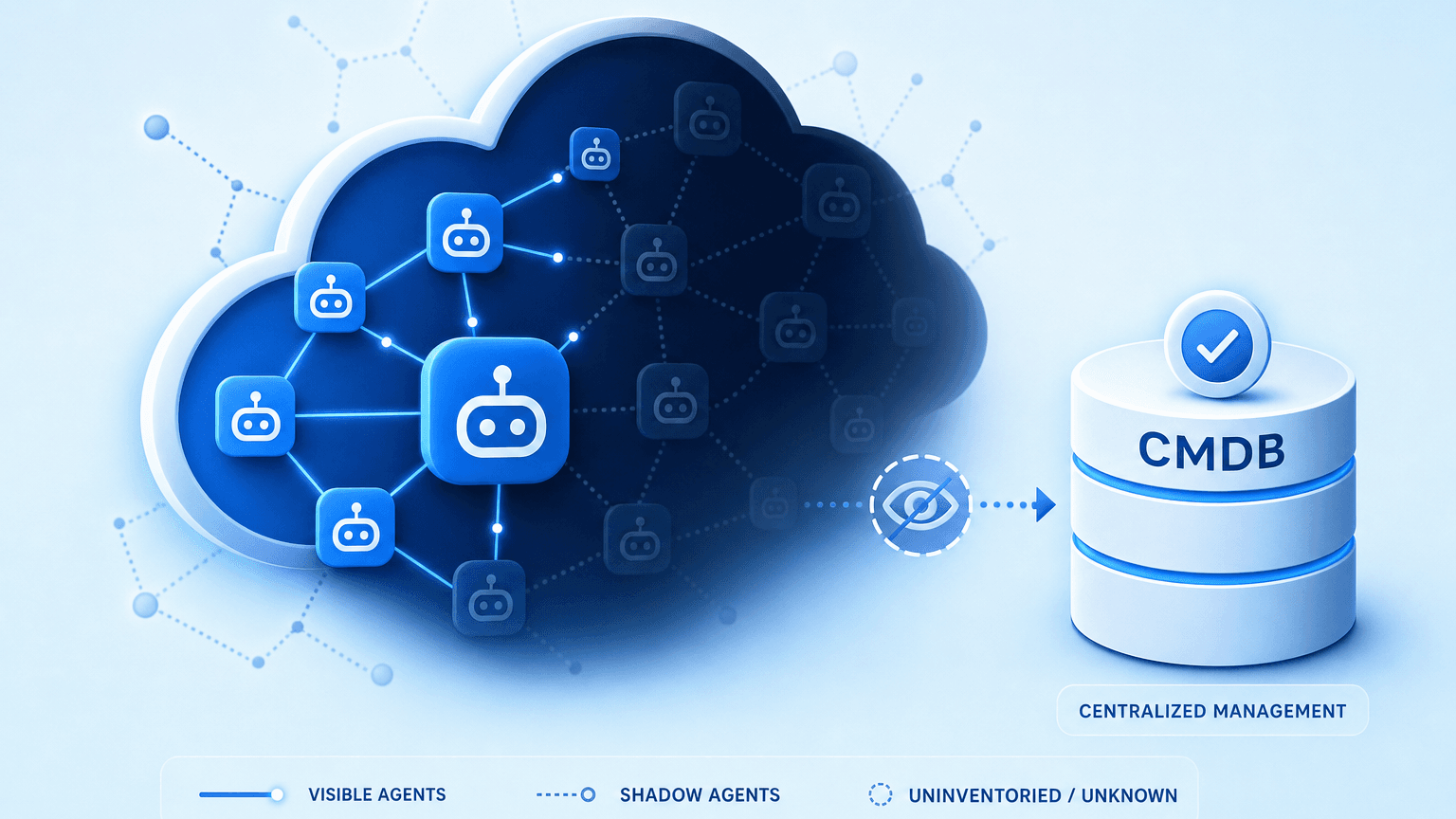
Agent Sprawl Is 2026’s Shadow IT, and Most CMDBs Still Can’t See It

When Microsoft turned Agent 365 visibility tooling on inside its own estate, it reported visibility into more than 500,000 agents that had not been held in one governed inventory before. The company’s Inside Track write-up on implementing Agent 365 frames that number as inventory and lifecycle control coming online, not as agents appearing from nowhere the day the console went live.
Those AI agents were already running. The tooling made them countable. That is the core problem for everyone else: AI agent visibility is what is new, not the existence of agents. Agent sprawl is shadow IT with a faster clock. Most organizations are trying to govern it on top of an asset picture that was already incomplete before the first production AI agent shipped.
What is agent sprawl (and what does real AI agent visibility require)?
NIST’s Cybersecurity Framework still starts with Identify and Asset Management (ID.AM): you cannot secure or operate what you have not inventoried. ITIL 4 Service Configuration Management makes the same demand for service and configuration records. Agent sprawl is what happens when AI agents are created, connected, and given standing access faster than any team inventories them, assigns ownership, or retires them.
Real AI agent visibility is not only a row in an agent catalog. It needs:
- A current record of the infrastructure and accounts the AI agent can reach
- Verified ownership of that infrastructure, not only ownership of the AI agent
- Dependency and blast-radius context for what breaks if the AI agent acts
- A freshness signal so “current” means a dated discovery source, not a remembered spreadsheet
The hidden problem
| Situation | What happens |
|---|---|
| A team spins up an AI agent with standing credentials to move faster | It never enters the CMDB, so no one can name its blast radius when it touches production |
| Security asks which AI agents can reach a specific database | No system answers that in under a day |
| An agent registry logs the AI agent’s identity and owner | The registry has no independent ground truth on the infrastructure the AI agent is reasoning about |
AI agents are already moving from demo paths into production operations. Virima’s own take on that shift sits in change intelligence for production IT. Catalogs alone do not answer what the AI agent can touch once it is live.
Why the gap is widening in 2026, not closing
Adoption is outrunning governance. OutSystems’ 2026 State of AI Development report surveyed 1,900 IT leaders. 96% of organizations already use AI agents in some capacity. 94% say AI sprawl is increasing complexity, technical debt, and security risk. Only about 12% report a centralized platform to manage that sprawl. The same release cites the industry forecast that roughly 40% of enterprise applications will include task-specific AI agents by the end of 2026 (Gartner prediction as reported by OutSystems; Gartner’s own newsroom page returns a hard block to many automated fetchers, so the claim is attributed through OutSystems’ public release).
Microsoft’s Agent 365 general-availability security blog makes the same operational point without the internal headcount: AI agents proliferate across apps, endpoints, and cloud, often outside the visibility of the teams accountable for risk. Forrester’s 2026 cybersecurity threats framing puts agent-driven risk in the same year’s threat conversation, which is useful context even when the control plane debate stays separate from CMDB work.
The infrastructure layer is the missing middle. McKinsey’s April 2026 article “Reimagining tech infrastructure for (and with) agentic AI” argues infrastructure becomes the backbone of an orchestrated system. It names reliable operational data for assets, dependencies, and ownership as a pressure point. In the same piece, agent workflows are described as correlating logs, configuration management database (CMDB) records, recent changes, and prior incidents. McKinsey’s public page is slow or intermittent for automated link checkers, so that claim stays plain-text attributed from the published article rather than hyperlinked. Agent registries and identity controls still assume that layer is trustworthy. In many estates it is not.
Where the gap shows up
- Configuration drift compounds silently. An AI agent changes something that never lands in a change record. Outcome: the next incident’s root-cause search starts from zero.
- Alert triage loses its context. A SecOps team gets an alert with no enriched asset data behind it, AI-agent-caused or not. Outcome: mean time to triage rises even while AI agents add speed elsewhere.
- Ownership disputes stall response. Two AI agents built by two teams both touch the same system; neither on-call rotation owns the incident. Outcome: response time depends on who notices first, not on a defined path.
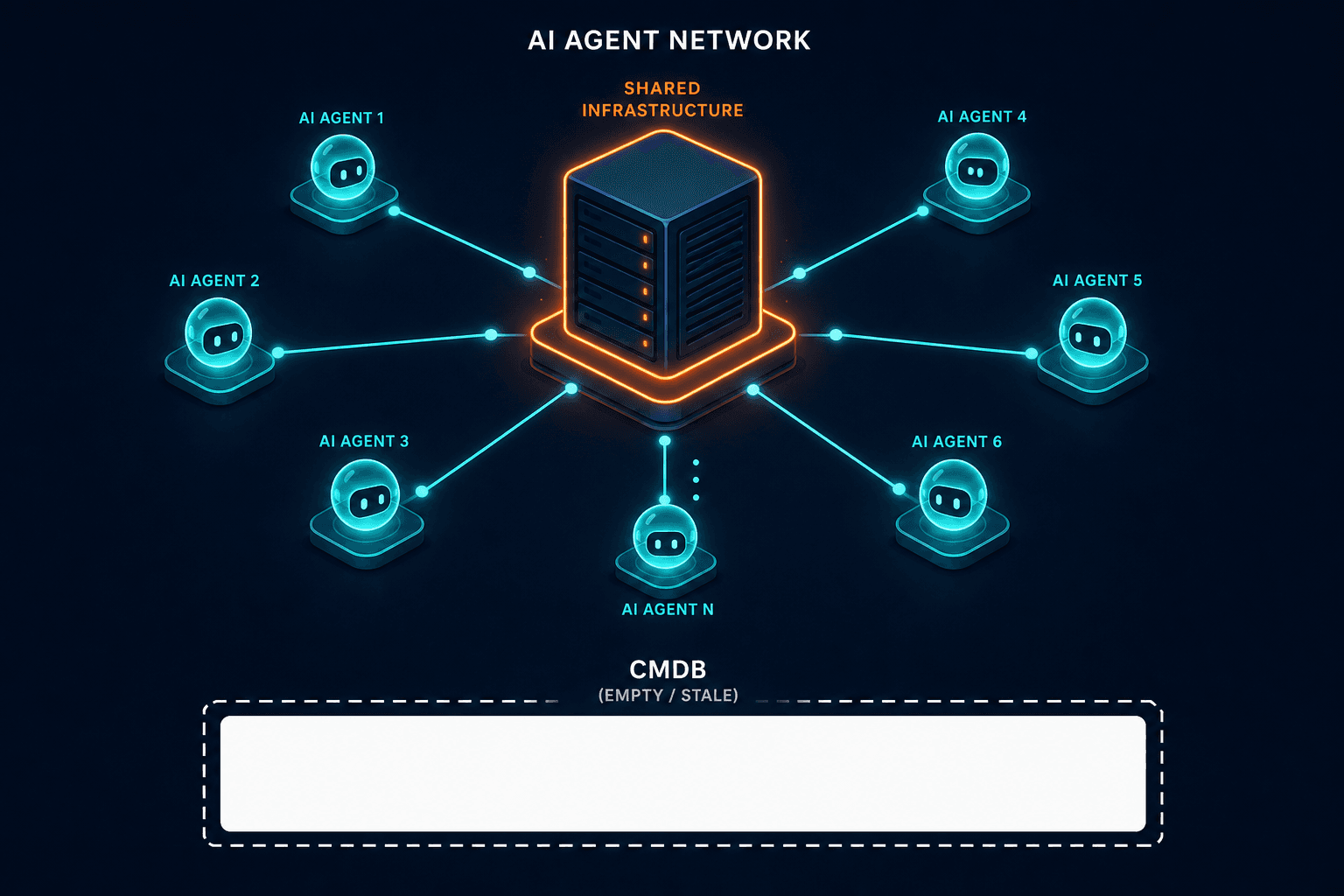
The real cost of flying blind on agent sprawl
For CIOs and CTOs
McKinsey’s infrastructure argument (same April 2026 agentic AI infrastructure article) is the board-level version of the same claim: agentic programs scale only when operational records are clear enough for systems to act without inventing topology on the fly. When CMDB records and ownership are weak, AI agents inherit every blind spot humans already had, then multiply actions against it. That is unpriced operational risk, not an abstract data-quality project.
Teams that want a clearer language for discovery-sourced ground truth can start with Virima’s view of Trusted Runtime Truth.
For SecOps leads
An incomplete asset inventory is a CMDB visibility gap before it is a vulnerability-context gap. AI-agent traffic adds volume and new paths to an incomplete picture; it does not invent the gap. When scanners and SIEM tools cannot join alerts to owned configuration items, triage stays slow. Choosing vulnerability management tools that reduce real risk still depends on knowing which hosts, identities, and services exist. (That page discusses security tooling agents in the EDR sense; here “AI agent” means autonomous workflow software, not a sensor install.)
Cybersecurity Asset Management (CSAM) programs inherit the same inventory constraint: you cannot prioritize exposure you cannot attribute to a current CI.
For ITAM and CMDB owners
Flexera’s 2026 State of ITAM Report press release reports complete IT asset visibility at 36% and accurate visibility into AI software at only 31%. Separately, 59% say wasted AI spend increased year over year. AI agents and AI software spend sit on top of an inventory problem ITAM already struggled to close. Virima’s own breakdown of what keeps ITAM inventories audit-ready covers the same reconciliation problem, minus the AI agent layer. The Impact of GDPR on IT Asset Management. Secondary blogs sometimes quote multi-million average CMDB incident costs or Fortune 500 agent headcount forecasts without a primary source. Those figures stay out of this piece.
At market scale for CISOs
Okta’s 2026 Global CISO Insights report finds 81% of CISOs are concerned about excessive AI access and 68% seeing at least some unsanctioned AI or agentic AI use. That is shadow AI as an access and identity problem. It still collides with CMDB reality: unauthorized AI agent use is harder to contain when nobody can list the systems those AI agents can reach.
Closing the gap: what real AI agent visibility requires
Closing the CMDB visibility gap under agent governance comes down to three mechanisms, not another dashboard.
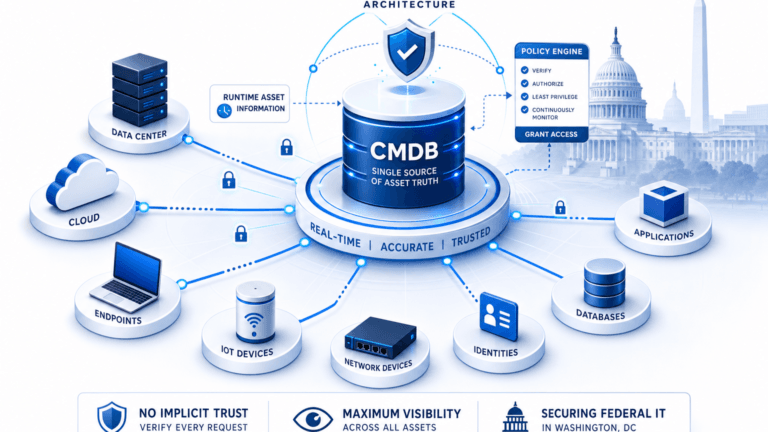
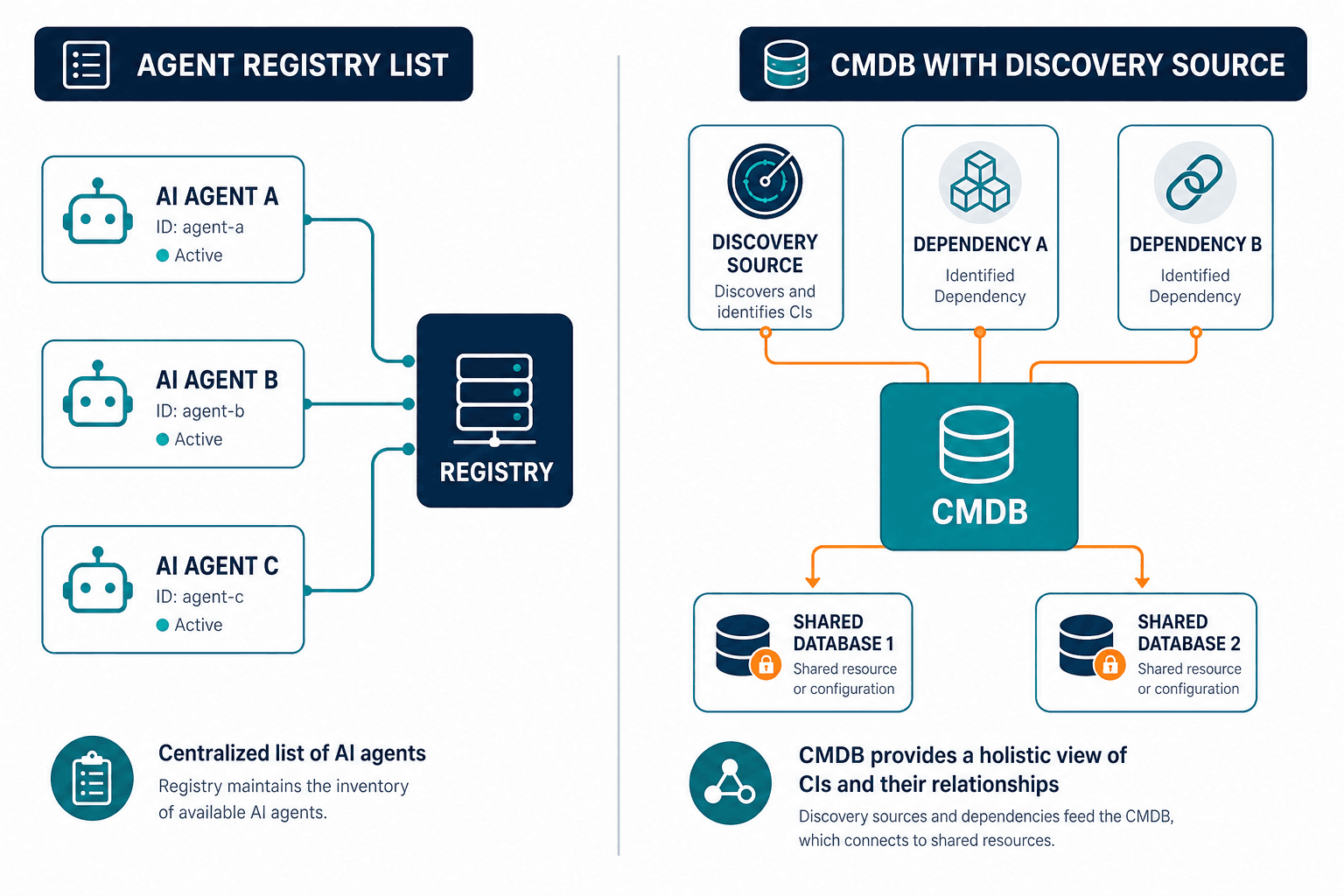
- Multi-source discovery reconciled into one record. Agentless scanning, agent-based discovery probes (discovery agents on endpoints, not AI agents), and cloud APIs feed a single deduplicated CMDB entry instead of three conflicting ones. That is the job of discovery-sourced CMDB software, not a quarterly spreadsheet import.
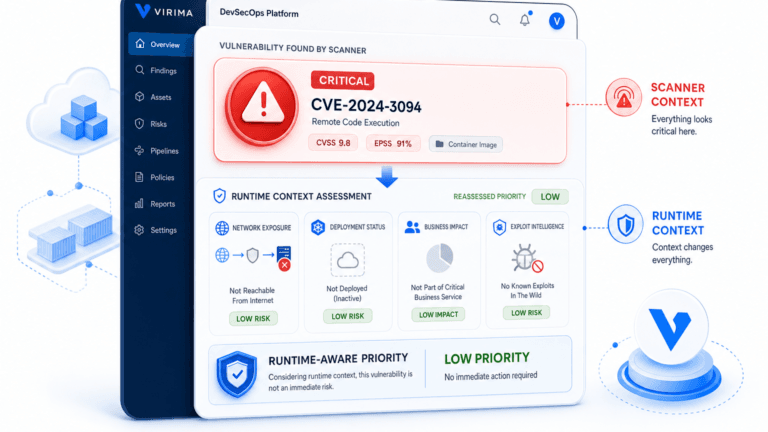
- Dependency and blast-radius context before anything acts. Once service definitions are provided, ViVID™ builds application-to-infrastructure maps so a change, human- or AI-agent-initiated, has visible downstream risk before it fires. Service mapping for agentic IT is the page that carries this argument in product language.
- Flow into tools already in place. Discovery and map context should land in ServiceNow, Jira Service Management, Ivanti, or the agent-registry tooling already chosen, not force a second desk. Partner names stay plain text; the single integrations entry is Virima’s integrations hub.
| Assumption-based visibility | Discovery-sourced visibility | |
|---|---|---|
| How CI data enters the system | Manual entry, spreadsheet import, occasional audit | High-frequency scheduled discovery across on-prem, cloud, and network-connected systems |
| What an AI agent registry sees underneath it | Whatever was last manually updated | A record with a verified discovery source and freshness timestamp |
| Blast radius before a change | Estimated from memory or tribal knowledge | Mapped from current dependency data |
Agent sprawl in practice
These patterns come from published multi-business-unit guidance, not invented company stories.
- Duplicated builds. AWS’s guidance on managing AI agent sprawl across business units names business units independently building AI agents that solve the same problem, unaware of each other.
- Conflicting permissions on shared systems. The same AWS piece describes conflicting actions on shared systems and credential proliferation when policy is not centralized as the second AI agent is built.
- Cost hidden inside business-unit budgets. Sprawl costs stay buried in team spend and never surface as an enterprise line item until finance or risk asks for a rollup nobody can produce.
Every one of these is a visibility failure before it is a governance failure. Shared policy cannot cover AI agents you cannot see reaching into infrastructure you have not inventoried.
Where Virima fits
Immediate operational impact
Multi-source discovery and ViVID™ maps give change and incident work a dependency picture from existing estate data, without waiting for a multi-year CMDB rewrite project.
Lasting accuracy
High-frequency scheduled discovery cycles refresh CI and relationship data so records do not rot between audits. Virima does not claim passive continuous or event-stream discovery in the current product.
Fits existing workflows
Discovery and maps sit beside ServiceNow, Jira Service Management, and Ivanti rather than demanding a rip-and-replace. AI agent registries and identity products still own identity-layer and browser-side problems. Virima covers network-connected infrastructure, endpoints, and cloud accounts as the ground-truth layer those controls need underneath them. It does not claim to detect personal AI agents that only live inside browser hooks or inbox clients.
For a fuller product path, review why teams choose Virima after the inventory and map questions are clear.
See how discovery-sourced CMDB data and ViVID™ maps give AI agent programs the infrastructure ground truth registries assume is already there.
Moving from assumption-based IT to evidence-based IT
- Run a baseline discovery pass across on-prem, cloud, and network-connected systems.
- Reconcile results into one CMDB record with source and freshness attached.
- Map dependencies and ownership before any AI agent, or human change, touches production.
- Connect that CMDB to the ITSM or agent-registry tooling already in place.
- Set a review cadence so newly deployed AI agents and the infrastructure behind them enter the same inventory; platform teams retire AI agents that no longer have an owner or a purpose.
Agent sprawl is not a reason to freeze AI adoption. It is a reason to build real AI agent visibility into the ground truth underneath it. See how Virima’s discovery-sourced CMDB supports that foundation as the next step for your estate.
Frequently Asked Questions
What is agent sprawl?
Agent sprawl is the uncontrolled growth of AI agents created and given standing access faster than any team can inventory, own, or retire them. It is shadow IT with a faster deployment clock and weaker default audit trails.
Why does AI agent visibility matter for enterprise IT teams?
AI agent visibility matters because AI agents act on infrastructure. Without current CI ownership, dependencies, and freshness, teams cannot name the blast radius, route incidents, or support audit evidence when an AI agent changes production systems.
How is shadow AI different from traditional shadow IT?
Shadow AI adds autonomous action and standing credentials on top of unsanctioned tools. Traditional shadow IT was often a missing application or SaaS seat. Shadow AI can change systems, move data, and chain tools without a human at every step.
Does Virima’s CMDB integrate with AI agent registries and identity tools?
No. Virima’s CMDB doesn’t integrate directly with agent registries or identity tools. It supplies the infrastructure context those systems don’t: current hosts, cloud resources, dependencies, and ownership, mapped through ViVID for blast-radius visibility.
Can Virima’s ViVID™ maps show the blast radius of an AI-agent-initiated change?
Once service definitions are in place, ViVID™ builds application-to-infrastructure maps that show downstream dependencies before a change fires, whether that change is initiated by a person or an AI agent. That gives incident and change teams a blast-radius picture instead of a guess.