ITOM in 2026: What Does the Future Hold?

ITOM in 2026: Starting with a Clear Definition
IT Operations Management (ITOM) is the discipline responsible for administering the technology and application infrastructure of an IT organization. Under the ITIL framework, ITOM covers monitoring, controlling, and executing the routine tasks that keep IT services running. Effective ITOM ensures provisioning, performance, cost governance, capacity planning, and security across your entire IT environment.
| What is ITOM in 2026? IT Operations Management (ITOM) is the set of practices and tools used to administer, monitor, and control an organization’s IT infrastructure under the ITIL framework. ITOM solutions manage capacity, cost, performance, and security across on-premises, cloud, and hybrid environments. As enterprise infrastructure grew more complex, ITOM in 2026 expanded to incorporate AIOps, automation, and unified hybrid management. |
For a deeper look at how ITOM fits within the broader ITIL 4 framework, see ITIL 4 and IT Operations Management.
AI now supports IT Service Management (ITSM) and ITOM simultaneously. The operational logic originally designed for IT infrastructure is spreading into the rest of the organization through Enterprise Service Management (ESM). That expansion makes a reliable ITOM foundation more important, not less.
For background on how ITSM and ITOM relate, see ITOM vs. ITSM: A Complete Guide.
The five trends below represent the most consequential shifts in ITOM in 2026 and beyond. Each carries direct implications for how you manage IT infrastructure, govern operational data, and prepare for a future of AI-driven IT operations.
1. Data-Driven IT Operations
The Uptime Institute’s 2025 Annual Outage Analysis found that human error drives approximately 80 percent of all IT outages, with most incidents traceable to decisions made without accurate operational data. When your teams act on stale or incomplete infrastructure data, outages follow.
IT operations have always depended on incoming data to renew previous assumptions, improve processes, and increase performance efficiency. The data requirements are intensifying: logs, metrics, and traces from multiple sources now form the minimum baseline for operational visibility.
Private sector organizations are increasingly seeking data sovereignty, low-latency performance, and compliance through private cloud systems. This approach lets enterprise services retain cloud agility while preserving isolated infrastructure where regulations or security requirements demand it.
| Why does data-driven IT matter for ITOM in 2026 and today? The Uptime Institute’s 2025 Annual Outage Analysis found that human error drives approximately 80 percent of all IT outages, with most incidents traceable to decisions made without accurate operational data. Data-driven ITOM replaces this failure mode by using discovery-driven telemetry, including logs, metrics, and dependency maps, to surface the right information before your teams act. |
AIOps platforms ingest operational and event data at scale, correlating signals that would be impossible to process manually. Virima’s ITOM capabilities connect discovery-driven infrastructure data directly to operational workflows, giving your teams the trusted data foundation that AIOps and automation require.
2. Increased Adoption of ESM Solutions
IT operations data and expertise are being applied to improve non-IT functions across the organization, from HR and finance to marketing and facilities. This cross-functional value has driven the increased adoption of Enterprise Service Management (ESM) solutions as a long-term growth strategy.
ESM adoption should follow a structured order of priority. Lead your organization through each phase deliberately, beginning with the IT functions closest to your existing ITOM infrastructure before extending service management principles to adjacent departments.
| What is ESM and how does it relate to ITOM? Enterprise Service Management (ESM) extends IT service management principles and tooling to non-IT business functions such as HR, finance, and facilities. ESM adoption is driven by ITOM infrastructure that already handles service requests, incident management, and workflow automation. Organizations that mature their ITOM foundation first scale ESM across departments without creating operational silos. |
Adopting an ESM solution ensures your IT infrastructure can absorb competitive pressure, shifting consumer expectations, and tighter delivery margins. The organizations that align ITOM maturity with ESM expansion are the ones that scale without breaking their operational backbone.
Virima provides the discovery-driven operational foundation that makes ITOM and ESM expansion reliable. See how Virima delivers Trusted Runtime Truth for Agentic IT to ensure your infrastructure data is accurate before you automate or scale.
3. Automation-Based Infrastructure Operations
Automation-based infrastructure operations elevated ITOM in 2026 from a reactive discipline into a proactive one. Gartner identified a sustained rise in organizations adopting automation strategies to repurpose IT staff toward tasks of higher complexity and value.
By automating repetitive tasks in execution workflows, ITOM solutions reduce the inconsistencies and errors that come from manual processes. The operational reach of ITOM extends into ITSM, IT Asset Management (ITAM), and other management disciplines, creating a surface area where automation replaces expensive manual effort and frees teams for higher-value problem-solving.
| How does ITOM automation reduce operational costs? ITOM automation cuts costs by eliminating manual repetition from routine infrastructure tasks such as provisioning, patching, compliance checks, and incident response. Gartner found that organizations adopting automation strategies consistently redirect IT staff from low-value execution work to higher-complexity functions. Platforms like Virima combine discovery-driven asset data with ViVID service maps to automate workflows that previously required constant manual intervention. |
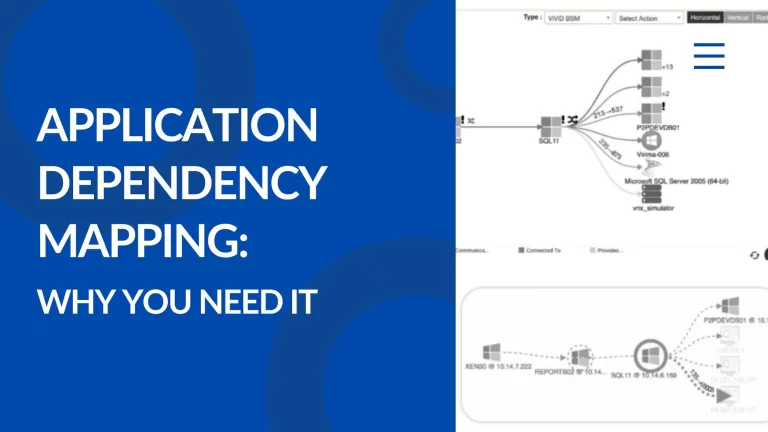
Virima’s ViVID service mapping capabilities give automation workflows the accurate dependency data they need to execute without introducing unintended change risk. When automation acts on stale or incomplete infrastructure data, the consequences can be severe. Discovery-driven runtime truth prevents that failure mode.
| Ready to see how Virima supports your ITOM strategy? Schedule a demo. |
4. Unified Management for Hybrid Infrastructure
A unified management solution for hybrid infrastructure, referred to as Hybrid Digital Infrastructure Management (HDIM), is emerging as a practical response to the operational complexity of mixed on-premises and cloud environments.
HDIM integrates infrastructure management, data management, cloud management, security, and ITSM functions into one consolidated solution. This is particularly relevant if you are managing complex IT environments, where the gap between cloud-native tooling and legacy on-premises management creates blind spots that both security and operations teams cannot afford.
Gartner has predicted that 20 percent of IT organizations will adopt HDIM technologies to optimize hybrid IT infrastructure operations. The underlying operational need is immediate: your teams require a single source of truth across all infrastructure types, not separate tools for each environment.
| What is HDIM and why does it matter for enterprise ITOM? Hybrid Digital Infrastructure Management (HDIM) consolidates on-premises, cloud, and multi-cloud infrastructure management into a single operational layer. Gartner has predicted 20 percent of IT organizations will adopt HDIM approaches to eliminate management silos. Virima’s CMDB and IT discovery capabilities provide the cross-environment asset visibility that HDIM strategies require, ensuring infrastructure data is accurate regardless of where workloads reside. |
Virima’s CMDB and ITOM platform are built for hybrid environments, providing discovery-driven inventory and dependency mapping across cloud and on-premises assets via AWS and Azure API-based discovery. That gives your IT leaders the unified view required to make HDIM a practical reality.
5. Transitioning from Traditional ITSM and ITOM to AIOps
Artificial Intelligence for IT Operations (AIOps) is the application of machine learning and AI to automate and augment IT operations within the organization. As enterprise infrastructure grows more complex, AIOps addresses the scale limitations of traditional ITSM and ITOM by automating key components of the operational process.
Additionally, An AIOps platform can identify a network failure or service outage, correlate the probable root cause using historical and high-frequency signal data, and initiate remediation steps before customers are affected. This compresses incident response time, reduces mean time to repair (MTTR), and measurably improves the end-user experience.
The transition from traditional ITOM to AIOps-augmented operations requires one critical prerequisite: accurate, discovery-driven infrastructure data. AIOps algorithms are only as reliable as the configuration and dependency data they operate on. To understand this connection further, see ITOM service mapping: what it is and best practices. Organizations that invest in CMDB accuracy and service dependency mapping before deploying AIOps are the ones that see measurable results.
Building the ITOM Foundation That Scales with Your Organization
The ITOM in 2026 trends covered here point to a single conclusion: IT Operations Management is evolving from a cost-control discipline into the operational backbone of your entire organization. ITOM automation will handle alert monitoring, initiate response protocols for network intrusions or service failures, and collect operational data that AI uses to prevent future incidents.
An effective ITOM solution lays the foundation for the governance, automation, and AI-readiness that modern enterprises require. Virima ITOM is an affordable, deployable solution powered by ViVID service maps that improves IT operations health while supporting asset, service, security, risk, and compliance management.
Virima discovers and maps your critical IT resources and the interconnections that link them to applications, services, and users. Through high-frequency discovery cycles, Virima keeps your IT foundation current so your staff can focus on higher-value work. To learn more about what modern IT operations management demands, see what is ITOM and why it fails.
Frequently Asked Questions
What is the difference between ITOM and ITSM?
ITOM focuses on administering and maintaining the IT infrastructure that keeps services running, covering monitoring, capacity planning, and incident response. ITSM focuses on managing how IT services are designed, delivered, and improved for end users. ITOM provides the operational foundation that ITSM depends on, and the two disciplines work together under the ITIL framework. For a detailed comparison, see ITOM vs. ITSM: A Complete Guide.
Why was ITOM in 2026 a turning point for data-driven operations?
ITOM in 2026 marked the point where data demands from AIOps, ESM, and hybrid infrastructure converged. Teams could no longer rely on periodic manual inventories or point-in-time snapshots. Discovery-driven operational data, refreshed at high frequency across all infrastructure types, became the minimum standard for keeping pace with the complexity of modern IT environments. ServiceNow, Ivanti, Halo, Jira service management, Xurrent.
What does AIOps mean for traditional ITOM teams?
AIOps extends traditional ITOM by automating the correlation and analysis of operational data at a scale no human team can match. For your ITOM team, that means faster incident detection, reduced mean time to repair, and the ability to shift focus from reactive firefighting to proactive infrastructure governance. The prerequisite is a reliable CMDB and accurate dependency data.
How does hybrid infrastructure management affect ITOM governance?
Hybrid infrastructure introduces management silos between on-premises systems and cloud environments. Without a unified data layer, your teams make decisions based on incomplete or conflicting information. Effective ITOM governance in hybrid environments requires cross-environment visibility, discovery-driven asset accuracy, and a single source of truth that spans every workload type.
Virima discovers and maps your critical IT resources and the interconnections that link them to applications, services, and users. Through high-frequency discovery cycles, Virima keeps your IT foundation current so your staff can focus on higher-value work. To learn more about what modern IT operations management demands, see what is ITOM and why it fails.