ITAM for Data Centers: Managing Coverage Across the Hardware Fleet

In September 2025, a fire broke out at South Korea’s National Information Resources Service during preparations to relocate batteries, destroying 384 battery packs and directly affecting fifth-floor government systems, according to Korea JoongAng Daily. The incident doesn’t show that missing asset records caused the fire — it shows how much shared infrastructure sits behind a single piece of equipment work, and why operations and asset managers need to know which units are involved, who owns them, and what services depend on them before that work begins. ITAM for data centers answers that question by linking each unit to its lifecycle and coverage records before a refresh, repair, or retirement decision.
What is ITAM for data centers, and what does it cover?
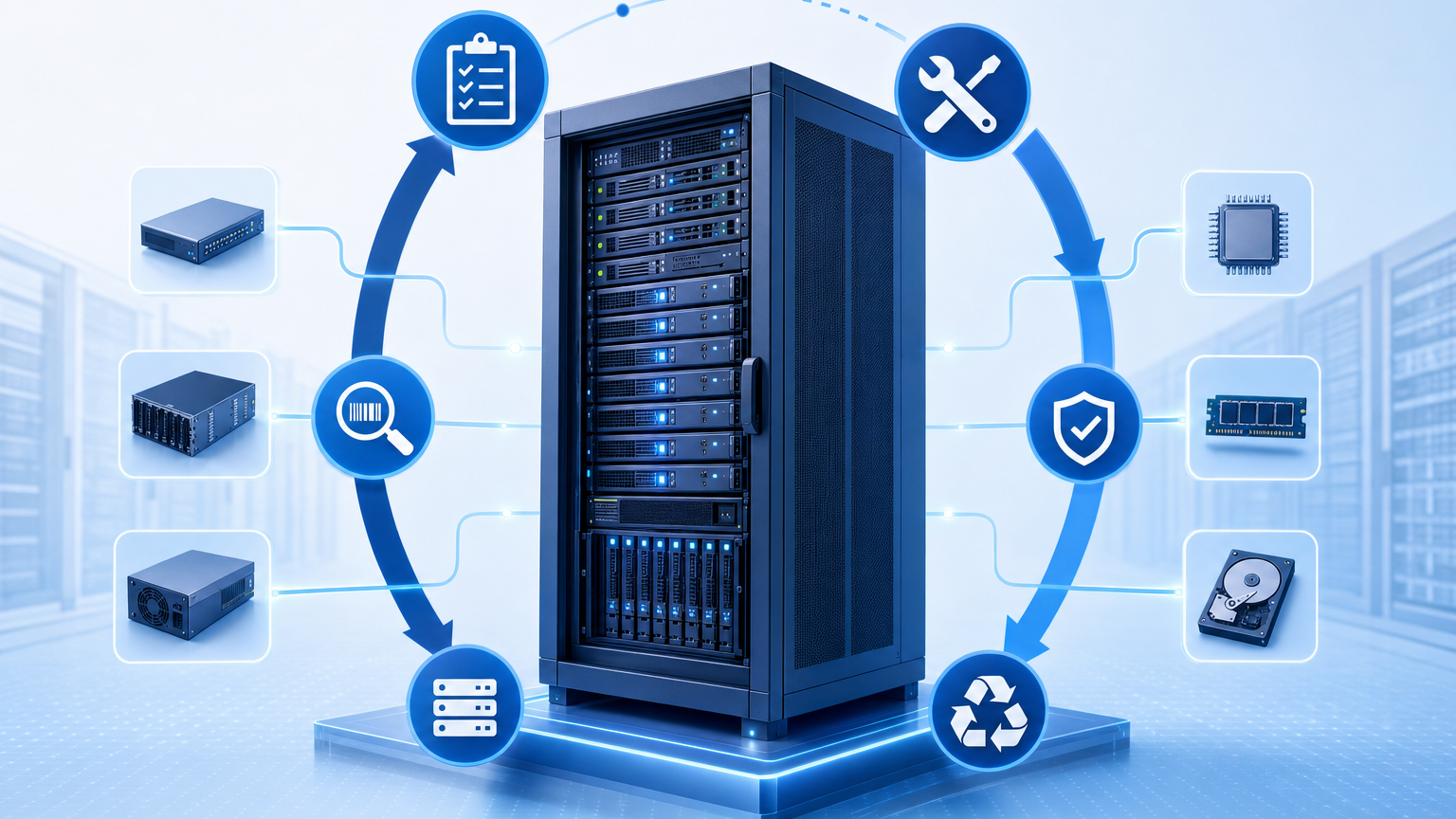
IT asset management gives data center teams a way to track hardware and its associated ownership, contracts, and lifecycle information. That combination of records is data center hardware lifecycle management: tying identity, ownership, and lifecycle state together so refresh, repair, and retirement decisions use current information.
ISO/IEC 19770-1:2017 specifies requirements for an IT asset management system. The standard applies to organizations of different sizes and to different types of IT assets.
A data center adds complexity through the number of similar units and the pace of physical change. Servers ordered together may arrive in separate shipments. A repair can replace a component or an entire unit. Equipment moved into storage may remain on an active support contract.
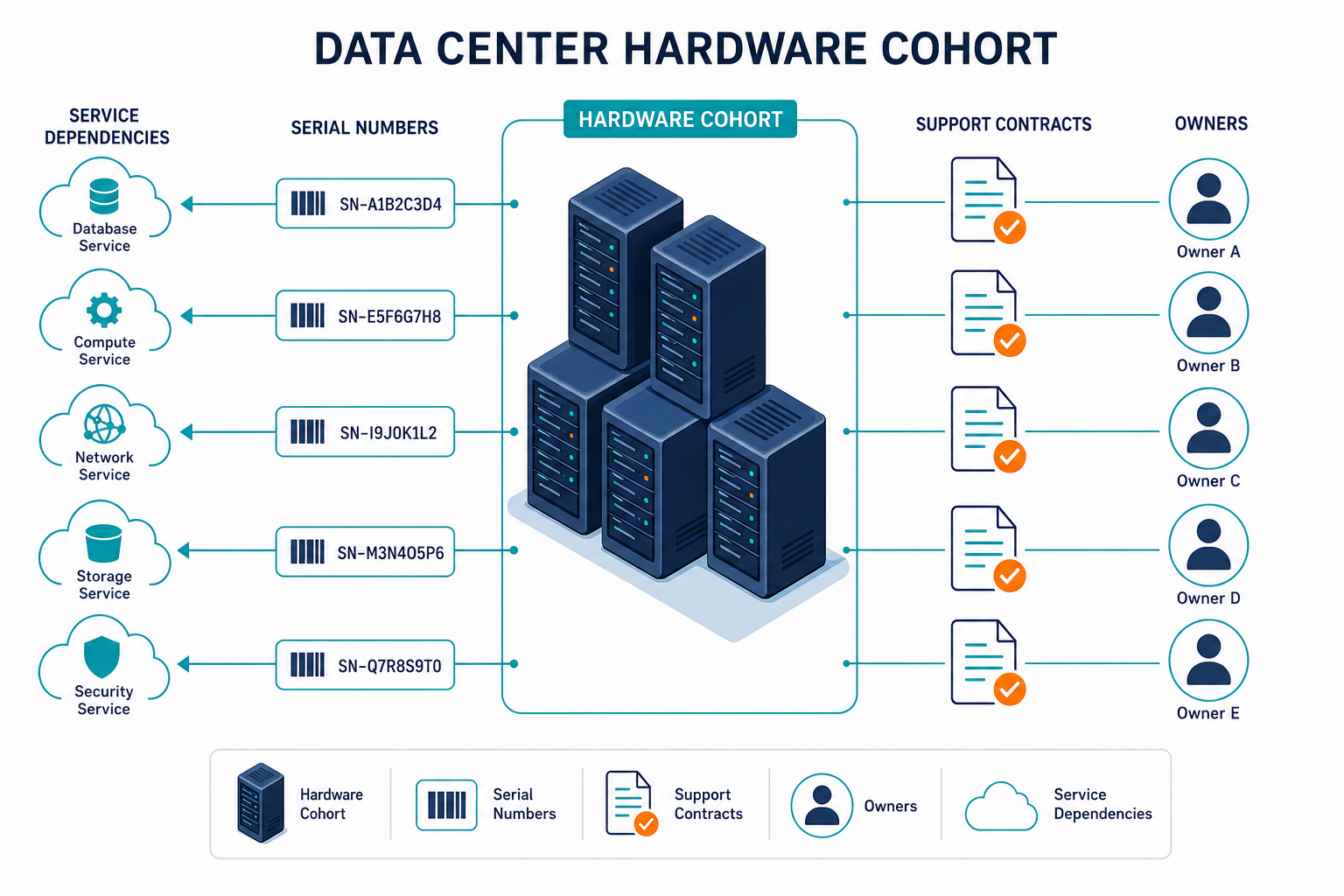
A useful asset record brings together:
- A durable identifier, such as the hardware serial number.
- The site and other location information maintained by the organization.
- The responsible owner and the unit’s lifecycle state.
- Warranty and support details, including the applicable end date.
- Related services and infrastructure, where those relationships are known.
- Retirement or disposal evidence when the unit leaves service.
Virima ITAM brings hardware lifecycle, financial, contract, and warranty information into the asset management process. Teams still need to verify ownership and supply information that discovery cannot determine.
Data center infrastructure management, or DCIM, serves a related but distinct purpose: it tracks facilities concerns such as power, cooling, and space. ITAM tracks the hardware asset itself — its owner, lifecycle stage, warranty status, and service dependencies. The two are complementary, not interchangeable, and a complete data center operations view needs both.
What the spreadsheet says versus what the rack holds
A spreadsheet can provide a useful starting inventory. Its value depends on whether changes in the data center reach the record.
| Situation | Potential record gap |
|---|---|
| A failed unit is exchanged during a repair. | The asset record retains the old serial number, making a coverage lookup unreliable. |
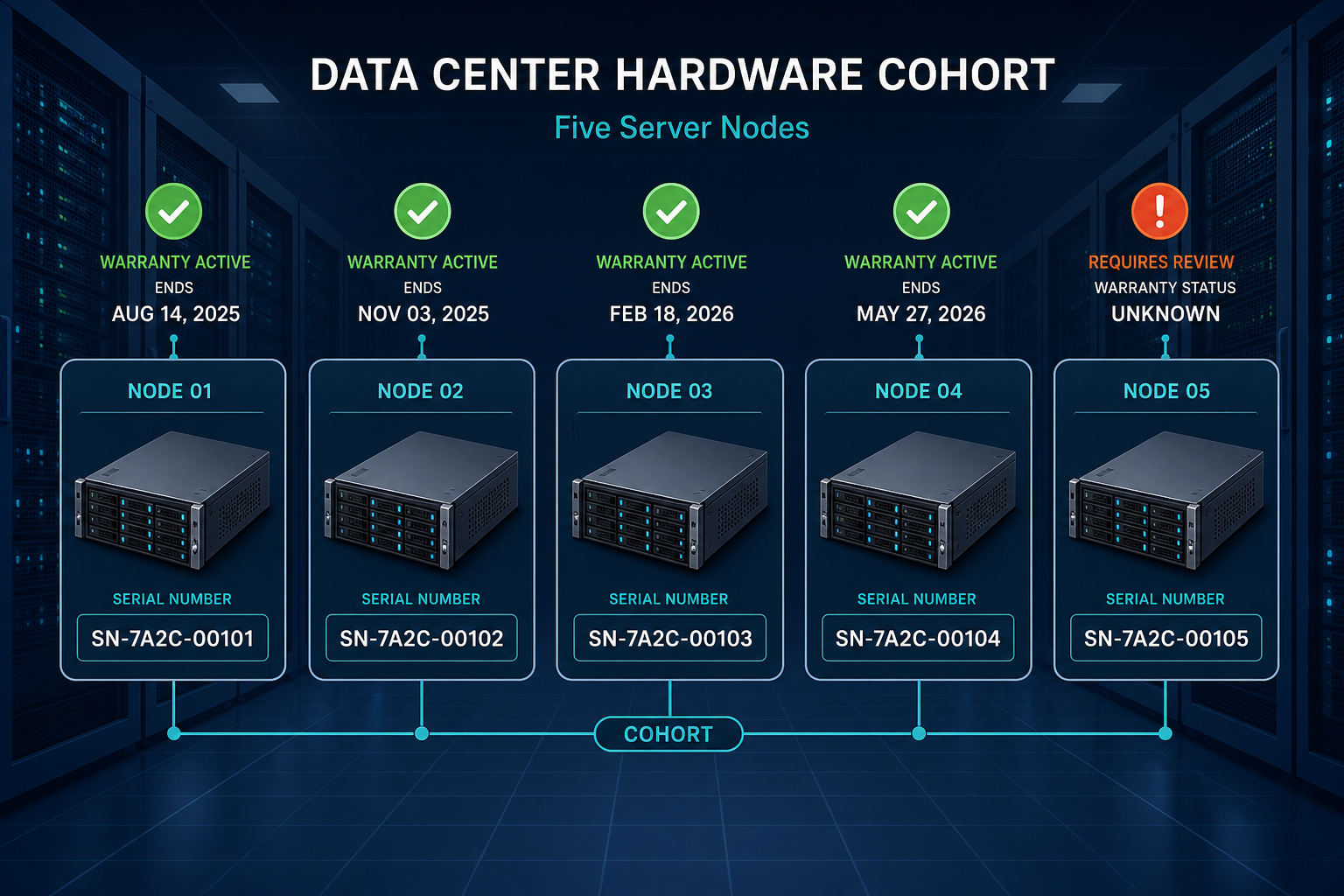
| One purchase order arrives in several shipments. | Units treated as one cohort may have different warranty start or end dates. |
| Older equipment moves into a spare cage. | Support may renew for hardware that no longer has an assigned use. |
| A retired system remains listed as active. | Capacity and coverage reviews include a unit that has already left service. |
Each discrepancy has a different owner and remedy. Procurement can check the contract, infrastructure teams can confirm the hardware, and the asset owner can update the lifecycle decision.
Why lifecycle and warranty control matter at scale
A data center operator may manage many units purchased under the same agreement. Those units can still follow different paths after installation. Some receive replacement components, some move between sites, and others remain in service after their planned refresh date. Reliable hardware warranty tracking depends on catching that drift before it turns into a failure.
The stakes behind that drift are not abstract. In ITIC’s 2024 Hourly Cost of Downtime survey, more than 90% of mid-size and large enterprises reported that a single hour of downtime costs over $300,000 (ITIC, 2024). That raises the cost of discovering a coverage gap after a failure instead of before one.
The coverage decision becomes harder when the asset list and the contract list describe different populations. A renewal may include equipment that has been retired. Another unit may remain operational even though its support arrangement has expired.
The same gap affects change planning. Before an infrastructure team powers down a server, it needs a reliable view of the workloads and services that may depend on it. Asset records contribute identity, ownership, and lifecycle information to that review. A service dependency view contributes context about potential impact.
Four places lifecycle control slips at scale
Refresh dates rely on a shared purchase date. Units can have different delivery, installation, and warranty dates even when they belong to one order. A cohort plan should account for those differences before the team commits to a refresh window.
That same gap shows up when a repair changes the equipment identity. When a replacement changes the relevant serial number, the record needs review. Otherwise, a warranty lookup may refer to the old unit or fail to match the replacement.
Elsewhere, an extended life has no support decision. Keeping hardware beyond its planned refresh can be reasonable. The owner should also confirm available vendor support, spare parts, and the team responsible for the decision.
And finally, a retirement request lacks dependency context. A device may appear ready for removal while supporting a workload that remains in use. The change owner should review known relationships and confirm them with the service owner.
The warranty and contract tracking guide covers the per-asset mechanics. At data center scale, the additional task is comparing coverage across a population before a contract or refresh decision.
What lapsed coverage costs each team
A coverage gap creates different work for operations, asset management, and finance. The size of the effect depends on the equipment, its role, and the support options available.
Operations leaders
When hardware fails without the expected support, the operations team may need to locate parts, find another repair provider, or move workloads. The time and expense depend on the contract terms and the equipment involved.
A coverage review allows the team to resolve those questions before a failure. It also helps distinguish a unit covered by a vendor agreement from one supported through an internal spare-parts plan. That same visibility shortens the response itself — see the blog post on cutting incident response time with accurate CMDB data for that side of the process.
ITAM and infrastructure managers
Asset managers need to reconcile the installed population with the units listed on support agreements. Infrastructure managers need to validate replacements and confirm which equipment remains active.
When identifiers differ across records, both teams spend time investigating the same unit. A serial-number match gives them a starting point, while exceptions receive manual review.
Finance and procurement
An equipment extension changes the timing of refresh spending. It may also change support costs, parts requirements, and operational risk.
Finance and procurement can compare the cost of continued operation with a replacement proposal. Their analysis should use the organization’s actual contract terms and accounting assumptions. The ITAM record provides unit-level inputs for that discussion; it does not make the financial decision.
See where lapsed coverage is costing your team time. The warranty and contract tracking guide walks through the per-asset mechanics behind the cohort-level review above.
How discovery-fed records support lifecycle and warranty reviews
Scheduled discovery helps teams compare network-visible hardware with their existing records. It is one input to the asset management process, alongside contracts, procurement records, service definitions, and human confirmation.
1. Compare discovered hardware with the asset record
IT asset discovery for data centers starts with comparing network-visible hardware against existing records. Virima’s IT discovery can collect hardware information, including serial numbers, from supported devices, and teams can compare those results with the inventory they already maintain.
A match can strengthen confidence that the record refers to the installed unit. A missing or conflicting identifier should enter a review queue. The reviewer can then determine whether the issue reflects a replacement, a data-entry error, or a device outside the discovery scope.
Discovery runs on a schedule selected for the environment. Changes between discovery cycles still require the team’s normal change and reconciliation processes.
2. Associate coverage information with the unit
Warranty and support information gives an asset record commercial context. The contract owner can associate relevant dates and agreements with the hardware they cover.
Virima’s integrations catalog lists Dell and Lenovo warranty connections. Teams should confirm supported models and integration prerequisites for their own fleet before relying on a vendor connection.
For other equipment, use the organization’s available contract and vendor records. The team should verify both the asset identifier and the terms that apply to the unit.
3. Review known service dependencies
An asset manager needs to know which hardware is in scope. A change owner also needs to understand which services may be affected.
Virima’s service mapping uses customer-provided service definitions to build dependency maps. Teams can review those relationships alongside asset records when planning changes. Service owners should confirm the relevant dependencies before work proceeds.
| Review activity | Record-led approach | Discovery-fed approach |
|---|---|---|
| Hardware identity | Compare spreadsheets and purchase records. | Compare those records with identifiers collected during scheduled discovery. |
| Warranty status | Look up units against contracts or vendor records. | Associate available warranty data with asset records, then investigate exceptions. |
| Cohort planning | Group units from purchasing files and installation records. | Use reconciled asset information to review the cohort and its coverage dates. |
| Retirement review | Check removal records against the inventory. | Review asset status and known relationships before updating the record. |
Neither approach removes the need for ownership or verification. Equipment that cannot be reached through network discovery, including powered-off or passive gear, requires a separate inventory process.
Where the record earns its keep
The value of an asset record becomes clear when a team has a specific decision to make. The following examples show how different groups can use the same information.
Refresh wave planning. Infrastructure and procurement teams compare support end dates across a proposed cohort. They can separate units needing an earlier decision from those whose coverage extends beyond the planned window.
Repair reconciliation. A technician records a replacement after a return merchandise authorization. The asset manager compares the replacement identifier with the next applicable discovery result and checks the support record.
Retirement approval. The responsible operations or facilities lead confirms that removal can proceed after service owners review known dependencies for the equipment involved. The team records the decision and retains the relevant disposal evidence.
For a deeper process, the decommissioned asset tracking guide covers how teams can maintain retirement records.
Virima helps teams find gaps in hardware records
Virima combines discovery, ITAM, and configuration management database (CMDB) capabilities to support a more reliable data center CMDB and a clearer view of the hardware estate. A team can start with one site, compare discoverable devices against existing records, and investigate mismatches.
Review the first set of exceptions
A scheduled discovery run can identify supported network-visible hardware in its configured scope. The asset team can compare those results with its inventory to find unmatched records or devices.
A discovery result alone does not establish whether a device is unowned or out of warranty. The team must compare it with ownership and coverage records before assigning an exception.
Maintain the record across changes
Later discovery cycles provide another opportunity to compare hardware details. Teams can review serial changes, investigate missing devices, and update records after approved work.
Ownership, contract terms, and retirement decisions still need input from the people responsible for them. The record becomes more useful when those updates follow a documented process.
Use the existing service workflow
Virima can work alongside an organization’s existing IT service management platform. Asset and configuration information can support the incident and change workflows the organization already uses.
Virima’s Trusted Runtime Truth approach brings discovery-sourced information together with relationship context. It helps teams review what exists, how equipment is connected, what has changed, and which services may be affected. Owners and change reviewers still confirm the information needed for a specific decision.
From fleet spreadsheets to a lifecycle record that stays current
A spreadsheet can remain useful during the transition to a more structured asset process. The first improvement is agreeing which record will own each piece of information and how discrepancies will be resolved.
| Change | Practical result |
|---|---|
| Compare inventory records with scheduled discovery results. | The team can investigate differences between recorded and discoverable hardware. |
| Review coverage by hardware cohort. | Owners can plan refreshes and support decisions using unit-level dates. |
Reviewing coverage by cohort rather than one unit at a time changes how each team works day to day: infrastructure and procurement can check individual support-end dates before committing to a refresh window, instead of assuming one purchase order means one coverage date; the contract owner can compare upcoming expirations against units still in service and route exceptions to procurement, infrastructure, or the relevant asset owner; and a retirement record can show the approved decision and the evidence retained after removal, so the asset list and related support agreements stay reconciled.
Getting started at one site
- Choose a manageable hardware cohort. Group units by site and use available purchase, vendor, and installation records to define the population.
- Compare discovery results with the inventory. Match supported, discoverable units using serial numbers and investigate missing or conflicting identifiers.
- Review coverage with the contract owner. Associate available warranty and support dates with the correct units. Record gaps that need vendor or procurement follow-up.
- Assign a refresh-or-extend decision. Name the owner, review date, support arrangement, and known service considerations for each cohort.
- Set a reconciliation cadence. Agree when discovery will run and how teams will review changes, including equipment outside network discovery.
The first cycle establishes the work queue. Later reviews should address new equipment, repairs, moves, and retirements as those changes are recorded.
Plan the next hardware decision with better records
A data center team needs more than a count of installed units. It needs a way to connect each decision to the hardware, coverage, and service information available at the time.
Start with a cohort whose next refresh or support review is approaching. Compare the inventory with discoverable hardware, resolve the exceptions, and ask owners to confirm the remaining gaps. That reconciliation work is what ITAM for data centers looks like in practice, one cohort at a time.
Frequently Asked Questions
What is ITAM for data centers?
ITAM for data centers is the management of hardware records across purchasing, use, support, and retirement. Teams connect identifiers with ownership, location, contracts, and known dependencies. Scheduled discovery can help reconcile supported network-visible hardware with those records.
Why does ITAM matter for data centers?
Data center hardware changes through repairs, moves, refreshes, and retirements. ITAM gives teams a way to associate those changes with ownership and coverage records. That information supports planning when equipment needs maintenance or a service is affected by a proposed change.
How do you track warranties across a data center fleet?
Associate each unit’s serial number with the applicable warranty or support agreement. Review end dates by cohort, and investigate missing or conflicting identifiers. After a repair or replacement, confirm whether the identifier and coverage record need to change.
How does Virima support data center asset reviews?
Virima combines scheduled discovery with ITAM and CMDB capabilities. Teams can compare discoverable hardware with asset records and review contract information. ViVID™ builds service maps that show dependencies after customers provide service definitions, giving change owners additional context for their reviews.
How does Virima work alongside DCIM and ITSM tools?
Virima provides discovery, asset management, configuration records, and service mapping alongside existing operational tools. DCIM addresses facilities concerns such as power, cooling, and space. Supported ITSM integrations can bring asset and configuration information into established service workflows.