Top IT Management Security Tools for Enterprise Teams in 2026

IT management security starts with one hard truth: you cannot protect what you cannot see. Today your team manages environments that span on-premises servers, cloud workloads, virtual machines, mobile devices, and a growing set of machine identities. According to the IBM Cost of a Data Breach Report 2024, the global average cost of a breach reached $4.88 million, and incomplete asset visibility is a recurring driver. Without accurate data about what you have, how it is configured, and who owns it, your security controls work from a partial picture.
This guide breaks down the top IT management security tools your team should evaluate in 2026, what each one does, and what to look for when choosing. The goal is a connected stack, not eight disconnected point tools.
The 8 IT Management Security Tools to Evaluate in 2026
1. Configuration Management Database (CMDB)
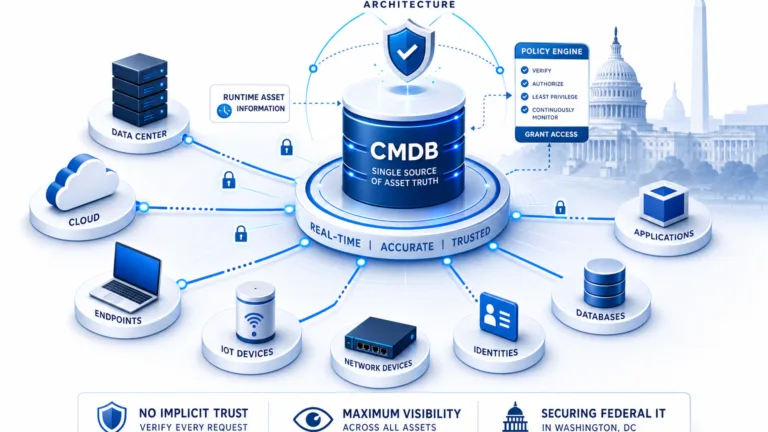
Your CMDB is the foundation of every other tool on this list. It stores a record of every configuration item (CI) in your environment, including servers, applications, network devices, and cloud resources. It maps the relationships between those CIs, tracks ownership, and records every change. A discovery-driven CMDB is far more reliable than one that depends on manual updates. If you are building the case for upgrading your CMDB or evaluating what a mature implementation looks like, our guide on why your business requires a modern enterprise CMDB covers the core requirements and architecture decisions in detail.
High-frequency discovery cycles keep the data aligned with your actual environment. Virima’s CMDB pulls asset data from AWS and Azure through API-based discovery and surfaces impact context before any change is approved. When your CMDB is accurate, your security teams can route vulnerability findings to the right owner and understand the effect of a proposed remediation before acting.
What to look for:
- Multi-source discovery ingestion (agent-based, agentless, API)
- CI relationship mapping with upstream and downstream dependencies
- Change history and an audit record per CI
- Integration with your ITSM platform for change and incident workflows
2. IT Asset Management (ITAM)
You cannot secure an asset you do not know exists. IT asset management tracks every hardware and software asset from procurement through retirement. A strong ITAM platform gives your security team a governed register of what is deployed, what is end-of-support, and what software is running without authorization.
Virima’s ITAM capability combines discovery-driven inventory with lifecycle tracking, so your security team works from a current asset register rather than a spreadsheet updated months ago. That accuracy is a core part of a strong security posture.
What to look for:
- Discovery-driven hardware and software inventory
- End-of-life and end-of-support tracking
- Unauthorized software detection
- Integration with your CMDB and vulnerability management tool
3. IT Discovery Engine
Discovery feeds every other tool on this list. Your CMDB, ITAM platform, and security tools are only as accurate as the data coming from your IT discovery engine. High-frequency discovery cycles catch configuration drift, new assets, and unauthorized changes before they turn into incidents.
Virima’s discovery engine runs recurring scheduled scans across AWS and Azure environments. It uses both agent-based and agentless methods to build an inventory of deployed assets, installed software, running services, and network connections. That inventory flows directly into your CMDB and IT asset register. Without a reliable discovery engine, your security scans operate on assumptions; with one, every downstream tool shares an accurate foundation.
4. Service Dependency Mapping
When a critical service fails, your team needs to know immediately which components are involved and which downstream systems are at risk. Service dependency mapping answers that question before a minor incident turns into a major outage.
Virima’s ViVID™ Service Mapping builds dynamic dependency maps from your discovery-driven CMDB data. You define the service boundaries, and ViVID™ builds the dependency map from that definition. The result is a current view of which applications, servers, and network devices support each service, along with ownership and change context.
For change management, ViVID™ gives your change advisory board an impact view (the blast radius of a proposed change) before it is approved. That context reduces the risk of change-driven outages.
What to look for:
- CI-to-service relationship mapping
- Impact visualization for proposed changes
- Integration with change management workflows
- Multi-cloud environment support (AWS, Azure)
5. Cybersecurity Asset Management (CSAM)
Traditional ITAM tracks assets for cost and compliance. Cybersecurity asset management (CSAM) focuses specifically on the security posture of those assets. It identifies unmanaged devices, maps vulnerability exposure per asset, and gives your security team a governed view of your attack surface.
Virima’s cybersecurity asset management capability extends discovery-driven inventory into a security context. It surfaces unmanaged assets, maps them to National Vulnerability Database (NVD) data, and connects your security workflows to your CMDB. Because the data comes from high-frequency discovery cycles, it reflects your current environment rather than a single point-in-time scan. For a deeper look at how CSAM fits your strategy, see our essential guide to cybersecurity asset management.
| What is IT management security? IT management security refers to the tools and practices that maintain accurate asset inventories, govern configurations, track changes, and manage vulnerabilities across enterprise IT environments. It bridges IT operations and security teams to reduce exposure and speed up incident response. The discipline depends on a discovery-driven data foundation that reflects the environment as it actually exists. |
6. IT Service Management (ITSM) Platform
ITSM platforms manage the full lifecycle of IT services, from incident response and change approval to service request fulfillment. From a security standpoint, ungoverned changes are one of the leading causes of both outages and security incidents.
Virima integrates with leading ITSM platforms including ServiceNow, Ivanti, Halo, Jira Service Management, and Xurrent. Those integrations carry Virima’s discovery-driven context directly into change and incident records, so your change advisory board approves changes with impact data, CI ownership, and full change history already attached. For more on how these layers fit together, read our guide on how your CMDB connects ITSM and ITOM. If your team runs ServiceNow and is dealing with stale CI data, see our breakdown of why your ServiceNow CMDB is always inaccurate and what structural gaps cause the drift.
7. Vulnerability Management
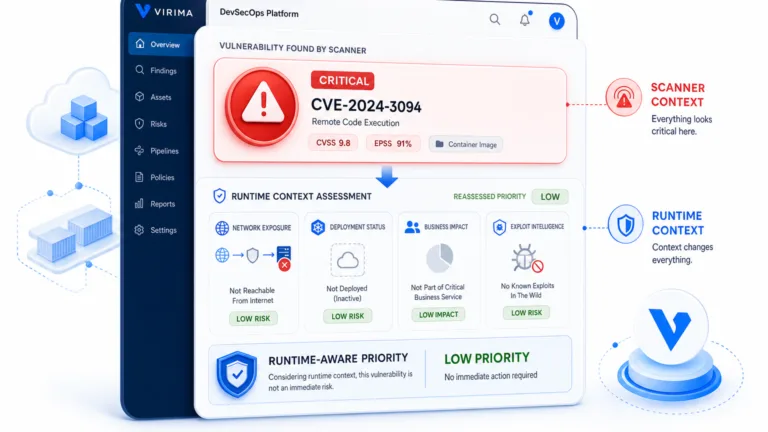
Vulnerability management tools scan your environment for known security weaknesses and prioritize them by risk. The common problem is that most scanners operate on a separate asset inventory from your CMDB. That disconnect means vulnerabilities are often assigned to the wrong owner, or the affected asset is not tracked at all.
A discovery-driven CMDB closes that gap. When your vulnerability management tool shares its asset scope with your CMDB, you can route findings to the correct owner and track remediation against real CI records. For context on how ITSM, ITOM, and vulnerability workflows connect, see our guide on ITOM vs. ITSM.
8. Identity and Access Management (IAM)
Identity and access management controls who and what can reach your IT resources. As enterprises adopt more AI agents and automated workflows, machine identities join human identities as entities that require active governance. Service accounts, API keys, and automated processes all represent potential exposure when they are not tracked and regularly reviewed.
Virima surfaces non-human identities (NHIs) as part of its discovery-driven asset inventory. That gives your security team visibility into which machine identities are active, which systems they can reach, and whether they are still authorized. This visibility becomes more important as agentic IT environments grow, which makes IAM a rising priority for security teams.
| What is the difference between ITAM and CSAM? IT asset management (ITAM) tracks assets across their full lifecycle with a focus on cost, licensing, and compliance. Cybersecurity asset management (CSAM) focuses on the security posture of those assets, including unmanaged devices, vulnerability exposure per asset, and attack surface governance. Both disciplines share a dependency on accurate, discovery-driven asset data. |
How These 8 Tools Work Together
These eight tools work best as a connected system. Your discovery engine feeds your CMDB. Your CMDB feeds your ITAM register, your service maps, and your CSAM capability. Your ITSM platform carries discovery-driven context into every change and incident workflow. As a result, your IT and security teams share a common data foundation instead of reconciling conflicting spreadsheets.
Without that foundation, teams patch vulnerabilities based on outdated data, approve changes without impact context, and respond to incidents without knowing what is actually running. Virima connects these layers through Trusted Runtime Truth: rather than scanning everything around the clock, it monitors the confidence of your asset data and refreshes it on demand when a decision needs current information. That gives your teams a discovery-driven view of your environment when it matters most.
| See how Virima connects your security tools on one discovery-driven foundation. Request a demo. |
What to Prioritize When Evaluating IT Management Security Tools
Not every organization needs all eight categories at once. Still, three principles apply across the board when evaluating any tool in this space.
First, prioritize data accuracy. A tool that operates on outdated or disconnected data gives you a false sense of security. Look for tools that feed from a discovery-driven CMDB rather than manual input or infrequent scans.
Second, evaluate integration depth. The most effective IT management security tools connect to the platforms your team already uses. Virima integrates with ServiceNow, Ivanti, Halo, Jira Service Management, and Xurrent to carry discovery context into your existing workflows.
Third, think about agentic IT readiness. As enterprises adopt AI agents for IT operations, those agents need trusted, current data to act safely. A well-implemented CMDB is the groundwork that helps make governed AI operations possible.
What should you look for in an IT asset management tool?
Look for discovery-driven hardware and software inventory, end-of-life and end-of-support tracking, unauthorized software detection, and integration with your CMDB and vulnerability management tool. The most effective ITAM platforms pull data from high-frequency discovery cycles rather than requiring manual updates.
The Shared Data Foundation That Makes IT Management Security Work
Every tool on this list depends on accurate data to deliver value. A vulnerability scanner without a current asset list patches the wrong systems. An ITSM platform without impact context approves risky changes. A service map built on outdated discovery data sends teams to the wrong root cause during incidents.
The right security stack starts with discovery-driven data and extends outward from there. That is what Virima’s Trusted Runtime Truth approach is built to deliver: a current, explainable, governed view of what exists in your environment, how it is connected, what changed, and what could break.
| Ready to build your security stack on a discovery-driven foundation? Request a demo to see it in action for your environment. |
Frequently Asked Questions
What are the most important IT management security tools for enterprise teams?
The most important tools include a discovery-driven CMDB, IT asset management, IT discovery, service dependency mapping, cybersecurity asset management, and an ITSM platform. Together, they give your IT and security teams accurate, governed visibility across the full environment.
How does a CMDB improve IT security?
A CMDB provides a discovery-driven record of every asset, its owner, its relationships, and its change history. Security teams use that data to prioritize vulnerability remediation, assign incidents to the correct owner, and understand the impact of proposed changes before acting.
What is the difference between ITSM and ITOM?
IT Service Management (ITSM) handles the lifecycle of IT services, including incidents, changes, and service requests. IT Operations Management (ITOM) monitors and manages the underlying infrastructure that delivers those services. Together, they provide end-to-end control.
Why does IT discovery matter for security?
Discovery runs recurring scheduled scans to identify assets, their configurations, installed software, and network connections. That data feeds your CMDB, ITAM register, and security tools. Without discovery, those tools operate on outdated or incomplete data, which creates visibility gaps attackers can exploit.
Can Virima integrate with my existing ITSM platform?
Yes. Virima integrates with ServiceNow, Ivanti, Halo, Jira Service Management, and Xurrent. Those integrations carry discovery-driven context, including CI relationships, ownership, and impact data, directly into your existing change and incident workflows.
How do IT management security tools support agentic AI?
Agentic AI systems need accurate, current data to act safely on IT infrastructure. A discovery-driven CMDB and CSAM capability provide the runtime context AI agents draw on to take governed actions, understand impact, and avoid unauthorized changes to production environments.