Campus Device Visibility Is Not Corporate BYOD at Larger Scale

A college campus does not have a workforce. It has a population that turns over on a calendar. Each fall, a large share of the network’s devices is new. Each spring, another wave leaves. Incoming students often arrive with several personal devices apiece, and most of those endpoints were never going to sit in central MDM.
IT Discovery for higher education has to start from that structure. Corporate BYOD treats unmanaged devices as the exception. On campus, unmanaged is the default, decentralization is often sanctioned, and inventory that assumes a stable, enrollable fleet falls behind before the next term starts. This piece covers why campus visibility is not just bigger BYOD, what calendar churn and research autonomy do to inventory, how GLBA Safeguards expectations reach beyond the financial aid office, and why scheduled multi-source discovery fits where enroll-or-block playbooks stall.
Why Campus Device Visibility Is Not Just Bigger BYOD
In a company, most endpoints are owned, provisioned, and enrolled. Personal devices are a deliberate carve-out. IT can require enrollment because employment and policy give it leverage.
On a campus, that leverage is thin for the bulk of the population. Students are not employees. Many staff and faculty devices stay personal. There is no practical path to enroll tens of thousands of phones, laptops, tablets, gaming consoles, and smart devices the way a corporate MDM program would.
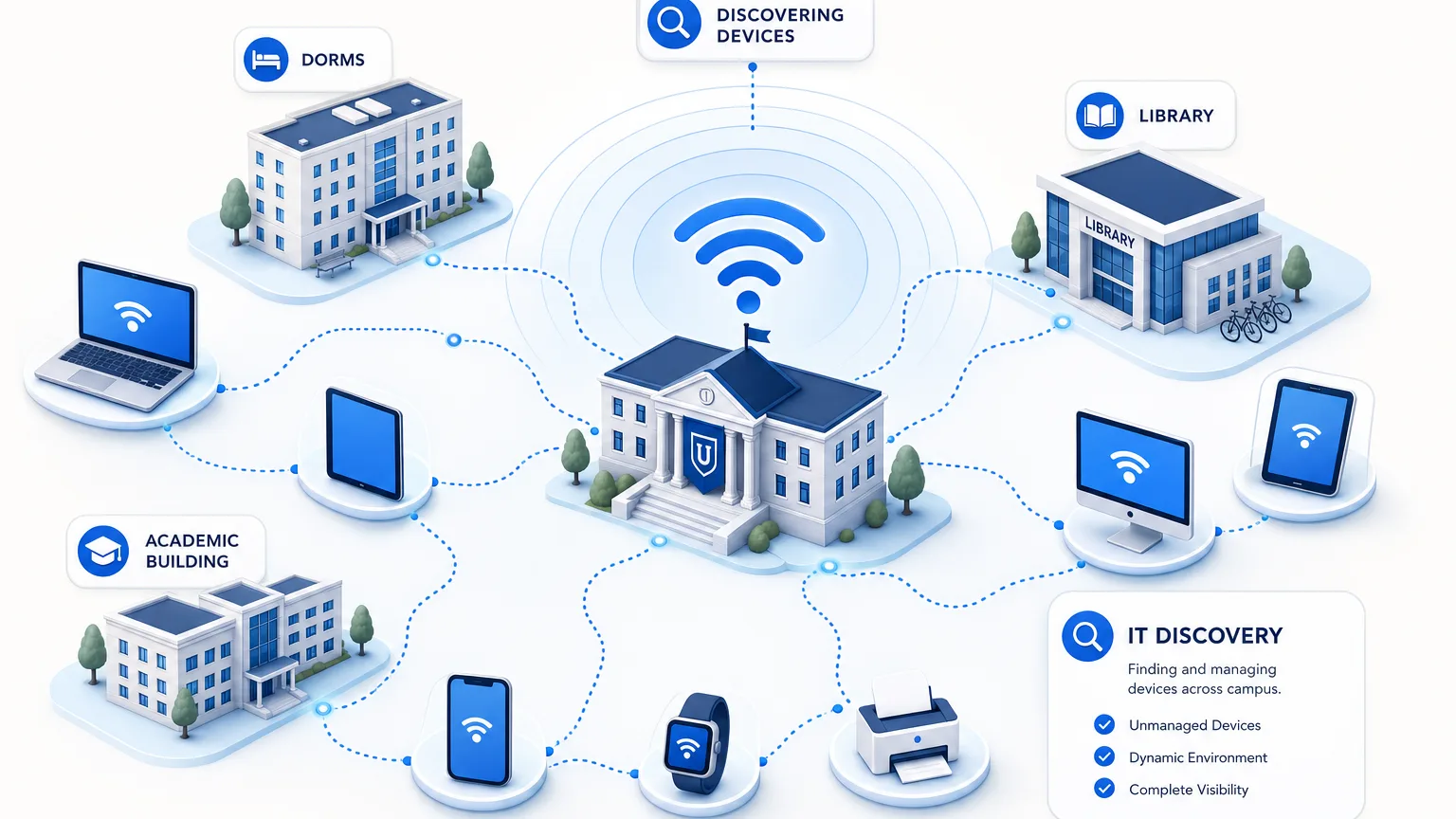
Scale compounds the gap. Incoming students commonly bring multiple connected devices each. Those devices spread across dorms, libraries, labs, and academic buildings. The visibility problem is not “more of the same BYOD.” It is a population that was never designed to be centrally managed in the first place.
Why is device visibility harder on a college campus than in a typical company?
Corporate fleets are mostly owned and enrollable. Campus networks are dominated by personal and departmental devices IT cannot require into MDM. Semester turnover and sanctioned lab autonomy add continuous churn. Visibility has to come from network and multi-source discovery, not from an agent on every endpoint.
The Churn Problem: A Population That Turns Over on a Calendar
Corporate hiring and attrition spread across the year. Campus device change concentrates in narrow windows: move-in, term start, and term end. A large share of the population can arrive or leave within weeks.
A one-time audit or an annual spreadsheet freezes a picture that is already wrong by the next cohort. Manual inventories lag. MDM enrollment rates stay low because the default device never enters the enrollment funnel. By mid-term, the CMDB that only tracked managed endpoints understates what is actually on the wire.
Discovery cadence has to match the academic calendar. Treat term boundaries as inventory checkpoints, not optional cleanup projects.
Decentralization Is Not a Bug, It Is How Higher Ed Is Built
Shadow IT on campus often correlates with unmanaged devices and department-built systems. The driver is frequently unmet need plus legitimate autonomy, not pure carelessness.
Grant-funded research groups hold real purchasing independence. Academic freedom lets a lab stand up servers, instruments, and software without a central IT ticket. Surveyed campus IT staff have summarized the stance plainly: research dollars stay under departmental control. That is a governance condition central IT works within, not a behavior policy alone can erase.
Illustrative pattern (not a named school): a research lab connects specialized instrumentation with embedded, unpatched software to the network to hit a grant deadline. The department sanctions the purchase. Central IT never sees a change request. Security never runs a review because no policy required one for that path.
The goal is not “eliminate every lab stack the way a corporate program would.” Central IT often lacks the authority to force that outcome. The realistic goal is visibility: know the system exists, who owns it, and what network path it uses.
The Regulatory Reality: GLBA Does Not Stop at the Financial Aid Office
This section is general awareness, not legal or compliance advice. Confirm current obligations with your compliance and legal counsel. Scope and enforcement can change.
The Federal Trade Commission’s Safeguards Rule under the Gramm-Leach-Bliley Act (GLBA) applies to many Title IV institutions, the large majority of U.S. colleges and universities that participate in federal student aid. In broad terms, covered institutions need an information security program that includes knowing what systems and devices handle customer information, including student financial data.
That inventory expectation is not limited to a sealed financial-aid silo. Student financial data moves on campus-wide networks that also carry personal devices, housing and bursar traffic, and departmental systems. If you only inventory the financial aid application tier, you miss the shared infrastructure and unmanaged endpoints that sit on the same paths.
Information Security and GRC leaders feel this at program and exam time. Network and infrastructure leads feel it when someone asks for a complete asset list the CMDB cannot produce. Loss of ability to process federal aid is a material institutional risk when programs fail requirements. Discovery and inventory do not certify compliance. They supply the evidence base a Safeguards-style inventory program needs to start from.
See how Virima approaches trusted runtime truth for discovery-sourced asset and configuration context teams can explain in operations and compliance conversations.
What does the GLBA Safeguards Rule require of colleges and universities?
For many Title IV schools, the FTC Safeguards Rule expects a risk-based information security program that includes inventory of systems and devices that touch student financial information. Scope often reaches campus networks that carry that data, not only a single financial-aid application. Confirm applicability with counsel; this is awareness, not legal advice.
Why Continuous Discovery Fits Where MDM and Manual Audits Do Not
The enterprise playbook (enroll the exceptions, block the rest) fails when unmanaged devices are the norm. Network access control and IoT security tools can detect and contain risk. That is a different job than inventory and CMDB hygiene.
What fits campus structure is multi-source IT discovery on a scheduled cadence. Agent-based discovery covers institution-owned, off-network, and roaming endpoints where agents are allowed. Agentless network discovery reaches dorm, lab, and academic segments where personal and departmental devices dominate. Cloud and virtualization discovery covers research and admin workloads that landed off the old data center. Results feed a CMDB built to reconcile constant turnover with clear source rules, not a once-a-year freeze that assumes a stable fleet.
Virima’s role is asset discovery and inventory, plus configuration history for ownership and change evidence. It is not network access control, not device quarantine, and not a replacement for IoT security platforms such as Armis or Ordr. It is not a GLBA certification product. Discovery runs on scheduled cycles (not passive real-time event streams). Multi-source reconciliation merges agent, agentless, and cloud inputs into CI records. Audit history helps Information Security and GRC show what was known when. Integrations with ServiceNow, Jira Service Management, Ivanti, HaloITSM, Xurrent, Hornbill, and others on the integrations hub keep inventory where tickets already live.
For generic discovery failure modes, see Virima’s guide to seven asset discovery challenges. Named assets feed an IT risk register practice once ownership is clear.
Why can central IT not just enroll every campus device in MDM?
Most campus endpoints are personal or department-owned. Students are not employees, and research labs often buy and connect gear under grant control. Without enrollment authority, MDM covers only the institution-owned slice. Network and multi-source discovery must cover the unmanaged majority that still sits on shared infrastructure.
Where to Start: Scoping Discovery Against Campus Reality
| Starting move | What to do | Why it fits campus structure |
|---|---|---|
| Segment by governance | Map ResNet, academic, administrative, and research segments | Unmanaged density and ownership differ by segment |
| Financial data paths first | Prioritize segments that touch housing billing, bursar, and aid processing | GLBA-style inventory pressure concentrates on those flows |
| Term-boundary checkpoints | Schedule discovery at start and end of each term | Churn is calendar-driven, not continuous random noise only |
| Owner gap flag | Flag live CIs with no central or departmental owner | Missing ownership marks decentralization residue, not a shaming list |
Work sequence that stays honest about roles:
- Inventory network segments with network engineering and academic IT partners, not only the data center diagram.
- Point agentless discovery at high-churn and research segments first; reserve agents for institution-owned fleets.
- Reconcile discovery into the CMDB with source priority rules that survive term turnover.
- Assign owners for systems on financial-data paths; escalate blanks to Information Security and GRC.
- Align inventory exports with Safeguards program evidence needs without treating discovery as certification.
- Re-run discovery on the academic calendar so the inventory does not freeze after move-in week.
ITAM lifecycle tracking helps once discovery has named institution-owned hardware and software. For tool landscape context, see Virima’s overview of IT asset management tools.
Keep Pace With a Campus Network That Keeps Changing
Campus device visibility is not corporate BYOD at larger scale. It is calendar-driven churn plus unmanaged-by-default populations plus sanctioned departmental autonomy. MDM and annual audits cannot cover that shape. Scheduled multi-source discovery into a CMDB built for turnover can. GLBA Safeguards expectations make incomplete inventory a present institutional risk, not a nice-to-have hygiene project.
Request a demo to see how Virima discovery keeps pace with a campus network that changes every term, with multi-source inventory and CMDB history built for ongoing visibility rather than a single move-in scramble.
Frequently Asked Questions
How is research-department shadow IT different from employee shadow IT?
Employee shadow IT is often unsanctioned SaaS outside policy. Research shadow IT is frequently grant-funded gear and software departments are allowed to buy and run. Central IT may lack authority to block it. The operating need is discovery and ownership visibility, not a pure ban.
Does the Safeguards Rule only cover financial aid software?
No. For covered Title IV institutions, inventory and safeguards expectations reach systems and devices that handle student financial information, including shared campus networks that carry that data. Confirm scope with counsel. This is not legal advice.
How should Information Security and central IT share campus inventory work?
IT runs discovery, CMDB hygiene, and ownership assignment. Information Security and GRC set evidence standards for the Safeguards program. A shared inventory of managed and unmanaged systems on financial-data paths is the handshake. Discovery tools do not issue legal opinions.
Does Virima replace NAC or IoT security tools on campus?
No. Virima provides scheduled multi-source discovery, CMDB inventory, and configuration history. Network access control, device quarantine, and IoT threat containment stay with purpose-built security platforms. Use discovery for what exists and what it touches; use NAC and IoT tools for access and risk response.