IT Asset Onboarding Best Practices for Large Organizations

If you manage IT at scale, you know how this plays out. A new server arrives. Someone logs it in a spreadsheet. Weeks later, your service desk handles an incident against that asset. No owner is on record, no policies apply, and the connections to other infrastructure are unmapped. That is not a workflow failure. It is an onboarding failure.
Large organizations onboard hundreds of assets every quarter. Without a structured process, each one creates a small data gap. Those gaps accumulate quickly. Before long, your CMDB no longer reflects your environment, and every change, incident, and audit becomes harder than it needs to be.
The seven steps below give you a repeatable IT asset onboarding process. You move from initial discovery scan through CMDB population, reconciliation, policy assignment, ITSM sync, service mapping, and ongoing governance, so every asset enters your environment with a complete, accurate record from the start.
Why Asset Onboarding Is an Accuracy Problem, Not a Procurement Problem
According to the Flexera 2025 State of IT Asset Management Report, only 43% of organizations have complete visibility into their IT assets, down from 47% the year before. For large enterprises, this decline points to one persistent root cause: assets enter the environment faster than your records can track them.
When onboarding breaks down, the consequences spread quickly. Untracked assets create security blind spots. Ghost assets inflate software license counts. Configuration items without ownership data slow incident resolution and change approvals. A structured onboarding process closes these gaps before they form, not after they surface during a live incident.
What is IT asset onboarding?
IT asset onboarding is the process of registering a new IT asset into your organization’s management systems. It covers discovery scanning, CMDB population, reconciliation, policy assignment, and ITSM synchronization. A complete onboarding process ensures every asset has an accurate, governable record from the moment it enters your environment, before it touches production workloads.
Step 1: Run a Discovery Scan Before You Log Anything
IT discovery using agentless methods (WMI, SSH, SNMP) captures a full attribute profile without requiring software installed on every device. That profile includes hostname, operating system, hardware specifications, installed applications, network location, and connections to existing infrastructure. Before you create a single record, scan the asset.
For cloud assets on AWS and Azure, API-based discovery pulls configuration data directly from the platform. This gives you a discovery-sourced baseline rather than a self-reported one. Procurement data tells you what you ordered. Discovery data tells you what actually arrived, what it is running, and what it already connects to.
High-frequency discovery cycles at onboarding also catch misconfigurations that procurement records will never surface. A server joined to the wrong subnet, a cloud instance with open ports, or software installed during staging that was never part of the original request. All of these show up in the scan before they create downstream problems.
To understand your scanning options, the comparison between agent-based and agentless discovery covers the tradeoffs for different asset types and environments.
Step 2: Populate Your CMDB with Discovery-Sourced Data
Once discovery completes, write the results directly to your CMDB as configuration items (CIs). Each CI needs a minimum viable attribute set at intake: asset type, hardware identifiers, software inventory, network address, and initial relationship mappings to the infrastructure it communicates with.
A discovery-sourced CMDB entry is far more reliable than one created from a procurement spreadsheet. Discovery captures the actual state of the asset, not what was ordered or what someone typed in manually. That distinction matters every time a change, incident, or vulnerability touches that CI later.
This step also builds the relational layer of your CMDB. As Virima populates each CI through high-frequency discovery cycles, it captures the connections between CIs as part of the same process. Your CMDB becomes a map of how assets relate, not just a list of what exists.
Step 3: Reconcile Discovered Assets Against Existing Records
Large environments always produce overlaps at onboarding. Your procurement system may already have a record for the asset. A prior discovery run may have captured a partial entry. A vendor may have pre-registered the serial number in a separate system.
Reconciliation matches discovered data against existing procurement records, prior CMDB entries, and vendor-provided asset registers. Your goal is one authoritative record per asset: no duplicates, no partial entries, no conflicting attributes. Virima’s multi-source data reconciliation merges CI data from all sources into a single verified record automatically.
During reconciliation, you will also surface ghost assets: records for equipment that no longer exists in your environment. Ghost assets inflate license counts, distort capacity planning data, and create false positives during change impact assessments. Removing them at intake keeps your CMDB clean. Review CMDB best practices to structure your reconciliation workflow at scale.
What is asset reconciliation in IT asset management?
Asset reconciliation matches discovered asset data against existing procurement records, prior CMDB entries, and vendor registers to produce one authoritative record per asset. It removes duplicates, surfaces ghost assets (equipment still logged in the CMDB but no longer present in the environment), and resolves conflicting attribute data before those conflicts affect operations.
Step 4: Assign Policies, Ownership, and Lifecycle Status
A CMDB entry without an owner is a governance gap. At this step, you assign the metadata that makes an asset actionable: responsible team, assigned user, cost center, warranty expiry, end-of-life date, and applicable compliance policies such as SOX, PCI-DSS, or ISO 27001.
Policy assignment also sets the maintenance cadence for each asset class. Does this server require monthly patching? Quarterly vulnerability scans? Annual hardware refresh? Define these parameters at onboarding, not after the first incident. Ownership discovered during a live P1 is not ownership. It is triage overhead.
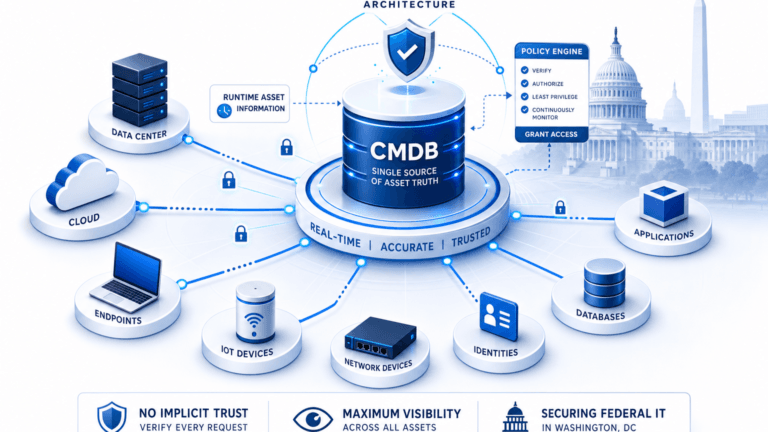
This step is where trusted runtime truth becomes an operational capability rather than a positioning concept. When your CMDB carries accurate ownership, policy, and lifecycle status for every CI, your teams have the context to act, not just a record to reference.
| Ready to see how Virima delivers discovery-sourced, policy-ready data across your entire asset lifecycle? Explore Trusted Runtime Truth |
Step 5: Sync Asset Records to Your ITSM Platform
Asset records only create operational value when your service desk can act on them. At this step, you push CI data from your CMDB to your ITSM platform (ServiceNow, Jira Service Management, Ivanti, Halo, or Xurrent), so every incident, change, and problem ticket carries full asset context from the moment it opens.
In mature environments, this sync runs in both directions. When a change is approved in your ITSM platform, the CMDB reflects it. When a vulnerability scan flags a CI, the ticket inherits all the relationship and ownership data needed to route it correctly. Your ITSM and CMDB stay in sync rather than drifting apart over update cycles.
This integration layer is what connects your IT asset management practice to daily service operations. Assets without an ITSM-connected record sit outside the governance loop until something breaks.
| How do you sync CMDB data to an ITSM platform? CMDB-to-ITSM synchronization pushes configuration item data from your CMDB to platforms such as ServiceNow, Jira Service Management, Ivanti, Halo, or Xurrent. This ensures that incident, change, and problem tickets automatically inherit asset context (ownership, relationships, and configuration state) without manual lookup or data re-entry at the time of the ticket. |
Step 6: Map Service Dependencies with ViVID™
Individual assets rarely fail in isolation. A single server hosts multiple application components. A network appliance sits in front of several services. When something breaks, you need to know the blast radius before you touch anything.
After onboarding an asset to your CMDB, ViVID™ service maps place it in its full service context. You define which applications and services each asset belongs to. From there, ViVID™ builds the dynamic dependency map, showing upstream and downstream relationships, associated CI statuses, active incidents, and open changes in a single view.
This step protects your change approval process. A CI with a complete service map gives your change advisory board real impact data. A CI without one forces your board to approve changes based on incomplete information, which is where preventable outages originate.
Step 7: Establish a Recurring Discovery Cadence
Onboarding is not a one-time event. Environments change after the initial scan. New software gets installed. Network connections shift. Cloud instances spin up and down between formal procurement cycles.
Recurring scheduled scans keep your CMDB current after the initial onboarding pass. Set scan frequency based on asset class and risk profile: servers and network infrastructure typically benefit from more frequent cycles than endpoint devices. Pair this with governance workflows that require sign-off before any asset leaves active management. Decommissioned assets need proper retirement from your records, not just removal from the environment.
Learning how to build a CMDB that stays accurate over time means treating discovery cadence as a governance decision, not an infrastructure task.
| How often should large organizations run IT asset discovery scans? Scan frequency depends on asset class and risk profile. Servers and network infrastructure benefit from weekly or biweekly recurring scheduled scans. Endpoint devices can run on a less frequent cycle. The goal is to detect configuration drift, unauthorized software installations, and new assets between formal onboarding cycles, before they create security or compliance gaps. |
Common IT Asset Onboarding Mistakes That Create Downstream Damage
Even teams with strong intent make these mistakes at onboarding. Each one creates a data gap that compounds over time.
- Relying on procurement data instead of discovery. Procurement tells you what you ordered. Only a discovery scan tells you what arrived, what it is running, and what it connects to.
- Running onboarding in batches, not on a continuous cadence. Organizations that sweep quarterly accumulate weeks of untracked assets between cycles. Each untracked asset is a potential gap in your CMDB, license counts, and service maps.
- Treating CMDB population and ITSM sync as separate projects. They should be steps in the same workflow. Separate projects create separate timelines, and the window between them is where data gaps form.
- Leaving ownership fields blank at intake. Every asset needs an owner before it reaches the service desk. Ownership discovered during an incident is not a governance process. It is triage scramble.
- Building service maps only after an outage. ViVID™ service maps are most valuable when they exist before a failure. Building them reactively means your first blast radius assessment happens under incident conditions.
| Schedule a demo today to see how Virima supports a structured asset onboarding workflow across thousands of CIs. |
Build Accurate Records at Intake, Not During Your Next Outage
The cost of a missed onboarding step surfaces during your next incident. A CI with no owner. A service map with a critical gap. A change approval that overlooks three downstream dependencies. Each of these is an onboarding failure, and each one was preventable.
CMDB accuracy improves through structured intake at the front of the asset lifecycle, not through audits run after the fact. The seven steps above give your team the framework to onboard every asset with complete, trustworthy records from the start.
Frequently Asked Questions
What is the difference between IT asset management and a CMDB?
IT asset management (ITAM) tracks the financial, contractual, and lifecycle details of assets (cost, warranty, ownership, and depreciation). A CMDB tracks configuration items, their technical attributes, and their relationships to other CIs and services. Effective onboarding populates both systems from the same discovery-sourced data so they stay in sync throughout the asset lifecycle.
Why does discovery come before CMDB entry?
Discovery-sourced data is more accurate than manually entered records. Running a discovery scan first captures the actual state of the asset (its software, network relationships, and configuration) rather than relying on what was ordered or self-reported. This prevents data gaps that compound over time and produce inaccurate CMDB records that mislead incident and change workflows.
How does IT asset onboarding differ for cloud assets?
Cloud assets on AWS and Azure can be discovered through API-based methods that pull configuration data directly from each platform. This means your onboarding process does not require a separate scan workflow for cloud infrastructure. The same discovery-driven process that covers on-premises assets extends to your cloud environment through API integration, producing consistent CI records across your hybrid estate.
What does Virima do during IT asset onboarding?
Virima runs high-frequency discovery cycles to capture asset attributes at intake, populates CMDB records with discovery-sourced data, reconciles new CIs against existing records from multiple sources, and syncs CI data to your ITSM platform. ViVID™ then builds the service dependency map for each newly onboarded asset once service definitions are provided. The result is a complete, policy-ready CI record from day one.
What is a ghost asset in IT asset management?
A ghost asset is a CI that exists in your CMDB but no longer exists in your actual environment. Ghost assets appear when equipment is decommissioned without a proper retirement workflow. They inflate software license counts, distort capacity planning data, and create false positives during change impact assessments. Reconciliation at onboarding surfaces and removes them before they enter your active records. For tooling context, see the top IT asset management tools overview.