IPAM and CMDB Together: Why Managing IP Addresses Inside Your Configuration Database Changes Everything

Managing IP addresses in a standalone IPAM tool creates a persistent reconciliation gap with your CMDB. Virima 6.1.1 includes native IPAM inside the CMDB, so Discovery automatically correlates IP addresses to CIs, subnet management shares the same data layer as configuration records, and the reconciliation problem disappears entirely.
Every network team eventually runs into the same problem: the IPAM tool says one thing, and the CMDB says another. An IP address appears allocated in the IPAM tool but the corresponding device hasn’t existed in the CMDB for six months. A new server is provisioned and added to the CMDB, but the IPAM tool still shows that IP range as available. Someone spends hours manually cross-referencing two systems to figure out the actual current state of the network.
This is the reconciliation problem — and it never fully goes away as long as IPAM and the CMDB are separate tools. You can build integrations, schedule sync jobs, and assign someone to reconcile the data weekly. But the gap reappears as fast as you close it, because the two systems update at different rates, for different reasons, by different teams.
The only permanent solution is to manage IP addresses and configuration items in the same platform. That’s exactly what Virima 6.1.1 does.
Table of Contents
- What Is IPAM and Why Does It Belong in the CMDB?
- The Problem with Standalone IPAM Tools
- How Virima Includes IPAM Natively in the CMDB
- How Discovery Automatically Correlates IP Addresses to CIs
- Subnet Management with Real-Time CI Association
- Use Cases: Network Change Planning, IP Conflict Detection, Subnet Audit
- IPAM + CMDB vs. IPAM + CMDB + ITSM: The Unified Platform Advantage
- Conclusion
- FAQ
What Is IPAM and Why Does It Belong in the CMDB?
IP Address Management (IPAM) is the practice of planning, tracking, and managing the IP address space across a network. It covers:
- Maintaining an inventory of all IP addresses in use and available
- Tracking which device or service owns each IP address
- Managing subnet ranges and ensuring new allocations don’t conflict with existing ones
- Supporting network change planning with accurate IP availability data
The connection to the CMDB is direct and obvious: every CI that communicates on the network has an IP address. Servers, workstations, VMs, routers, switches, IoT devices — they all appear in the CMDB with IP addresses as key attributes.
When IPAM and CMDB data live in the same system, that relationship is always accurate. When they live in separate systems, maintaining that relationship becomes a manual process subject to constant drift.
The Problem with Standalone IPAM Tools
Standalone IPAM tools — dedicated applications focused exclusively on IP address management — solve the immediate problem of tracking IP address allocations. But they introduce a structural problem: the data they hold must stay synchronized with the CMDB for either system to be accurate.
According to Enterprise Management Associates (EMA), organizations with fragmented IPAM and CMDB environments consistently report higher change-related outage rates and slower incident resolution compared to those operating from a unified data layer — because every integration point between separate tools is a potential point of drift.
The synchronization challenge creates several failure modes:
Data drift. The CMDB gets updated when a device is provisioned or decommissioned. The IPAM tool gets updated when an IP is allocated or released. These two events don’t always happen at the same time, by the same team, in the same workflow. Within weeks, the two systems diverge.
Manual reconciliation overhead. Someone in the network team runs a reconciliation process — comparing IPAM records against CMDB CIs — to find the discrepancies. This is time-consuming, error-prone, and never fully resolves the drift before new drift accumulates.
Audit and compliance gaps. When an auditor asks “what device was using IP address 10.10.5.47 on this date?”, the answer requires correlating IPAM history with CMDB history across two systems. If those histories don’t align, the answer is unreliable.
Change failure risk. A network change that relies on IPAM data to identify available IP ranges may proceed on inaccurate data because the IPAM tool hasn’t been updated to reflect recent CMDB changes. The result is IP conflicts, failed provisioning, or unplanned outages.
The reconciliation problem isn’t a process failure — it’s an architectural one. Two separate systems with overlapping data will always drift.
How Virima Includes IPAM Natively in the CMDB
Virima 6.1.1 includes IP Address Management as a native capability within the CMDB. IPAM in Virima is not an integration point or an add-on module — IP address records live in the same data layer as CI records, with the same relationship model, the same audit history, and the same governance framework.
What this means in practice:
- IP address records are CIs. Each IP address in Virima is a tracked record with attributes (address, subnet, status, assignment), linked via relationships to the CI that holds it.
- Subnet records are CIs. Subnet definitions live in the CMDB alongside the devices they serve. A subnet record connects to every CI with an IP address in that range.
- The same discovery engine populates both. When Virima Discovery scans the network, it simultaneously updates CI records and IP address records — in a single operation, in a single data store.
- The same audit trail covers both. IP address assignment history and CI configuration history share the same versioning and audit log framework.
There is no reconciliation to run, because there is no gap to close. The data is unified at the source.
How Discovery Automatically Correlates IP Addresses to CIs
Virima’s Discovery engine is the mechanism that keeps both CI data and IP address data accurate without manual input.
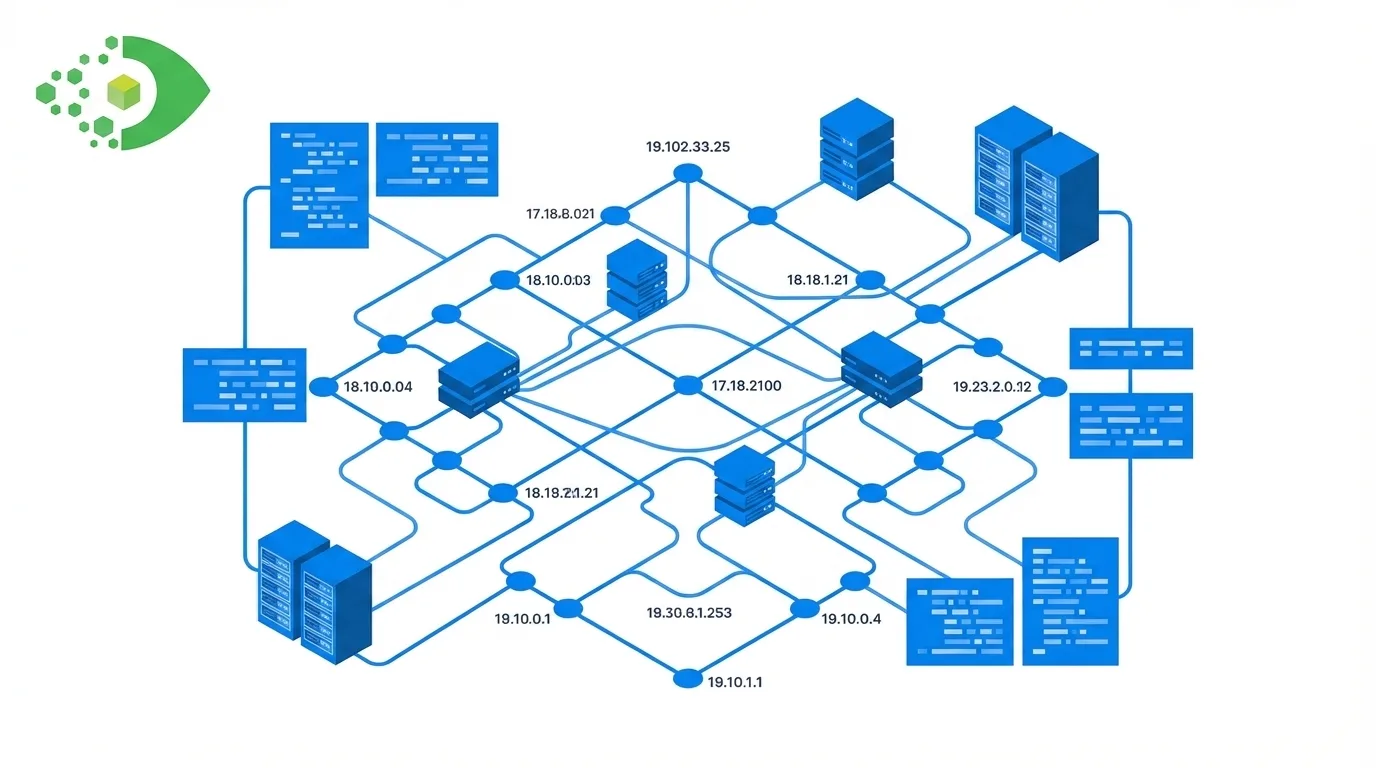
During a discovery scan, Virima identifies active devices on the network, captures their IP addresses, and correlates each IP to the CI it belongs to. The correlation happens automatically:
- Discovery detects a device at a specific IP address
- The device is identified and matched to an existing CI, or a new CI is created
- The IP address record is created or updated in the IPAM layer
- A relationship is established between the IP address record and the CI
- The subnet record for that IP range is updated to reflect current allocation status
This process runs every time Discovery scans the network. New devices get their IP records created. Decommissioned devices have their IP records updated to reflect that the address is now unallocated. The IPAM data stays current with the actual network state, not with what someone last manually updated.
Subnet Management with Real-Time CI Association
Subnet management in Virima goes beyond tracking which IP addresses are in use. Each subnet record in Virima maintains a live picture of:
- Total IP capacity for the subnet
- Allocated IPs and the CIs they’re assigned to
- Available IPs for new provisioning
- Historical allocation data for audit and planning purposes
Because subnet records connect directly to CI records, network planners can answer questions like:
- “Which subnet has capacity for the 20 new VMs we’re provisioning next month?”
- “Which devices in the 10.10.5.0/24 subnet are running end-of-life operating systems?”
- “What services does this subnet support, and what’s the impact of a change to its routing configuration?”
These questions require the intersection of IPAM data and CI data. In a standalone IPAM tool, the device-level context isn’t there. In Virima, it’s native.
Use Cases: Network Change Planning, IP Conflict Detection, Subnet Audit
Network change planning. Before provisioning new infrastructure, network engineers query Virima to find subnets with available IP ranges and verify that the CIs planned for those subnets won’t conflict with existing allocations. Because Discovery keeps the data current, the availability picture is accurate at the time of planning.
IP conflict detection. When Discovery scans a device at an IP address already assigned to a different CI in the CMDB, Virima surfaces that conflict immediately. The network team sees the discrepancy, investigates, and resolves it — before the conflict causes an outage or a failed provisioning workflow.
Subnet audit. Compliance frameworks and internal audit requirements often include network segmentation reviews. Virima’s subnet records provide the structured data for those reviews — which CIs are in which subnet, when IP allocations changed, and whether any unauthorized devices have appeared in restricted segments.
IPAM + CMDB vs. IPAM + CMDB + ITSM: The Unified Platform Advantage
Virima connects IPAM and CMDB data not just to each other, but to the broader ITSM ecosystem. When Virima integrates with ITSM platforms — ServiceNow, Jira, Ivanti, Halo ITSM, Xurrent, Hornbill — the IPAM data becomes part of the change and incident management workflow.
A change request for a network reconfiguration automatically surfaces the CIs and IP records affected. An incident involving a server pulls in the network context — which subnet the server is on, which other CIs share that subnet, and whether any recent IP changes might be related to the incident.
This is the unified platform advantage: IPAM data doesn’t sit in isolation. It enriches every ITSM workflow that touches the network.
Conclusion
The reconciliation problem between standalone IPAM tools and the CMDB is architectural, not operational. You cannot fully solve it by building better integrations or scheduling more frequent sync jobs — because two systems with overlapping data will always drift.
Virima 6.1.1 solves the problem at the root by including IPAM natively in the CMDB. IP addresses, subnets, and CIs share the same data layer, the same discovery pipeline, and the same relationship model. The reconciliation gap closes permanently.
The NIST Cybersecurity Framework 2.0 (2024) establishes network asset inventory — including IP address assignments — as foundational to the Identify function: organizations cannot protect or manage what they cannot accurately enumerate. A fragmented IPAM-CMDB architecture makes that enumeration structurally unreliable.
Schedule a Demo at virima.com to see how Virima’s native IPAM capability works within the CMDB.
Frequently Asked Questions
Why can’t organizations just build a better integration between their IPAM tool and their CMDB?
Integration-based approaches reduce the reconciliation gap but never eliminate it. Even well-built integrations update on a schedule, not in real time, and depend on both systems being updated consistently. When the underlying systems have different data models, update frequencies, and ownership structures, drift accumulates faster than integrations can correct it. Native IPAM within the CMDB removes the architectural dependency on integration entirely.
Does native IPAM in Virima replace DNS and DHCP management?
Virima’s IPAM capability focuses on IP address tracking, subnet management, and CI correlation within the CMDB. It’s not a DDI (DNS, DHCP, IPAM) solution. Organizations that need active DNS and DHCP management alongside IPAM typically use a dedicated DDI platform for those services, while using Virima to maintain the CI-correlated IP address record in the CMDB.
How does Virima handle IP address management in cloud environments?
Virima Discovery covers cloud-hosted infrastructure alongside on-premises CIs. Cloud instances with assigned IP addresses appear in the CMDB alongside their IP records, with the same relationship model as on-premises devices. This gives network and cloud teams a unified view of IP allocations across hybrid environments.
This article reflects capabilities in Virima 6.1.1. For the latest feature information, visit virima.com.