Flexera IT asset management: Pros, cons, and alternative

From tracking licenses to handling audits, the challenges in IT asset management can feel endless. That’s where Flexera IT asset management steps in. It’s built to simplify asset management, boost efficiency, and help businesses stay ahead in this tech world.
But like any tool, it’s not without its flaws. In this blog, we’ll explore the benefits Flexera IT asset management brings to the table. We’ll also explore the limitations that might hold you back, and some alternatives to consider.
Whether you’re already using Flexera or other asset management tools, this guide will help you make informed decisions. Let’s dive in!
A software true-up lands next quarter, and the license team trusts Flexera for entitlement math, while change and security still rebuild device and dependency truth in separate systems. That split is why Flexera IT asset management can win on SAM and SaaS control and still leave teams shopping for an alternative when CMDB-grade inventory and service impact are the missing layer.
When do teams look for a Flexera IT asset management alternative?
Flexera IT asset management is strongest for software license position, recognition libraries, and SaaS subscription control. Teams look past it when they need discovery-sourced CI accuracy, CMDB structure, and dependency maps for change and exposure work on the same estate. Virima is an alternative when ITAM must sit on runtime inventory and service context, not only license optimization.
| See how discovery-sourced inventory becomes Trusted Runtime Truth for license, ownership, and dependency decisions on the same CI records. Explore Trusted Runtime Truth. |
Overview of Flexera IT asset management
Flexera IT asset management simplifies managing software, hardware, and SaaS assets in hybrid IT environments. It also addresses the increasing complexity of IT systems while offering clear asset lifecycle management. Businesses can often optimize software licenses, lower audit risks, and improve vendor negotiations.
For Flexera's own product framing of IT asset management inside Flexera One, see the public Flexera One IT asset management overview.
By combining software, hardware, and SaaS management, Flexera provides a centralized solution. This integration also helps streamline IT operations, reduce manual work, and deliver valuable insights for better decision-making.
Features of Flexera IT asset management
Flexera IT asset management stands out by offering features designed to streamline IT asset tracking, licensing, and compliance.
- Complete asset discovery
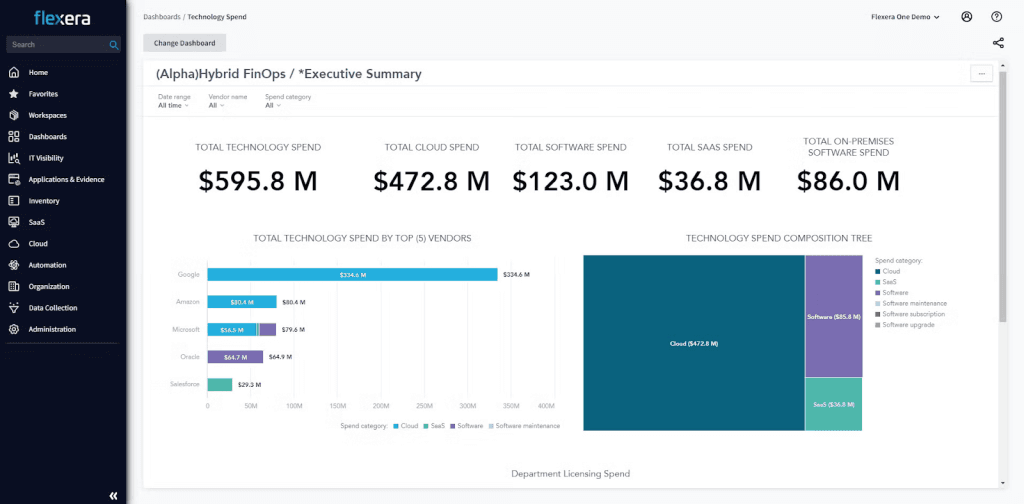
Establish a strong ITAM practice with reliable and precise data on your software, hardware, and SaaS usage.
Visibility across environments: Flexera IT asset management helps organizations discover and track all IT assets. It includes software, SaaS apps, and hardware, giving a clear view of the company’s IT landscape.
- Accurate recognition: The platform uses a strong Application Recognition Library (ARL) to correctly identify and further organize applications, versions, and publishers.
- License optimization
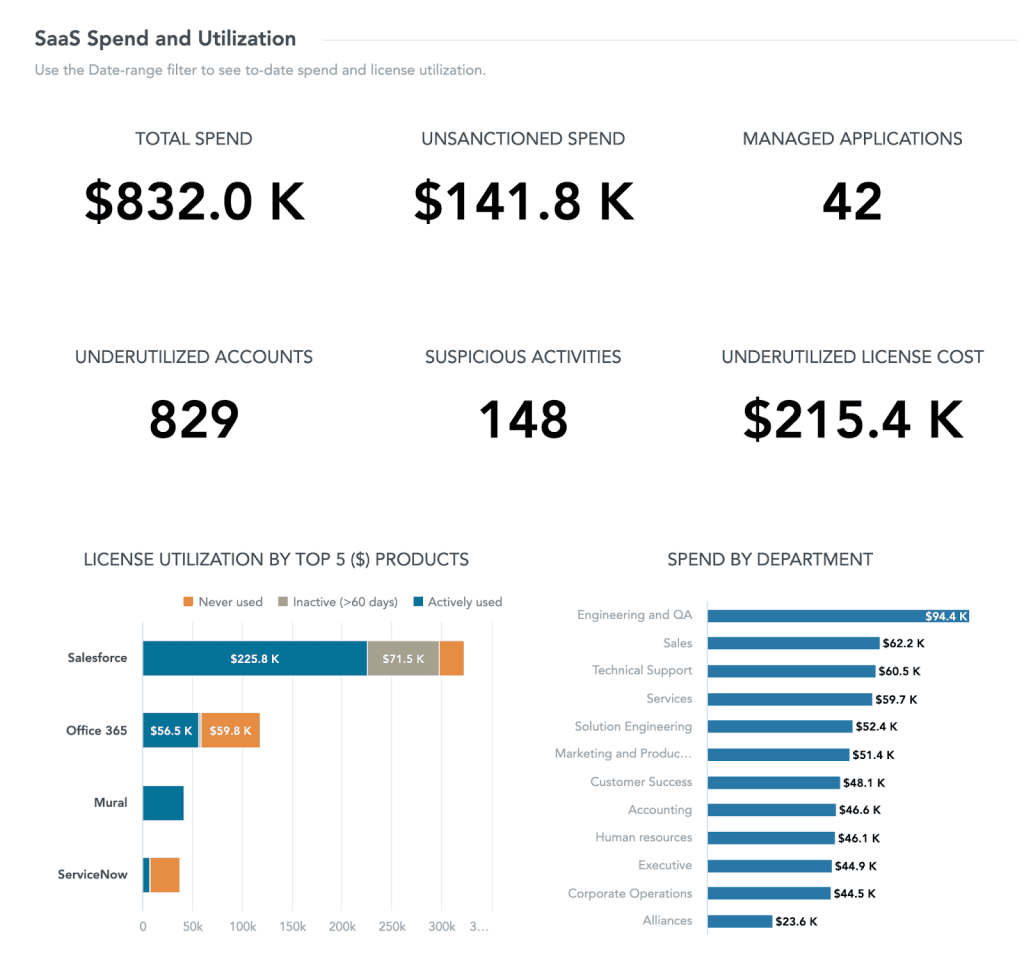
Flexera helps discover shadow SaaS, eliminate redundant apps, and optimize subscriptions based on real usage.
Product Use Rights Library (PURL): Flexera IT asset management automates license benefits like upgrade rights and hybrid use rights, ensuring efficient license use.
- SKU library: Flexera IT asset management compares purchased and used licenses. As a result, it helps to establish a clear license position across vendors.
- SaaS management
- SaaS visibility and optimization: Flexera IT asset management software helps find SaaS apps in use, manage subscriptions, and remove inactive ones to minimize costs.
- Data protection: It also automatically deletes data from unused SaaS subscriptions to protect sensitive information.
- Hardware asset management
- Lifecycle automation: Flexera IT asset management software automates the entire hardware asset lifecycle, from purchase to retirement, including warranty reminders.
- Contextualization: It connects hardware with organizational data, such as users and cost centers, for improved management insights.
- Policy automation
- Automated actions: The policy engine automates actions based on asset data, thus, supporting governance and compliance.
- Integration capabilities
- Interoperability with other systems: Flexera IT asset management software integrates with IT Service Management (ITSM) tools like ServiceNow and BMC. It also offers an open API for easy expansion and interoperability with other systems and platforms.
- Risk management
- Compliance monitoring: Flexera asset management tools help manage risks around vendor license compliance, regulatory compliance, and security vulnerabilities.
- Proactive risk identification: It also highlights risks and potential improvements through dashboards and visualizations.
- Reporting and analytics
- Data insights: Flexera asset management tools offer in-depth reports on usage patterns, cost-saving opportunities, and vendor management strategies.
By using these features, businesses can effectively manage IT resources, minimize waste, and improve license compliance.
Benefits of Flexera IT asset management
Here are the key benefits of using Flexera IT asset management to optimize your organization’s asset lifecycle.
- Save costs: Reduce extra expenses by optimizing SaaS subscriptions, maximizing license value, and also avoiding software waste.
- Improve data accuracy: Use reliable IT discovery tools to maintain clean, precise data for a strong ITAM foundation.
- Boost productivity: Automate tasks like software license management and asset provisioning often to focus on strategic business goals.
- Ensure compliance: Simplify audits and further meet vendor requirements, including IBM and Oracle certifications, with ease.
- Stay future-ready: Manage hybrid IT complexities and global licensing challenges with a platform built for modern enterprises.
Where does Flexera IT asset management still win?
Flexera still wins when Application Recognition Library depth, Product Use Rights automation, SKU-level license position, and SaaS find-and-optimize workflows are the main program jobs. Those strengths matter most for audit-driven SAM teams that already accept Flexera as the license system of record.
Limitations of Flexera IT asset management
Here are some key limitations of Flexera IT asset management, as noted in user reviews on platforms like G2 and Gartner.
- SaaS management needs improvement: Flexera’s asset management tools’ dashboard and metrics customization are limited and require better development.
- Weekly metering data updates: The platform provides metering updates only once a week, limiting how quickly usage signals refresh for day-to-day decisions.
- Deployment issues at scale: Large-scale deployments often encounter unresolved issues, thus, leading to delays and team frustration.
- Incomplete API documentation: Limited API examples make customization difficult, also requiring more technical expertise than expected.
- Challenging learning curve: The platform’s unique language and custom actions are hard to grasp, especially for new users.
- High price tag: Flexera IT asset management software is costly. Its value can look weaker as cloud-native tools become more efficient.
- Complex SaaS integrations: Integrating with multiple vendors adds complexity and also increases overall costs.
To get the most out of IT asset management tools, organizations should address these challenges with effective strategies.
| Dimension | Flexera ITAM strengths | Watch-outs teams report | Virima alternative path |
|---|---|---|---|
| Primary job | Software license position, recognition, SaaS control | Ops still needs CI and dependency truth elsewhere | Discovery-sourced inventory and ITAM fields on CMDB CIs |
| Recognition and rights | ARL, PURL, SKU libraries for entitlement math | Depth varies by catalog coverage and process maturity | Discovery plus ITAM workflows without claiming ARL parity |
| Metering and refresh | Strong for scheduled license and SaaS optimization cycles | Review themes cite slower metering refresh for some use cases | Scheduled high-frequency discovery cycles for estate inventory |
| Service and blast radius | Not the core SAM story on most Flexera ITAM programs | Change impact still rebuilt outside the license tool | ViVID™ maps after service definitions are provided |
| ITSM join | Enterprise ecosystem and partner integrations | Integration cost and complexity can rise with stack size | Partner names stay plain text via the integrations hub |
| Security context | Pairs with broader security and SAM programs | Not a substitute for full multi-OS vulnerability management | Windows Server NIST NVD overlay on maps plus your scanners |
When is Virima the better Flexera ITAM alternative?
Virima fits when license and SaaS control are not enough, and teams need multi-method discovery, CMDB structure, ITAM ownership fields, and dependency maps after service definitions on one operational foundation. Stay on Flexera when ARL-led SAM is already the winning program and infrastructure truth is solved elsewhere.
When Virima is the better ITAM path than Flexera alone
Virima delivers IT asset management on discovery-sourced inventory, CMDB structure, and service dependency context for teams that need more than license and SaaS optimization alone.
Broad visibility
Virima offers broad visibility into your IT environment through its advanced IT discovery features.
- Automated discovery and inventory: Virima automatically discovers and further tracks all IT assets, including hardware, software, and cloud resources.
- High-frequency discovery inventory updates: Access inventory refreshed through scheduled high-frequency discovery cycles so decisions rest on current estate data.
Actionable insights with ViVID™
Once service definitions are provided, manually, by spreadsheet import, or through an enterprise architecture integration, ViVID™ service mapping builds dependency maps and visual overlays from that input. ViVID™ does not invent which applications form a service.
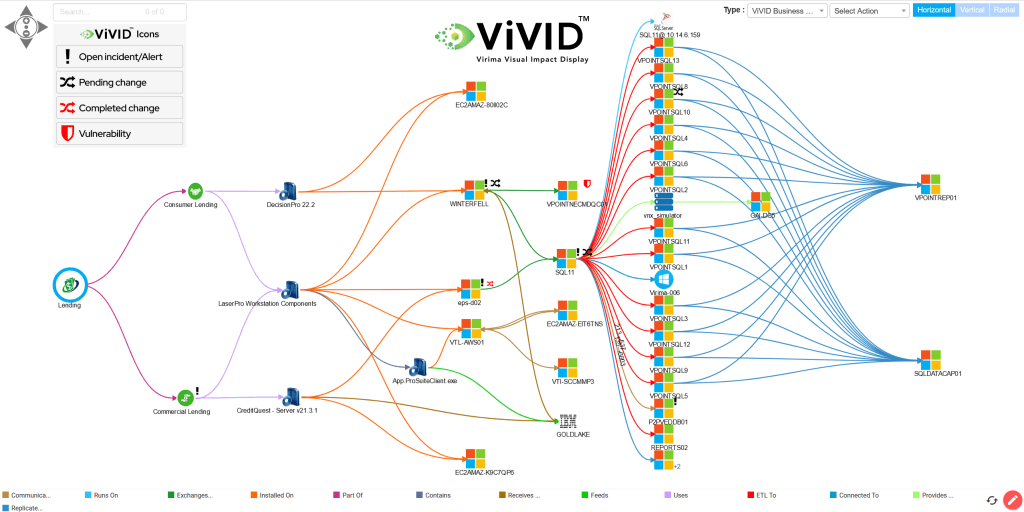
After definitions are in place, ViVID™ maps show how assets and applications interconnect so change and incident teams can work from dependency context.
- Visually appealing service maps: ViVID™ produces filterable, shareable dependency maps after service definitions are set.
- Data-driven insights: Overlay ITSM data, vulnerabilities, and also other essential details to uncover deeper insights into your environment.
Streamlined IT operations
Virima automates IT processes and integrates with key tools to boost operational efficiency.
- ITSM integration: Connect ITSM platforms such as ServiceNow and Jira through Virima integrations for a shared operational view. See the integrations hub for the full partner list.
- Windows Server vulnerability context: Where Virima surfaces NIST NVD CVE context on maps, that overlay applies to Windows Server configuration items and should be paired with your existing scanner stack for broader multi-OS coverage.
Enhanced collaboration
Virima fosters teamwork by offering a shared platform where IT teams can access and analyze asset data easily.
Future-proof ITAM
Virima’s platform is built for scalability and flexibility. It also ensures data portability across ITSM platforms as your needs change.
With Virima’s advanced features, you gain a thorough understanding of your IT assets. Optimize resources, streamline IT operations, and enhance your overall security with a solution designed for continuous improvement.
Choose your path: stay on Flexera, dual-run, or move ITAM ops to Virima
Stay on Flexera ITAM if: Application Recognition Library depth, Product Use Rights automation, and SaaS subscription control already solve the urgent audit and license jobs, and infrastructure CI truth plus dependency maps are covered in another system of record.
Dual-run Flexera and Virima if: finance and SAM keep Flexera for entitlement math, while ops and security need discovery-sourced CMDB records and ViVID™ maps after service definitions for change and exposure work.
Move ITAM operations onto Virima if: the program must unite hardware and software inventory, ownership, CMDB relationships, and service impact on the same CIs, and Flexera alone leaves those layers split.
Finding the right IT asset management software depends on your goals and IT environment. For a scalable platform with advanced features like service mapping, software license management, and Windows Server NIST NVD context on maps, Virima is a practical alternative to evaluate.
The right system significantly plays a key role in achieving success. Flexera is often strongest when software license position, recognition libraries, and SaaS subscription control are the primary jobs. Virima is a stronger fit when IT asset management must sit on discovery-sourced CMDB records plus dependency context for change and exposure work. It helps you gain better insights into your IT assets, optimize resources, and improve overall IT performance.
See license, ownership, and dependency context share one discovery-sourced foundation as Trusted Runtime Truth before you schedule a deeper walkthrough.
See how multi-method discovery, CMDB structure, ITAM workflows, and ViVID™ maps after service definitions give SAM and ops teams one inventory foundation without treating Flexera SAM strengths as failures.
Flexera IT asset management FAQs
What is Flexera IT asset management best at?
Flexera IT asset management is best when software license position, application recognition, product use rights automation, and SaaS subscription control are the primary program jobs. Those capabilities matter most for audit-driven SAM teams.
When should you evaluate a Flexera alternative?
Evaluate an alternative when discovery-sourced CI accuracy, CMDB structure, and dependency maps for change or exposure work are still missing after Flexera covers license and SaaS control. The gap is usually operational truth, not a single missing SAM report.
Does Virima replace Flexera for software license management?
Not always. Many teams dual-run Flexera for entitlement depth and Virima for discovery-sourced inventory, CMDB, and maps after service definitions. Full replacement makes sense only when ITAM operations must live on the same CI foundation as infrastructure and service context.
How does Virima handle vulnerability context compared with a full scanner?
Where Virima surfaces NIST NVD CVE context on maps, that overlay applies to Windows Server configuration items. Pair it with your existing vulnerability management scanners for broader multi-OS coverage rather than treating Virima as a full multi-OS vulnerability product.
What is Trusted Runtime Truth in an ITAM decision?
Trusted Runtime Truth is discovery-sourced ground truth for what exists, how it connects, what changed, what breaks, and who owns it. For ITAM buyers, it means license and ownership decisions share the same runtime inventory foundation used for change and exposure work.