Cloud Migration Planning With Dependency and Wave Mapping

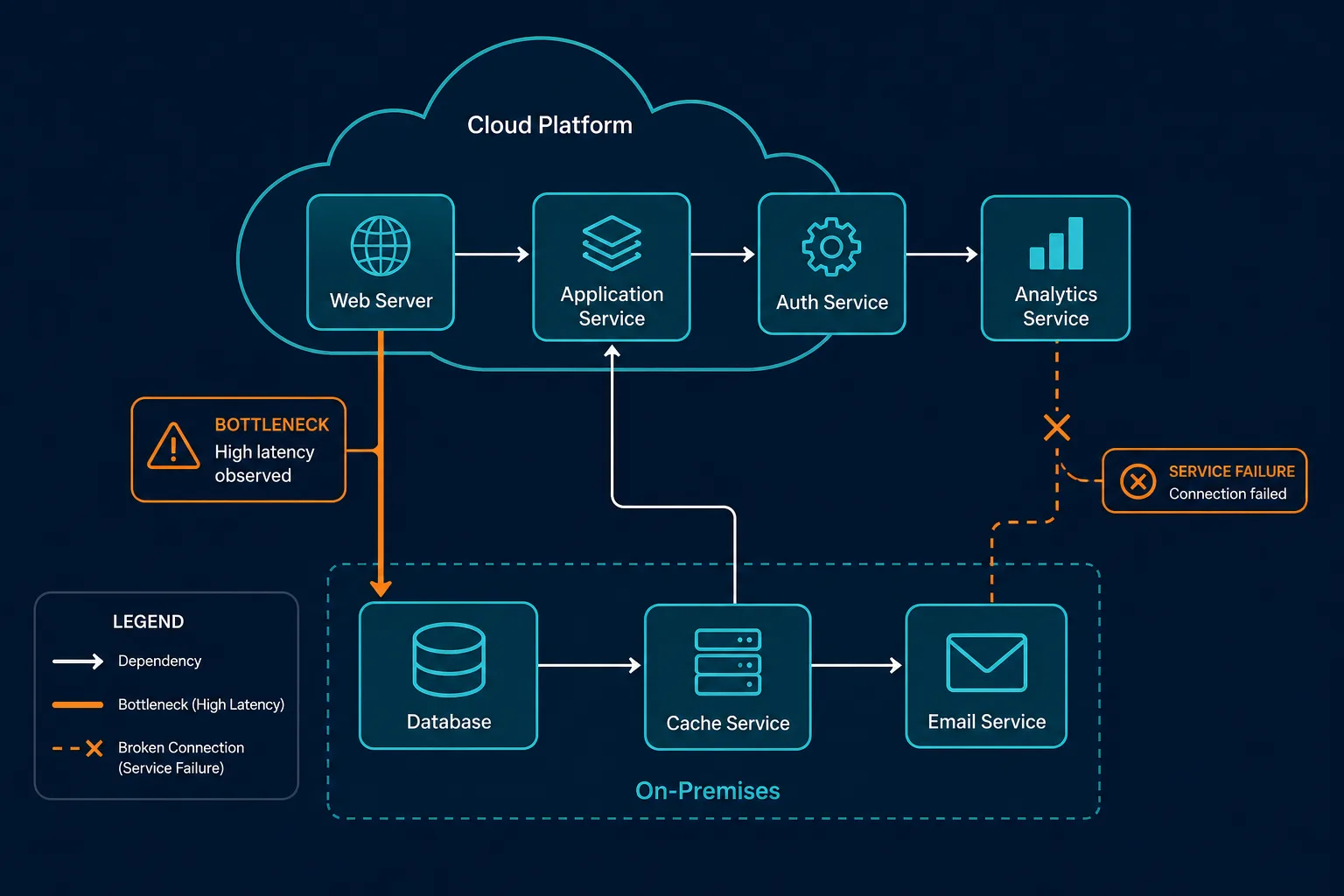
A team migrates a web server to AWS while its database stays on-premises. Network latency spikes within minutes, a firewall rule tied to the old subnet breaks, and end users hit outages before anyone traces the failure back to a dependency nobody mapped. That is the routine cost of skipping dependency discovery: teams migrate application by application, then rebuild the connections between them during cutover, under pressure, in production. Cloud migration planning that starts with automated dependency discovery, instead of interviews and spreadsheets, groups workloads into migration waves by what they actually connect to, not by org chart. That distinction is what separates a wave plan that survives cutover from one that doesn’t. Cloud migration planning is the process of mapping every technical dependency between applications, databases, and infrastructure before sequencing workloads into migration waves — the step that determines whether cutover is a non-event or an outage.
Migrating enterprise applications to cloud platforms involves rehosting, refactoring, or replatforming interconnected workloads. IT Directors must group workloads into migration waves based on technical dependencies rather than arbitrary business units.
The Operational Risks of Unmapped Cloud Migrations
Moving applications to the cloud without complete dependency maps creates severe operational hazards during cutover.
Complex enterprise software relies on multi-tiered architectures. A single business application may connect to shared databases, identity providers, internal microservices, and external SaaS endpoints. When teams move a web server to AWS while its database remains on-premises, network latency spikes. If dependent security rules or API links break, end users experience immediate outages.
Unexpected technical dependencies are a recurring driver of enterprise cloud migration budget overruns and schedule delays, and discovering hidden connections during cutover forces teams into emergency rollbacks. Those hidden connections are rarely a single hop: a billing service that depends on a shared authentication microservice, which in turn depends on an on-premises directory server, can look like three unrelated migration decisions until the full chain is mapped end to end.
Manual dependency discovery relying on application owner interviews is notoriously unreliable. Tribal knowledge leaves gaps, while configuration documentation ages quickly. Effective cloud migration planning requires automated discovery tools that map live network traffic and system relationships across target infrastructure.
Unmapped migrations also inflate cloud infrastructure costs. When infrastructure teams migrate servers without understanding active database connections, they often over-provision cloud resources to compensate for network latency. Accurate dependency maps allow teams to right-size target cloud instances based on actual workload traffic — and surface dormant legacy connections that should be retired rather than migrated, cutting cloud licensing costs and simplifying the target architecture.
What is migration wave planning in cloud migration?
Migration wave planning is the practice of grouping applications and infrastructure into logical migration batches. Migration teams order these groups by architectural complexity, business criticality, and technical dependencies to minimize outage risks and network latency during cutover.
How Application Dependency Mapping Powers Migration Waves
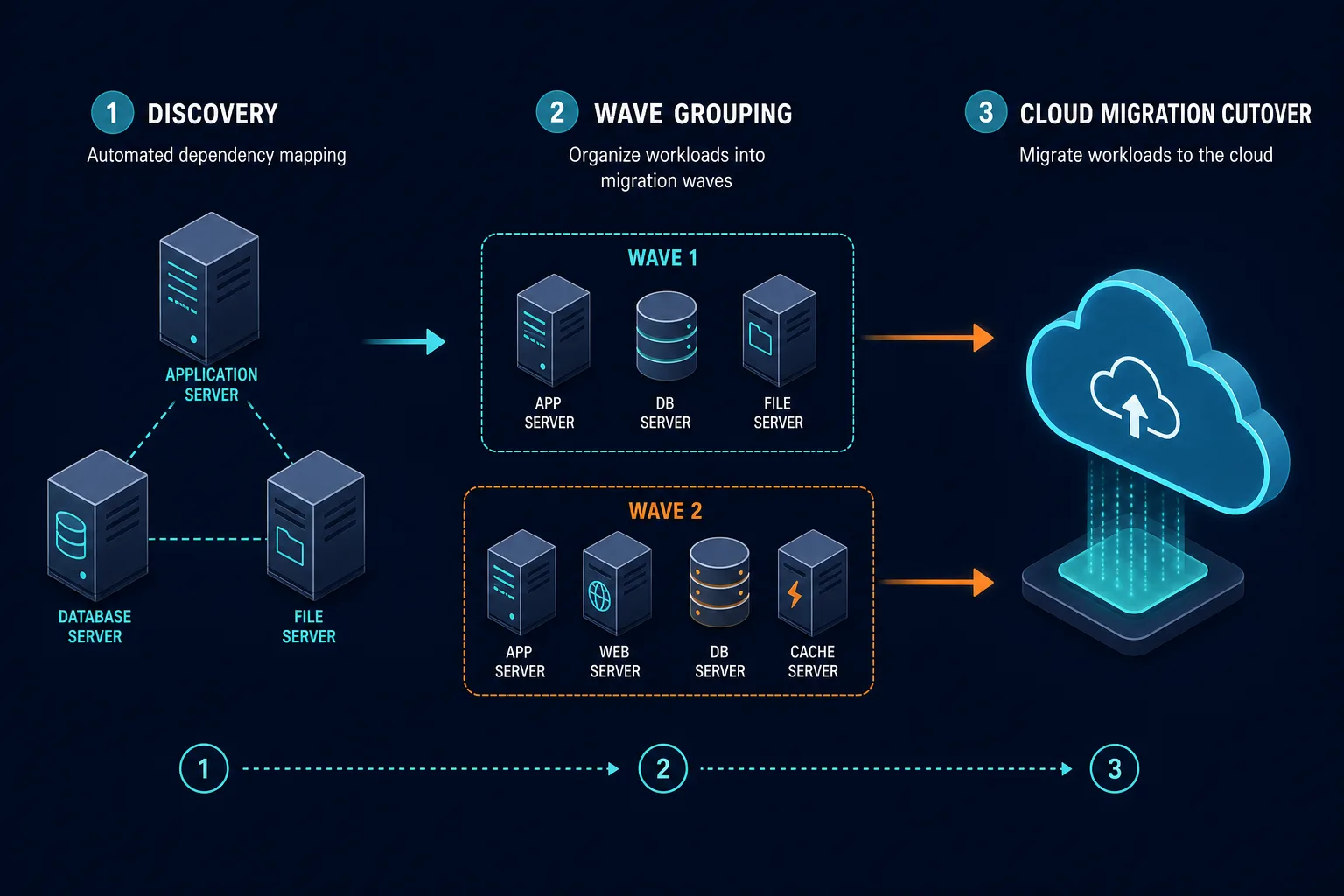
Application dependency mapping establishes the foundational blueprint for cloud migration sequencing. Automated discovery tools map system communications to identify host-to-host links, database queries, and active process connections.
Mapping tools build visual relationship graphs that reveal how components interact across environments. This approach surfaces host-to-host links, database dependencies, and API calls, giving migration architects the specific data needed to determine exact application boundaries before designing migration waves.
Dependency mapping simplifies wave planning through what this guide calls the Discovery-to-Wave sequence — a clear set of execution phases:
- Identify core application boundaries and shared infrastructure services.
- Group tightly coupled microservices and databases into single migration units.
- Isolate legacy systems that require extended hybrid connectivity during transition.
- Establish migration wave groups based on risk tolerance and dependency chains.
- Verify post-migration performance and service maps in the target cloud.
Not every dependency carries equal weight in wave planning. An application querying a shared database dozens of times per second has a strong dependency and must migrate in the same wave as that database. An application that only touches a batch job overnight has a weak dependency and can move independently. Wave plans that don’t distinguish the two routinely misjudge risk and schedule strongly-coupled systems apart.
According to the Flexera 2026 State of Cloud Migration Report, 86% of successful cloud migration projects rely on automated dependency mapping to sequence workload moves, removing guesswork from wave design and preventing unexpected network failures — Virima’s breakdown of that report covers what the gap means for teams still relying on manual discovery during planning.
IT teams evaluating migration platforms can explore Virima’s trusted runtime truth to build accurate dependency maps prior to cloud cutover.
Framework for Sequencing Migration Waves
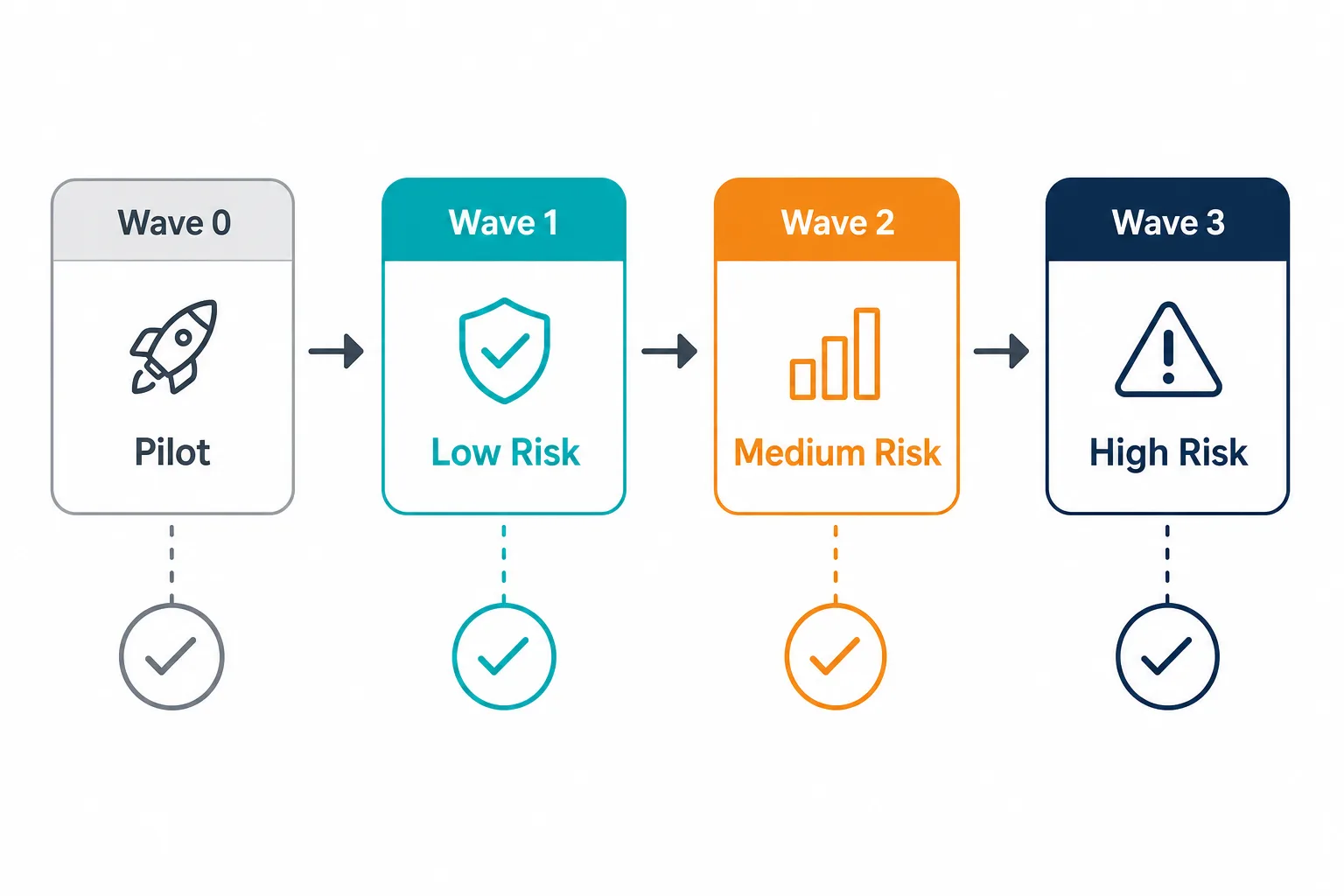
IT Directors structure migration waves to balance operational risk against migration velocity. Workloads transition logically from low-complexity isolated systems to complex core business platforms.
| Migration Wave | Target Workload Profile | Dependency Level | Primary Migration Objective | Risk Profile |
|---|---|---|---|---|
| Wave 0: Pilot | Non-production dev/test environments | Minimal / Isolated | Validate cloud landing zone and migration automation | Low |
| Wave 1: Low Risk | Standalone internal applications | Simple / Low | Refine operational processes and team roles | Low-Medium |
| Wave 2: Medium Risk | Tier-2 business tools, regional databases | Moderate | Migrate standard multi-tier workloads | Medium |
| Wave 3: High Risk | Core ERP, primary database clusters, shared identity | High / Complex | Move mission-critical infrastructure | High |
Starting with low-risk pilot environments allows teams to test cloud landing zones and network tunnels without threatening revenue operations.
As migration waves progress to core infrastructure, dependency mapping ensures linked components move together. When a shared database supports multiple applications, migration wave planning determines optimal sequencing. Once those dependency chains are mapped and confirmed, teams can decide whether to move all dependent tools simultaneously or maintain temporary hybrid cloud connections during transition.
Wave sequencing also aligns migration schedules with business maintenance windows. High-risk waves should be scheduled during low-volume operational periods to minimize business impact if issues arise during cutover.
Only the wave immediately ahead needs full technical detail — every host and every dependency confirmed before cutover. Waves scheduled two or more cycles out should stay high-level: infrastructure ownership and configurations change faster than a static plan can track, and over-specifying those later waves wastes discovery effort on data that will be stale by the time execution arrives.
How does dependency mapping simplify cloud migration wave planning?
Dependency mapping identifies all technical connections between servers, databases, and microservices. Revealing shared dependencies enables IT teams to group linked components into the same migration wave. This approach prevents network latency and broken API links during cloud cutover.
Where Migration Wave Plans Actually Break in Practice
Most migration wave plans fail for a handful of repeatable reasons, and none of them are exotic.
The first is scope. Teams typically map the dependencies visible in their own team’s documentation, not the ones one hop further out. A billing service that calls a shared authentication microservice, which in turn calls a legacy directory server, looks like three separate migration decisions until someone traces the chain end to end. Miss that chain and a wave that looked low risk on paper turns into an emergency rollback during cutover, which is the same execution gap described above.
The second is staleness. Dependency maps built during a planning phase that starts months before cutover go out of date as application owners ship changes in the meantime. Keeping service maps accurate as infrastructure changes covers the same discipline outside a migration context, and it applies here too: dependency data needs to refresh on a schedule, not just once at kickoff.
The third is shared infrastructure that nobody owns. Active Directory, DNS, and shared database tiers rarely belong to a single application team, so they fall through the cracks of a wave plan built around application ownership instead of technical dependency. Shared database dependencies walks through what happens when a shared database tier gets treated as one application’s dependency instead of the multi-tenant chokepoint it actually is.
Best Practices for Cloud Migration Dependency Mapping
Executing a smooth cloud migration requires combining continuous asset discovery with governance best practices.
1. Run Automated Multi-Layer Asset Discovery
Combine agentless network probes, cloud API connectors, and host-level data feeds. Discovering active processes, open listening ports, and cloud resource tags provides a complete inventory of physical, virtual, and cloud assets. Continuous discovery captures transient workload spikes that single point-in-time scans miss.
2. Map Service Dependencies Visually
Raw asset lists do not explain operational relationships. Use dependency mapping engines to generate visual service topologies. Teams can inspect these maps using Virima’s ViVID™ service maps to visualize change impact and blast radius before scheduling migration windows. Visual maps help cross-functional teams agree on wave boundaries.
3. Account for Shared On-Premises Services
Many cloud-bound applications depend on shared on-premises utilities. Key shared services include Active Directory, DNS, mainframe databases, and security logging endpoints. Migration wave plans must account for hybrid network latency and bandwidth limits when accessing remaining data center services.
4. Establish Hybrid Network Performance Baselines
Before executing wave cutovers, measure baseline network latency between data centers and cloud landing zones. Benchmark performance for core database queries and file transfers. Comparing post-migration network metrics against pre-migration baselines confirms that migrated applications operate within acceptable latency thresholds.
5. Integrate Dependency Data into Central CMDB
Keep your configuration management database updated throughout the migration process. Bi-directional sync keeps asset states accurate across cloud and data center boundaries. Ensure native integration with ITSM platforms including ServiceNow, Jira Service Management, Ivanti, HaloITSM, Xurrent, and Hornbill.
Organizations that maintain CMDB accuracy throughout a cloud migration report fewer post-migration incidents than those relying on a one-time, pre-migration snapshot.
Why is real-time dependency visibility essential during cloud cutover?
Real-time dependency visibility tracks live traffic flows and configuration changes during cutover. It allows migration teams to confirm that target cloud instances maintain active connections with required databases and external APIs. This verification happens before decommissioning legacy hosts.
Turn the wave-sequencing framework above into a working plan — Cherwell Discovery and Dependency Mapping (DDM) to map your own Wave 0–3 groupings before your next cutover window.