CMDB in Insurance: Mapping Legacy Policy Systems After M&A

An insurer acquires another carrier and inherits its core policy platform. That platform remains active years later because active policy contracts reside on it. The carrier also inherits surrounding databases, middleware, batch interfaces, and reporting feeds. Difficulty arises not in identifying old policy systems, but in knowing what still depends on them.
What is a CMDB in insurance?
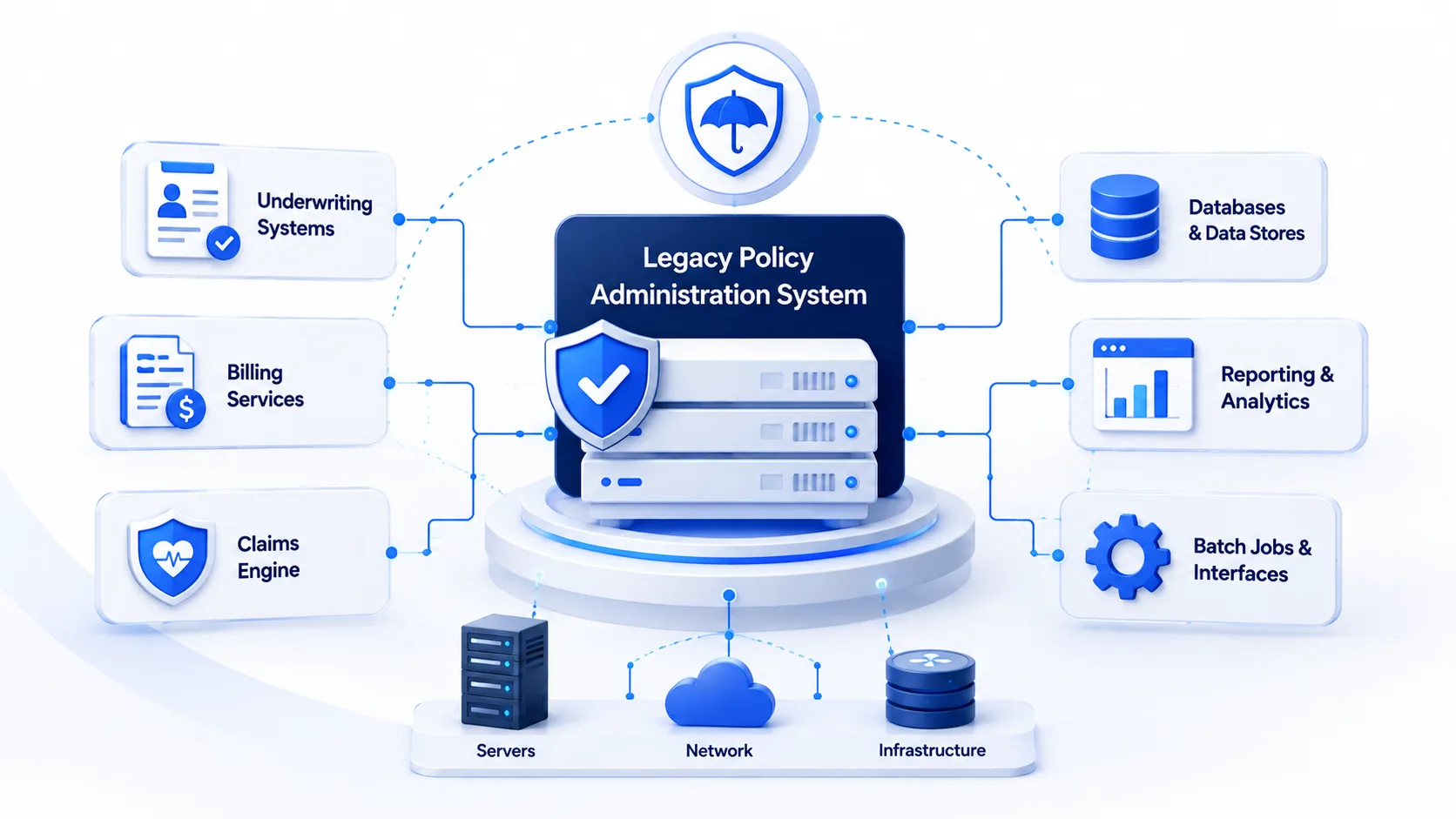
A configuration management database (CMDB) in insurance records relationship context around policy administration systems (PAS). It maps how legacy policy platforms connect to claims engines, billing services, databases, and network infrastructure across acquired carrier environments.
Mergers create portfolios of policy systems, not one legacy platform
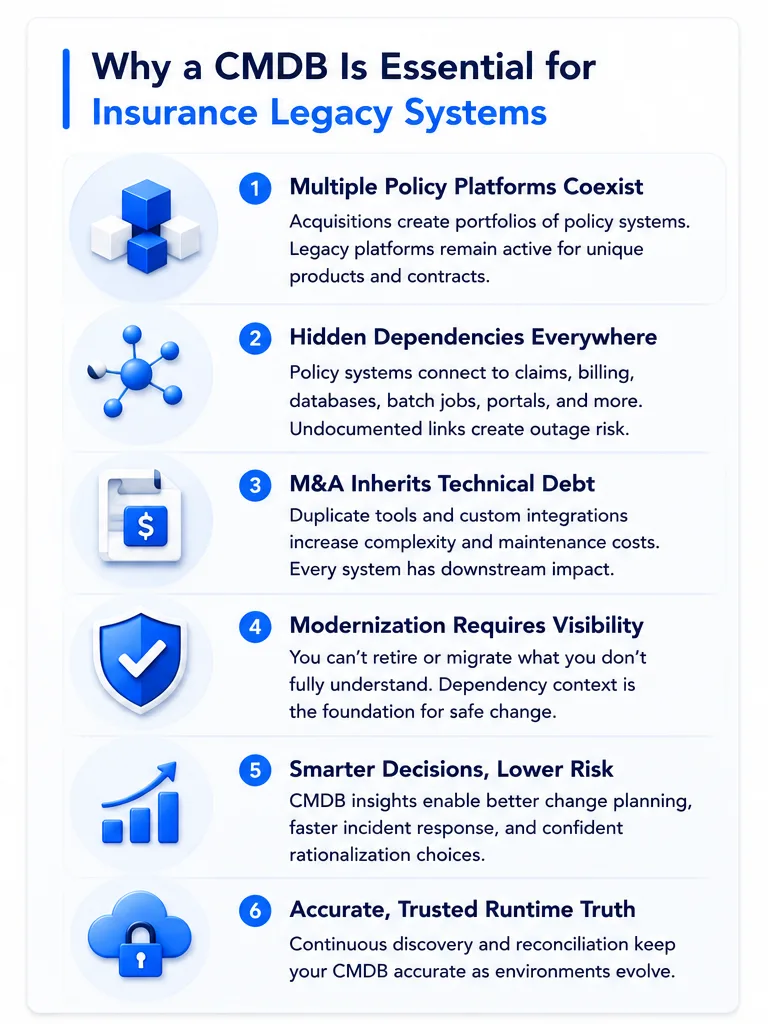
Insurance acquisitions rarely produce single-system environments. A case study from Cognizant describes a U.S. insurer that accumulated 13 policy administration systems after decades of mergers. Many of those platforms remained active, creating duplicative maintenance overhead and complex integration paths across the enterprise.
Industry research by Deloitte confirms multi-system portfolios are widespread. Two-thirds of surveyed life and annuity insurers operated more than one policy administration platform, while 23% managed more than four. The research noted that insurers frequently choose to enhance or upgrade legacy platforms rather than eliminate them immediately.
Coexistence remains common because policy conversion is expensive and risk-intensive. Acquired books of business carry distinct product rules embedded in legacy code. Moving those rules requires extensive testing and regulatory validation. That’s why carriers maintain multiple policy platforms while modernization proceeds in phases.
A policy administration system is surrounded by hidden dependencies
A policy administration system does not run in isolation. It exchanges data with underwriting tools, billing engines, claims portals, commission platforms, and reporting data warehouses. Batch jobs move policy records to financial ledgers every evening.
Deloitte describes legacy insurance environments as networks of core systems joined through point-to-point integrations. These integration webs restrict data access and increase operational complexity during system updates. A change to a legacy database schema can inadvertently disrupt downstream claims processing or customer portal authentication. A billing update on one acquired platform can quietly break policy status on another, because the connection between them was documented nowhere — it was patched in during the original merger and never revisited.
Application inventories list active software licenses and server locations. They do not explain why shutting down a system causes unmapped service outages. Dependency mapping reveals the operational relationships that keep legacy platforms indispensable to daily business functions.
M&A turns technical debt into dependency inheritance
Carriers inherit complete operational environments with every acquisition. Two merged insurers may operate separate billing engines, customer portals, and document management tools. Duplicate system categories do not mean those platforms are interchangeable.
One acquired policy platform might feed a specialized reinsurance reporting engine. Another platform might contain product logic for discontinued annuity lines. A case study by Equisoft on Columbian Financial Group highlights this operational pattern. Two decades of acquisitions left over 700,000 policies distributed across several legacy administration platforms. Discovering IT Assets After Mergers and Acquisitions covers how this kind of inherited technical debt shows up during due diligence, before the deal even closes.
Legacy technology remains operational because downstream services depend on its data. Retiring an acquired platform requires identifying every connected service first.
Why is retiring a legacy policy administration system difficult?
Retiring a policy platform is difficult because downstream claims, billing, and reporting systems depend on its underlying data. Insurers must map application interfaces, batch schedules, and infrastructure dependencies before converting policy records to a new platform.
Policy administration system modernization requires more than a migration plan
Policy administration system modernization depends on policy conversion, which remains difficult to execute and justify financially. Migration plans often focus on data conversion while overlooking operational dependencies. Teams need answers about active products, scheduled batch jobs, and database relationships before scheduling decommissioning dates.
Consolidation decisions require verified technical details. Architects must identify which customer portals query the legacy system. They must determine which servers host the underlying databases and which business teams own each interface.
Modernization plans stall when dependency context is missing. Teams cannot decommission an application without knowing what replaces every integration. Dependency mapping is the foundation for safe system retirement.
What CMDB in insurance workflows should map around the policy system
A configuration management database does not serve as the policy administration master database. The policy platform remains authoritative for policy records and coverage rules. The CMDB records configuration context and structural relationships around that platform — discovery-sourced ground truth architects can verify instead of relying on assumptions carried over from the original merger documentation.
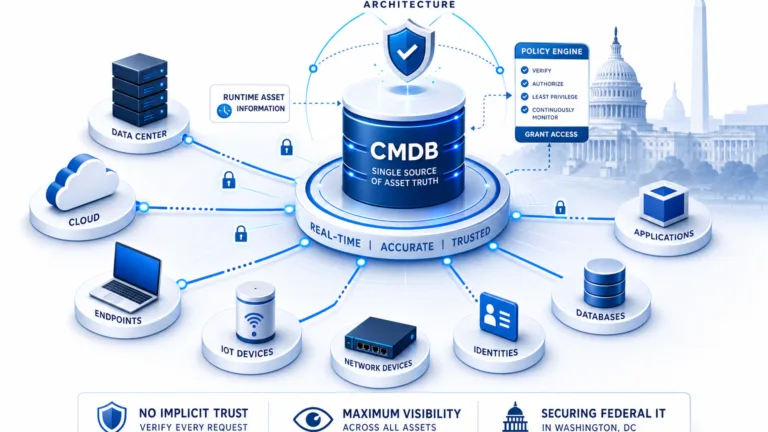
The CMDB links business services to supporting applications and infrastructure. Relationships flow from business services to policy applications, application services, middleware, database instances, and virtual servers. This structure maps how physical and virtual infrastructure supports insurance operations.
Enterprise architecture guidance from ServiceNow emphasizes application rationalization during mergers. Modernization relies on mapping business applications to application services and underlying infrastructure in the CMDB. That relationship model helps carriers evaluate system redundancy during mergers and corporate restructuring. Virima’s own CMDB best practices guidance covers how to structure these application-to-infrastructure relationships for accurate reconciliation.
Discovery should validate inherited infrastructure
Merger documentation becomes outdated as systems evolve. Infrastructure moves, hosts change, and databases migrate across cloud and on-premise environments. Integration endpoints change without updates to original architecture diagrams.
A CMDB relies on observed infrastructure data to maintain accuracy. Automated discovery identifies active servers, database instances, and network connections across distributed environments. CMDB reconciliation then merges duplicate records inherited from acquired source systems.
Discovery supplies infrastructure visibility, but it does not decode custom business logic automatically. Teams combine automated discovery data with traffic observation, architecture records, and application-owner input. That combined approach produces a complete map of inherited dependencies.
How does a CMDB support insurance application rationalization?
A CMDB supports application rationalization by revealing which downstream services, databases, and business units depend on each legacy platform. This visibility helps IT teams distinguish redundant applications from operationally indispensable core systems.
Dependency visibility changes modernization decisions
Dependency context transforms how insurance IT teams approach system modernization. It replaces assumptions with verified operational data during platform changes and consolidation projects.
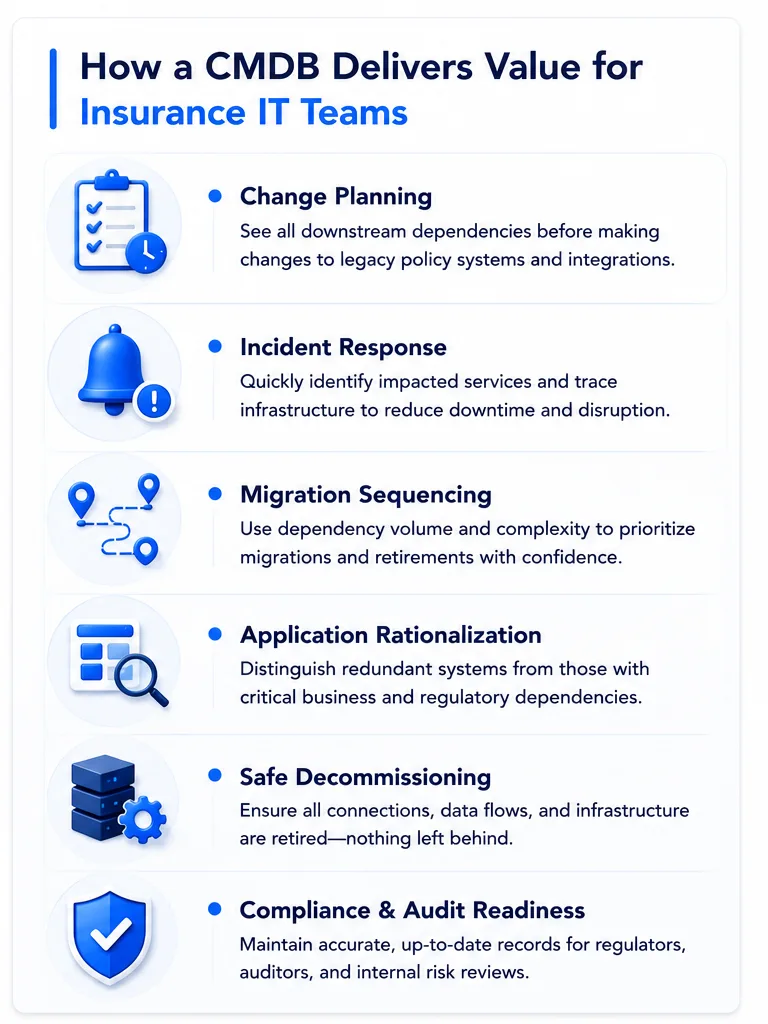
Change planning
IT teams inspect downstream dependencies before altering a legacy policy platform. This inspection prevents unexpected outages in connected claims or billing systems during maintenance windows.
Incident response
When a legacy platform experiences an outage, operators identify affected business services quickly. They trace infrastructure relationships to isolate failing components and reduce service disruption.
Migration sequencing
Carriers evaluate dependency volume to sequence platform retirements effectively. Systems with fewer downstream integrations become early candidates for policy migration and decommissioning. Virima blog post on sequencing legacy application retirements after an acquisition walks through how teams prioritize that sequencing in practice.
Application rationalization
Enterprise architects distinguish redundant software from systems that support unique business capabilities. They avoid shutting down platforms that feed essential financial or regulatory reporting pipelines.
Decommissioning
Retirement workflows remove related application services, database instances, and virtual hosts alongside the main application. This thorough cleanup prevents orphaned infrastructure from drawing ongoing hosting fees.
What an insurance CMDB should show around each legacy PAS
A complete CMDB record connects technical, operational, and business context for every policy administration platform.
| Question | Context Needed |
|---|---|
| What is this system? | Policy platform name, version, technical owner, lifecycle state |
| What business does it support? | Covered product lines, policy types, supported business units |
| What connects to it? | API endpoints, middleware queues, batch interfaces, data feeds |
| What data does it use? | Database instances, storage volumes, external data sources |
| Where does it run? | Physical servers, virtual machines, cloud instances, data centers |
| What depends on it? | Claims systems, billing engines, customer portals, reporting tools |
| Who owns dependencies? | Application owners, infrastructure managers, business contacts |
| What is changing? | Active migration projects, scheduled maintenance, retirement plans |
| Can it retire safely? | Replacement status for integrations, remaining policy counts |
A practical CMDB workflow after insurance mergers
Managing inherited insurance technology requires a structured sequence across IT teams.
- Discover: Scan network environments to identify connected application servers, databases, and cloud resources.
- Reconcile: Consolidate duplicate configuration item records created during corporate acquisitions.
- Map: Connect policy applications to supporting infrastructure, middleware, and downstream business services.
- Validate: Review mapped relationships with application owners and enterprise architects to confirm operational accuracy.
- Rationalize: Evaluate system redundancy and dependency complexity to identify retirement candidates.
- Retire: Decommission application services, revoke database access, and release infrastructure after replacements go live.
Bringing legacy insurance dependency mapping together with Virima
Legacy insurance systems accumulate across years of acquisitions — specialized policy administration platforms, claims management engines, and financial systems that all remain in production. Virima provides an automated discovery, reconciliation, CMDB, and service mapping layer that reconciles enterprise infrastructure around those inherited platforms. It establishes visibility across applications, dependencies, and supporting technology without disrupting core policy operations.
Virima’s IT discovery capability scans physical, virtual, and cloud environments to inventory active hardware and operating systems, then detects installed software packages, database instances, and application services across enterprise networks. From there:
- CMDB Reconciliation: Merges multi-source inventory data into reconciled CMDB records with verified change history.
- Application Dependency Mapping: Maps relationships between policy platforms, application servers, databases, and network components.
- ViVID™ service maps: Generate application-to-infrastructure dependency maps once service definitions are provided, maintaining accurate service context as infrastructure changes.
- Configuration Change Tracking: Monitors configuration edits across supporting infrastructure to detect unauthorized changes.
- ITSM Integrations: Connects dependency data to downstream service management tools such as ServiceNow and Jira Service Management, with direct connectivity available through Virima all integrations.
Virima does not replace policy administration systems, execute policy record conversions, or manage insurance underwriting rules. It provides the dependency and infrastructure data that architecture and modernization teams need to plan retirements safely.
Frequently Asked Questions
Why do insurers operate multiple policy administration systems after mergers?
Acquisitions bring distinct books of business with embedded product rules. Policy conversion is expensive and regulatory-intensive, leading carriers to maintain legacy platforms while executing gradual modernization plans.
How does a CMDB differ from a policy administration system?
A policy administration system manages policy contracts, coverage rules, and premium billing. A CMDB records the underlying technical infrastructure, software dependencies, and service relationships surrounding those policy systems.
Can automated discovery uncover all legacy application integrations?
Automated discovery identifies active network connections, servers, and database instances. Uncovering custom batch schedules and business logic requires combining discovery data with application-owner input and architecture documentation.
Why is dependency mapping necessary before system decommissioning?
Decommissioning a system without dependency mapping risks breaking downstream claims, billing, or reporting services. Dependency mapping confirms that all connected interfaces have valid replacements before shutdown.
What role does Virima play in insurance IT modernization?
Virima provides automated discovery, CMDB reconciliation, and ViVID service mapping. It maps infrastructure and application relationships around legacy platforms to support modernization and change planning.
Does Virima replace a policy administration system or ITSM platform during insurance modernization?
No. Virima provides discovery, CMDB reconciliation, and dependency mapping around existing policy administration and ITSM platforms such as ServiceNow and Jira Service Management — it doesn’t replace policy record-keeping or ITSM workflows.