Why Airline CIOs Need a CMDB in Aviation and Airline Operations

On July 28, 2026, a ground stop was issued. Every aircraft waiting to depart was frozen in place. The flight operations system that handles dispatch, weight-and-balance calculations, and crew scheduling had failed. This was the third ground stop in under two years caused by the exact same IT architecture gap within American’s operational technology stack.
The real problem emerges in the pattern. A hardware fault on December 24, 2024 took down dispatch and flight planning. June 27, 2025: a connectivity outage froze booking, check-in, and maintenance systems simultaneously across eight major hubs. July 28, 2026: the same failure mode, different month. Each time, the root cause was not a single broken system. It was fragmentation. American’s operations teams did not have a unified view of how their reservation system, crew scheduling, maintenance tracking, weight-and-balance calculation, and departure control actually connect.
What is a CMDB, and Why Does Aviation Need One?
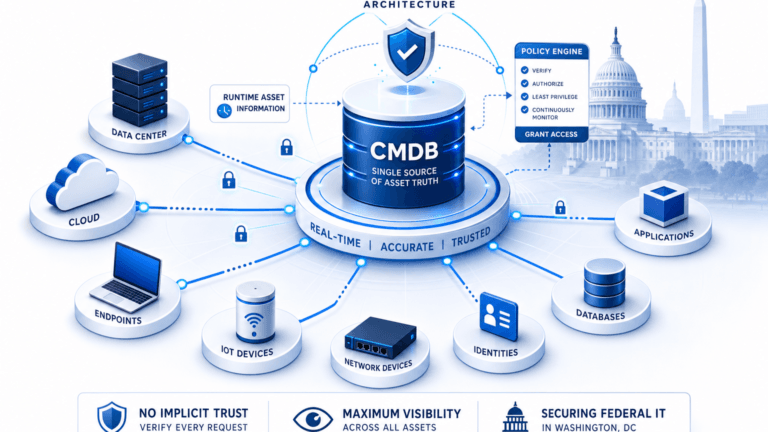
A Configuration Management Database (CMDB) is a central repository that records every system, application, hardware component, cloud service, and the dependencies linking them. In aviation operations, this means mapping Passenger Service Systems (PSS) to crew scheduling, weight-and-balance tools to gate management, and maintenance systems to flight planning. A CMDB in aviation and airlines creates the complete picture of operational interconnections that safety and reliability depend on.
According to the ITIL 4 framework, a CMDB is foundational for operational awareness. Without it, teams manage systems in isolation. When one fails, nobody knows which downstream systems lose data or process inputs. When one is updated, teams miss the services that depend on it.
For aviation, the stakes are operational continuity and passenger safety. According to a GAO review, regulators found 34 significant incidents across three years, with 85 percent causing flight delays or cancellations. The common thread: fragmented visibility. Teams could not answer the question quickly enough.
If the departure control system is down, which gates are affected?
If weight-and-balance is offline, which aircraft can legally depart?
See how enterprise CIOs establish trusted runtime truth to de-risk digital transformation and eliminate critical outage exposure: https://virima.com/trusted-runtime-truth/
Where Silos Become Single Points of Failure
Aviation operations run extraordinarily interconnected technology stacks. A single failure propagates quickly because dependencies run deep and nobody has mapped them in one place.
| Operational Layer | Typical Silo | Real Interconnection Missing |
| Reservations | Passenger Service System | Books seats, seats determine aircraft weight, weight impacts dispatch approval |
| Crew Management | Crew Scheduling System | Schedules crews for flights, needs dispatch to release aircraft, needs maintenance to clear maintenance holds |
| Ground Operations | Gate Management, Catering, Baggage | Requires aircraft location from departure control, needs weight-and-balance clearance before pushback |
| Aircraft Readiness | Maintenance, Dispatch | Maintenance hold blocks departure control release, which blocks crew notification, which blocks gate pushback |
| Regulatory Compliance | Weight-and-Balance, Flight Planning | Needs accurate manifest from reservations, needs crew rest data from scheduling, needs aircraft COG from maintenance |
Without a CMDB mapping these connections, each system team owns their piece, and nobody owns the whole picture. When one fails, teams spend hours discovering which other systems depend on it.
Why is CMDB in Aviation Critical?
Every unplanned minute of downtime in aviation costs the airline real revenue. According to the SITA 2024 report, airlines globally spend an estimated $37 billion annually on IT, yet persistent gaps remain in modernization and resilience. These gaps are not technology deficits. They are visibility deficits.
The American Airlines incidents reveal this directly. The Alliance Pilots Association identified the failure point: the Flight Operations System (FOS). But FOS does not exist in isolation. It receives weight-and-balance constraints from maintenance systems, crew rest data from scheduling systems, passenger count from reservations, and gate assignments from ground control. One piece of that data becomes stale or incorrect, and the entire operational chain is at risk.
Three Failure Modes That a CMDB Prevents
- The Invisible Dependency Chain: When operations span Passenger Service Systems, Crew Management platforms, Weight-and-Balance tools, Gate Management, and Maintenance Tracking, no single system team understands the full flow. A network upgrade in one hub takes down the reservations link to crew scheduling. Three hours later, when crew is not notified of schedule changes, flights depart with mismatched crews. A CMDB maps this chain in advance so changes are orchestrated, not improvised. Result: dependencies become visible before the failure occurs.
- The Recovery Blindness: When a system fails, the first question is always the same: which other systems does this one feed into? American Airlines answered this question differently each of its three outages because they never mapped it. A CMDB records the exact data flow, system-to-system, so when departure control goes down, operations immediately know which gates, which aircraft, which crew notifications are blocked. Result: mean time to recovery shrinks because diagnosis is instant, not exploratory.
- The Cascading Outage: Airlines run cost-optimized networks with minimal redundancy in some layers. When Passenger Service System feeds directly into Crew Scheduling, and Crew Scheduling connects to Gate Management, a single component failure propagates in seconds. According to SITA research, even when airlines migrate workloads to cloud or SaaS providers, dependencies do not disappear; they shift. If that shift is not mapped, one provider outage becomes an all-systems outage. A CMDB catches these shifted dependencies so teams can architect backup paths or failover windows in advance. Result: cascading failures become contained failures.
What Fragmented Visibility Costs Every Role
For Airline Leadership and Operations Directors
An unplanned ground stop costs a major carrier millions in direct expenses, crew overtime, fuel burn, and hotel vouchers, alongside severe regulatory scrutiny and board-level fallout. When operational technology breaks, CIOs face immediate accountability for transformation initiatives built on unverified data architectures. According to the GAO review, no consistent public reporting taxonomy exists for airline disruptions, leaving executive teams to rebuild operational visibility from scratch during a crisis. Implementing a CMDB grounded in trusted runtime truth provides the board-ready diagnostic transparency required to de-risk operations before outages escalate.
For IT Operations and Technical Teams
Maintaining legacy systems in silos means reconciling configurations manually. When Passenger Service Systems, Maintenance systems, and Dispatch systems run on different vendors and update on different cycles, integration breaks silently. Technical teams discover the break when customer-facing symptoms appear, not when the configuration drifted. A CMDB in aviation operations tracks configuration across all those systems, so drift is detected during high-frequency scheduled discovery scans, not during an outage.
For Regulatory and Safety Compliance
Aviation regulators require airlines to prove that weight-and-balance, crew rest, and aircraft maintenance status are reconciled before dispatch. That reconciliation lives across three different systems today. Auditors request proof that the data was accurate at the moment of departure. Airlines compile that proof manually from logs. A CMDB that records the state of weight-and-balance, crew scheduling, and maintenance systems at departure time becomes the authoritative audit trail, reducing compliance evidence collection time from days to minutes.
How Automated CMDB Discovery Fixes This
A modern CMDB does not live in a static spreadsheet updated quarterly. It lives in a discovered state. A discovery engine scans across on-premise data centers, cloud accounts, and SaaS instances to locate systems, map connections, and record the current operational reality.

Unified Discovery Across Operational Technology
The baseline for everything that follows is the discovered state. Passenger Service Systems, crew scheduling platforms, weight-and-balance calculators, gate management, maintenance tracking, and reservation systems are scattered across data centers, cloud accounts, and third-party platforms. Virima discovery locates all of them in a single operation, recording running processes, network connections, and API behavior. Change is caught within hours, not months, so the CMDB reflects current operations, not yesterday’s configuration.
Dependency Mapping in Real Time
Once systems are discovered, the next layer is understanding how data flows between them. When the reservations system A sends the passenger manifest to crew scheduling system B, and crew scheduling B connects to dispatch system C, those are hard dependencies that dispatch decisions rely on. Dependency mapping records which system depends on which other system for which specific data inputs. That dependency map becomes queryable. When dispatch fails, operations can instantly determine: which crew scheduling instances are affected, which gate management consoles lose assignment data, which maintenance systems cannot receive weight-and-balance inputs.
Impact Analysis Before Changes
Before a planned maintenance window or system upgrade, a CMDB answers the question operationally critical teams need: if we take this component offline, what else stops working? That question cannot be answered from system documentation because actual dependencies often differ from documented ones. Discovery-driven CMDB answers that question from reality, not design documents. Airlines can then schedule changes during maintenance windows, create manual workarounds, or bring in staff to monitor dependent systems.
Manual vs. Automated: Why Discovery Matters
For aviation operations teams running Passenger Service Systems, Crew Scheduling, Weight-and-Balance, Gate Management, Maintenance Tracking, and Departure Control, the difference between manual and automated is the difference between incident recovery and incident prevention.
| Aspect | Manual CMDB Upkeep | Automated CMDB with Discovery |
|---|---|---|
| Configuration Accuracy | Updated when IT remembers; can be 6-12 months stale | Scanned at high frequency; current within hours |
| Dependency Discovery | Teams report what they think they know; often incomplete | Discovered by observing actual system connections and API calls |
| Onboarding New Systems | Added by hand; integration missed until incident reveals it | Discovered immediately in next scan; dependencies auto-mapped |
| Change Impact Analysis | Time-consuming manual review; subject to human oversight | Queryable against live dependency map; answers in minutes |
CMDB in Aviation and Airlines: Real-World Operational Scenarios
Scenario 1: The Unplanned PSS Upgrade
A Passenger Service System upgrade is scheduled for Sunday afternoon.
- Problem: Operations doesn’t know which downstream systems depend on PSS (crew scheduling APIs, gate management queries, weight-and-balance tools).
- CMDB Solution: Answers the dependency question in minutes.
- Result: Operations schedules staff to monitor dependent systems or reschedules upgrade to low-traffic maintenance window.
Scenario 2: The Cascading Outage Recovery
Crew Scheduling system goes offline. Vendor estimates 2-hour restoration.
- Problem: Departure control can’t release aircraft without crew rest data from crew scheduling; downstream systems are blocked.
- CMDB Solution: Dependency map shows crew scheduling feeds three downstream systems.
- Result: IT prioritizes crew scheduling recovery first, notifies dependent system teams, publishes timeline. Recovery time becomes “orchestrated” instead of “unknown”.
Scenario 3: The Integration Blind Spot
A new third-party maintenance system is added via acquisition.
- Problem: API connection to flight operations system silently fails; IT manually feeds data for 2 weeks before discovering the break.
- CMDB Solution: Next discovery scan detects missing dependency data from maintenance system.
- Result: IT alerted before impact (prevented missed maintenance hold on aircraft).
How Virima Powers CMDB in Aviation and Airlines
The discovery engine is built for exactly this use case: extraordinarily interconnected operational technology stacks with constant change, multiple system boundaries, and mission-critical visibility requirements.
Immediate Operational Impact
Multi-platform discovery locates Passenger Service Systems, Crew Management platforms, Weight-and-Balance systems, Gate Management, Maintenance Tracking, and Departure Control systems across data centers and cloud accounts in a single sweep. That discovery identifies running processes, listening network ports, API endpoints, and database connections. The first scan creates the operational inventory that aviation teams never had. From the first scan, operations can answer: which systems are running, where are they running, and which are currently connected?
Continuous Accuracy and Change Mapping
High-frequency scheduled discovery runs repeatedly, so configuration drift is detected in hours, not months. When a weight-and-balance system is updated and its API changes, the next discovery scan records that change. When IT operations deliberate and decommission a legacy crew scheduling platform in favor of a cloud-based replacement, discovery updates map the new dependencies in the next scan. Change becomes visible as it happens, not after the incident report.
Integration with Existing Operational Workflows
Virima integrations connect with Jira Service Management, ServiceNow, and other ITSM platforms that airlines use for incident management. When an incident is opened against crew scheduling, the ITSM platform can query the Virima service map to understand: which systems depend on crew scheduling? Which impacts are likely? Which teams need notification? Service maps make the CMDB an active part of operational incident response rather than a reference tool updated after the crisis.
From Reactive Crisis Response to Proactive Operational Planning
Airlines have repeatedly demonstrated that reactive incident response is not enough. American Airlines responded to a December 2024 ground stop, then a June 2025 disruption of the same root cause, then a July 2026 repetition of the same failure mode. The pattern shows that visibility gaps are institutional, not incidental. Building a CMDB in aviation and airline operations is the structural change that prevents the pattern from continuing.
Discover the Current State
Your operations run on systems that are documented, partially documented, or not documented at all. Some were built five years ago, and nobody still knows all the dependencies. Others were added last quarter, and their integrations are still incomplete. A CMDB discovery exercise locates all of them, discovers what they are, finds what they connect to, and records the current operational reality.
Map Dependencies Before the Crisis
Once discovery establishes the baseline, the next step is understanding which systems depend on which others for operational continuity. That dependency map is the operational playbook for change management, incident response, and capacity planning. It is also the audit trail for compliance.
Plan Changes and Maintain Compliance
With dependencies mapped, planned maintenance becomes orchestrated instead of improvised. Crew scheduling upgrades can be scheduled when crew scheduling dependency systems have monitoring. Weight-and-balance changes can be tested against reservation systems that depend on them. Regulatory bodies demanding proof of accurate reconciliation receive it from the CMDB, not from manual log compilation.
Five Steps to Getting Started
- Audit your current documentation. Passenger Service Systems, Crew Management, Weight-and-Balance, Gate Management, Maintenance Tracking, and Departure Control are the layers. Document which ones you run today, where they run, and who operates them.
- Run an initial discovery scan. A CMDB platform discovers the current state of all running systems without requiring agents on every machine. The first scan creates the baseline that manual documentation never achieves.
- Reconcile discovery against your current list. Compare what discovery found against what you documented. The gaps reveal hidden systems, decommissioned systems still running, and integrations you did not know existed.
- Map the critical operational flows. Define which dependencies are mission-critical: PSS to crew scheduling, crew scheduling to dispatch, dispatch to gate management. These are the chains that, if broken, trigger ground stops.
- Integrate with your incident management and change management workflows. Connect the CMDB to your existing ITSM platform so that incident response, change approval, and capacity planning workflows become dependency-aware.
The Interconnection Problem Is the Visibility Problem
American Airlines operated without seeing its own operational interconnections. The result was three crises spanning 18 months, each caused by the same visibility gap. Rebuilding the same infrastructure after each incident guarantees the next incident will follow the same pattern.
A CMDB in aviation and airlines is not a feature. It is structural visibility that makes reliability possible. Airlines that have invested in discovering and mapping their operational connections do not experience repeated ground stops from the same root cause. They experience planned maintenance windows that succeed because teams understand what depends on what. They respond faster to incidents because diagnosis is instant. They pass compliance audits because the evidence is built into the system, not compiled manually after the fact.
The next time an operational system fails at an airline, the question that matters is not whether it fails. It is whether operations already understands what else will fail with it. That understanding comes from a CMDB. That visibility is not optional in an industry where passengers and revenue both depend on continuous operation.
ViVID™ service mapping powers discovery-driven CMDB visibility for aviation and airline operations. Schedule an Executive Briefing to calculate your IT estate risk exposure and map cross-system operational dependencies: https://virima.com/request-demo