Can One CMDB for Hybrid Cloud Visibility in Warsaw Shared Services Serve Every Business Unit?

A vendor outage crosses five business units at once, and the Warsaw shared services team has an hour to tell each unit what’s affected before leadership asks. On 18 July 2024, a faulty CrowdStrike update affected IT systems worldwide; Microsoft estimated it reached 8.5 million Windows devices. CMDB for hybrid cloud visibility in Warsaw shared services is the record built for that hour: discovery reaching each estate, ownership fields staying mandatory, each unit’s records staying segmented. A hybrid cloud CMDB for shared services centers is a single configuration record spanning every business unit’s on-premises and cloud estate, but only for the estates discovery can reach.
Why Warsaw’s shared centers carry a visibility burden
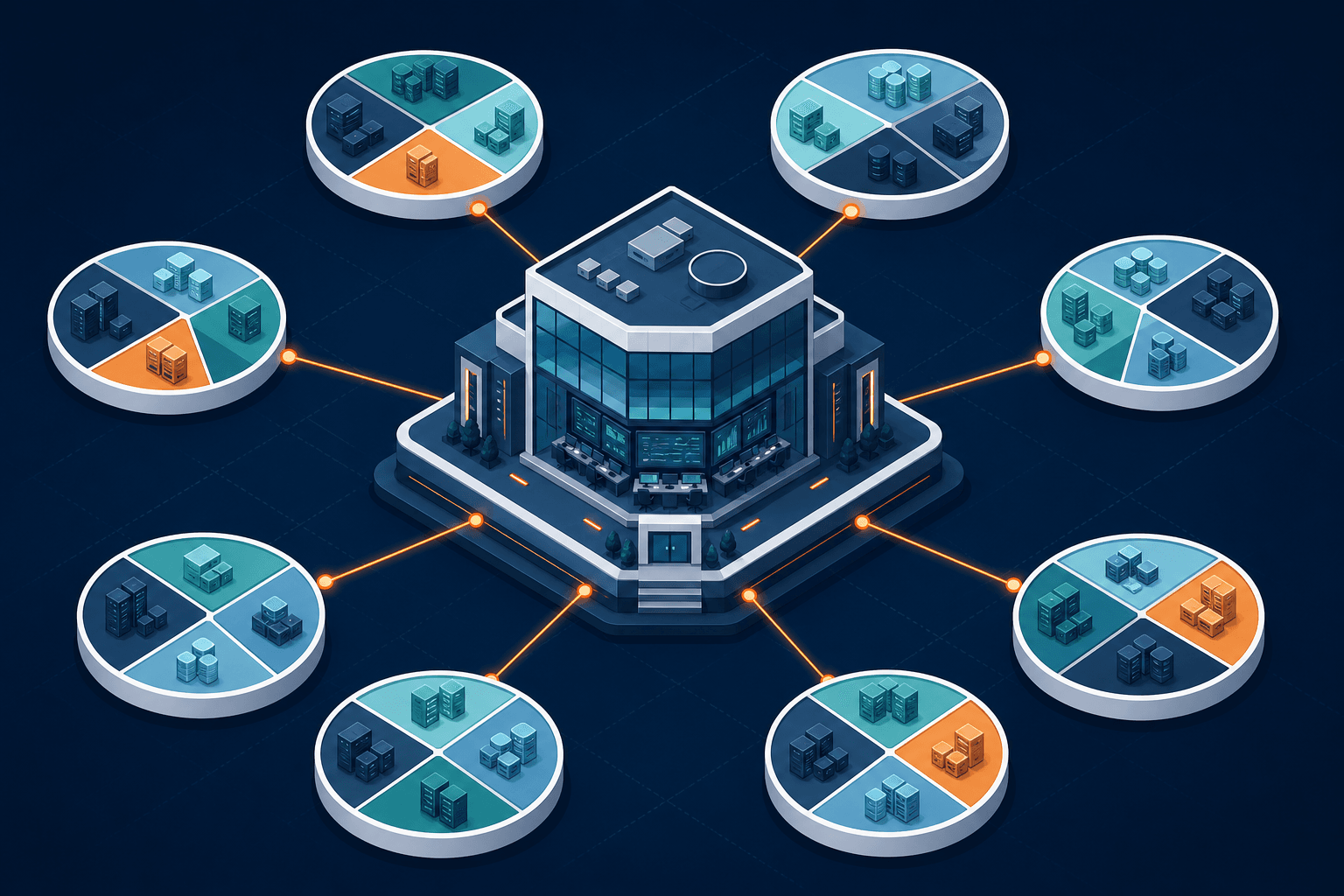
Warsaw earned the hub role, then inherited the visibility load that comes with it. Shared IT teams in the capital run hybrid estates for many business units out of one operations center, so every onboarding adds accounts, applications, and owners to the same team’s plate. The ABSL Warsaw 2025/2026 sector summary reports 111,200 people employed in Warsaw’s business services sector in 2025, nearly a quarter of Poland’s total in the sector, and 66.5% growth from 2020 to 2025. The same summary states that the share of IT centers in Warsaw employment rose from 18.7% to 31.6% since 2015. Nationally, ABSL’s sector-in-numbers dashboard lists 2,179 business services centers belonging to 1,303 investors.
That scale pairs with pressure to improve process efficiency and control costs. Deloitte’s 2025 Global Business Services Survey finds GBS organizations prioritizing technology investment for process efficiency and cost reduction, and reports that 50% of global business services organizations plan to increase their footprint. Expansion adds accounts, applications, and owners faster than spreadsheet inventories can keep pace. Shared centers in Warsaw absorb that growth as parent groups move functions into the hub and ask the same team to operate more estates under one operating model.
Hybrid and multi-cloud patterns amplify the load. Flexera’s 2026 State of the Cloud press release, based on 753 respondents, reports that 73% of organizations operate hybrid environments and 88% use multiple clouds. Warsaw shared centers inherit the same split of on-premises systems and public cloud accounts their parent groups already run, then add business-unit handoffs on top of the technical split.
Leaders who want conservative cost reduction still need a single place to see what each unit runs, or efficiency programs stall on basic questions: who owns a server, which unit pays for an orphaned instance, which applications share a dependency path before a change window.
Warsaw’s cloud footprint
Local cloud capacity sits next to those shared centers. Microsoft lists Poland Central among Azure regions on its global geographies page, describing the Central and Eastern Europe presence as located in Poland, near Warsaw. Google announced a Warsaw cloud region for Google Cloud customers in Poland and the wider region. Discovery-backed CMDB work for hybrid estates depends on which cloud platforms the inventory platform can reach with credentials and integrations. Virima’s published cloud discovery covers AWS and Azure; teams should treat other providers as out of band until integrations exist.
City-level cloud presence makes hybrid designs practical for Warsaw hubs, yet it does not by itself create a multi-unit configuration record. The operating model still has to decide who owns each CI, which unit a dependency serves, and how onboarding and exit change those fields. Estate-layer thinking for hybrid cloud still applies; the shared-services difference is many business units sharing one operations team and one inventory platform.
Where visibility slips when one center runs many estates
Visibility problems in multi-unit centers follow repeatable patterns. Each pattern ends in a concrete operational result for the teams that run the estates day to day.
- Each business unit arrives with its own tools and naming conventions. Import jobs create parallel records for the same serial number, instance ID, or hostname alias. Result: Duplicated records for the same asset, and conflicting owners on the same change ticket.
- Ownership and cost-center data never land on the resource record. Cloud tags stay empty, and on-premises spreadsheets stop at hostname. Result: Nobody can approve a removal or a rightsizing action with an accountable name attached.
- Business units open cloud accounts outside the center’s credential set. Discovery runs only where credentials and network paths exist. Result: The inventory trails the live estate, and shadow accounts surface only after a bill or an incident.
- Links between on-premises and cloud estates sit in nobody’s system of record. Application tiers span a data center host and a cloud database with no stored relationship. Result: The dependency path breaks at the boundary during impact analysis.
These failure modes match what hybrid environments produce when discovery and ownership stay fragmented. Shared-services centers feel the same drift across business-unit boundaries rather than only across resource types. Hostname aliases make the problem worse when teams treat names as durable join keys. Durable identifiers such as serial numbers and cloud instance IDs keep the same asset tied to one CI as naming conventions change across units and tools. Maximizing CMDB asset management with the Virima-Ivanti partnership.
Onboarding and exit cycles expose the same gaps. When a business unit joins the center, the team needs a clean list of accounts, ranges, and owners to bring under discovery. When a unit leaves or splits, the team needs the same list to retire credentials, reassign cost centers, and close residual tickets. Centers that store those facts only in project folders rebuild the list under time pressure every time the organization chart changes.
What discovery-sourced records cover across business units
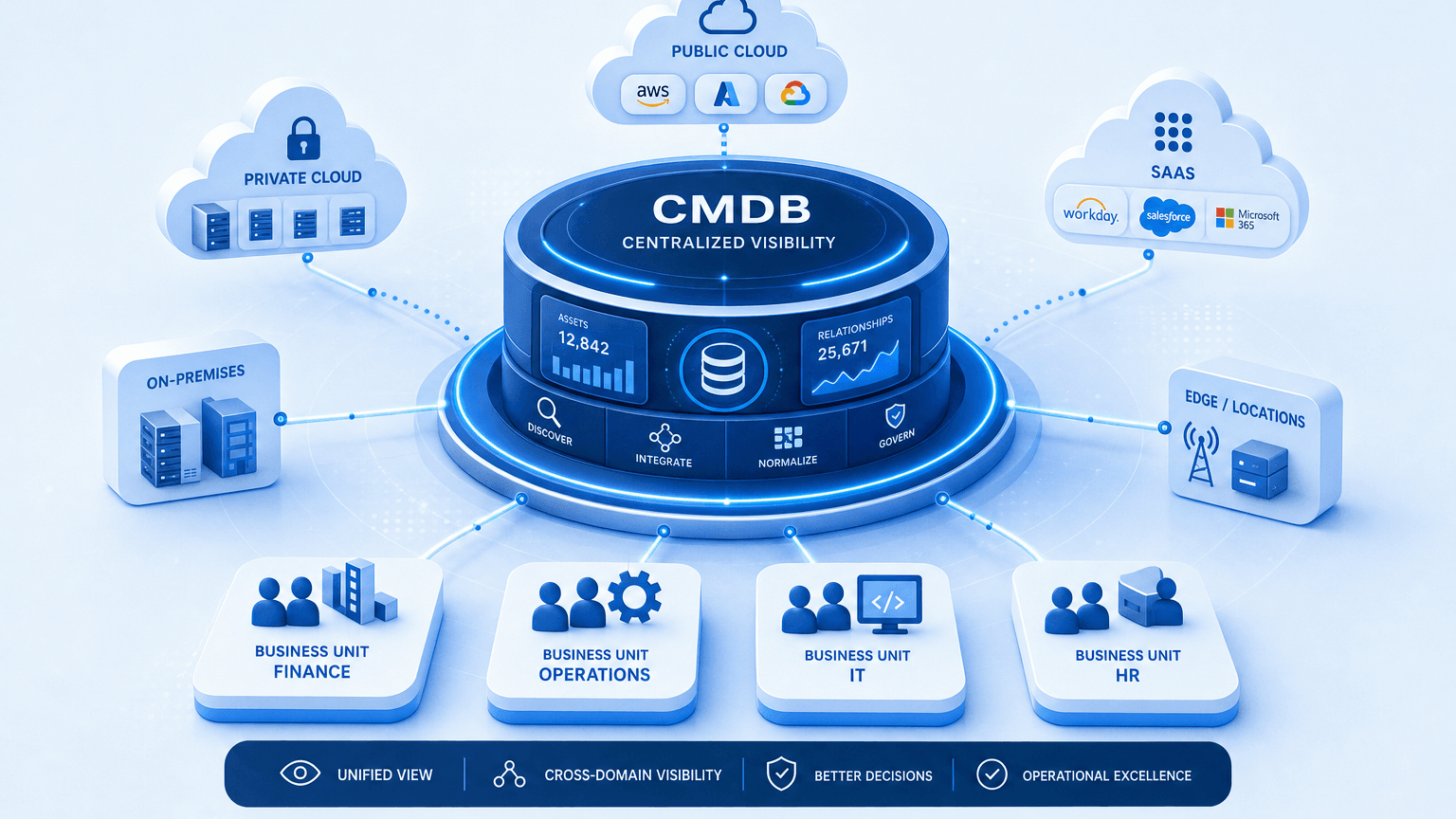
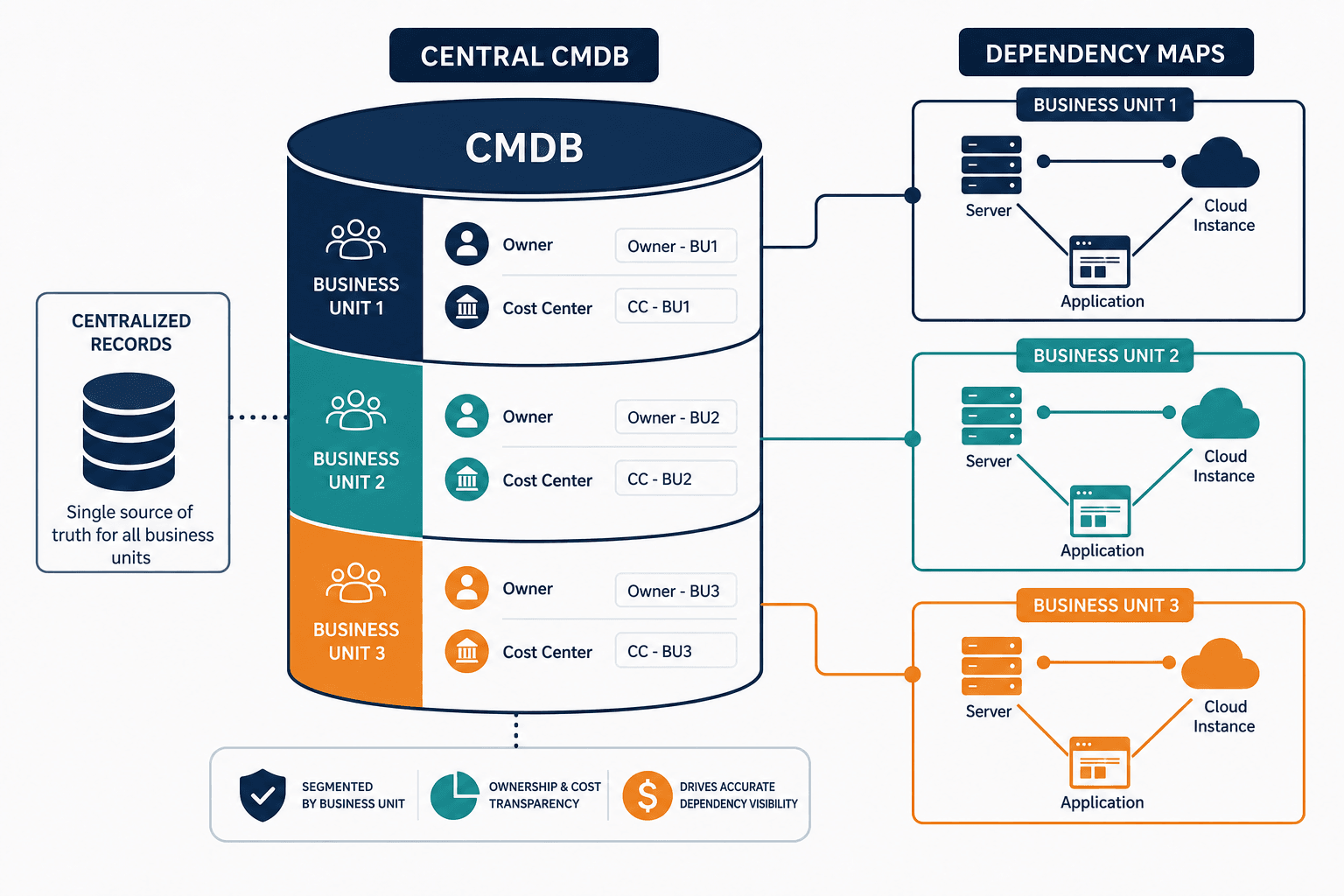
One CMDB can hold many business units’ estates in a single platform when each unit’s records stay separate, and the center sets mandatory fields for owner, business unit, and cost center. The same platform cannot serve a unit whose estate discovery never reaches. That answer is the honest limit behind the headline question, and it should sit in every design review with unit leads.
Discovery-sourced inventory fills the record from the environments the center can reach. Published integration classes include:
- Hypervisors: VMware, Microsoft Hyper-V, Nutanix
- Network infrastructure: vendors listed in the catalog
- Cloud: AWS and Azure
- Containers: Kubernetes, OpenShift, AWS EKS, Azure AKS, Docker
- ITSM platforms: ServiceNow, Jira Service Management, Ivanti, Halo, Xurrent, Hornbill, TeamDynamix, with bidirectional sync where configured
Partner names stay plain in operational speech. Current connector coverage lives on Virima’s integrations catalog.
High-frequency scheduled discovery refreshes configuration items on a cycle the operations team controls. After service definitions arrive through manual entry, spreadsheet import, or an architecture feed, Virima’s ViVID™ service maps build dependency maps from discovered infrastructure relationships. Those maps stay useful only when the underlying CIs keep current ownership and unit fields, because impact paths must name a business unit as clearly as they name a host.
Three everyday examples make this concrete:
- Incident triage: an operator pulls a CI’s business-unit field to notify the right stakeholders before the bridge call starts.
- Change impact checks: an approver traces the dependency path to confirm which units sit downstream of a planned change window.
- Onboarding and offboarding: a unit lead pulls a filtered CI list by business unit to hand over or retire accounts cleanly.
IT discovery depth matters because agent-based, agentless, and cloud collectors feed the same reconciliation layer. A single CI should carry hardware, software, cloud, and relationship attributes from those sources after the platform merges them on durable keys. That merge is what lets a Warsaw shared center answer incident and change questions without opening four separate tools for four business units. The operational goal is trusted runtime truth across hybrid estates: discovery-backed CIs and explained dependencies that change boards and incident commanders can consume without rebuilding ownership from scratch. Reduce MTTR with Xurrent Ticketing & Virima Service Mapping.
REST access supports custom joins into internal portals and automation, including JSON methods such as GET, POST, and PATCH against keys and tenant identifiers the platform issues. Shared centers often need those joins so unit dashboards and ITSM queues read the same CI identifiers the discovery layer maintains. Credential rotation, account onboarding, and exit checklists should reference those identifiers so operators do not fall back to hostnames as the only join key during handovers.
Multi-unit centers also need segmentation so one unit’s CIs, maps, and reports stay out of another unit’s view. Virima documents a multi-tenant architecture with full segmentation of client data on its MSP capabilities page, and its writing on multi-client environments describes discovery data, records, and service maps kept logically separate per client. Internal shared-services designs should confirm the same segmentation model and licensing path with product specialists before treating multi-unit separation as a settled deployment choice.
What a CMDB leaves to other systems
A CMDB supplies inventory, relationships, and ownership context. FinOps, security/privacy tooling, and observability stacks own the adjacent jobs: spend allocation, data classification, and policy enforcement, respectively:
| Question | CMDB scope | FinOps scope |
|---|---|---|
| What does it own? | Inventory, relationships, ownership | Spend allocation, forecasting |
| What does it answer? | Which unit owns this CI? | What did this unit spend, and on what? |
| What breaks without it? | Impact analysis, incident triage | Budget accuracy, chargeback |
Coverage stops at the estates the integrations and credentials can reach. Compliance programs still need process, evidence collection, and control testing; the CMDB supports those programs by supplying the configuration record they reference.
Two providers, one question: which clients share this environment?
Providers that serve many clients from shared environments face the same first question during an incident: which clients’ systems and data sit in the affected portion of the estate. Public cases show how large that question becomes when one environment supports many organisations.
On 15 October 2025, the UK Information Commissioner’s Office fined Capita £14 million over a 2023 breach that touched over 600 client organisations, 325 of them directly, after a compromised device went unquarantined for 58 hours. Conduent’s breach disclosures, summarised by HIPAA Journal, describe a similar pattern: a breach identified on 13 January 2025 touching client-environment files, with notifications continuing into October 2025. Both cases turn on knowing which client populations share the affected environment. No separately documented Warsaw shared-center incident appears in the same public record set, so local centers should treat the question as structural rather than as a city-specific case study.
The operational lesson for shared IT is narrower than the regulatory outcomes. When many business units share people, tooling, and sometimes infrastructure, the center needs a record that can list affected CIs by unit, owner, and service without a multi-day reconstruction from email threads and billing exports. That capability is what the multi-unit CMDB design is for, long before any external investigation asks the same question.
What a better record can and cannot cut
A better multi-unit record cuts time spent identifying which business unit owns a host, instance, or dependency path, and it reduces duplicated provisioning that follows from conflicting inventories. Cloud spend allocation, commitment planning, and unit economics stay with FinOps practice.
Flexera’s 2026 press materials report that respondents estimated wasted cloud spend at 29%, the first increase in five years in that series. That figure is an industry survey estimate across the respondent base. Shared-services leaders can pair it with an internal metric they control: elapsed time to identify the affected business unit’s systems before and after a discovery-backed CMDB goes live for a pilot unit. Measure that interval on a fixed sample of incidents and change requests so the pilot has a board-ready before-and-after number without inventing savings claims.
Orphaned resources still need a named owner and a decision path before removal. The record surfaces candidates with last-seen discovery data and missing ownership fields. The business unit lead or the center cost owner authorises the action, and the next discovery cycle confirms the resource is gone. Clearer inventory supports allocation conversations with finance while finance systems keep the books. That boundary matches how IT visibility supports operational efficiency without replacing finance systems.
Five steps to start with one business unit
Start with one unit so the center proves the model before every estate lands in the same platform. A pilot that finishes with measured time-to-identify results is easier to extend than a big-bang import of every account on day one.
- Trace one service by hand across that unit’s cloud accounts and on-premises systems, and write down every hop the team can prove today from runbooks and operator knowledge.
- Run discovery on that unit’s AWS, Azure, and on-premises ranges, then compare the result with the existing inventory and ticket queues for gaps and duplicates.
- Set the CI model so business unit, owner, and cost center are mandatory fields on every record that enters production use, with durable hardware and cloud identifiers preferred over hostname alone.
- Keep each unit’s records segmented, and connect the ITSM platform the center already uses so incidents and changes read the same CI keys the discovery layer maintains.
- Set a review cadence at onboarding and at handover, and measure time to identify affected systems on a fixed sample of incidents and change requests for ninety days.
After the pilot, add the next unit with the same field rules and the same discovery credential process. Resist special-case fields per unit unless a regulatory requirement forces them; special cases become the next generation of duplicate records. Warsaw e-commerce and logistics estates raise a different local operating pattern; the shared-services problem here remains many business units under one hub.
See one business unit’s estate mapped
A pilot with one business unit is the fastest way to prove whether CMDB for hybrid cloud visibility can serve a Warsaw shared services center’s every business unit. To see how dependency maps are built from discovered infrastructure once service definitions are in place, start with Virima’s service mapping overview.
Frequently Asked Questions
What is a hybrid cloud CMDB, and how does it differ for a shared services center?
A hybrid cloud CMDB records configuration items and relationships across on-premises systems, cloud accounts, and connected services. A shared services center also needs each business unit’s records kept separate under shared ownership rules the center and the units both accept.
Why does hybrid cloud visibility matter for global business services centers?
Deloitte’s 2025 Global Business Services Survey found that 50% of GBS organizations plan to increase their footprint, which adds estates, accounts, and owners the shared center must track with a single operational record.
How is a CMDB different from FinOps tooling?
A CMDB supplies inventory, relationships, and ownership context for operations and change. FinOps tooling allocates and forecasts spend; Flexera’s 29% wasted-spend figure is an industry survey estimate, separate from CMDB scope.
Does Virima support multi-tenant CMDB segmentation for shared services centers?
Virima documents a multi-tenant architecture with full segmentation of client data on its MSP capabilities page, keeping discovery data, records, and service maps logically separate per client or business unit. Internal shared-services teams should confirm the specific segmentation and licensing model before go-live.
What are examples of CMDB use in shared IT operations?
Shared IT operations use the CMDB for dependency lookups during incidents, impact checks before a change window, and ownership lookups when a business unit is onboarded or leaves the shared center.