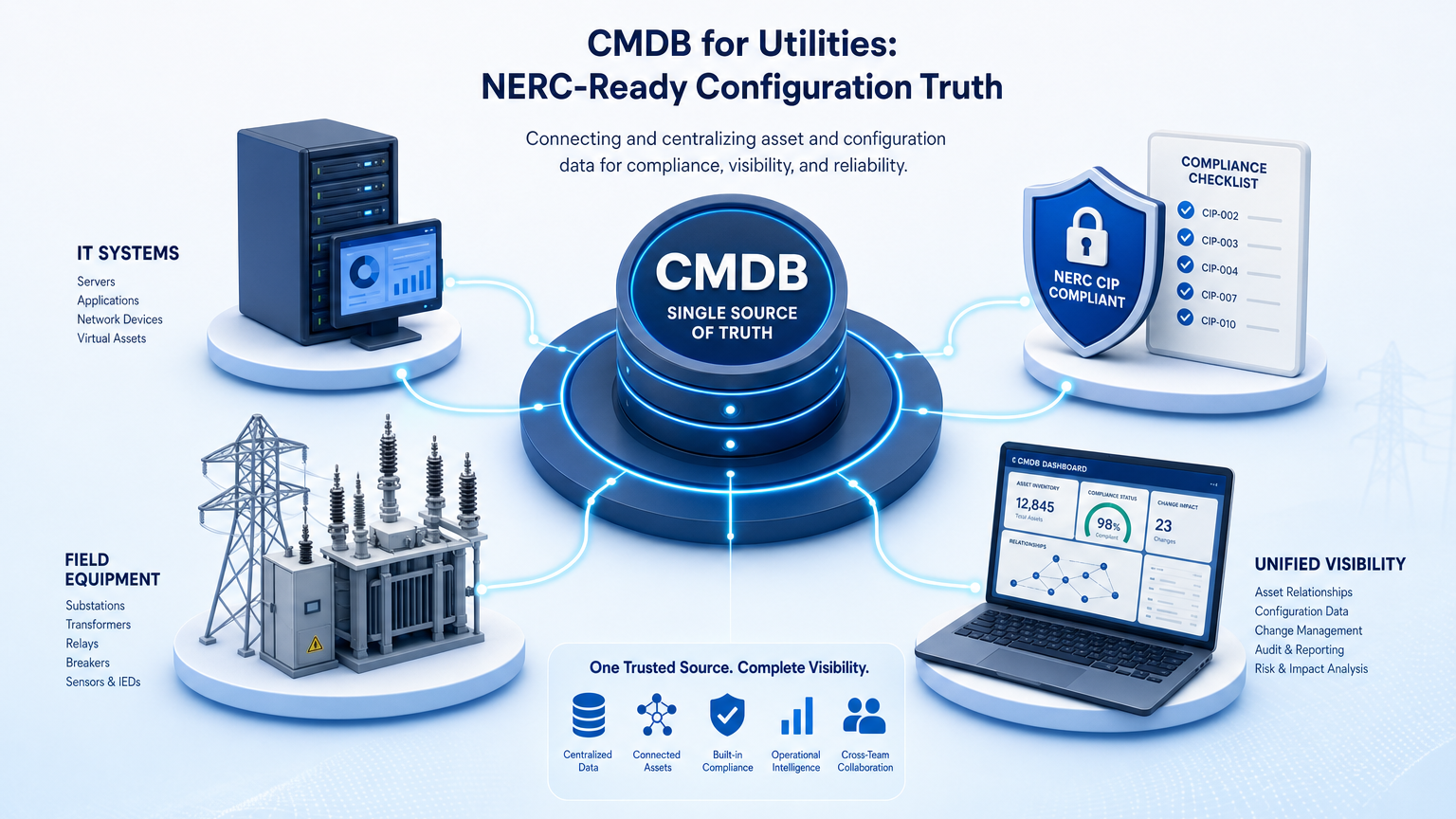
CMDB for Utilities: NERC-Ready Configuration Truth

A NERC CIP auditor asks a utility to produce the baseline for a substation relay, and the compliance team pulls three different answers from three different systems — one from IT, one from a field spreadsheet, one that no longer exists. A CMDB for utilities closes that gap by connecting asset identity, ownership, and configuration evidence into one record teams can defend under audit.
That fragmentation is common when enterprise IT, operations, and field engineering maintain separate inventories: a server may appear in a central database while its location and operational role sit in a substation spreadsheet, and a replacement device may be recorded in a work order before the CMDB reflects it.
A reliable record depends on clear ownership, suitable collection methods, and a documented process for resolving differences between sources.
Why utilities need configuration records they can defend
Utilities operate assets across corporate networks, control centers, generation sites, and substations. Some systems support ordinary business applications. Others support operational processes with strict availability and safety requirements.
These environments often have different owners and collection methods. Enterprise IT may maintain server records through scheduled discovery cycles. Field engineering may document equipment through maintenance systems, vendor files, or physical inspections. Compliance teams may maintain separate lists for regulated assets and evidence.
Each source can serve a legitimate purpose. Problems arise when teams cannot connect the records or explain why their values differ. That risk is measurable: NERC’s 2025 enforcement data shows CIP standards as the most-reported violation category, with five CIP standards accounting for more than 800 noncompliances that year (RTO Insider). Many of those noncompliances traced back to asset and configuration records utilities could not produce on demand during an audit.
A useful utility configuration record should help answer:
- Which asset does this record describe, and where is it located?
- Who owns the asset and its configuration?
- Which attributes were observed, and when were they last checked?
- Which source supplied each important value?
- Which approved change or maintenance activity relates to the record?
- Which services or other assets depend on it, where those relationships are known?
These questions matter during operational changes as well as audits. A maintenance team replacing a network device needs its identity, location, and dependencies. A compliance team needs the relevant baseline and supporting records for assets within its control scope.
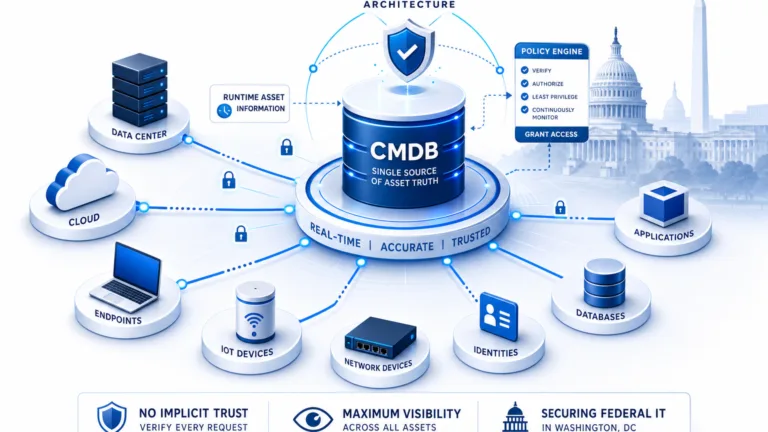
Virima’s Trusted Runtime Truth approach connects discovery-sourced asset information with relationships, ownership, and change context. That context helps teams evaluate what exists, how it connects, what changed, and what a change could affect. This is a variation on a challenge common to every hybrid environment, not just utilities. See Why CMDBs Keep Failing (And What CMDB Governance Actually Fixes) for how the same ownership and source conflicts show up across general IT estates.
Establish the scope before mapping NERC CIP controls
NERC Critical Infrastructure Protection requirements apply to specified responsible entities and assets under the relevant standards. An organization should confirm its own obligations with its compliance team. A utility’s full inventory should not automatically be treated as its regulated asset population.
For applicable systems, NERC CIP-010-4 describes configuration change management and monitoring requirements. Its baseline provisions cover specified attributes:
- Operating systems
- Commercially available or open-source application software
- Logical network-accessible ports
- Security patches
- Other relevant software
The standard also includes monitoring and investigation requirements for applicable systems. For the relevant population, it specifies monitoring at least once every 35 calendar days for changes to the baseline configuration. Applicability, exceptions, implementation details, and the effective standard version require confirmation against the current requirements.
NERC’s newer CIP-015-1 standard extends this scope further. It takes effect September 2, 2025, with phased compliance through 2030. The standard requires monitoring for internal network activity and lateral movement — a gap that perimeter-focused tools and point-in-time spreadsheets do not close (WWT). Utilities confirming CIP-010 scope should also check whether CIP-015 changes which systems and evidence their compliance team needs to track.
A CMDB can support this work by organizing asset records and linking them to supporting evidence. Compliance teams still need to establish scope, approve baselines, investigate discrepancies, and retain evidence under their own procedures.
How can a utility CMDB support NERC CIP audit preparation?
A utility CMDB can organize asset identities, owners, locations, and available configuration records for the systems a compliance team identifies as in scope. Teams can use those records to locate supporting baselines and change evidence. The utility remains responsible for determining applicability and meeting each requirement.
Separate the inventory from the compliance determination
Start with a population that operations and compliance owners can review together. For each candidate asset, record its location, operational role, owner, and source system. Then document the compliance team’s determination and the basis for including or excluding it.
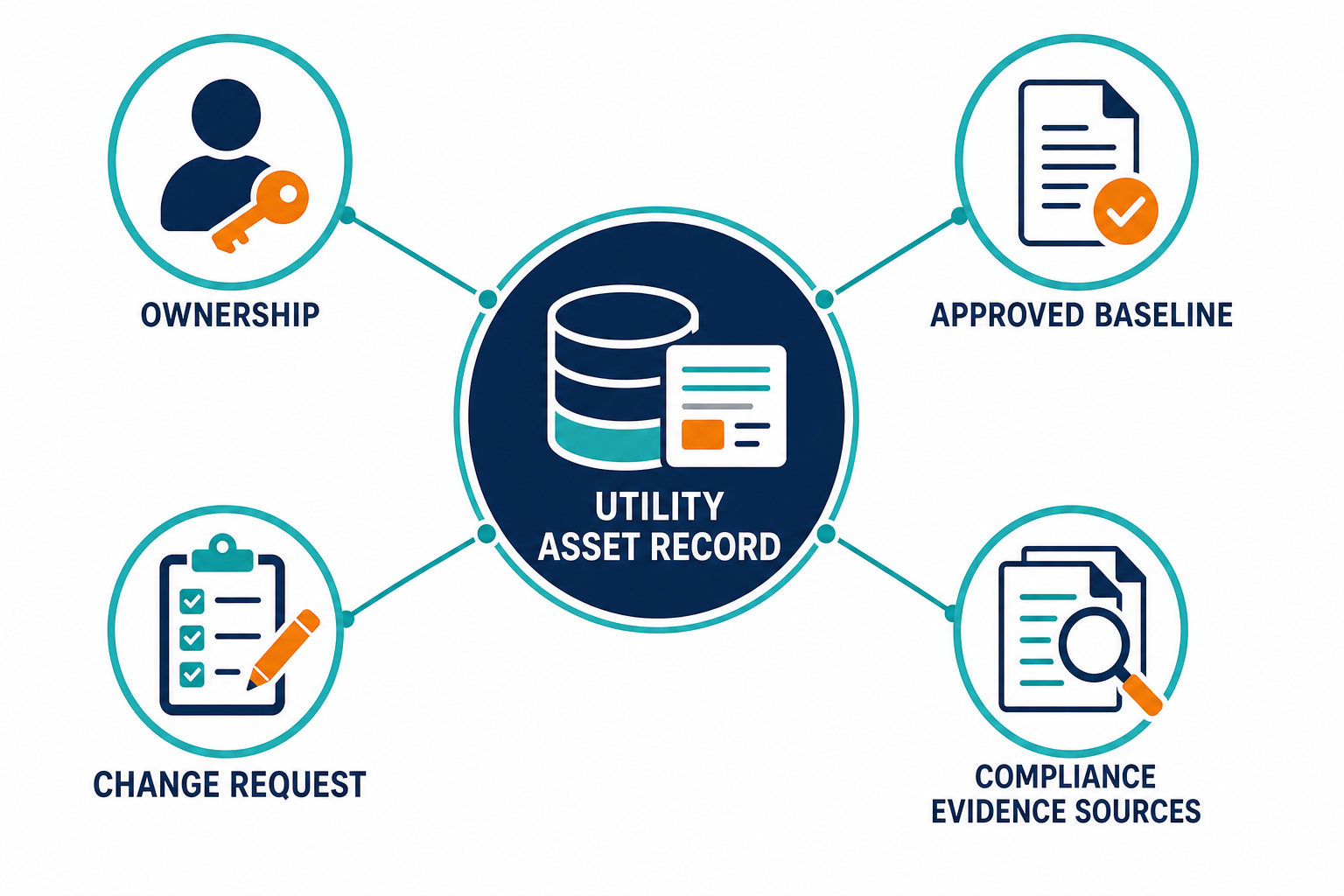
A central record can reference an approved baseline without replacing the baseline itself. It can also point reviewers to change requests, validation records, and evidence held in other systems.
This distinction prevents an inventory field from becoming an unsupported compliance conclusion. A device’s presence in a CMDB does not establish its impact classification or prove that a control operated.
For each in-scope record, designate:
- An asset or configuration owner who can resolve identity questions.
- A compliance owner who confirms the applicable classification and controls.
- A source for the approved baseline and its effective date.
- A location for change approvals, investigation records, and supporting evidence.
- A review date for the asset’s scope and ownership.
Choose collection methods that respect OT boundaries
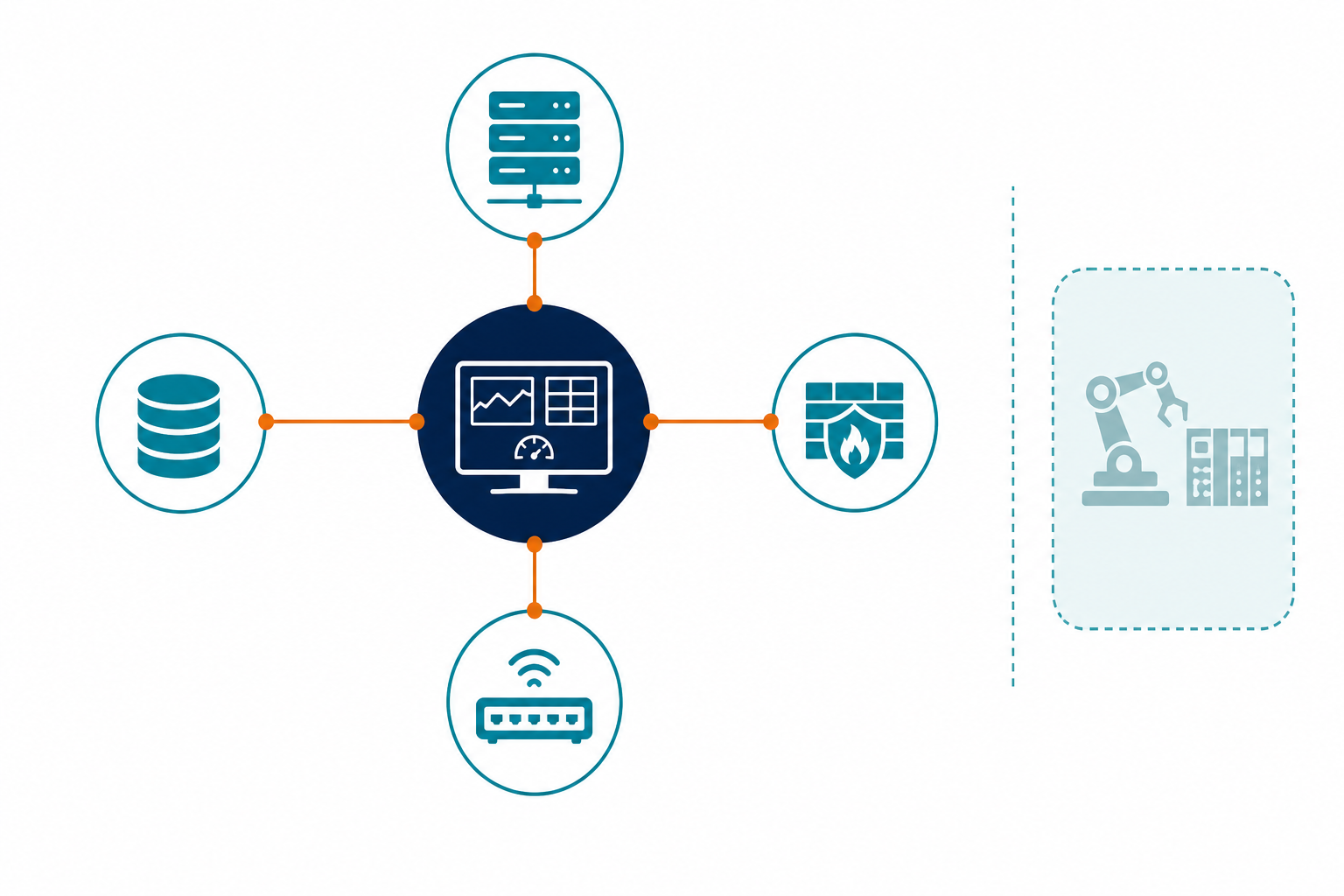
Operational technology environments require collection plans suited to the equipment and network. A method appropriate for corporate servers may be unsuitable for a protective relay or a sensitive control network.
Before collecting data, the operations owner should approve the asset population, method, credentials, timing, and traffic limits. Test proposed collection methods in a representative environment where feasible. Document exclusions and escalation procedures before expanding coverage.
For enterprise IT, scheduled agent-based or credentialed agentless discovery can populate records for supported systems. Virima’s IT discovery capabilities include hardware and operating-system fingerprinting, network device discovery, and software inventory. Actual results depend on access, device support, and configuration. For more on balancing automated and manual collection across environments with different access constraints, see Agent-based vs. agentless discovery: which is best for your business?.
For restricted OT segments, OT asset discovery typically relies on engineering records, approved exports from existing OT security or monitoring tools, or manually documented field inventories rather than direct network scanning. A physically isolated network requires an approved transfer procedure. Teams should validate any proposed data import or integration for their environment before assuming it is supported.
| Environment | Potential source of configuration data | Decision before collection |
|---|---|---|
| Enterprise IT | Scheduled discovery and existing infrastructure inventories | Confirm access, credentials, scope, and collection windows |
| Control center systems | Approved discovery methods and system-owner records | Confirm operational approval and device compatibility |
| Substation networks | Engineering records, approved tool exports, or field inventories | Confirm the permitted method for each device and network |
| Physically isolated environments | Locally maintained records and approved transfers | Confirm transfer controls and how records will be reviewed |
The CMDB should make collection gaps visible: if a relay’s configuration comes from a field record rather than discovery, identify its source and review date so the owner can judge the record’s reliability.
How should utilities collect configuration data from sensitive OT networks?
The utility’s operations and security owners should approve collection methods for each network and device type. Depending on the environment, teams may use approved system records, controlled exports, or tested discovery methods. Document exclusions, review dates, and transfer procedures for isolated networks.
Reconcile records using durable identifiers
A utility may encounter the same device in a maintenance system, a network inventory, and a CMDB. Those records can use different names, abbreviations, or location codes. Reconciliation connects the records without losing the evidence behind each value.
Use a hardware serial number where available and reliable. For cloud assets, use the cloud instance ID. Utility asset tags and site identifiers can provide additional context and help resolve exceptions.
Hostnames and IP addresses remain useful attributes, but they can change or be reused. They should not serve as the sole durable join key. A private address may appear in multiple isolated sites, and a replacement device may inherit its predecessor’s name.
When sources disagree, avoid silently overwriting the conflict. Assign an owner to determine whether the records represent the same asset and which source governs each field.
For example, field engineering may own physical location and equipment status. The infrastructure team may own operating-system information collected from a supported server. Compliance may own the documented scope determination. These responsibilities should be agreed with each team rather than inferred from the tool.
Virima’s CMDB supports multi-source data reconciliation and tracks configuration-item history. Teams can use those capabilities to build records that bring together available asset information, while retaining review and approval responsibilities.
Record the timing of each observation
The date attached to a record affects how much confidence an operator can place in it. A serial number collected during installation may remain useful for years. A software version or device status may need review more often.
For each important attribute, retain the source and the most recent available observation date. Where a collection cycle fails or cannot reach an asset, show that condition to the record owner. Do not treat an unchanged value as proof that a device has been checked.
A practical review queue can separate:
- Records with conflicting identifiers.
- Assets missing an assigned owner or location.
- Records whose collection date falls outside the utility’s review policy.
- Devices awaiting confirmation after replacement or decommissioning.
The queue turns data quality into assigned work. It also gives compliance and operations teams a shared way to discuss gaps before an audit.
Connect approved baselines to change evidence
A configuration baseline describes an authorized state for an applicable asset or group of assets. The utility’s procedures should define the attributes, approval process, review frequency, and evidence requirements.
The CMDB record can serve as an index to that material. It can identify the asset, its owner, and the location of the approved baseline. A related change request can record who approved a modification and where the validation evidence is stored. The financial stakes for getting this wrong are real: NERC penalties can reach $1 million per violation per day. One recent CIP enforcement action totaled $10 million for nearly 130 violations tied to gaps in configuration and security evidence (SecurityWeek).
Before your next audit cycle, walk your own configuration records through the review process below, or use the How to Build an AI-Ready CMDB Checklist for 2026 to structure that review with your team.
A workable review process follows the asset through a change:
- Identify the asset. Confirm the serial number or other durable identifier, site, owner, and applicable scope.
- Find the authorized baseline. Check the approved version and the attributes relevant to the system.
- Review the proposed change. Link the work order or change request to the affected record.
- Validate the result. Use an approved collection method or engineering evidence to confirm the completed work.
- Resolve differences. Investigate discrepancies and document the outcome under the utility’s procedures.
- Update the baseline when authorized. Record the approval and retain supporting evidence in the designated system.
This process applies whether a change involves a server, a network device, or a manually documented field asset. The collection and validation methods may differ substantially between those systems.
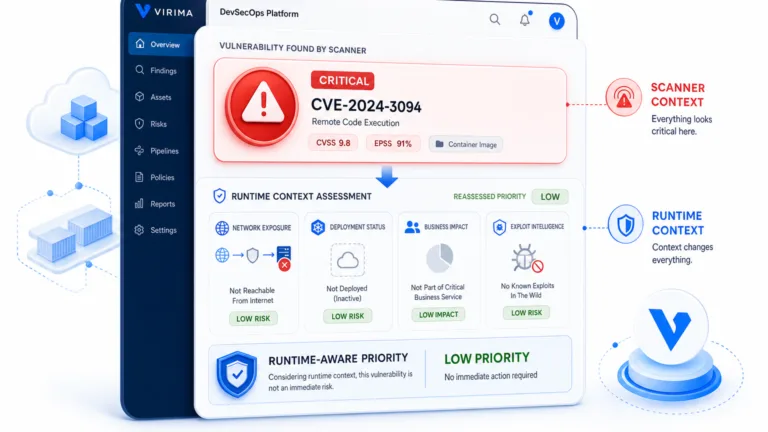
Scheduled discovery can contribute observations for supported, accessible infrastructure. A discovery result alone does not establish authorization or prove that every required configuration attribute was checked. Teams should validate coverage for each asset type before relying on a particular source for compliance evidence.
Does a CMDB establish compliance with NERC CIP requirements?
A CMDB can support compliance work by organizing configuration records and references to evidence. The responsible entity must determine which requirements apply, approve and maintain baselines, perform required monitoring and investigations, and retain evidence. Product capabilities should be validated against the utility’s control design.
Use service relationships to review change impact
A configuration record is more useful when teams can understand its relationship to a service. Before changing a control-center server or network component, an operator may need to identify connected infrastructure and the services that depend on it.
A service map can bring those relationships into view for the systems included in the map, while also showing the limits of the available data — a missing relationship may reflect an incomplete source or an excluded network segment rather than a confirmed absence of dependency.
Virima builds ViVID™ service maps after customers provide service definitions, supplied manually, through an import, or through supported integrations. For a deeper look at using dependency maps during change approval, see What Is Blast Radius in IT Change Management?.
For utility operations, start with a service whose supporting systems are already documented: confirm the application components, infrastructure dependencies, owners, and known gaps, then use the map alongside engineering diagrams and operational procedures during change planning. Protective schemes, operational redundancy, and field-device behavior still require validation by the relevant technical owners — maps support the impact discussion, they don’t replace it.
Evaluate a CMDB against a utility workflow
A useful evaluation of utility IT asset management fit follows a specific record through the work your teams already perform, not a generic feature checklist. Select a bounded population that includes supported enterprise systems and any field records the utility wants to reconcile.
Ask the vendor and your internal owners to demonstrate how they would handle these tasks:
- Identity: Match records using a serial number or cloud instance ID and identify unresolved duplicates.
- Source attribution: Show where each important value came from and when it was last checked.
- Collection controls: Explain supported methods, credentials, schedules, and exclusions for the selected systems.
- Configuration history: Review available changes to a configuration item’s record and identify the evidence retained.
- Ownership: Assign a person or team to resolve an incomplete or conflicting record.
- Service relationships: Build a map from a customer-provided service definition and review its coverage.
- Workflow handoff: Show how relevant CI information reaches the service desk or another approved system.
Include OT engineering and compliance staff in the evaluation. They can identify where vendor discovery is appropriate, where another evidence source is required, and which workflows must remain under local control.
ServiceNow, Jira, and other service-management platforms may already hold change requests or asset data. Review the available integration options against your existing workflows and verify the fields and permissions needed for each handoff.
Build a defensible configuration record
A CMDB for utilities earns trust the same way an audit case does: through named owners, durable identifiers, and evidence a reviewer can trace back to its source — not through the tool itself.
Virima provides discovery-sourced configuration data, multi-source reconciliation, and service mapping for supported infrastructure. The utility’s engineering and compliance teams determine the appropriate controls, validate coverage, and approve how those records are used.
Frequently Asked Questions
What should a utility include in its CMDB?
A utility can record asset identifiers, locations, owners, configuration attributes, and known relationships. For assets within an applicable compliance scope, records can also reference approved baselines and supporting evidence. The utility should define which fields are required for each asset type.
Does NERC CIP apply to every utility asset?
No. Applicability depends on the responsible entity, the relevant standard, and the systems or assets in scope. Utility compliance owners should document the applicable requirements and their scope decisions rather than treating the entire inventory as a regulated population.
Can utilities use a CMDB for assets in isolated networks?
A CMDB may hold records derived from approved field inventories or transferred exports, subject to the utility’s controls and the product’s supported import methods. The utility should validate the transfer process, data format, ownership, and review schedule before relying on those records.
How does Virima help utility teams reconcile configuration records?
Virima supports multi-source reconciliation, configuration-item history, and scheduled discovery for supported infrastructure. Teams should validate the sources and asset types relevant to their environment. Utility owners remain responsible for resolving discrepancies and approving authoritative values.
How does Virima create service dependency maps?
Customers first provide service definitions manually, through an import, or through supported integrations. Virima then builds dependency maps using those definitions and available infrastructure data. Teams should review map coverage and known gaps with the relevant service and engineering owners.
Download the How to Build an AI-Ready CMDB Checklist for 2026 to walk your vendor and internal owners through identity, source attribution, collection controls, and service-mapping tests before your next audit cycle.