ITAM for Utilities: Extending Life of Grid and Plant Assets

When a protective relay’s control-center server falls out of vendor support, IT asset managers and plant engineers have no reliable way to know what breaks if they delay the fix — or what else depends on it if they don’t. ITAM for utilities is the practice of linking technology asset records — support dates, ownership, and dependencies — to the grid and plant equipment they serve, so teams can decide whether to retain, upgrade, replace, or retire with evidence instead of guesswork.
Extending an asset’s service life still requires engineering approval. An inventory can inform that decision, but it cannot establish the condition of a transformer, breaker, or protective relay. Field inspections, vendor guidance, operating history, and applicable safety requirements remain essential.
Why ITAM for Utilities Needs Different Lifecycle Plans
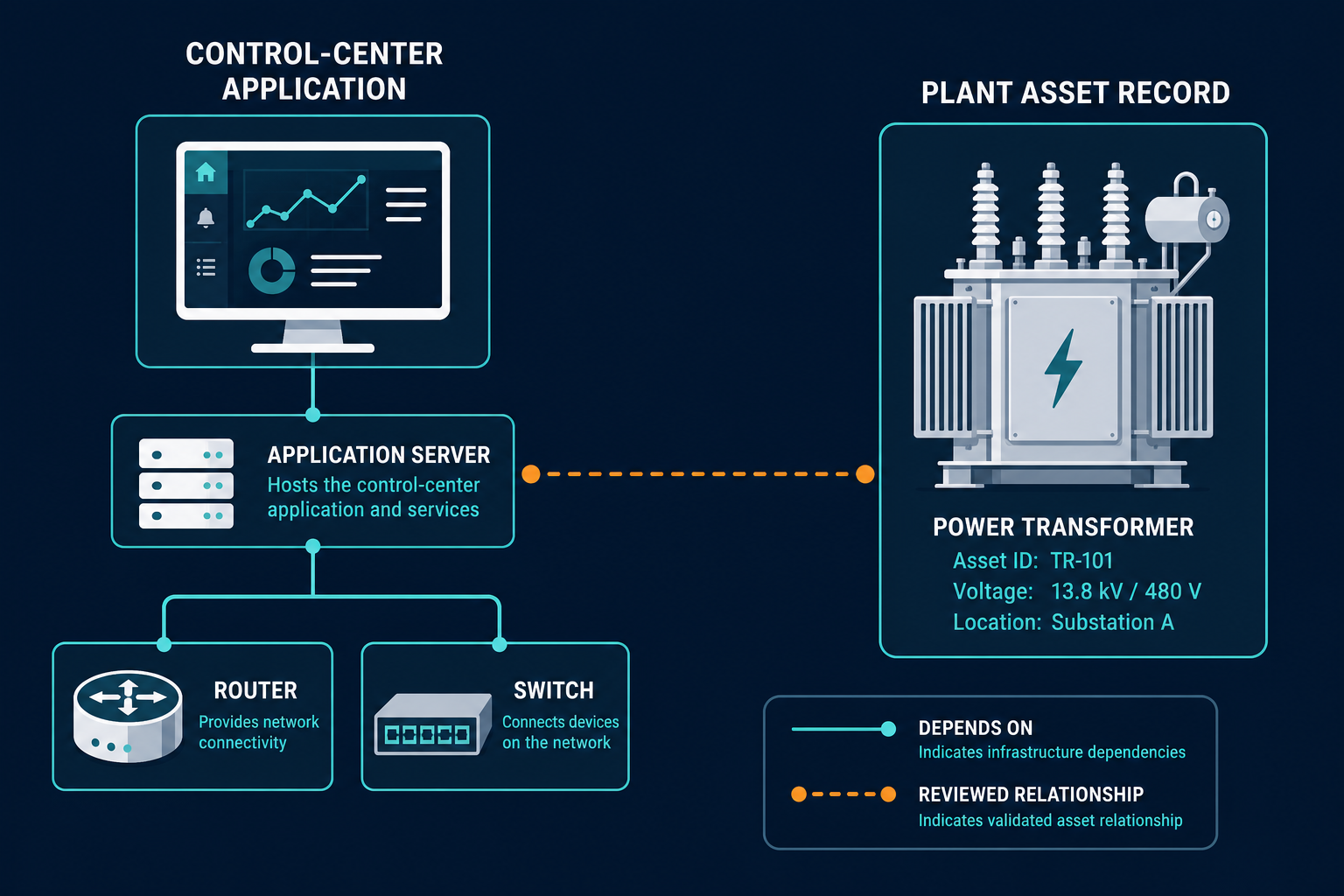
Utilities maintain physical infrastructure alongside the digital systems that monitor and support it. Their useful lives and support arrangements may differ. A control-center server can reach its vendor support deadline while the plant equipment associated with its applications remains in service.
That mismatch creates a planning problem for the ITAM manager. A replacement plan based only on the age of the physical installation can miss unsupported software or network equipment. A plan based only on a server’s support date can overlook the applications and operating procedures that depend on it.
An asset record should separate the physical equipment from its associated technology components. Each record can carry its own owner, location, model, support status, and planned review date. Documented relationships then help planners assess how a change to one component may affect another.
For example, the owner of a historian server can review its operating system support alongside the applications that use its data. Operations can then evaluate a migration plan against its maintenance schedule. Engineering must validate dependencies and the proposed work before changes reach an operational environment. Utilities running a CMDB alongside an existing ITSM suite can extend it to cover grid and plant assets instead of standing up a separate system – see pairing ITAM with an existing CMDB.
Make support status part of the decision
End-of-support dates are a signal to investigate, not a mandatory replacement date for an entire installation. A vendor may offer a supported upgrade path, a replacement module, or an alternative service agreement, and the responsible team needs to verify availability and compatibility for the specific model.
ITAM records let that team compare support dates against contracts and replacement plans, and flag records that lack enough evidence for a decision — rather than treating an empty field as an acceptable risk.
Build an Asset Record That Supports Field Decisions
A useful utility IT asset management record starts with the identifiers that let teams match records across purchasing, IT, and operations. Model and serial number help distinguish one installed device from another. A hostname can change, so it should not serve as the sole durable join key.
For cloud assets, use the cloud instance ID where appropriate. For physical assets, use the serial number when available and validate the match against location and other identifying details. Missing or duplicated identifiers need review before records are merged.
ITAM and CMDB records differ from a computerized maintenance management system (CMMS) or enterprise asset management (EAM) tool: a CMMS or EAM tracks work orders and maintenance schedules, while ITAM and CMDB records track ownership, support status, and dependency context for a technology refresh decision.
Fields to collect before a lifecycle review
ITAM managers can start with these fields for each asset in scope:
- Identity: manufacturer, model, serial number, and relevant software or operating system version.
- Accountability: business owner, technical owner, site, and the team responsible for maintenance.
- Lifecycle: acquisition date, known support end date, warranty, contract, and planned review date.
- Operational context: related applications or equipment, service criticality, and approved change window.
- Evidence: source of each record, last verification date, and an owner for unresolved discrepancies.
Some records will require input from an operations system, vendor notice, or field inspection, and manual entry remains common even in mature programs. A 2026 EMA Research benchmark of 203 organizations with 1,000+ employees found that 65.5% still populate their CMDB at least partly by hand. Data accuracy was named as one of the most common gaps in discovery and asset data (EMA Research, via Xurrent). Discovery adds evidence for supported IT-class devices where the utility has approved the collection method, but it does not replace that verification. Teams weighing whether their asset data is trustworthy enough for a lifecycle decision can use that same evidence trail.
Virima’s IT asset management capabilities include lifecycle tracking, end-of-life and end-of-support tracking, and contract and warranty management. The utility determines which data to maintain and confirms the vendor status for each asset.
Which asset details help a utility plan a technology refresh?
Start with the asset’s model, serial number, owner, location, software version, support date, and contract. Add the applications or services it supports and the next approved change window. Engineering teams should verify compatibility and physical condition before approving a replacement or an extension.
Reconcile IT Records with OT Sources
Utilities often maintain separate records for enterprise IT and operational technology (OT). OT includes systems used to monitor or control physical processes. Field records may sit with engineering, while IT teams manage inventories for servers and network devices. IT and OT networks that once ran as fully separate domains increasingly share the same IP infrastructure, which widens the set of devices an inventory needs to cover (Renewable Energy World).
An engineering workstation may appear in an IT inventory, while its plant role and maintenance restrictions reside elsewhere. If those records disagree, the owner should investigate the mismatch before a change is approved. Utilities that have already reconciled IT and OT-adjacent asset records through discovery can extend that view into lifecycle planning instead of building a second one.
Choose collection methods by zone
Virima supports agent-based and credential-based agentless discovery for supported IT-class assets, using scheduled discovery cycles for approved servers, workstations, and network devices. Operations should approve the scope, credentials, and schedule before collection begins in an OT-adjacent zone.
Industrial field devices can be sensitive to network activity, so dedicated OT tools and engineering records may provide information about controllers, remote terminal units, and protective relays instead. Where appropriate, the Virima REST API offers a route for bringing records from other systems into the CMDB, subject to the utility’s validation.
Discovery coverage depends on access, configuration, and device support. Document exclusions alongside the inventory so decision-makers can distinguish an unknown asset from one confirmed absent.
Explore Trusted Runtime Truth for utility assets to see how discovery-sourced records help teams understand what exists, how it connects, what changed, and who owns it.
Turn Support Dates Into a Lifecycle Plan
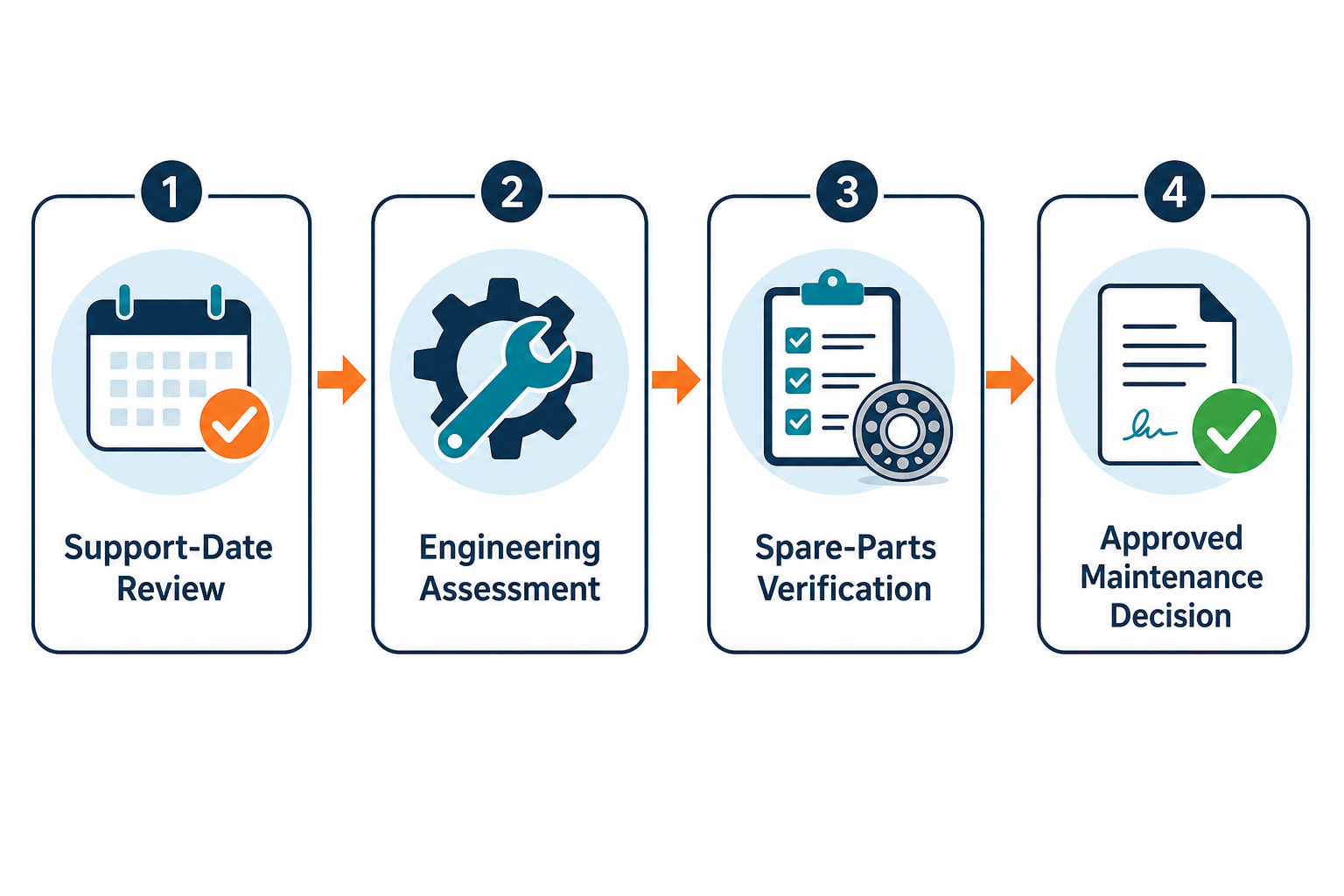
A support deadline alone does not identify the right action in a grid asset lifecycle review. The ITAM manager needs the asset’s function, dependencies, contract status, and owner. Engineering then evaluates technical compatibility, safety, and the available maintenance window.
Classify the decision before committing funds
Use the following decision paths to structure a joint review:
- Retain with a documented review date. Confirm the support arrangement and record the next assessment.
- Upgrade a component. Ask the vendor and engineering team to validate compatibility and test the proposed configuration.
- Replace the system. Identify dependent applications, interfaces, data migration needs, and rollback requirements.
- Retire the asset. Confirm that dependent services have moved and that records reflect the approved decommissioning.
These paths are planning options, not guarantees. A component upgrade may be unavailable or inappropriate for a particular installation. Engineering and vendor evidence determine whether an extension is acceptable.
Prepare for parts and maintenance constraints
A spare component is useful only if the team can identify it and confirm that it fits the intended installation. Record the model, revision, condition, storage location, and any test evidence available, and have the maintenance team confirm compatibility before dispatching a part.
Where the spare inventory lives in a separate maintenance system, agree on a shared identifier and a named owner for discrepancies. Periodic checks can identify missing parts and outdated records before a planned maintenance window.
Review Dependencies Before a Change Window
A server replacement can affect more than the machine in the work order. Applications, databases, network devices, and downstream users may depend on it. The owner needs a reviewed picture of those relationships before estimating the work.
A configuration management database (CMDB) stores configuration items and their relationships. A utility can reconcile records from multiple sources and review the resulting connections against engineering documentation. Missing relationships should be assigned for verification rather than assumed away.
Define the service before building its map
For ViVID™ service mapping — Virima’s dependency-mapping capability for IT and OT-adjacent assets — the utility supplies service definitions through manual entry, spreadsheet import, or a supported integration. Virima builds maps from those definitions and available dependency information. Coverage depends on the source data and the scope the team has configured.
A change planner can use the map to identify candidate dependencies for review. Operations and engineering should verify the impact, backup path, and rollback procedure against their own records. A map supports that assessment; it does not certify that an outage or protective trip cannot occur.
The team can begin with a service such as outage management and the infrastructure known to support it. Record the service owner and ask that owner to review the mapped relationships. Revisit the map after a migration or major configuration change.
Can a service map determine whether utility maintenance is safe?
A service map can help identify documented dependencies for a maintenance review. Operations and engineering still need to validate the map, assess equipment behavior, approve the work, and prepare a rollback plan. The assessment depends on the specific site and the completeness of its records.
Use Inventory Evidence in Compliance Reviews
The North American Electric Reliability Corporation publishes Critical Infrastructure Protection standards, including requirements for categorization, electronic security perimeters, system security, and configuration change management. Categorization typically falls under CIP-002, while configuration and baseline tracking falls under CIP-010 — an inventory alone satisfies neither requirement on its own. Applicability depends on the entity, assets, and relevant standard.
Asset records can help compliance teams identify the systems that need review, and support dates, ownership, configuration history, and source information can help prepare evidence. The compliance owner must determine which requirements apply and verify that the necessary controls operate as required.
Keep the inventory and compliance decisions connected
A lifecycle review should record who evaluated an asset and when the next review is due. If a support deadline changes, assign an owner to assess the effect on the relevant maintenance and security plans. Preserve the source documentation according to the utility’s policies.
A CMDB or ITAM platform can support these workflows, but an inventory alone does not establish NERC CIP compliance. Auditors and internal reviewers will also need evidence of the relevant processes, approvals, and controls.
Prioritize a First Utility Lifecycle Review
Choose one control center, plant, or substation asset management environment with an identified IT and operations owner. Agree on the assets and records included before collection begins. The first review should establish a repeatable decision process, rather than attempt to resolve the entire estate at once.
Start by comparing support and contract dates with the inventory of approved IT-class systems. Assign unknown dates and mismatched identifiers to named owners. Operations can add field-device information from its own tools and verify relationships to the selected service.
For each item requiring a decision, record the proposed path, evidence, approver, and review date. Separate the budget estimate from the technical approval. That distinction allows the utility to prepare a capital request while engineering completes its assessment.
At the end of the review, measure the records with confirmed owners, support dates, and verified identifiers. Also track open discrepancies and decisions awaiting engineering input. Those measures show where the next cycle needs attention without assuming a particular savings or extension of asset life.
Plan the Next Grid and Plant Asset Decision
ITAM for utilities gives asset managers a framework for connecting support deadlines to operational decisions. The strongest plans combine discovery evidence for approved IT-class assets with engineering records, vendor guidance, and field inspection results.
Begin with a bounded service and its supporting assets. Then use the reviewed records to plan upgrades, spares, and replacement work with the people responsible for the equipment.
Frequently Asked Questions
What is ITAM for utilities?
ITAM for utilities tracks technology assets, their owners, contracts, support dates, and lifecycle decisions. Teams can use those records alongside engineering and maintenance information when planning work on grid and plant systems.
Can ITAM extend the life of grid equipment?
ITAM can inform a decision by identifying technology support dates, replacement options, and documented dependencies. Engineers and vendors must assess the equipment’s condition, compatibility, and applicable safety requirements before approving continued use.
Does an asset inventory establish NERC CIP compliance?
An inventory can support asset identification and evidence gathering. Compliance teams must determine which requirements apply and verify the associated controls, approvals, and records under their own program.
How does Virima collect utility asset information?
Virima supports agent-based and credential-based agentless discovery for supported IT-class assets. Utilities should approve the scope and schedule for OT-adjacent zones. Records from other systems may be integrated through the REST API, subject to validation.
How does Virima build a utility service map?
The utility provides service definitions through manual entry, spreadsheet import, or a supported integration. ViVID™ builds dependency maps from those definitions and available data. Operations teams should validate the relationships before using them for maintenance decisions.