Reconciling Fragmented Agency Ownership Into One CMDB Record

The Department of Health and Human Services did not need 99 separate systems to prepare for and respond to a pandemic. It ended up with them anyway. Each one made sense to the office that built it. No one owned the job of knowing about all 99 at once.
That is the shape of CMDB for government and public sector work when the estate is owned in pieces: program offices, bureaus, shared-services IT, and contractors, each with a budget line and little shared reason to keep one record of the whole.
Before anyone can reconcile ownership, they still have to find legacy and undocumented systems that never made it onto an official list. Once those systems are visible, citizen-facing services still need uptime discipline, and finance still needs asset tracking for audit and budget. The open question is what the CMDB must do when the people who own those systems do not share a boss.
Why the Standard CMDB Playbook Falls Short in Public Sector
Public-sector IT teams already hear a familiar sequence. Run discovery. Populate configuration items (CIs). Stand up a CMDB. Report coverage. That sequence works when one organization funds the estate and one executive owns the outcome. Many federal, state, and local bodies, and the shared-services shops that serve them, do not have that structure.
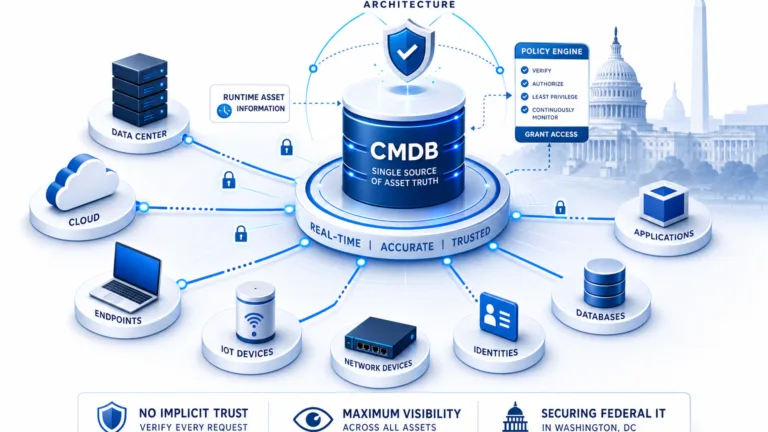
Enterprise architects and CMDB owners still get asked for “the inventory.” Security leads inherit risk from systems no single office claims. GRC and audit-readiness teams need a population for FISMA and NIST SP 800-53-style reporting. IT asset managers need a reconciled base before license or budget work is defensible. Procurement and shared-services leads get tasked with consolidated IT while feeder offices keep local lists. The CMDB sits in the middle of those asks. If it assumes single ownership, it becomes one more fragment.
What makes a CMDB for government and public sector different from a standard enterprise CMDB rollout?
Government and public-sector estates are often owned across program offices, bureaus, shared-services IT, and contractors with separate budget lines. A CMDB that assumes one owner and one incentive structure understates the reconciliation problem those teams face after discovery finds the systems.
Why “Buy a CMDB” Undersells the Problem
“CMDB for government” still gets treated as a deployment choice: which product, which agency boundary, which go-live date. The harder problem is structural. Program offices stand up systems against grant deadlines, mission spikes, and vendor contracts. Contractors maintain their own asset lists under their statements of work. Shared-services IT runs platforms many consumers use, but few want to document for someone else’s audit. After the system is live, no office is paid to keep a whole-of-mission view current.
A single company’s IT organization usually has one budget and one accountable executive. A government body often does not, even inside one department. So a tool that only “stores CIs” after a one-time load will look complete on day one and drift as soon as two offices update the same shared middleware, network segment, or integration path differently.
What Fragmented Ownership Actually Looks Like
GAO’s 2025 annual report on fragmentation, overlap, and duplication (GAO-25-107604) put numbers on the pattern. HHS alone had identified 99 separate systems tied to one mission area: pandemic preparedness and response. Those systems accumulated as different program offices stood up their own stacks over time. GAO estimated that consolidating even one could save hundreds of thousands of dollars over its lifespan.
The 2026 annual report (GAO-26-108505) showed a related pattern one level up. FirstNet, built as shared public-safety broadband for state and local first-responder agencies, carried “fragmented authority” serious enough that GAO recommended Congress reconsider statutory placement before authorities sunset in 2027, with an estimated $15 billion in savings over 15 years on the table. Those findings are not discovery failures. Owners knew the systems and the network existed. What was missing was a shared record and a shared incentive to reconcile ownership, configuration, and accountability across stakeholders.
Discovery is still how an agency surfaces fragmented inventory in the first place. Agent, agentless, and API methods that surface legacy systems before the next outage answer what is running. They do not decide who is accountable for a shared CI, or which office’s attributes win when two lists disagree.
How does federal IT fragmentation show up in GAO reporting?
GAO-25-107604 reported HHS had identified 99 systems in a single mission area (pandemic preparedness and response). GAO-26-108505 flagged fragmented authority in FirstNet, shared public-safety broadband across state and local agencies. Both cases show many stakeholders and no single owner of a reconciled configuration record.
The Cost of Not Having One Record
Scale the HHS example outward. The same 2025 GAO report identified more than $100 billion in potential government-wide savings tied to fragmentation, overlap, and duplication across 148 matters. That is a recurring annual finding, not a one-time cleanup project.
OMB and 24 federal agencies already face annual IT portfolio review requirements under statute, as that report notes. Fragmentation is a standing oversight and appropriations issue agencies are expected to answer every year. For CMDB owners, that means “who owns this CI” and “which source is trusted” stop being internal hygiene questions. They become evidence questions under schedule pressure. For CISOs, unclaimed systems are exposure without a clear operator. For procurement leads consolidating shared services, dual records on the same asset block any honest cost or contract conversation.
| Pressure | What breaks without one reconciled record | Who feels it first |
|---|---|---|
| Mission consolidation | Duplicate systems stay funded because no office can prove overlap with confidence | IT directors, enterprise architects |
| Security and risk | Systems no office claims still sit on networks and carry vulnerabilities | CISO / SecOps |
| Audit and portfolio review | Populations for control testing and annual reviews are rebuilt from spreadsheets | GRC / audit-readiness |
| Asset and budget truth | License, refresh, and chargeback math runs on partial lists | ITAM, procurement, shared services |
Why a Reconciled Record Needs Authority Rules, Not Another Spreadsheet
Finding assets and centralizing records about them are different jobs. Discovery answers what is running. A multi-source CMDB answers whether two offices’ descriptions of the same shared asset agree, and which description wins when they do not.
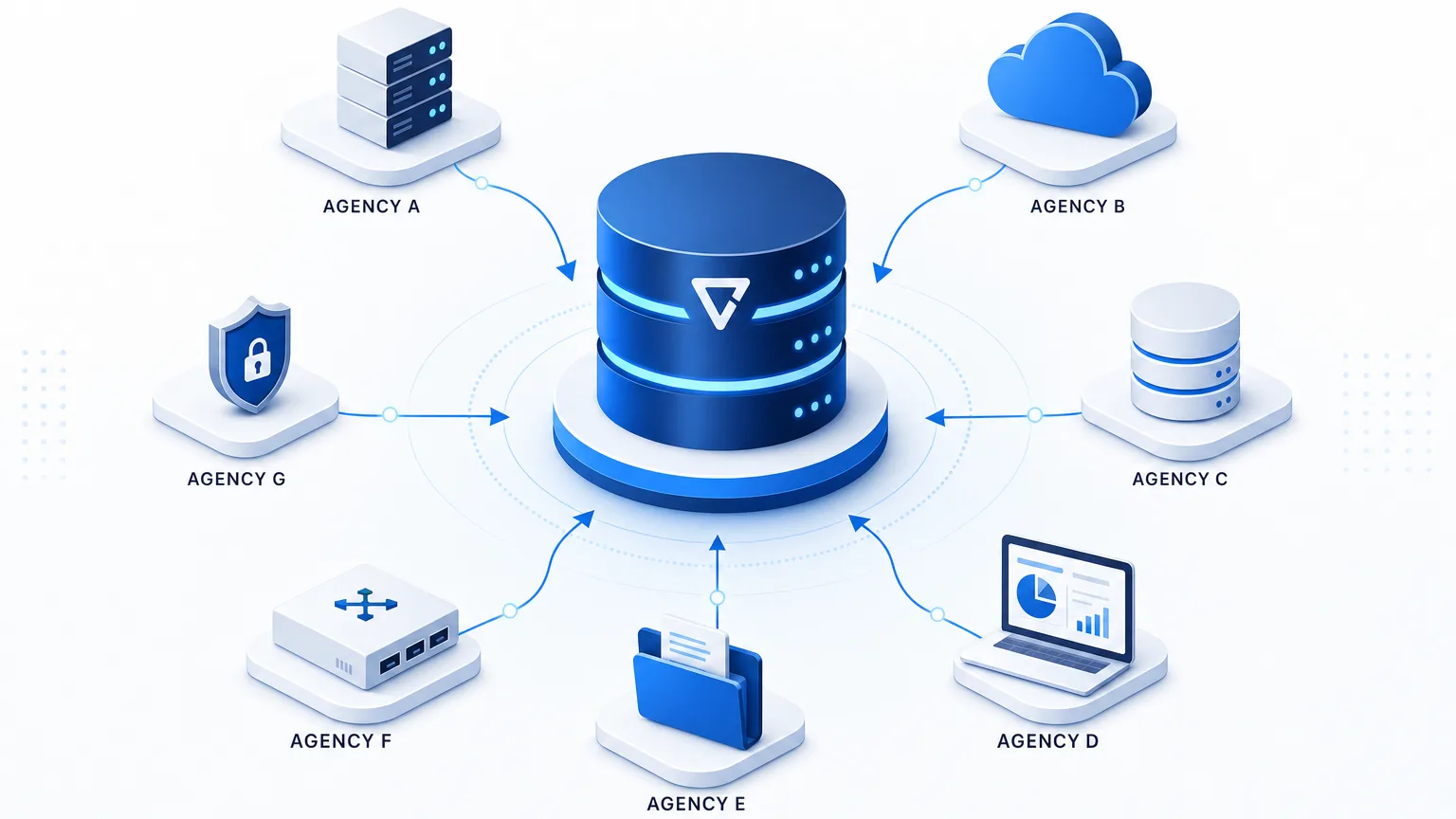
The practical requirement is a CMDB that accepts configuration data from multiple contributing sources (different offices’ discovery scans, a contractor asset list, a shared-services inventory, an import from an ITSM tool) and resolves conflicts with defined authority rules. Last-write-wins is not a policy. Hand arbitration under audit pressure is not a policy. Authority rules state which source is trusted for which attribute class, keep a reconciliation history, and leave a trail someone can defend later.
That model works inside one CMDB deployment fed by many contributing teams, offices, and discovery sources. It does not automatically federate separate agencies’ separate CMDB instances across organizational or authorization boundaries. Shared-services and multi-bureau programs still need clear boundary design; the record problem inside the boundary is still real.
Citizen-service dependency maps only hold if that record is trustworthy. When the same shared middleware shows three owners in three office lists, uptime monitoring for essential services cannot tell operators which path actually carries the citizen workload.
How should a CMDB resolve conflicting records when multiple offices touch the same system?
Define authority rules before merge: which contributing source wins for each attribute class, and why. Retain reconciliation history so audit and operations can see how a CI value was chosen. Prefer rules over last-update-wins or ad hoc spreadsheet merges.
Where Virima Fits
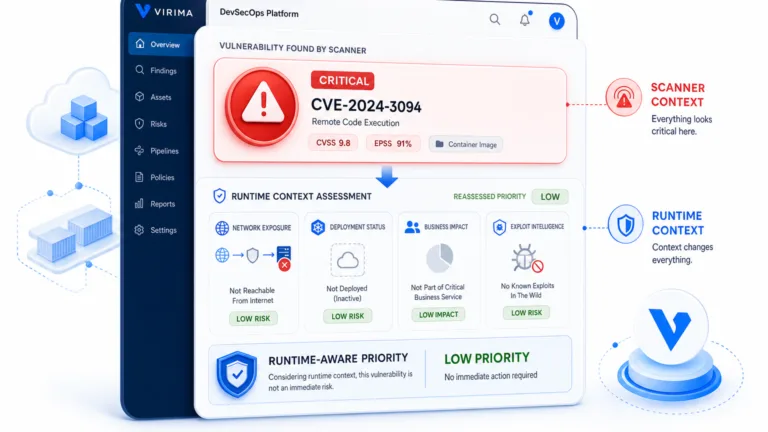
Virima is built for discovery-sourced configuration management inside a single CMDB that many sources can feed. Multi-source data reconciliation merges CI attributes from those sources into one record under your authority model. CIs carry source and freshness context so staleness is visible between high-frequency discovery cycles (not passive real-time event streams). Relationship data supports change impact and service context once service definitions are supplied. Lifecycle tracking follows CIs from deployment through decommission instead of silent deletion. CMDB health scoring surfaces accuracy, completeness, and staleness so owners can see decay before an outage or an audit meeting does.
Integrations with ServiceNow, Jira Service Management, Ivanti, HaloITSM, Xurrent, Hornbill, and related ITSM platforms matter here as feeders and consumers of the same reconciled record, not as a rip-and-replace story. Partner platforms stay plain names in day-to-day ops; the full connector list lives on Virima’s integrations hub.
For CMDB owners tired of being the most questioned person in the room when two offices disagree about the same CI, the practical path is discovery-sourced data, authority-rule merge, retained history, and a living record you can show.
| Eliminate data decay with discovery-sourced Trusted Runtime Truth. See how Virima keeps configuration records explainable when multiple offices feed the same CMDB. Explore Trusted Runtime Truth |
Why This Also Answers Tomorrow’s Audit, Not Just Today’s Outage
A reconciled record with full reconciliation history is the same evidence annual portfolio reviews and control testing keep requesting: what exists, who is accountable, and whether the record matches the environment. Teams stop running three separate scrambles (operations after a change fails, security after an unowned host appears, GRC before a review). One maintained population feeds those moments.
Without that base, IT asset audit tracking in the public sector turns into another export race: whichever office answers email first supplies the population for the review. A reconciled CMDB is what keeps audit and budget reporting from rebuilding inventory under deadline pressure.
Where to Start: Scoping a Reconciled Record
- List every office, bureau, or contractor that keeps a partial system of record for infrastructure your organization is still accountable for.
- Flag shared assets (network segments, integration middleware, shared-services platforms) where two or more of those records already disagree on ownership or configuration.
- Write authority rules before you merge anything: which source wins when attributes conflict, and why. Reconciliation should be a documented rule, not a judgment call made under audit pressure.
- Treat the result as a living record refreshed on a defined discovery cadence. GAO’s fragmentation findings recur because static consolidation projects age out while offices keep shipping new systems.
Government IT Stays Fragmented When No One Owns the Record
Government IT does not stay fragmented mainly because nobody can find the systems. GAO’s own findings show agencies often know what they built. It stays fragmented because no one owns reconciling what everyone else built into one configuration record. That is a CMDB problem, and it is a different problem from discovery, uptime monitoring, or audit tracking alone.
See how Virima reconciles configuration data from multiple contributing sources into one CMDB under authority rules your team defines. Request a demo focused on multi-source reconciliation and CMDB health for shared-services or multi-bureau estates.
Frequently Asked Questions
Why does government IT stay fragmented across agencies and offices after consolidation efforts?
Program offices, bureaus, and contractors often have valid short-term reasons to stand up their own systems (grants, mission spikes, contracts). After go-live, few are incentivized to maintain a whole-of-mission configuration record. Consolidation projects that do not assign ongoing ownership of that record age out while new systems keep appearing.
What is the difference between finding government IT assets and centralizing records about them?
Discovery answers what is present in the environment. Centralizing records answers whether multiple offices’ descriptions of the same shared asset agree, who is accountable, and which source wins when attributes conflict. You can find 99 systems and still lack one defensible CI for each.
How much does fragmented, duplicate IT cost the federal government?
GAO’s 2025 fragmentation, overlap, and duplication report (GAO-25-107604) identified more than $100 billion in potential government-wide savings across 148 matters. That figure is an oversight estimate of opportunity, not a single line item in one agency budget. Local savings still depend on which systems you can prove are duplicates with a reconciled record.
What does a reconciled CMDB record require in a multi-agency or multi-bureau environment?
Multiple contributing sources feeding one CMDB deployment, authority rules for conflict resolution, retained reconciliation history, source and freshness context on CIs, and a living refresh cadence. Do not assume automatic federation of completely separate agency CMDB instances across authorization boundaries unless your architecture and contracts explicitly design for that.
How does Virima help CMDB owners facing fragmented public-sector ownership?
Virima supports discovery-sourced CI population, multi-source data reconciliation under authority rules, relationship and lifecycle tracking, and CMDB health scoring inside one deployment fed by many offices and tools. Teams use that record for operations, security context, and audit populations without treating last spreadsheet edit as truth.