Tracking Public IT Assets for Audit and Budget Reporting

When state or federal auditors review public sector IT operations, missing asset records and inaccurate software license reports trigger immediate compliance findings. Government IT directors and agency procurement officers must justify every taxpayer dollar spent on hardware infrastructure, cloud services, and enterprise software licenses to auditors and budget committees.
Public sector agencies operate under stringent regulatory mandates such as FISMA, NIST SP 800-53, and state-level capital expenditure guidelines, yet agency IT teams struggle to maintain accurate inventories across multi-building government complexes, remote regional offices, public safety networks, and multi-cloud environments. Public sector IT asset tracking for audit and budget reporting has to close that gap, or every audit cycle starts from a guess instead of a record.
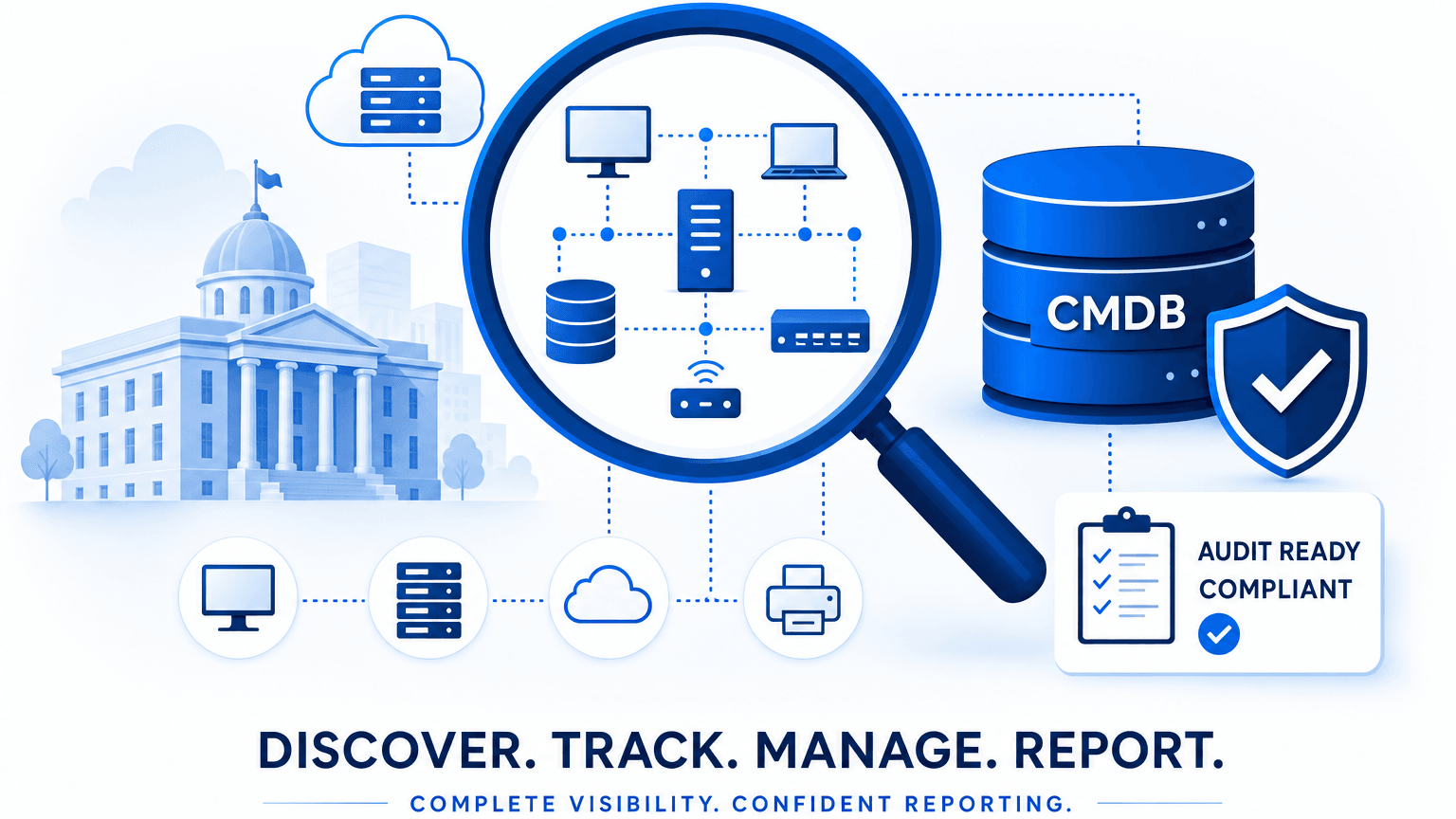
When public sector IT leaders rely on manual asset logs, department-level spreadsheets, or periodic physical audits, unrecorded hardware and shadow cloud workloads create severe financial and regulatory risks. Achieving full audit readiness requires continuous automated discovery, core-aware IT asset management (ITAM), and unified configuration management database (CMDB) controls.

Why is tracking public IT assets for audit and budget reporting difficult for government agencies?
Government agencies manage decentralized, multi-facility infrastructure containing legacy mainframes, departmental servers, and cloud workloads. Lacking automated discovery, agencies face audit penalties under FISMA and NIST guidelines, unbudgeted software license true-ups, and inaccurate capital expenditure requests during legislative budget cycles.
The structural challenges of public sector IT asset tracking for audit and budget reporting
Public sector IT asset management operates in a highly constrained environment. Unlike private enterprises that can write off lost assets quickly, government entities must account for every hardware asset and software entitlement across its entire lifecycle.
The GAO’s FY2025 audit of the federal government’s consolidated financial statements found continuing material weaknesses in agencies’ ability to safeguard and report assets, tied to unresolved information system control deficiencies (GAO FY2025 financial audit). That traces back to two operational challenges state and local agencies see every budget cycle.
1. Multi-facility hardware sprawl and ghost assets
State agencies, county governments, and federal bureaus manage hardware distributed across hundreds of locations, including courtrooms, public health clinics, maintenance depots, and remote administrative centers.
A ghost asset is IT equipment or software still recorded on an agency’s financial books that no longer delivers any operational value — a decommissioned server, a lost laptop, or an unused license still generating maintenance and renewal costs. When local office technicians deploy replacement servers or retire aging desktop computers without central IT notification, inventory records decay just as fast, and those unmapped CIs remain on the books long after the hardware itself is gone. Left untracked, ghost assets can drain a significant share of a government IT budget — funds a capital request could otherwise use. A single unretired server cluster can carry those maintenance and license line items for years after the asset itself is gone, quietly draining the same budget it was meant to protect. For a closer look at how this happens, see how ghost servers corrupt CMDB data.
License entitlement drift follows the same pattern as ghost assets — it just shows up on the vendor’s audit instead of the depreciation schedule.
2. Software license entitlement drift and audit penalties
Enterprise software vendors serving government agencies, such as Microsoft, Oracle, and SAP, enforce complex core-based and named-user licensing agreements.
When agency IT teams expand virtual machine core counts or assign software access to contractor accounts without centralized ITAM oversight, license consumption exceeds purchased entitlements. During vendor compliance audits, agencies face unbudgeted, six-figure true-up fees that disrupt planned capital improvement projects. Walking through a software license compliance audit step by step shows where most agencies lose entitlement visibility first.
How does automated discovery streamline government audit compliance and budget reporting?
Automated discovery continuously scans agency subnets, cloud environments, and remote facility networks to maintain an accurate hardware and software inventory. By logging asset configurations and hypervisor core counts automatically, agencies generate auditable compliance reports instantly during budget reviews.
Establishing continuous asset discovery across regulated government networks
Government networks require strict security controls to safeguard sensitive citizen data and maintain compliance with CJIS, HIPAA, and federal cybersecurity standards. Traditional network scanning tools often fail because strict firewall rules block invasive management traffic.
That erosion of confidence is measurable. The 2026 NASCIO-Deloitte Cybersecurity Study found that only 26% of state chief information security officers are now “extremely” or “very” confident their state’s information assets are protected from cyber threats. That’s down from 48% in 2022 (2026 NASCIO-Deloitte Cybersecurity Study). Closing that gap starts with knowing what is actually running on the network, not what the spreadsheet says is running.
To establish complete asset visibility across isolated agency subnets, public sector organizations deploy a secure, multi-tier discovery architecture.
Secure discovery architecture for public sector entities
- Zero-Footprint Datacenter Probes: Deployed within secure agency datacenters, agentless probes use WMI, SSH, and SNMP protocols to inventory physical servers, storage area networks (SANs), and hypervisors without installing local software footprints.
- Isolated Subnet Collectors: Placed inside secure public safety, judicial, or health subnets, dedicated gateway collectors perform localized asset scanning and transmit encrypted configuration metadata to the central CMDB.
- GovCloud API Connectors: Native API integrations continuously track virtual machines and serverless workloads across AWS GovCloud and Azure Government instances, capturing dynamic auto-scaling events as they occur.
Because these probes and collectors use read-only protocols and never touch confidential citizen records or case data, the same architecture that satisfies FISMA and NIST controls also holds up under CJIS and HIPAA data-handling requirements — the scan reads configuration metadata, not the records stored on the asset.
Consolidating these multi-environment discovery feeds into a unified CMDB gives public sector leaders complete asset context for legislative and financial reporting. That consolidated feed is what Virima calls Trusted Runtime Truth: discovery-sourced, policy-aware, and explainable data that traces every CI back to the scan that found it, rather than a self-reported spreadsheet entry nobody has verified in months. To see how automated discovery connects with enterprise service desk platforms, visit the Virima integrations hub.
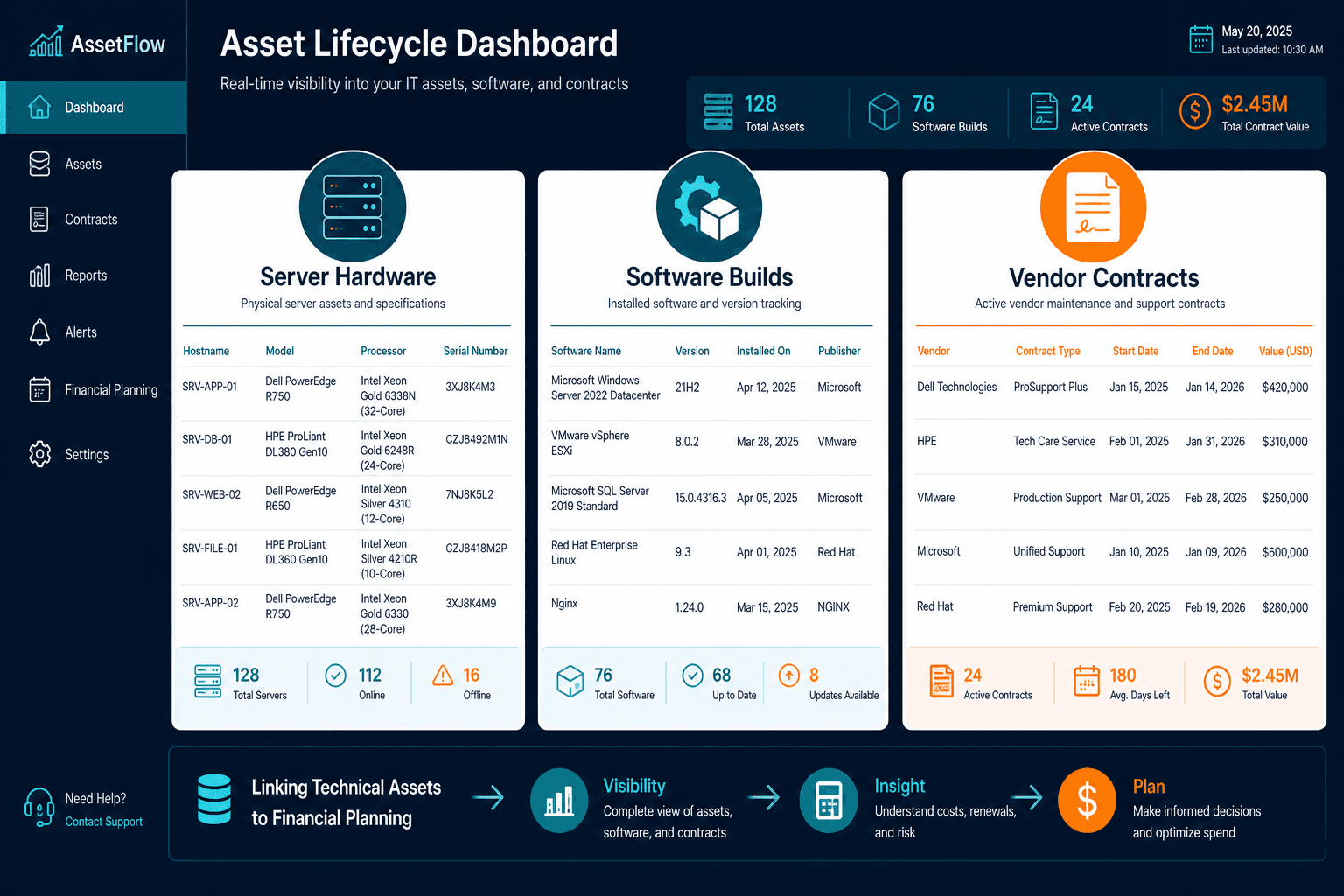
Connecting asset lifecycle data to capital budget allocation
Precise budget reporting requires linking technical asset data directly to financial planning workflows. When agency CIOs request funding for IT modernization during legislative sessions, lawmakers demand verifiable proof of asset utilization and end-of-life (EOL) risks.
Well-documented IT asset audits can cut related program costs by 20 to 30 percent, according to a 2025 federal ITAM audit cost-reduction guide built with federal ITAM practitioners. Those savings only materialize when the underlying inventory is accurate enough for finance and legislative staff to trust it.
Streamlining legislative appropriations and capital planning
Automated discovery engines capture hardware specifications, serial numbers, processor models, and operating system build dates across all facilities. By cross-referencing discovered assets against vendor lifecycle databases, IT leaders can:
- Justify Hardware Refresh Cycles: Demonstrate exactly which agency servers and network switches have reached vendor EOL status, presenting objective risk metrics to legislative budget committees, the same kind of finding one team surfaced just weeks before a budget cycle closed.
- Eliminate Unnecessary Procurement Requests: Identify underutilized hardware assets in one department that can be repurposed to fulfill equipment requests in another, reducing net capital requests.
- Optimize Software Entitlement Spend: Harvest unassigned software licenses across agency user pools before submitting requests for new software license purchases.
That same lifecycle data becomes the evidence base compliance auditors ask for next. To learn how public sector teams eliminate data decay and maintain authoritative asset records, see how IT managers establish Trusted Runtime Truth.
Simplifying NIST and FISMA compliance audits
Federal and state compliance frameworks require public agencies to maintain an accurate, continuously updated inventory of all authorization boundary CIs.
An automated CMDB is an auditable system of record. During a compliance audit, agency staff generate detailed hardware and software baseline reports instantly, proving that authorized security controls, patch levels, and asset ownership records are enforced across all operational subnets.
Best practices for public sector IT asset governance
Achieving audit readiness and transparent budget reporting across government agencies requires pairing automated discovery technology with disciplined IT governance workflows. Once an inventory is continuously updated and exportable in seconds, the audit stops being a scramble and becomes the moment IT demonstrates its value to finance and leadership, a pattern documented across agencies that automated their discovery process (a 2026 review of automated hardware audits in public agencies). Leading public sector IT organizations implement four core management practices:
- Establish Standardized Asset Taxonomies: Define uniform naming conventions, CI categories, and criticality tiers across all agency departments to ensure consistent central reporting.
- Automate Monthly Software Entitlement Reconciliation: Reconcile discovered hypervisor core counts and user accounts against active software license pools monthly to eliminate vendor audit exposure.
- Enforce Pre-Budget Impact Analysis: Require departmental IT leads to submit automated discovery usage reports before approving capital asset replacement requests.
- Integrate CMDB Data with Public Sector ITSM Platforms: Connect central CMDB data directly to service desk systems like ServiceNow, Jira, or Ivanti, providing technicians with instant asset ownership and contract context when resolving tickets.
When preparing for legislative budget reviews or federal cybersecurity audits, the agencies with the least last-minute scrambling are the ones where these four practices are already routine, not assembled the week the auditor’s request lands.
What are the primary financial benefits of automated asset tracking for public agencies?
Automated tracking eliminates software audit true-up penalties, prevents ongoing maintenance spend on ghost assets, streamlines annual FISMA/NIST audit preparation, and provides verifiable data to support legislative capital funding requests.
The next constraint: agentic IT oversight
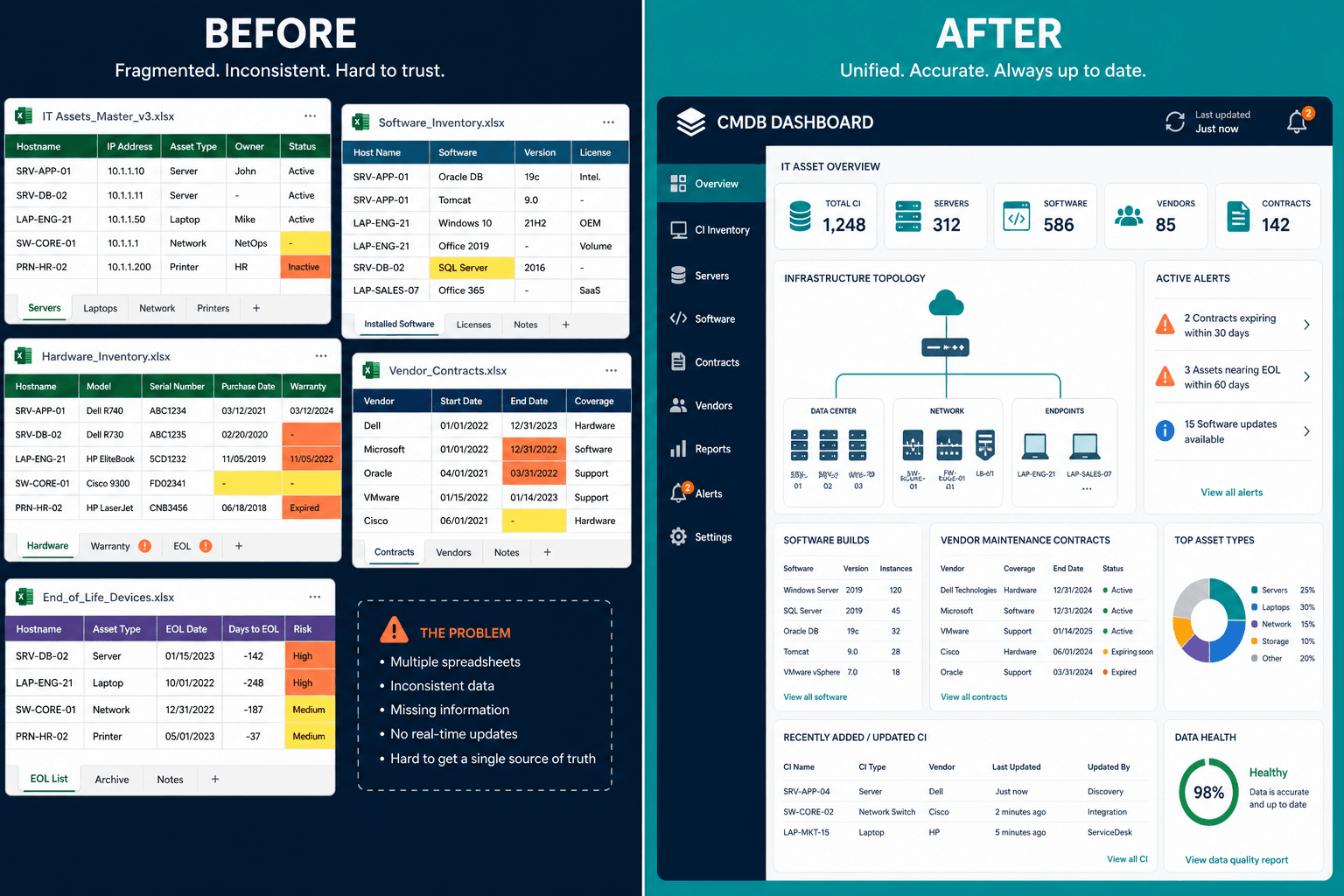
As agencies accelerate digital government initiatives — modernizing legacy systems, adopting cloud services, and starting to pilot AI-driven IT operations — accurate asset tracking stops being optional.
Automated ticket triage, AI-assisted change approval, and agent-driven patch scheduling all read from the same CMDB an auditor would check. An agent recommending a change approval or flagging a license renewal is only as reliable as the asset data underneath it. Agencies that get continuous discovery and CI-level accuracy right now are positioned to extend that same discovery-sourced, explainable asset data into agentic IT decisions later, without redoing the inventory work first. Agencies still relying on manual spreadsheets or fragmented departmental records carry that same audit and budget risk into whatever automation comes next.
Frequently Asked Questions
How does automated discovery protect CJIS and HIPAA data privacy during public sector asset scans?
Automated discovery uses read-only, agentless protocols that inspect hardware and operating system metadata without accessing confidential citizen records or sensitive databases. Transmitted metadata is encrypted in transit and at rest, maintaining full compliance with CJIS and HIPAA security standards.
Can automated ITAM discovery track assets across both on-premises data centers and GovCloud environments?
Yes. Advanced discovery platforms combine agentless datacenter probes with direct API connectors for AWS GovCloud and Azure Government, consolidating physical servers, virtual machines, and cloud workloads into a single unified asset repository.
How does Virima help public agencies reduce audit preparation time for legislative and federal reviews?
Virima maintains a continuously updated CMDB and ITAM inventory with complete configuration histories and software entitlement links. During an audit, agency managers generate pre-formatted hardware baseline and license compliance reports instantly, eliminating weeks of manual asset verification.