How CMDB Automation Reduces Mean Time to Resolve (MTTR)

CMDB automation reduces MTTR by eliminating the verification step that consumes the first phase of every incident — the time teams spend confirming whether their configuration data is accurate before they can act on it. When discovery-sourced CI records and service dependency maps are continuously updated, responders skip that research phase entirely and move straight to diagnosis, cutting the identification-to-resolution window significantly.
Every minute of an outage costs the business trust and pulls engineers off roadmap work to run a manual investigation: what actually changed, what depends on what, and who owns which piece. For IT operations managers and SREs, MTTR is the clearest signal of whether your team’s data keeps pace with your infrastructure. Without CMDB automation, every incident starts with a research project instead of a response.
What is MTTR? Mean time to resolve (MTTR) measures the average elapsed time from when an incident is detected to when service is fully restored. The formula: MTTR = Total Resolution Time ÷ Number of Incidents Resolved. For IT ops teams, the clock starts with an alert and stops only after the affected service is confirmed stable — making every minute of diagnostic delay directly visible in this number.
Why MTTR Breaks Down Before the Fix Even Starts
MTTR is usually framed as a triage and remediation problem, but a large share of the clock ticks before anyone touches the fix. Responders spend the first stretch of an incident establishing what they’re looking at: which configuration items (CIs) are involved, what they depend on, who owns them, and what changed recently. In organizations running a manually updated CMDB, that information is frequently wrong, missing, or three change cycles behind reality.
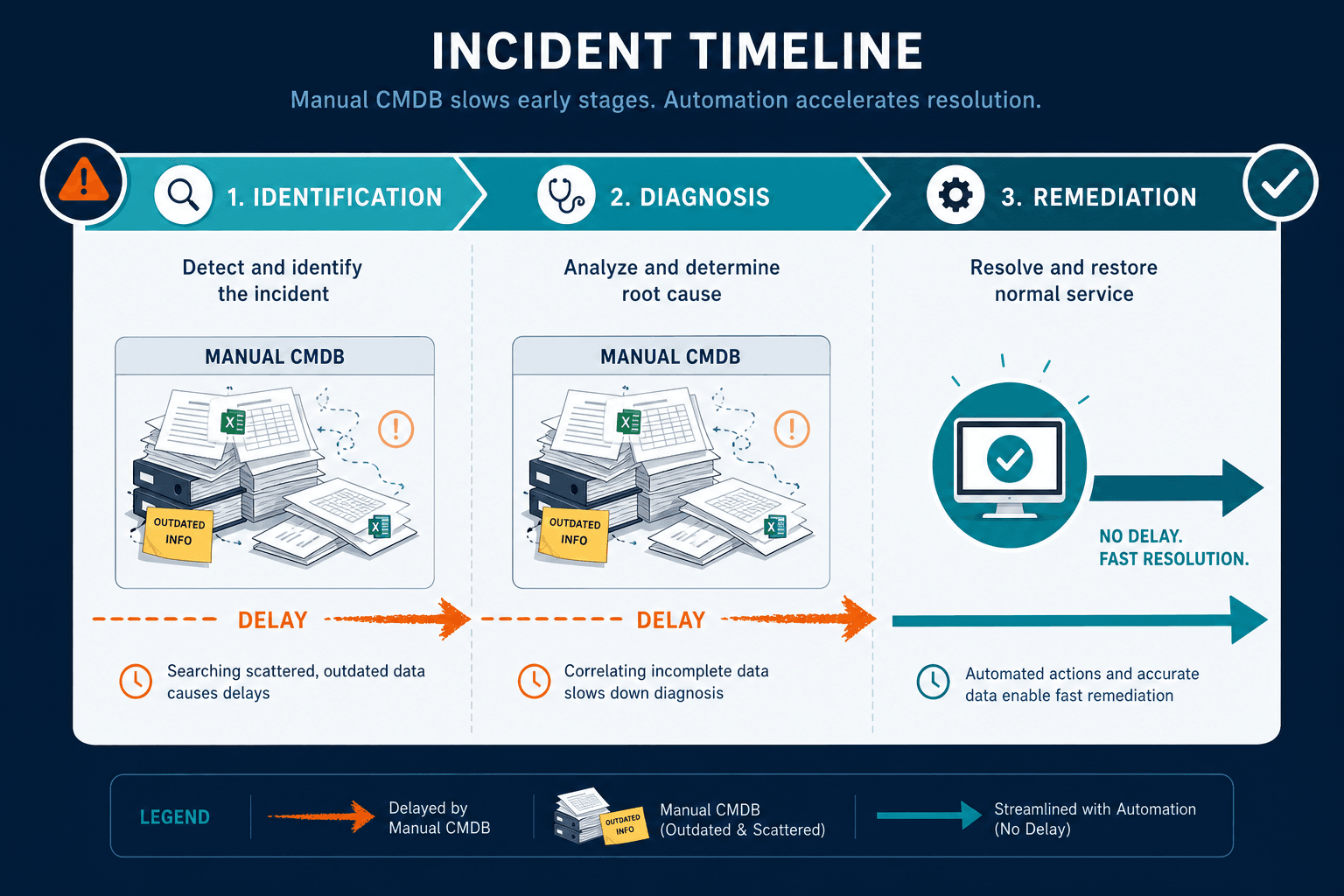
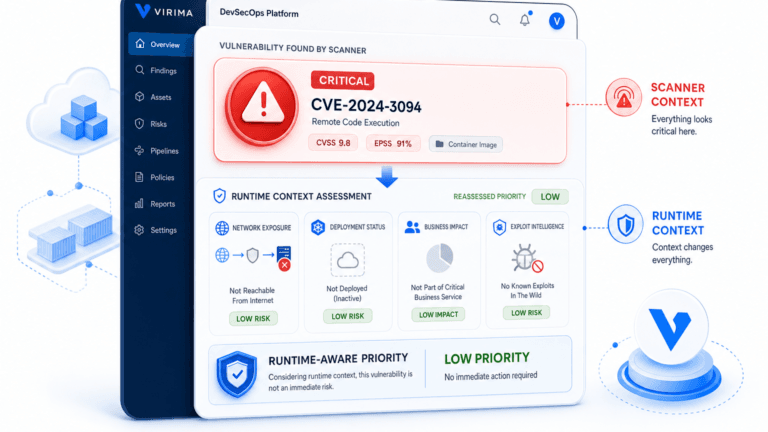
Forrester’s 2024 research on IT operations found that inaccurate configuration data is one of the most common root causes of extended incident duration. Teams lose time verifying data before they can trust it enough to act on it. Call this the CMDB verification tax: the hidden delay that accumulates before remediation even begins, and the part that CMDB automation is built to remove.
The difference shows up at every stage of the incident cycle — not just at the triage step where most teams feel the pain:
Manual vs. automated CMDB at each incident stage
| Incident Stage | Manual CMDB | Automated CMDB |
|---|---|---|
| Identify affected CIs | Search tickets, ask on-call engineers, cross-check spreadsheets | Discovery-sourced CI data available immediately |
| Map dependencies | Manually trace connections across teams | Service mapping shows upstream/downstream impact |
| Assess blast radius | Guesswork based on who remembers the architecture | Blast radius data shows exactly what’s at risk |
| Confirm recent changes | Change tickets often out of sync with reality | CI history tied to discovery-confirmed state |
How CMDB automation closes the data-accuracy gap
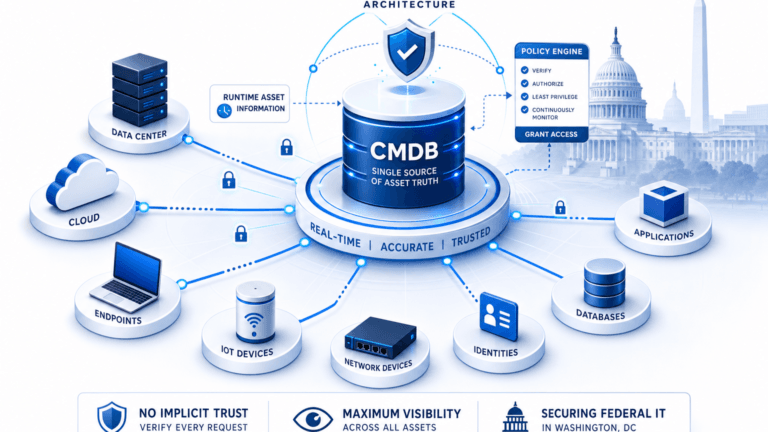
The starting point for faster incident resolution is IT discovery automation: a CMDB populated by discovery, not by whoever last remembered to update a record. Automated discovery scans and reconciles infrastructure on a schedule. CI records stay close to what’s actually running — not what was documented at go-live. Virima’s IT discovery capability builds this foundation.
This matters because incident responders don’t have time to question their data mid-fire. When engineers trust that the CMDB reflects the current environment, they skip the verification step entirely and move straight into diagnosis.
Service mapping turns “what’s connected” into an answer, not a guess
Once CI data is accurate, the next bottleneck is dependency context. A single failed server rarely causes an isolated problem. It’s the services, applications, and downstream systems tied to that server that determine the real severity of an incident. Virima’s ViVID™ service mapping visualizes those dependencies once service definitions are in place, so responders see the full chain of impact instead of reconstructing it from memory. Service mapping in incident response removes the manual dependency-tracing step that slows triage.
That visibility changes how triage happens. Instead of asking “does anyone know what this server supports,” the team sees it directly and routes the incident to the right owner immediately.
Blast Radius Context Prevents the Second Incident
A fix applied without understanding its blast radius often creates a new problem downstream. This is where change-related MTTR extends further than it should. A team resolves the original issue, then spends hours cleaning up an unintended side effect they never saw coming. Understanding blast radius before acting, not after, separates a contained incident from a cascading one.
Blast radius awareness backed by discovery-sourced data gives responders a defensible answer to “what will this change affect” before they touch anything, which shortens both the current incident and the odds of a repeat one.
Root cause analysis gets faster when the data is already there
Root cause analysis is only as fast as the evidence available to support it. When CI history, change records, and dependency maps stay current and centralized, responders trace a problem back to its source without pulling logs from five different systems first. Virima builds this on trusted runtime truth: discovery-sourced, explainable, and governed data on what exists, how it’s connected, what changed, what will break, and who owns it.
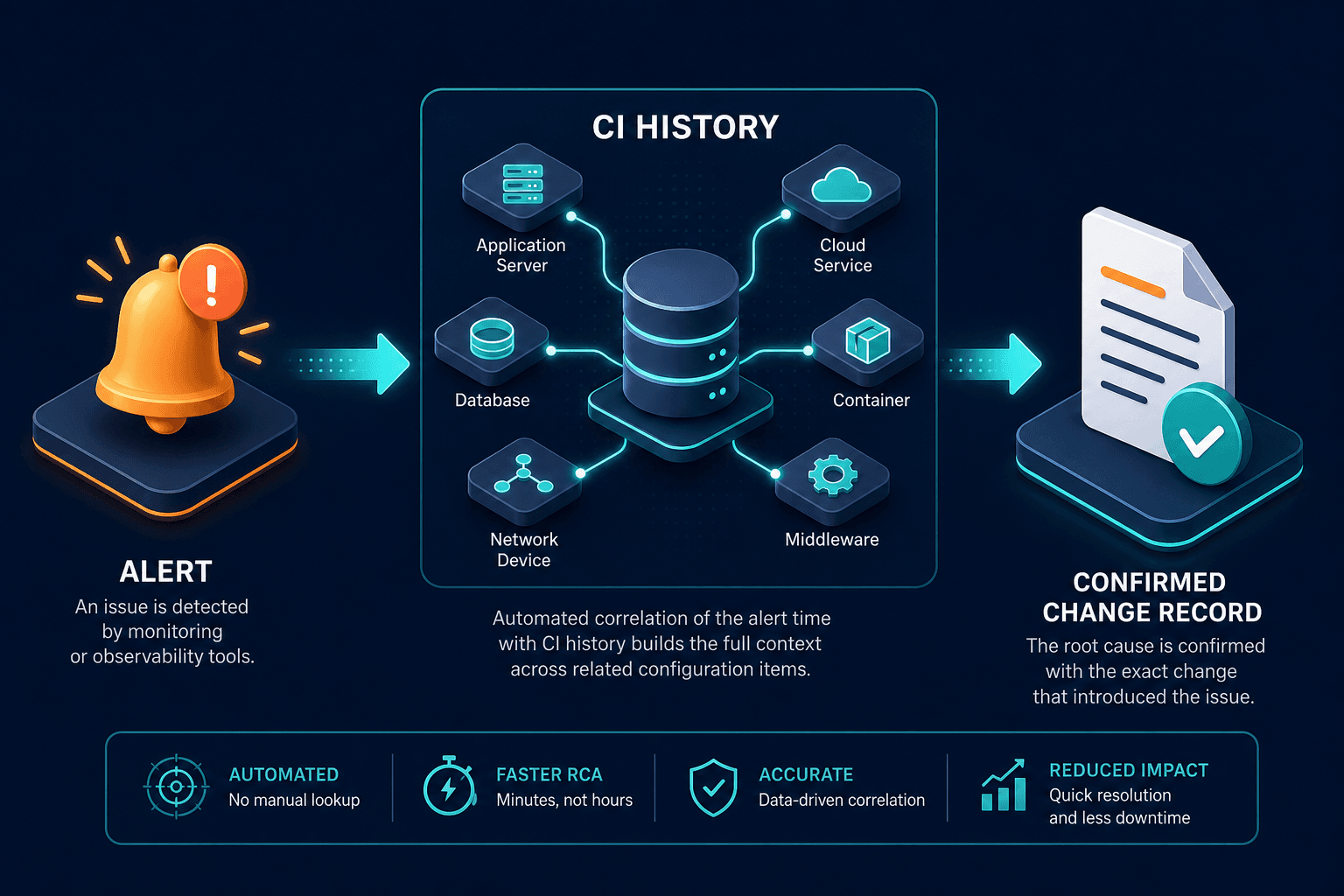
PagerDuty’s 2024 State of Digital Operations report found that the biggest time loss in incidents happens before remediation — not during it. Better configuration context cuts that pre-fix research phase directly.
What to Measure Once Automation Is in Place
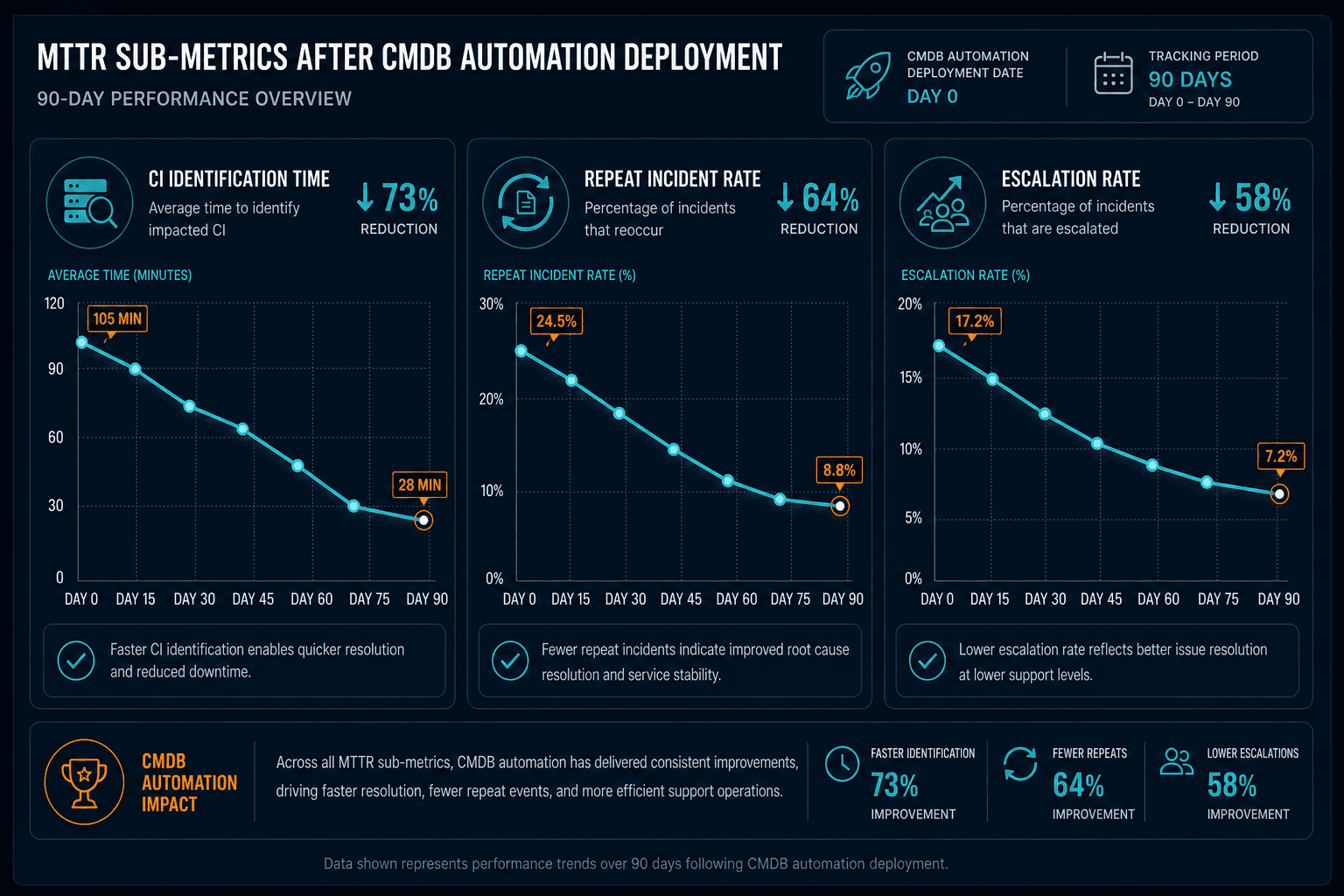
MTTR improvement from CMDB automation shows up in a few specific places, not just the top-line average:
| Metric | What It Tells You |
|---|---|
| Time to identify affected CIs | Whether discovery data reduces initial triage time |
| Repeat incident rate | Whether blast radius awareness prevents cascading fixes |
| Escalation rate to secondary teams | Whether ownership data is accurate enough to route correctly the first time |
Industry research supports the potential: organizations with mature CMDB automation report up to 40% reductions in incident resolution time (ServiceNow IT Tool Kit, 2025). Tracking these sub-metrics alongside overall MTTR shows exactly where automation pays off and where CI or service map coverage still has gaps.
Building an MTTR Reduction Plan Around Trusted Data
None of this holds if discovery runs on an ad-hoc schedule. MTTR gains depend on continuous reconciliation — not a once-a-year cleanup project. Discovery must run on a consistent schedule, service maps must stay current as architecture changes, and ownership data must be enforced rather than assumed.
Trusted runtime truth is live, policy-aware data on what exists, how it’s connected, and who owns it. See how it changes incident response from a research exercise into a routing decision.
Ready to audit your CMDB’s impact on incident response? Explore eight proven strategies to reduce MTTR that pair automated CMDB with process and tooling improvements — or schedule a demo to walk through how Virima’s automated discovery would apply to your environment.